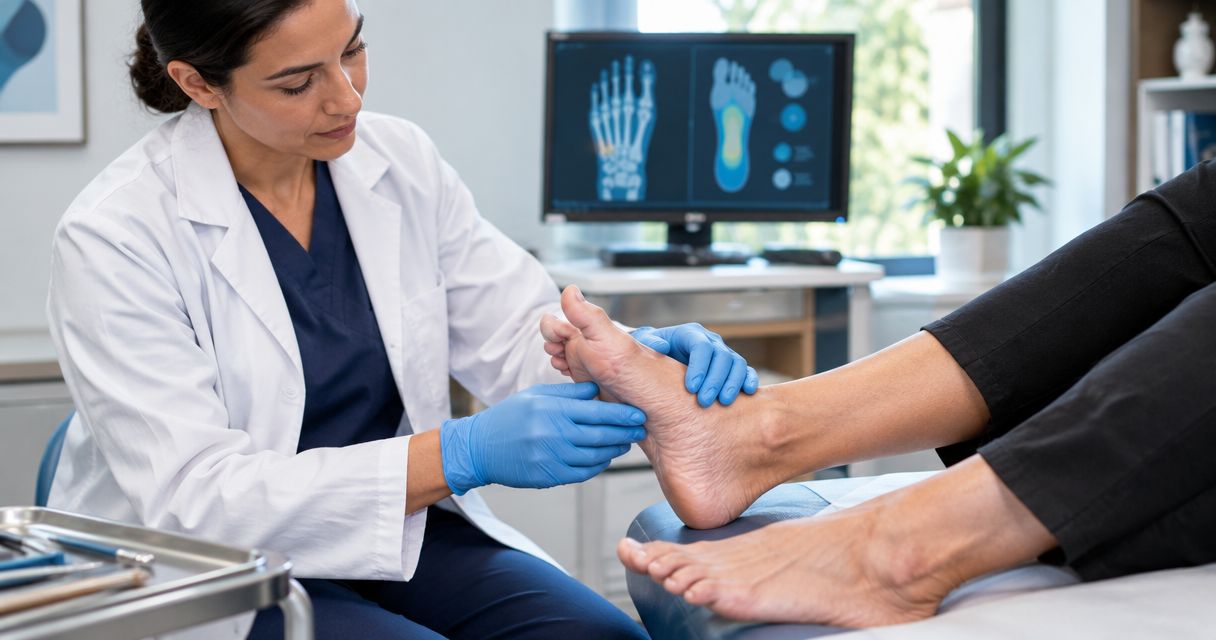

Instead of repeatedly testing a painful foot or ankle at practice, work with a sports podiatrist through evaluation, treatment, rehabilitation, and a supervised return-to-play decision. This 2026 workflow explains what to prepare, what each stage should establish, and when to stop rather than push through symptoms.
- A sports podiatrist evaluates foot and ankle injuries before setting rehabilitation and return-to-play goals.
- Achilles Foot and Ankle Center provides foot and ankle care for Richmond-area patients with sports injuries.
- Pain relief alone does not establish readiness for running, jumping, cutting, or competition.
- Return-to-play clearance depends on the injury, examination, functional recovery, and your sport’s demands.
Why this matters
Feeling better and being ready to compete are different milestones. Walking comfortably does not demonstrate that your ankle can tolerate a sudden landing or that your foot can handle repeated sprints.
Achilles Foot and Ankle Center provides foot and ankle evaluation and treatment for Richmond-area patients, including athletes with sports injuries. An appropriate evaluation helps establish what is injured and which activities need to change before you return to the activities you love.
Use this 2026 guide as a preparation and communication tool, not a self-clearance checklist. A clinician must individualize the examination, treatment, exercise progression, and clearance decision. Your school, league, or employer can also have documentation requirements separate from the medical plan.
Before you start
- Prepare your injury history and equipment. Bring your usual athletic shoes, any brace or insert you use, a medication list, and available imaging reports. Describe how the injury happened, where symptoms occur, and which movements make them worse.
- Check access and paperwork requirements. Ask your insurer whether a referral is required, and ask your team or school which clearance form it accepts. For a child or teenager, arrange the necessary parent or guardian participation.
- Do not use walking ability as proof that nothing is torn. Some significant tendon injuries still allow walking. A sudden pop, loss of push-off, marked swelling, or inability to bear weight needs prompt assessment rather than another practice test.
Seek emergency care for an obvious deformity, exposed bone, uncontrolled bleeding, or a foot that becomes cold, pale, or newly numb after injury. Chest pain or shortness of breath with new leg swelling also requires emergency evaluation.
Injury history and clinical evaluation
Establish the diagnosis before testing performance
- Describe the injury event. Explain whether symptoms followed a twist, collision, awkward landing, or gradual training increase. Point to the painful area rather than labeling every ankle injury a sprain.
- Record your symptom pattern. Use a 0–10 pain scale if helpful, with 0 meaning no pain and 10 meaning the worst pain imaginable. Add whether pain occurs during activity, afterward, or at rest; the score alone does not measure tissue healing.
- Explain your sport’s demands. Tell the clinician about running surfaces, footwear, jumping, cutting, contact, and your playing position. Include work shifts and daily walking because those activities also load the injured area.
- Complete the recommended examination. Depending on the injury, the clinician assesses tenderness, swelling, movement, strength, stability, sensation, circulation, and walking. Do not attempt painful hopping or balance tests before the clinician determines they are appropriate.
- Discuss whether imaging changes the plan. X-rays assess bones and alignment; ultrasound or MRI can help answer selected soft-tissue questions. Not every injury requires every scan, and a normal initial X-ray does not exclude every injury.
Expected result: You understand the working diagnosis, any remaining uncertainty, and the next step needed to resolve it. You also know what activity is restricted while that assessment continues.
For more detail about the imaging stage, read the foot X-ray to diagnosis workflow.
Questions to settle before leaving
Ask what findings support the diagnosis and whether a fracture, tendon injury, or other condition still needs to be excluded. Then ask what symptoms should trigger an earlier call.
Leave with a clear follow-up plan. If you are waiting for imaging, clarify whether you should avoid weight-bearing, use prescribed support, or modify daily activities during that interval.
Protection and rehabilitation plan
Set activity limits you can follow
- Get specific restrictions. Ask whether walking, stairs, driving, work, and training require changes. Instructions such as rest are less useful than a clear explanation of permitted and restricted activity.
- Confirm how to use prescribed support. If a clinician recommends a brace, boot, crutches, or another device, ask about fit, wear instructions, skin checks, and when to seek help. Do not borrow equipment and assume the settings suit your injury.
- Agree on rehabilitation goals. Ask which movements, strength exercises, and balance activities are appropriate now. A physical therapist or other treating professional can guide the program when recommended.
- Track your response. Record symptoms during activity, afterward, and over the following 24 hours. This is a practical observation window for your notes, not a universal rule that makes an activity safe.
- Review the next progression criteria. Ask what must improve before you add impact, speed, direction changes, or contact. Do not advance solely because a date on the calendar has arrived.
Expected result: You have an understandable plan for protection, permitted activity, rehabilitation, and reassessment. You know which symptoms mean stop and contact the treating team.
Match the treatment discussion to the problem
These approaches serve different purposes. They are not interchangeable, and none independently establishes readiness for sport.
| Approach | Best for | Potential benefit | Limitation or trade-off |
|---|---|---|---|
| Activity modification | Athletes who need to reduce stress on injured tissue | Removes aggravating movements while preserving permitted activity | Does not identify the injury or rebuild strength by itself |
| Brace or immobilization | Injuries that need clinician-directed support or protection | Limits selected movements or loading | Fit and duration matter; unnecessary restriction can contribute to stiffness |
| Rehabilitation | Athletes rebuilding movement, strength, balance, and sport function | Addresses physical demands needed for return | Requires an injury-specific progression and consistent participation |
| Surgical evaluation | Injuries for which the diagnosis or response to treatment warrants discussion | Clarifies whether an operation is appropriate | Not every sports injury needs surgery; recovery still requires a separate plan |
In 2026, use your treatment instructions—not a teammate’s recovery schedule—as the reference. Even injuries with similar names can involve different structures and different restrictions.
Sport progression and clearance documentation
Separate participation from competition
- Confirm readiness to begin sport-specific loading. Ask the treating clinician whether healing and function support the next stage. Comfortable daily walking alone is not enough.
- Introduce permitted training demands gradually. Follow the prescribed sequence for straight-line movement, speed, jumping, direction changes, or contact. The order depends on the injury and sport; not every athlete needs every task.
- Change the workload deliberately. When your plan allows progression, change 1 training variable at a time, such as duration or intensity. This makes a symptom flare easier to interpret; it does not replace clinical limits.
- Report the actual response. Note pain, swelling, limping, instability, reduced confidence, or compensating movements. Include symptoms after practice, not only how you felt during the warm-up.
- Complete the reassessment and paperwork. Bring any required form and describe your sport’s demands. Ask whether the decision permits modified participation, full practice, or unrestricted competition, and whether conditions apply.
Expected result: You have a clearly communicated participation status, including restrictions and follow-up needs. A scheduled game does not override an unresolved injury or an incomplete assessment.
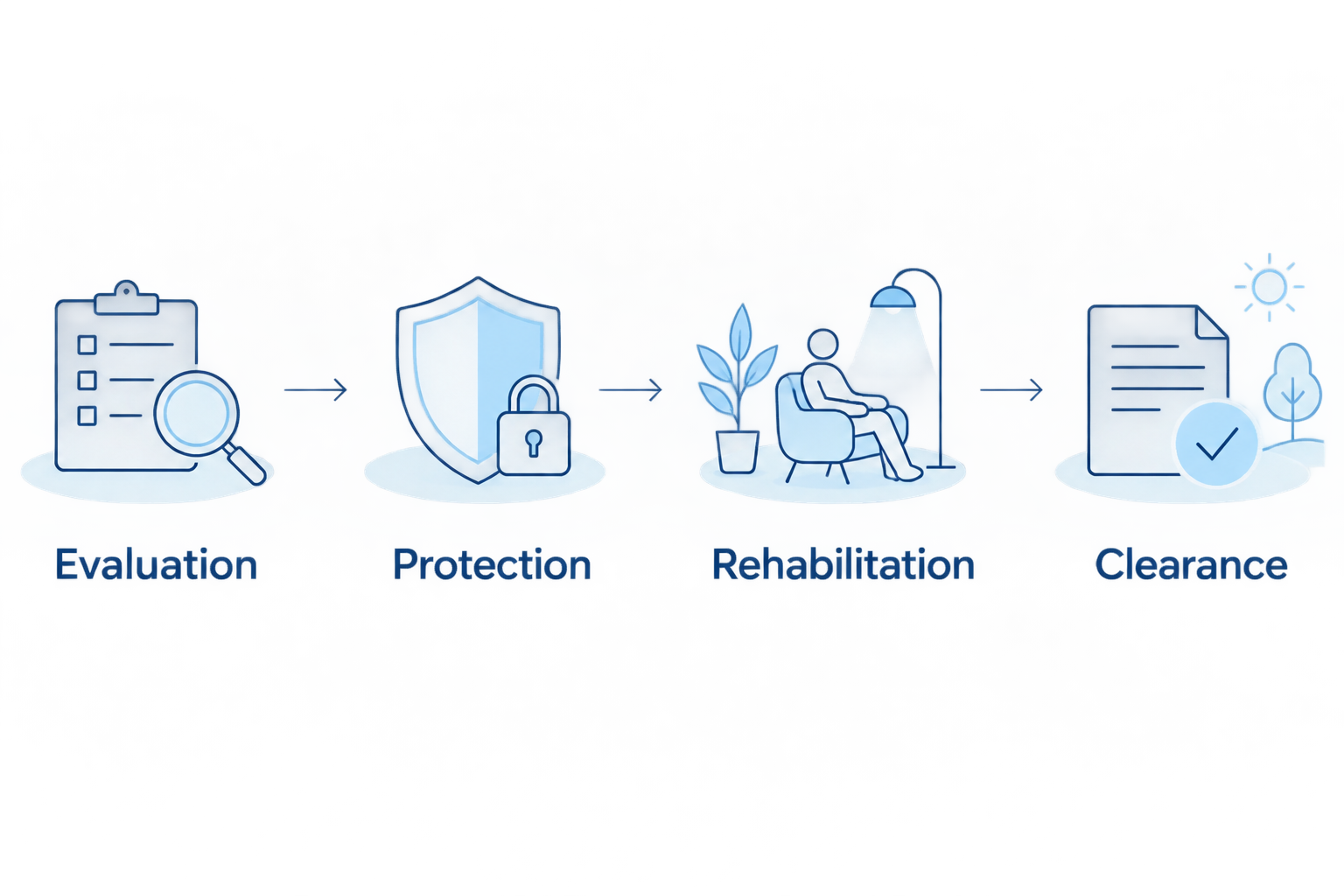
The 2026 workflow has four connected stages: evaluation, protection, rehabilitation, and clearance. Moving between stages depends on clinical findings and function rather than a fixed timetable.
What a useful clearance decision includes
A useful decision identifies the activity being considered and any remaining restrictions. Ask whether protective equipment, continued rehabilitation, or another review remains necessary.
Medical clearance and administrative acceptance are separate tasks. Confirm who must receive the documentation and whether your organization requires a particular authorized professional to complete it.
When symptoms return during training
A symptom flare creates a second workflow: pause progression, describe the change, and ask whether reassessment is needed. It is not a reason to repeat increasingly painful tests until you can complete them.
- Stop the activity that triggered the problem. Follow any stop rules already provided. Do not use pain medicine simply to get through a clearance test or conceal symptoms.
- Write down what changed. Record the movement, training surface, footwear, workload, and timing of symptoms. Include new swelling, instability, or changes in walking.
- Contact the treating team for direction. Ask whether to return to the last permitted activity level, pause training, or arrange an examination. New trauma or a sudden loss of function needs prompt assessment.
- Update the plan before advancing again. The clinician decides whether the issue calls for a workload adjustment, equipment review, further rehabilitation, or additional investigation.
Expected result: The revised plan addresses the new symptoms rather than treating the original clearance as permanent permission.
For recurring heel pain, describe whether discomfort is under the heel, behind it, or elsewhere. Those locations can involve different structures, so do not assume every episode is plantar fasciitis.
Troubleshooting common delays
Walking feels fine, but cutting hurts
Do not treat comfortable walking as clearance for direction changes. Cutting places different demands on the foot and ankle. Report the specific movement that causes symptoms and request guidance before repeating it at full speed.
Swelling returns after practice
Record when the swelling appears and whether it accompanies pain, warmth, instability, or limping. Stop advancing the workload and contact the treating team; sudden or substantial worsening needs prompt assessment.
The brace rubs or causes numbness
Stop activity and check the fit according to the instructions you received. Contact the prescribing team for adjustment guidance, and seek urgent care for persistent numbness or a cold, pale foot. Do not tighten the brace further to chase a feeling of stability.
The scan looks reassuring, but pain continues
Ask whether the imaging answered the original clinical question and whether another examination is needed. Imaging findings and functional readiness are different pieces of the assessment; neither should be interpreted alone.
The school rejects the clearance form
Ask which section is incomplete and who is authorized to sign it. Send that requirement to the treating office before arranging another visit, but do not ask anyone to change a medical restriction solely to satisfy a deadline.
Customize your workflow
Achilles Foot and Ankle Center offers local foot and ankle care for athletes who need an injury evaluated. The benefit is an examination-based plan; the limitation is that this article cannot establish your diagnosis, recovery timeline, or eligibility to compete.
Patients in Mechanicsville and West End can use the same preparation checklist when arranging an appropriate evaluation. Confirm the appointment location and explain whether the concern is a recent injury, recurring heel pain, or a return-to-play assessment.
For your 2026 visit, bring your training notes and the exact question you need answered: what is injured, what activity is permitted, or what remains before clearance? A focused question helps connect the examination to your next practical decision.
Arrange a foot and ankle evaluation
Discuss your sports injury, activity limits, and questions about returning to play.
FAQ
When should I see a sports podiatrist after an injury?
Arrange an evaluation for persistent foot or ankle pain, recurring instability, swelling, or difficulty returning to activity. A sudden pop, loss of push-off, or inability to bear weight needs prompt assessment; deformity or a cold, pale foot requires emergency care.
Can I play sports if I can walk without pain?
Pain-free walking alone does not establish readiness for sport. Running, landing, cutting, and contact place different demands on the foot and ankle, so clearance requires an injury-specific assessment.
Do I need an MRI before return-to-play clearance?
Not every athlete needs an MRI before clearance. The clinician selects imaging according to the suspected injury, examination findings, and whether the result would change treatment.
How long does it take to get cleared after an ankle sprain?
There is no single clearance timeline for every ankle sprain. Injury severity, associated damage, symptoms, strength, balance, and sport-specific function influence the decision.
Does a brace make it safe to return to competition?
A brace does not replace healing, rehabilitation, or clearance. It provides support for selected situations, but its suitability depends on the injury, fit, and clinician’s instructions.
What should I bring to a sports injury appointment?
Bring your athletic shoes, current support devices, medication list, available imaging reports, and any required clearance form. Include notes about the injury, training demands, and symptoms during and after activity.
Can Achilles Foot and Ankle Center evaluate sports injuries?
Achilles Foot and Ankle Center provides foot and ankle care that includes sports injuries. Contact the practice to arrange an appropriate evaluation and explain any team or school documentation requirements.
One last thing
Bring your normal training schedule—not just the date of your next game. Practice, conditioning, work, and daily walking all contribute to the demands on an injured foot or ankle. Your return plan needs to address that full workload, not just whether you can finish a brief office test.
Related guides
- Foot and ankle care for runners
- Sports injury care for youth athletes
- Ankle braces for sports injuries