Youth athletes’ sports injury care is the assessment, protection, and rehabilitation of sports-related injuries to support a safe return to activity. This 2026 guide focuses on foot and ankle injuries, where growing bones, changing shoe fit, and overlapping team schedules require a different approach from adult care.
- Sports injury care for youth athletes starts with stopping painful activity and checking for urgent warning signs.
- Achilles Foot and Ankle Center fits Richmond-area families seeking youth foot and ankle injury evaluation.
- Persistent heel pain needs assessment; growing athletes do not automatically have plantar fasciitis.
- Return to sport depends on function and clinical guidance, not the next game’s date.
Why sports injury care matters for youth athletes
A child who limps needs a change in activity, not encouragement to push through. Growth plates—the areas where children’s bones grow—create injury considerations that differ from those in adults. Repeated running and jumping also stress the heel, tendons, and bones without a single memorable accident.
Achilles Foot and Ankle Center is best suited to Richmond-area youth athletes who need foot or ankle evaluation. Its scope includes sports injuries, heel pain, and foot and ankle care for patients of all ages; injuries elsewhere need an appropriate clinician.
Families in Mechanicsville and West End can start with Achilles Foot and Ankle Center for information about the practice. For your 2026 season, the useful starting point is identifying what hurts, what changed, and whether your child can walk normally—not choosing a brace before understanding the injury.
How to manage a young athlete’s foot or ankle injury
Stop play and check for urgent warning signs
Remove your child from activity when pain changes their stride, causes a limp, or follows a significant twist or impact. Do not ask them to run another lap to prove the injury is minor. Walking ability alone does not rule out a fracture.
Emergency care takes priority over a routine appointment for an obvious deformity, an open injury with exposed bone, or a foot that becomes cold, pale, or numb after trauma. Inability to bear weight, marked swelling, or focal bone tenderness calls for prompt medical assessment. Fever with a red, hot, swollen foot also needs urgent attention.
Use these care categories to decide the next move, rather than trying to name the injury yourself.
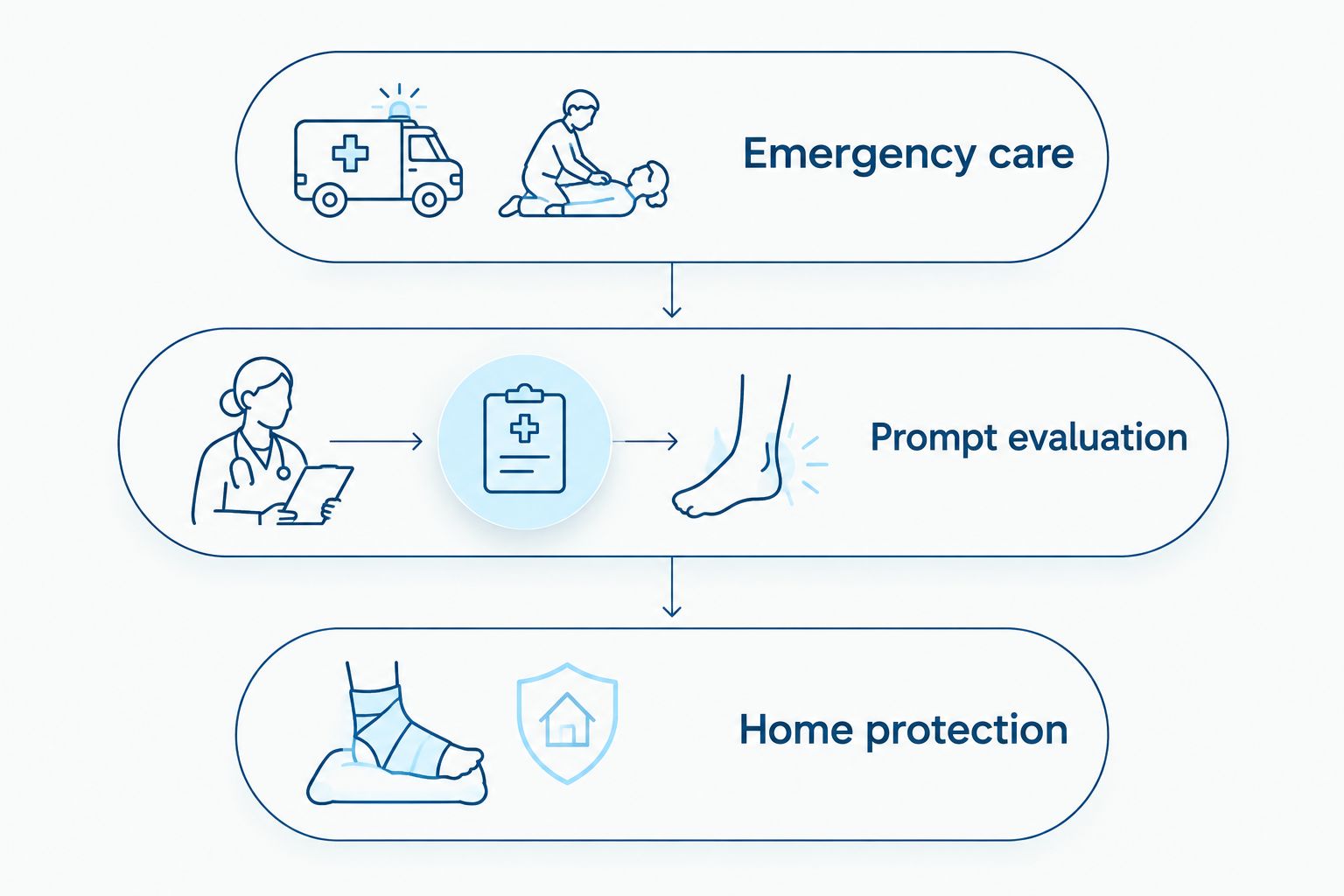
- Emergency care: Seek immediate help for deformity, exposed bone, or circulation changes.
- Prompt evaluation: Arrange assessment for inability to bear weight or marked swelling.
- Home protection: Stop painful activity while watching for worsening symptoms.
- Tell the clinician whether the injury followed a fall, collision, twist, or repeated activity.
Protect the injury without testing it repeatedly
For a minor injury without urgent warning signs, start by stopping the activity that hurts. Protect the foot or ankle from another impact and elevate it when resting. A wrapped cold pack can help with pain; use it for 15–20 minutes at a time, never directly against skin.
Avoid aggressive stretching, deep massage, or forcing movement immediately after an injury. Compression should feel supportive, not restrictive: remove it if toes become numb, cold, discolored, or more painful. Ask a clinician whether your child needs crutches, a boot, or another form of protection rather than borrowing equipment and guessing the fit.
- Stop running, jumping, and cutting movements that reproduce pain.
- Place fabric between a cold pack and the skin.
- Check toe warmth, color, and sensation after applying compression.
- Avoid heat on a newly swollen injury.
- Seek assessment if symptoms worsen or walking remains difficult.
Record symptoms and arrange the right evaluation
Write down where the pain is and how it started before details blur together. Ask your child to point with one finger to the most painful spot. Record whether symptoms occur during play, afterward, on first steps, or at rest; these patterns help guide an examination but do not establish a diagnosis.
Bring a 7-day activity log to the appointment if available, including school PE, practices, games, and recreational activity. Do not delay urgent care to complete it. Achilles Foot and Ankle Center provides sports injury care within its foot and ankle scope; head injuries, breathing problems, and injuries outside that scope require the appropriate medical service.
- Note the injury date and mechanism.
- Record swelling, bruising, limping, and difficulty bearing weight.
- List recent changes in training, surfaces, or footwear.
- Bring the shoes and any brace your child uses.
- Share previous injuries, medical conditions, and current medicines.
Match heel and ankle symptoms to an assessment
Do not label every young athlete’s heel pain as plantar fasciitis. Heel growth-plate irritation, often called Sever’s disease, is another cause in growing children. Tendon problems, bone stress injuries, and other conditions also need consideration. Location and timing help a clinician decide what to examine.
A twisted ankle is not automatically a simple sprain either. Children can injure growing bone, and persistent pain deserves reassessment even when the initial swelling settles. Imaging decisions depend on the history and examination; neither an online symptom checklist nor a brace can replace that judgment.
For the 2026 season, keep treatment tied to the diagnosis rather than a teammate’s recovery plan.
- Describe heel pain separately from arch or ankle pain.
- Report pain at rest or pain that wakes your child.
- Mention recurring ankle rolling or a feeling of giving way.
- Ask whether imaging or follow-up is needed.
- Request clear limits for PE, practice, and competition.
Adjust training and check equipment fit
Start with changes you can make without buying anything: remove painful drills, account for every team’s schedule, and inspect existing shoes. A child playing on several teams still has one body. Separately manageable practices can create an excessive combined workload.
Check length, width, heel security, and pressure points while your child stands in the shoes. Equipment should not squeeze toes or rub injured skin. A brace offers support for selected ankle injuries, but it does not establish readiness to play. The guide to ankle braces for sports injuries explains options to discuss after the injury has been assessed.
- Share activity restrictions with every coach and the PE teacher.
- Remove drills that cause pain or limping.
- Inspect shoes for tight areas and damaged soles.
- Check skin after wearing a brace or changing footwear.
- Ask before adding inserts, heel lifts, or restrictive supports.
Follow a diagnosis-specific rehabilitation plan
Once the injury has been assessed, follow the prescribed progression rather than adding exercises from unrelated injury videos. Rehabilitation often addresses movement, strength, and balance, but the starting point depends on what is injured. A fracture and an ankle sprain do not share the same early plan.
A physical therapist can guide exercise progression when that is part of the treatment plan. Keep exercises comfortable and report increasing pain, swelling, or a new limp. Pain medicine should not become a way to pass a practice trial; ask your child’s clinician or pharmacist about age-appropriate use and contraindications.
- Confirm which movements and activities are currently permitted.
- Practice only the exercises your child has been given.
- Track symptoms during exercise and afterward.
- Report new swelling, instability, or difficulty walking.
- Keep follow-up appointments even if the next game creates pressure.
Return to sport by function, not the calendar
The next tournament is not a return-to-play test. Progress from comfortable daily activity to the movements the sport requires, following clinical guidance. Running straight ahead does not demonstrate readiness for cutting, landing, or contact.
Ask for a written progression that explains what to do if symptoms return. Track your child’s response during activity and over the following 24 hours; next-day pain or limping is information to report, not something to hide. A 2026 return-to-sport plan should also state whether a brace, rehabilitation, or follow-up remains necessary.
- Confirm comfortable walking before attempting sport-specific progression.
- Follow guidance for jogging, acceleration, jumping, and direction changes.
- Stop a session if pain changes movement or causes a limp.
- Record swelling and next-day symptoms.
- Obtain the recommended clearance before full competition.
Compare care options for a youth sports injury
Choose the setting by symptoms and injury scope. The nearest routine appointment is not a substitute for emergency care, while an emergency department is not a replacement for ongoing rehabilitation.
| Option | Best for | Main advantage | Key limitation |
|---|---|---|---|
| Home protection | Mild symptoms without warning signs while monitoring | Stops further painful loading immediately | Cannot diagnose a fracture or determine return-to-play readiness |
| Primary care or pediatrician | Initial assessment and broader health concerns | Considers the child’s overall health and coordinates referrals | Some injuries require additional specialist assessment |
| Achilles Foot and Ankle Center | Richmond-area youth foot and ankle concerns | Practice scope includes sports injuries and heel pain | Foot and ankle care does not cover every sports injury |
| Pediatric orthopedics or sports medicine | Injuries needing broader musculoskeletal expertise | Addresses injury-specific diagnosis and management | Rehabilitation and follow-up still depend on the individual injury |
| Physical therapy | Prescribed rehabilitation and movement retraining | Guides strength, balance, and functional progression | Does not replace urgent medical assessment |
| Emergency department | Severe injury, deformity, or circulation warning signs | Provides emergency assessment and treatment | Ongoing recovery often requires follow-up elsewhere |
For Mechanicsville and West End families, the practical next step is the same: match the care setting to the symptoms, then ask for a clear activity plan. Bring the training schedule and footwear so the evaluation addresses what your child actually does.
Discuss your child’s foot or ankle pain
Explore foot and ankle care for a young athlete with persistent pain, limping, or recurring injuries.
Common mistakes families of youth athletes make
Calling persistent pain growing pains
Growth does not make a persistent limp normal. Pain in one specific spot, repeated activity-related pain, or symptoms that interrupt walking deserve assessment rather than a blanket explanation.
Correct the mistake: Describe the location and activity pattern, and arrange evaluation when symptoms persist or recur.
Counting each team’s workload separately
School PE, club practice, private coaching, and weekend games all contribute to the same athlete’s activity. A coach seeing only one session does not have the full picture.
Correct the mistake: Keep one shared 2026 schedule and communicate restrictions across teams instead of relying on your child to negotiate them.
Buying support before understanding the injury
A brace, insert, or new shoe can change comfort without identifying the cause of pain. Using support to continue painful activity delays the more useful question: what is injured?
Correct the mistake: Assess persistent symptoms first, then select equipment for the diagnosed problem and the child’s fit.
Treating less pain as complete recovery
An athlete can feel better at rest yet struggle with balance, landing, or rapid direction changes. Symptom improvement and competition readiness are different milestones.
Correct the mistake: Follow the functional progression and report symptoms honestly. Do not use pain relief to conceal a failed activity trial.
FAQ
What’s the first thing to do when my child hurts an ankle during a game?
Stop play and check for deformity, circulation changes, and difficulty bearing weight. Seek emergency care for an obvious deformity, an open injury with exposed bone, or a cold, pale, or numb foot; arrange prompt assessment for inability to bear weight or marked swelling.
Can my child keep playing if they can still walk?
Walking does not establish that playing is safe or rule out a fracture. Stop sports when pain causes limping or changes movement, and seek assessment for persistent or significant symptoms.
Is heel pain in young athletes always plantar fasciitis?
No, heel pain in young athletes is not always plantar fasciitis. Heel growth-plate irritation, tendon problems, and bone stress injuries are other considerations that require an appropriate examination.
Does my child need an X-ray for an ankle injury?
The need for an X-ray depends on the injury history and clinical examination. Difficulty bearing weight, focal bone tenderness, and other findings help the clinician decide whether imaging is needed.
Is an ankle brace enough to get my child back into sport?
An ankle brace alone does not establish readiness to return to sport. It supports selected injuries but does not replace diagnosis, rehabilitation, or assessment of sport-specific movement.
Who should evaluate a youth athlete’s foot or ankle pain near Richmond?
Achilles Foot and Ankle Center provides foot and ankle care, including sports injuries, for patients of all ages in the Richmond area. Families in Mechanicsville and West End should use emergency care rather than a routine appointment when severe injury or circulation warning signs are present.
How long does a young athlete need to stay out of sport?
Time away from sport depends on the diagnosis, injury severity, and recovery of function. Ask the treating clinician for a progression and clearance criteria rather than relying on a fixed deadline.
One last thing
Bring the whole sports schedule, not just the name of the injured team. The most useful detail at an appointment is sometimes the extra practice, PE session, or weekend tournament missing from the initial story. A complete activity picture helps your child receive advice they can follow across school, home, and sport.
Related guides
- Foot and ankle care for runners
- Pediatric orthotics for kids with flat feet
- Compression sleeves for shin splints