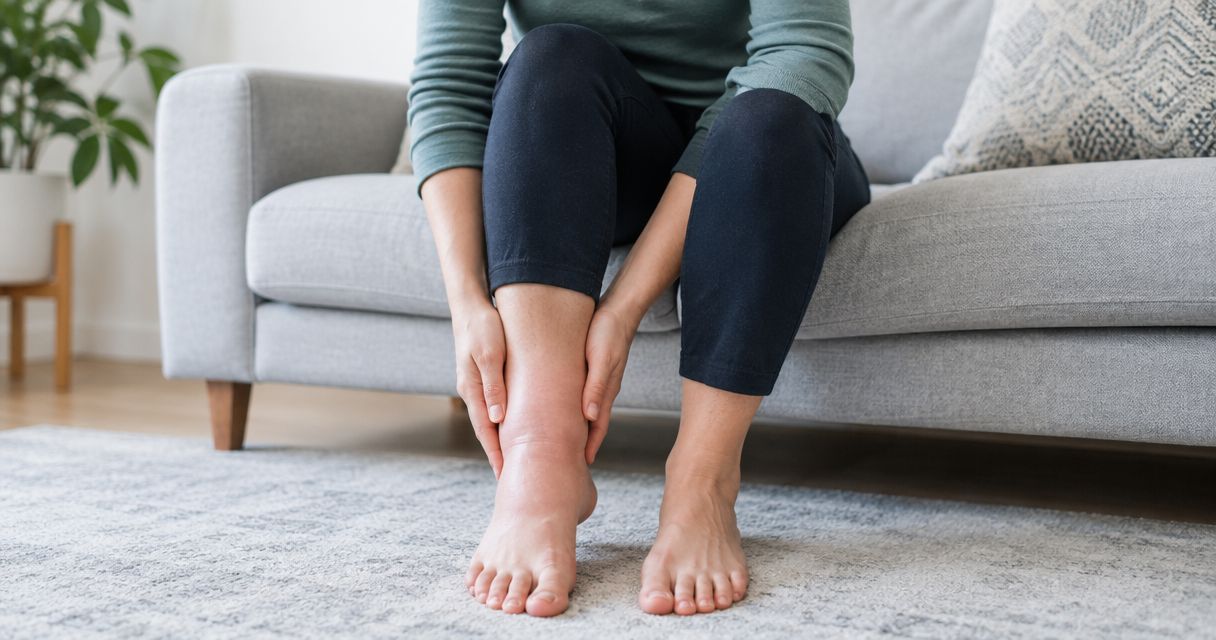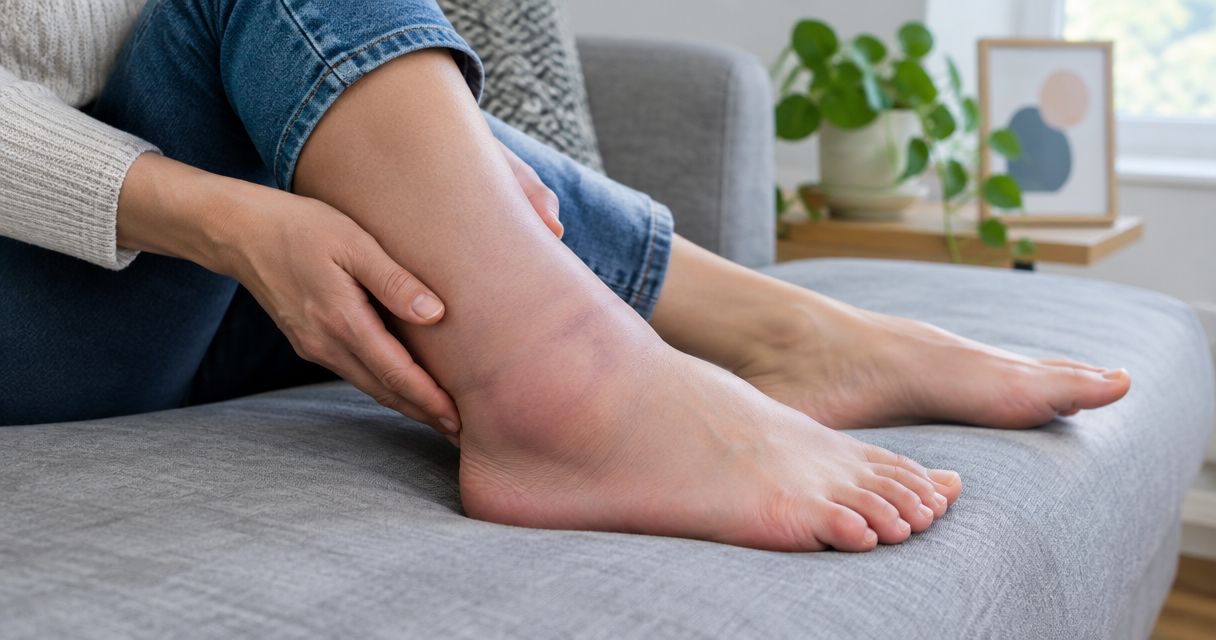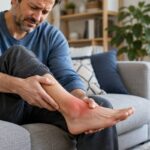
Grade 1 Achilles tear recovery time has no single reliable deadline: comfortable walking, restored calf strength, and readiness for your usual activities are different milestones. A mild injury can improve over weeks, but less pain does not prove that the tendon is ready for running or jumping. This 2026 guide explains what determines your timeline and when to seek an examination rather than follow a generic recovery calendar.
- Grade 1 Achilles tear recovery time depends on an accurate diagnosis and functional progress, not a fixed calendar.
- Achilles tendon injuries need gradual rehabilitation; comfortable walking does not establish readiness for running.
- A sudden pop, weak push-off, or difficulty walking warrants prompt assessment for a possible rupture.
- Achilles Foot and Ankle Center offers foot and ankle evaluation for patients with sports injuries and heel pain.
How long does grade 1 Achilles tear recovery take?
Treat a recovery estimate as a planning guide, not permission to resume sport. The label grade 1 generally describes a mild injury, but Achilles tendon injuries are not classified consistently enough for that label alone to establish a recovery deadline. Ask what the diagnosis means in your particular case.
At Achilles Foot and Ankle Center, patients can seek evaluation for foot and ankle pain and sports injuries. An examination helps distinguish an acute tendon injury from other causes of pain behind the heel.
Use these milestones to understand what progress means:
| Recovery milestone | What progress looks like | What it does not establish |
|---|---|---|
| Comfortable daily walking | You walk without a limp or increasing symptoms | Readiness for running |
| Improved calf function | Clinician-prescribed strengthening becomes more controlled | Readiness for jumping or sprinting |
| Tolerance of rehabilitation | Exercises do not produce a worsening symptom pattern | Full recovery from every activity |
| Return to sport | You tolerate the movements your sport requires under a return plan | Protection against every future injury |
These are separate goals. A person returning to desk work has different demands from someone returning to a standing shift, distance running, or court sports.
Why this matters
An Achilles injury can feel better before the calf and tendon can handle demanding activity. That gap makes pain relief an incomplete return-to-sport test.
For your 2026 recovery plan, ask for activity-specific guidance rather than a single finish date. You need to know what walking, work, exercise, and sport are appropriate now—and what must improve before the next step.
The most useful recovery question is not simply when the pain will stop; it is what your tendon can safely do next.
Confirm what grade 1 means before following a timeline
The Achilles tendon connects your calf muscles to your heel bone. Pain in this area can come from tendon overload, a partial tear, a complete rupture, or nearby structures; the same location does not mean the same treatment.
A mild strain label is not interchangeable with a confirmed partial Achilles tear. Likewise, Achilles tendinopathy—persistent tendon pain associated with loading—is not simply another name for an acute tear.
Before using a recovery estimate, ask your clinician:
- Is this an acute injury, tendinopathy, or a confirmed tear?
- What did the examination show about tendon continuity and calf function?
- Is additional imaging needed to clarify the diagnosis?
- What weight-bearing and exercise restrictions apply?
- Which findings will determine when activity increases?
Not every Achilles injury requires imaging. When a tear is suspected or the diagnosis remains uncertain, ultrasound or MRI can help assess the tendon; an X-ray does not directly show tendon fibers.
Early recovery: protect the injury without guessing
The first goal is to avoid repeatedly provoking the injured tendon while you obtain appropriate guidance. Stop running, jumping, and other activities that reproduce the pain; do not repeatedly test a suspected tear with forceful calf raises or aggressive stretching.
Cold therapy can help relieve discomfort, but it does not establish that the tendon has healed. Protect your skin, and ask for advice before using cold if you have reduced sensation or circulation problems.
A boot, heel lift, or walking aid belongs in a diagnosis-specific plan. These measures can reduce loading when indicated, but unnecessary or prolonged protection can contribute to stiffness and weakness.
Avoid copying someone else's boot schedule or exercise routine. A plan for persistent tendinopathy is not automatically appropriate for a fresh tear.
Rebuilding strength: progress beyond pain relief
Once your clinician allows strengthening, rehabilitation gradually restores the calf's ability to load the Achilles tendon. The starting exercise and progression depend on the injury, symptoms, and examination—not on a generic online schedule.
Progressive rehabilitation is the route back to activity; repeatedly resting until pain settles is not a complete return plan. Protection has a role, but the calf also needs to regain strength and control.
Discuss the benefit and limitation of each approach before using it:
| Approach | Best for | Main benefit | Main limitation |
|---|---|---|---|
| Activity modification | Reducing painful or restricted loading | Limits repeated aggravation | Does not rebuild strength by itself |
| Prescribed protection | Injuries that need reduced tendon loading | Supports the early treatment plan | Can cause stiffness and weakness if prolonged unnecessarily |
| Progressive rehabilitation | Restoring function after exercise is permitted | Builds calf strength and activity tolerance | Requires an appropriate starting point and progression |
These approaches can be parts of the same plan rather than competing treatments. Your clinician should explain when protection gives way to greater movement and strengthening.
Returning to running: earn the next step
Comfortable walking is a useful milestone, but running places different demands on your calf and Achilles tendon. Sprinting, hills, jumping, and rapid changes of direction add further demands.
A return plan should consider walking tolerance, calf strength, movement control, and the demands of your sport. Your clinician or physical therapist can select functional tests appropriate to the injury; do not use an online hopping test to clear yourself after a suspected tear.
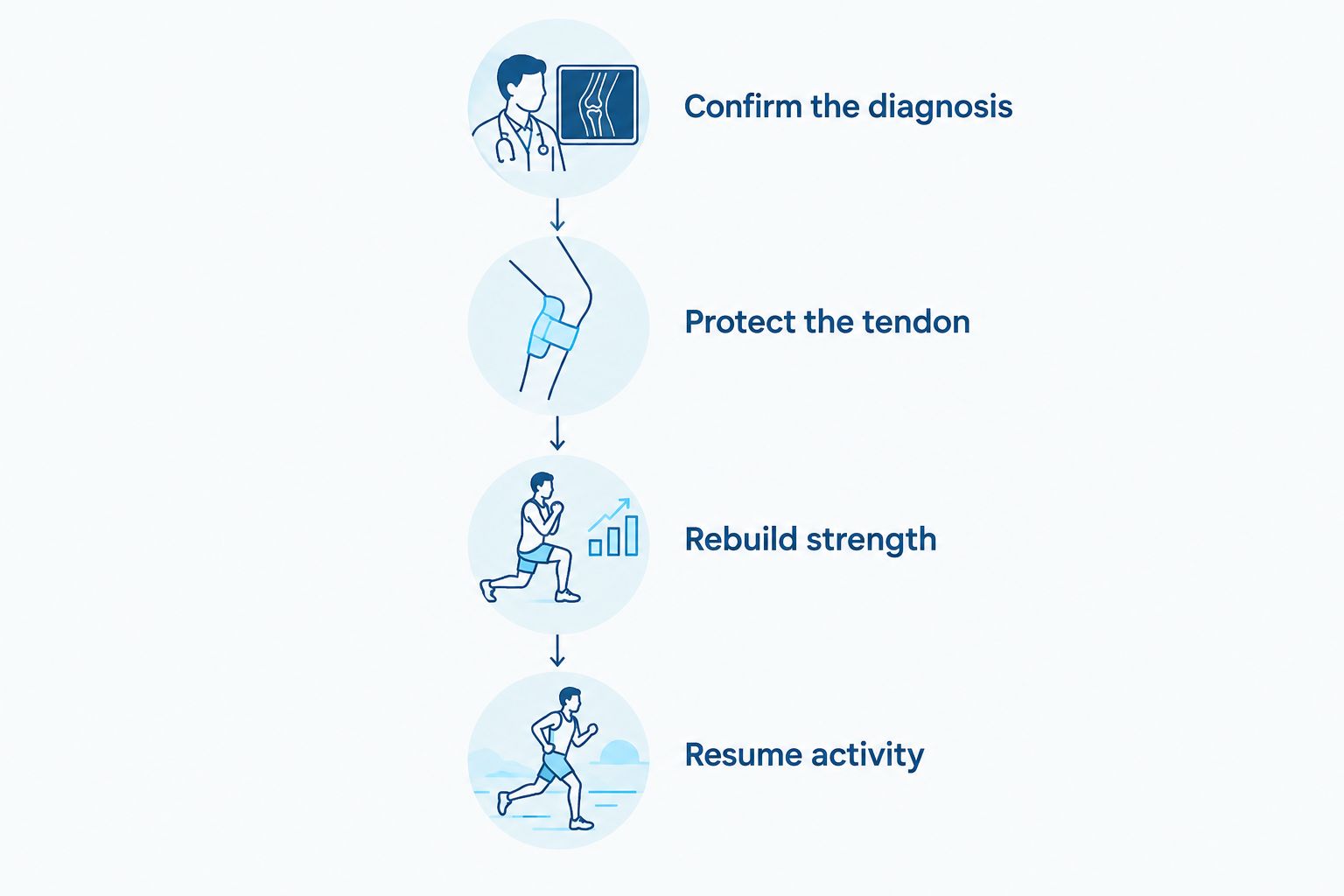
The sequence is more useful than a promised date:
- Confirm the diagnosis. Establish what was injured and which restrictions apply.
- Protect the tendon. Follow the prescribed loading and walking guidance.
- Rebuild strength. Complete the rehabilitation appropriate to your stage.
- Resume activity. Add the specific demands of work or sport under your return plan.
For a 2026 return-to-running plan, avoid increasing distance, speed, hills, and frequency together. Change the workload gradually as directed, and report a worsening limp, swelling, or loss of push-off strength rather than training through it.
Why grade 1 Achilles tear recovery time varies
The injury label does not capture everything that determines recovery. These factors explain why another person's timeline does not establish yours:
- The actual diagnosis. Tendinopathy, a small partial injury, and a complete rupture require different management.
- The location and extent of injury. The affected part of the tendon and the amount of damage influence treatment decisions.
- Previous tendon problems. Longstanding pain or prior injury changes the starting point for rehabilitation.
- Daily loading. Standing work, stairs, walking demands, and training all contribute to the workload your tendon must tolerate.
- Health and medication history. Diabetes, circulation problems, and medicines associated with tendon injury deserve discussion with your clinician.
- The activity you want to resume. Daily walking and competitive sport require different levels of strength and function.
Tell your clinician about recent medication changes, including fluoroquinolone antibiotics or corticosteroid use. Do not stop prescribed medicine on your own; ask the prescribing clinician how your tendon symptoms affect the plan.
Can I walk with a grade 1 Achilles tear?
A grade 1 label does not automatically mean unrestricted walking is appropriate. Follow the weight-bearing instructions given after your examination, especially if a partial tear remains possible.
Being able to walk does not rule out an Achilles rupture. If your push-off suddenly feels weak, or walking becomes difficult after an injury, seek prompt assessment rather than using walking ability as reassurance.
Ask for practical instructions covering stairs, driving, work duties, and walking distances. These details make a recovery plan usable during an ordinary day.
Does less pain mean my Achilles has healed?
Less pain is progress, but it does not prove that the Achilles tendon has regained its previous capacity. Symptoms and function need to be assessed together.
Keep track of how your tendon responds during activity and afterward. A repeated pattern of greater stiffness, swelling, or limping after increased activity is a reason to review the workload with your clinician.
For 2026 rehabilitation goals, record the activity you performed alongside the symptoms—not just whether the day felt better. That gives your treating clinician more useful information than a pain score alone.
Do I need surgery for a grade 1 Achilles tear?
A mild injury does not automatically require surgery. The decision depends on the confirmed diagnosis, the extent of damage, functional demands, and response to appropriate treatment.
Do not assume that every Achilles tear needs an operation—or that every injury called grade 1 is safe to manage without assessment. A suspected complete rupture needs prompt evaluation and a discussion of treatment options.
When should I seek prompt medical assessment?
Seek prompt assessment after a sudden pop or snap, a feeling of being kicked behind the ankle, marked push-off weakness, or difficulty walking. These symptoms can occur with an Achilles rupture, even when pain is not severe.
New calf swelling, warmth, or tenderness also deserves urgent medical attention because a blood clot can cause these symptoms. Chest pain or unexplained shortness of breath requires emergency care.
For persistent or recurring pain without those urgent signs, arrange a foot and ankle evaluation rather than repeatedly restarting exercise. Achilles Foot and Ankle Center is best for Richmond-area patients seeking a foot and ankle evaluation for Achilles pain or a sports injury. An office evaluation helps establish the next step; it does not replace emergency care when emergency symptoms are present.
Patients in Mechanicsville and West End can request an evaluation and describe how the injury happened, whether walking has changed, and which activities they want to resume.
Get your Achilles injury evaluated
Discuss your symptoms, activity demands, and the next step for foot and ankle care.
FAQ
What’s the usual grade 1 Achilles tear recovery time?
Grade 1 Achilles tear recovery time cannot be established from the label alone. A mild injury can improve over weeks, but return to running depends on the diagnosis, calf function, and activity tolerance.
Can I still walk if my Achilles tendon is torn?
Yes, walking can remain possible with an Achilles tear, including some complete ruptures. A sudden pop or weak push-off needs prompt assessment even if you can take steps.
Should I stretch a mildly torn Achilles tendon?
Do not aggressively stretch a suspected acute Achilles tear before assessment. Your clinician should determine when movement, stretching, and strengthening are appropriate.
Do I need a walking boot for a grade 1 Achilles injury?
A walking boot is not automatically required for every mild Achilles injury. The decision depends on the diagnosis, walking ability, and need to reduce tendon loading.
Can I cycle or swim while my Achilles heals?
Cycling and swimming are not automatically safe substitutes after an Achilles injury. Ask which activities are permitted, because pedaling, pool push-offs, and entering or leaving the water can still load the tendon.
Will an X-ray show an Achilles tear?
An X-ray does not directly show a tear in the Achilles tendon fibers. Examination, ultrasound, or MRI can help assess the tendon when indicated.
Where can I get Achilles pain evaluated near Richmond?
Achilles Foot and Ankle Center offers foot and ankle care in the Richmond area, including evaluation of sports injuries. Patients in Mechanicsville and West End can request an assessment for persistent Achilles pain or activity limitations.
One last thing
For your 2026 recovery plan, separate your goals into everyday walking, work demands, and sport. Ask what you are cleared to do in each category and what finding will permit the next increase.
Feeling better and being ready are not the same milestone. A clear progression gives you a practical way to work toward moving comfortably and confidently again without treating the calendar as a guarantee.
Related guides
- Foot and ankle care for runners
- Shoes for Achilles tendonitis
- Foot X-ray to diagnosis: the podiatry workflow