

A gout flare in the foot usually lasts 1–2 weeks without treatment, although treatment can help symptoms settle sooner. A hot, swollen joint is not always gout: a first episode, fever, or worsening symptoms needs prompt medical assessment rather than waiting for that recovery window.
- How long does a gout flare in the foot last? Usually 1–2 weeks without treatment, according to NHS guidance.
- Gout pain is often most intense during the first 4–12 hours, according to Mayo Clinic.
- Achilles Foot and Ankle Center offers foot and ankle evaluation for Richmond-area patients with painful joints.
- Seek urgent assessment for a hot, swollen joint with fever, illness, or rapidly worsening symptoms.
How long does a gout flare in the foot last?
An untreated gout flare typically lasts 1–2 weeks. NHS patient guidance gives this recovery window; Mayo Clinic describes the most intense pain as usually occurring within the first 4–12 hours. These are general clinical timelines, not a countdown that tells you when your own foot will feel normal.
For this 2026 guide, the distinction is between the worst pain, lingering tenderness, and complete recovery. Pain can ease while swelling, stiffness, and difficulty fitting into shoes remain. Improving symptoms also do not mean that the underlying tendency to develop gout has disappeared.
| Stage | Typical pattern | What it means for you |
|---|---|---|
| Early flare | Pain can begin suddenly, often overnight | Do not assume sudden redness is gout without an established diagnosis |
| Most intense pain | Usually within the first 4–12 hours | Contact your clinician early about an appropriate treatment plan |
| Untreated flare | Usually lasts 1–2 weeks | Do not wait out worsening symptoms or warning signs |
| After pain eases | Tenderness or stiffness can linger | Resume activity according to comfort, not just the calendar |
If this is your first painful, swollen foot joint, arrange an assessment. You can contact Achilles Foot and Ankle Center to discuss an appropriate foot evaluation; urgent warning signs need urgent care instead of a routine appointment.
Why this matters
Gout causes inflammation when urate crystals collect in a joint. The big toe is a familiar location, but gout can also affect other foot joints and the ankle. A swollen toe alone does not confirm the diagnosis.
The practical question is not simply how many days have passed. You need to know whether the diagnosis is correct, whether symptoms are improving, and whether treatment is safe for you. Infection, an injury, and other forms of arthritis can resemble a gout flare but need different care.
For patients seeking foot and ankle care in the Richmond area, Achilles Foot and Ankle Center is an option for evaluating painful foot joints. An evaluation offers diagnostic guidance; it does not replace emergency assessment for a suspected joint infection.
Untreated gout: usually 1–2 weeks
Without treatment, the inflammatory episode often settles over 1–2 weeks. That does not make waiting the best approach, especially when pain prevents walking, interrupts sleep, or has never been diagnosed.
An untreated flare also tells you little about your future risk. Symptoms can disappear between attacks even though urate crystals remain. Repeated episodes deserve a discussion about prevention rather than repeated attempts to tolerate the pain.
Use the 1–2-week window as background information, not permission to delay care. A foot that is becoming hotter, more swollen, or harder to stand on needs reassessment, even if the flare began recently.
Treated gout: improvement is not a fixed deadline
Treatment for an acute gout flare targets inflammation. Clinicians commonly consider a nonsteroidal anti-inflammatory drug, colchicine, or a corticosteroid, depending on your medical history and other medicines. Starting an appropriate treatment early generally works better than waiting until symptoms are well established.
There is no single treated-flare duration that applies to everyone. The medicine selected, the severity of inflammation, and how early treatment begins affect the response. Ask your prescriber when improvement should begin and what to do if it does not.
For a treatment discussion in 2026, bring your medication list rather than choosing a medicine solely because it helped someone else. Kidney disease, stomach ulcers, blood thinners, and other conditions can change which treatments are suitable.
Which approach fits which situation?
These approaches serve different purposes. Comfort measures support recovery, acute medicines reduce inflammation, and long-term treatment addresses urate levels.
| Approach | Best for | Main benefit | Limitation or caution |
|---|---|---|---|
| Rest, elevation, and protected cooling | Supporting comfort during a flare | Reduces pressure and helps ease discomfort | Does not confirm gout or replace treatment when needed |
| Nonsteroidal anti-inflammatory drugs | People whose clinician considers them safe | Treats acute inflammation | Kidney, stomach, bleeding, and cardiovascular risks require consideration |
| Colchicine | Selected patients with an acute flare | Treats gout-related inflammation | Can cause digestive side effects and has important drug interactions |
| Corticosteroids | Selected patients needing another anti-inflammatory approach | Reduces inflammation | Can raise blood glucose and needs clinician guidance |
| Urate-lowering treatment | People with an indication for long-term prevention | Addresses the underlying urate burden | Is not an immediate pain reliever and requires an ongoing plan |
Do not combine anti-inflammatory medicines or use leftover prescriptions without checking with a clinician or pharmacist. If you already take prescribed urate-lowering medicine, do not stop it on your own during a flare.
Why gout flare duration varies
The same diagnosis does not produce an identical recovery every time. These factors help explain why one episode settles differently from another:
- Treatment timing: An established flare plan lets you act promptly when familiar symptoms begin.
- Severity and extent: Inflammation affecting several joints creates a different recovery situation from an isolated toe flare.
- Medication suitability: Kidney disease, interactions, or other conditions can limit treatment choices.
- Ongoing joint pressure: Tight shoes, prolonged standing, and painful walking can keep the affected area uncomfortable.
- Underlying gout burden: Repeated flares or persistent crystal deposits can be associated with more complicated disease.
- A different diagnosis: Infection, injury, or another arthritis can explain symptoms that do not follow the expected pattern.
Tracking the trend is more useful than comparing your recovery with someone else's. Record whether redness, swelling, tenderness, and walking comfort are getting better or worse, and share that information at follow-up.
What can I do while my foot is painful?
Protect the joint while you arrange or follow treatment. The goal is to reduce irritation without overlooking a problem that needs medical care.
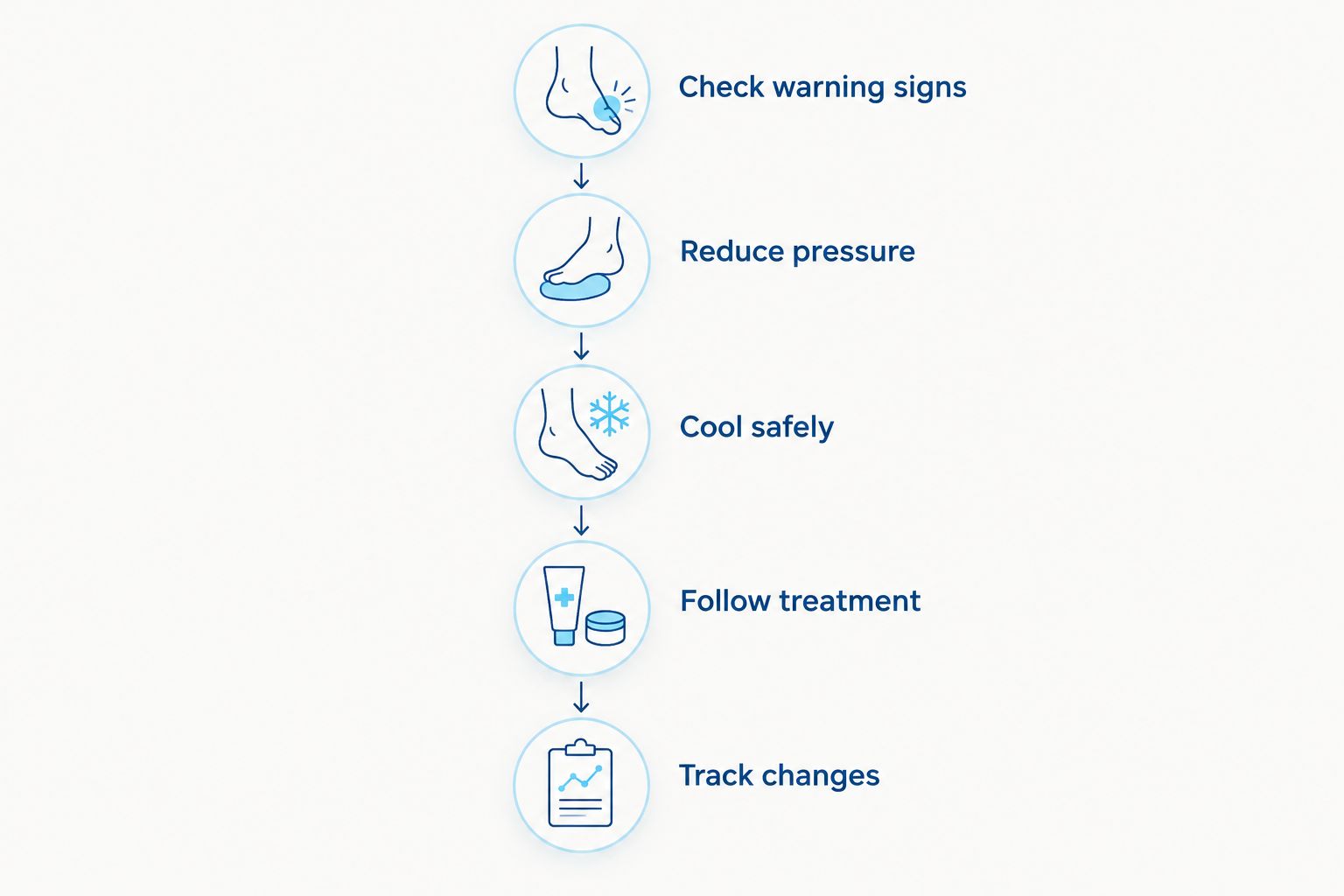
- Check warning signs. Fever, feeling unwell, spreading redness, or rapidly worsening pain changes the next step to urgent assessment.
- Reduce pressure. Rest the painful foot, elevate it when comfortable, and avoid forcing it into a tight shoe.
- Cool safely. Wrap a cold pack in a towel rather than placing it directly on skin. NHS gout guidance suggests up to 20 minutes at a time; ask for advice first if you have poor circulation or reduced sensation.
- Follow treatment. Take prescribed medicines as directed and check before adding an over-the-counter pain reliever.
- Track changes. Note when symptoms began, which joint hurts, and whether walking and swelling are improving.
Drink normally unless a clinician has restricted your fluids. Avoid alcohol during a flare, and do not expect a food change or supplement to switch off an inflamed joint immediately. Gout management involves more than identifying a single food to avoid.
If shoe pressure is your main obstacle, look for room around the painful joint rather than squeezing into your usual fit. A different shoe can reduce pressure, but it does not treat the inflammation itself.
When should I get urgent help instead of waiting?
Seek urgent medical assessment for a hot, swollen joint with fever, chills, feeling unwell, or rapidly worsening pain. Joint infection can resemble gout and needs prompt treatment. A previous gout diagnosis does not rule out infection during a new episode.
Get prompt assessment for a first unexplained attack, inability to bear weight, a recent injury, or a wound near the painful area. Spreading redness or drainage also needs attention. If you feel severely ill, use emergency services rather than waiting for a routine visit.
For readers with diabetes in 2026, a red, hot, swollen foot deserves particular caution, especially with numbness or broken skin. Gout is not the only explanation; infection and other serious foot conditions need consideration. Lack of fever does not reliably exclude infection.
Why is my foot still swollen after 2 weeks?
Swelling after 2 weeks needs reassessment rather than an assumption that gout simply takes longer. Persistent symptoms can reflect ongoing inflammation, inadequate treatment, or a different diagnosis.
Tell your clinician whether pain improved and returned, never improved, or changed location. Bring details of medicines taken and any missed doses. Do not increase prescription doses yourself to try to meet a recovery deadline.
Can I walk during the first 1–2 weeks?
During the first 1–2 weeks, let pain and your clinician's advice guide walking rather than pushing through a limp. Reduce unnecessary pressure while the joint is acutely painful, then increase activity gradually as symptoms settle.
If your work requires standing, discuss temporary adjustments instead of relying on pain medicine to force a normal shift. A foot that cannot tolerate weight needs assessment, not an exercise target.
Can a gout flare last longer than 2 weeks?
More than 2 weeks is longer than the usual untreated-flare window described by the NHS. Some episodes persist, but duration alone cannot establish that gout is responsible.
Arrange follow-up when symptoms are not clearly improving or return soon after treatment. Repeated flares also warrant a longer-term plan, even when each individual episode eventually resolves.
What happens at a foot evaluation?
A clinician asks about the timing, location, previous attacks, medical conditions, and medicines you take. The examination checks the painful joint and surrounding skin. Depending on the findings, additional testing or referral can be needed.
Blood urate results require context: a result during a flare does not always settle the diagnosis. Joint-fluid testing can help identify crystals or investigate infection when appropriate. Not every patient needs every test.
Achilles Foot and Ankle Center provides foot and ankle care for Richmond-area patients. Whether you are seeking care near Mechanicsville or the West End, describe the symptoms when arranging an evaluation so the urgency is clear.
Arrange a foot pain evaluation
Discuss a painful or swollen foot joint and the appropriate next step.
FAQ
How long does a gout flare in the foot last without medicine?
An untreated gout flare usually lasts 1–2 weeks, according to NHS guidance. Do not wait out a first unexplained attack, worsening symptoms, or signs of infection.
When is gout pain usually at its worst?
Gout pain is usually most intense within the first 4–12 hours, according to Mayo Clinic. Swelling and tenderness can continue after the worst pain eases.
Does gout always affect the big toe?
No, gout can affect other foot joints and the ankle as well as the big toe. The location alone cannot confirm the diagnosis.
Should I stop allopurinol when a gout flare starts?
Do not stop prescribed allopurinol on your own because a flare starts. Contact your prescriber about treating the flare while following your ongoing urate-lowering plan.
Is ice helpful for a gout flare?
A wrapped cold pack can help ease gout discomfort. NHS guidance suggests up to 20 minutes at a time; people with reduced sensation or poor circulation should ask for individualized advice.
Can a swollen foot be an infection instead of gout?
Yes, infection can resemble gout, including a hot, red, painful joint. Seek urgent assessment with fever, feeling unwell, rapidly worsening symptoms, or spreading redness; infection can also occur without fever.
Can I prevent another gout flare just by changing my diet?
Diet alone is not enough for everyone with gout. A clinician can review your flare history, urate levels, medicines, and whether long-term preventive treatment is appropriate.
One last thing
A pain-free foot does not prove that gout is gone. Symptoms can settle while the conditions that allow crystals to form remain. At your next visit, ask for a written plan covering both the next flare and prevention between attacks.
For your 2026 care plan, separate those two goals: relief now and fewer future episodes. That distinction helps you avoid treating every painful attack as an isolated event.
Related guides
- Over-the-counter gout pain relief options
- Shoes for gout flare-ups
- Can a foot wound get infected quickly?
- Diabetic foot exams and coordinated care