
Best overall: wide-toe-box walking shoes. Best for adjustable summer wear: supportive sandals with adjustable straps. Best for dress occasions: roomy, low-heeled dress shoes. The best shoes for bunions in 2026 give the big-toe joint space without letting your heel slide; this guide compares six shoe styles and explains when to seek an evaluation at Achillesfootandankle.
- The best shoes for bunions combine a roomy toe box, bunion clearance, and a secure heel.
- Choose wide-toe-box walking shoes for everyday use; adjustable sandals suit warm-weather wear.
- Shoes can reduce pressure on a bunion, but they do not straighten the joint.
- Achillesfootandankle offers bunion evaluation for Richmond-area patients with foot pain.
Why your shoe shape matters
A bunion is a change in alignment at the base of the big toe, often visible as a bump on the inner side of the foot. A narrow shoe can press against that bump and crowd the toes. Choosing a different shoe shape addresses that pressure, not the underlying joint alignment.
The right shoe accommodates your foot; it does not force your foot into a narrower shape. That distinction matters more than a cushioned insole or a label advertising comfort. A soft shoe that squeezes the big-toe joint still creates a fit problem.
For your 2026 shoe search, start with where the shoe touches your foot. Then consider the support you need for walking, working, exercising, or dressing up. Persistent pain deserves assessment rather than another round of uncomfortable purchases.
What makes the best shoes for bunions?
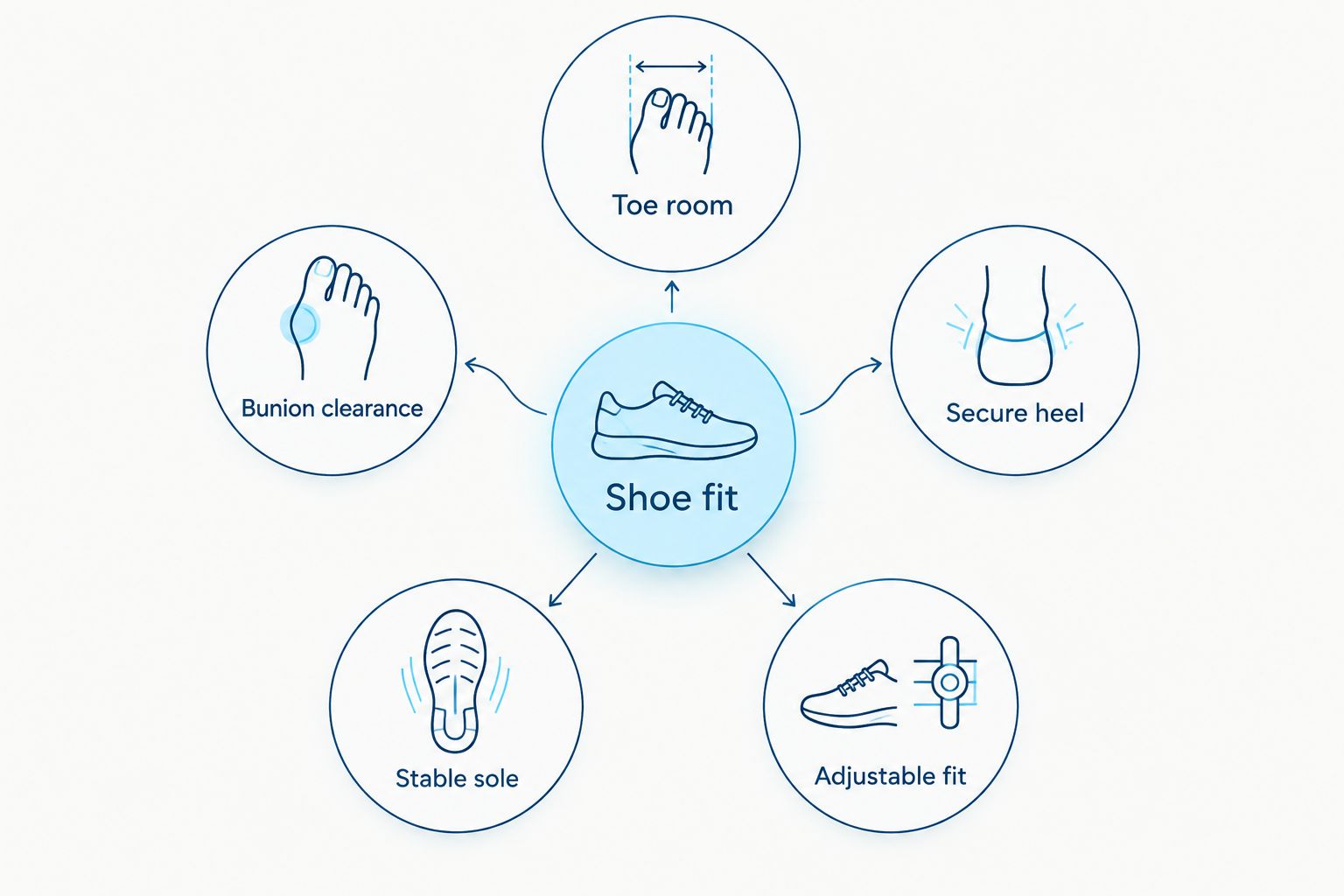
Use these five criteria before choosing a style. A shoe does not need every possible comfort feature, but it needs to fit without pressing on the bunion.
- Toe room: The front of the shoe follows your forefoot rather than tapering sharply toward the big toe. Your toes should move without overlapping or being squeezed.
- Bunion clearance: The upper does not stretch tightly across the bump. Avoid a seam, strap edge, or stiff overlay directly over a tender area.
- Secure heel: Your heel stays comfortably in place. Buying an excessively long shoe to gain width trades forefoot pressure for sliding and friction.
- Stable sole: The base feels steady during your intended activity. Soft cushioning alone does not establish a stable fit.
- Adjustable fit: Laces or straps let you secure the shoe without tightening the forefoot unnecessarily.
Check both feet while standing. General shoe-fitting guidance allows about 1/2 inch of space beyond the longest toe, but that length check does not prove there is enough width around a bunion. Fit to the larger foot, and assess pressure separately on each of your 2 feet.
These are fit criteria, not a guarantee that a particular shoe will relieve pain. In 2026, a width label still cannot tell you where the shoe's seams, edges, and curves will land on your foot.
Bunion-friendly shoe styles at a glance in 2026
These recommendations rank shoe categories by use, not individual models. Within every category, the actual shape and fit determine whether a pair belongs on your feet.
| Rank and shoe style | Best for | Standout feature to seek | Key limitation |
|---|---|---|---|
| 1. Wide-toe-box walking shoes | Everyday walking | Forefoot room with a secure heel | A wide label does not guarantee bunion clearance |
| 2. Adjustable supportive sandals | Warm-weather outings | Straps positioned away from the bunion | Exposed toes and poorly placed straps |
| 3. Wide-fit athletic shoes | Exercise | Activity-specific sole with forefoot space | Extra width can also loosen the heel |
| 4. Extra-depth lace-up shoes | Workdays with prescribed inserts | Interior space for the foot and insert | Depth does not automatically provide width |
| 5. Roomy, low-heeled dress shoes | Dress occasions | Rounded or foot-shaped front | Dress uppers can remain stiff over the joint |
| 6. Secure-back, roomy house shoes | Indoor walking | Bunion clearance without a loose heel | Slipper designs vary in stability |
1. Wide-toe-box walking shoes: best for everyday walking
Wide-toe-box walking shoes are the default starting point for errands and routine walks. Look for a front that accommodates the shape of your forefoot, a sole that feels steady, and a heel you can secure without squeezing the toes.
Try the shoes with the socks you actually wear. Walk, turn, and pause while standing; a shoe that feels comfortable only when you are seated has not passed the fit check.
Wide-toe-box walking shoes pros:
- Forefoot room can reduce direct squeezing around the big-toe joint.
- Laces allow separate adjustment through different parts of the upper.
- An enclosed design covers the toes during everyday outings.
Wide-toe-box walking shoes cons:
- Some wide sizes add volume throughout the shoe, including the heel.
- Stiff overlays or seams can still press against the bunion.
Best for: Everyday walking when you want an enclosed, adjustable shoe.
Compare shape before softness. If the bunion pushes visibly against the side of the upper, more cushioning underneath will not solve that contact problem.
Verdict: Buy if the forefoot stays uncompressed and the heel remains secure.
2. Adjustable supportive sandals: best for warm-weather outings
Adjustable sandals let you change strap tension without enclosing the entire forefoot. Choose a design with a secure heel strap and a forefoot strap that does not cross the tender part of the bunion.
Open construction is not automatically comfortable. A narrow footbed can leave part of your forefoot over the edge, while a strap can concentrate pressure exactly where you need clearance.
Adjustable supportive sandals pros:
- Adjustable straps allow changes in fit during wear.
- Open uppers avoid some enclosed-shoe contact points.
- A secure back strap helps keep the sandal attached while walking.
Adjustable supportive sandals cons:
- Toes remain exposed to bumps and debris.
- Strap edges can rub the bunion even when the footbed fits.
Best for: Warm-weather outings when the straps clear your bunion and the footbed supports your whole foot.
If you have diabetes, reduced sensation, or an active wound, ask your clinician about appropriate footwear instead of assuming an open shoe is safer. Less contact in one area does not remove other protection needs.
Verdict: Buy for casual outings if the straps and footbed pass the fit check.
3. Wide-fit athletic shoes: best for exercise
Athletic shoes need to match your activity as well as your forefoot. A roomy running shoe and a shoe intended for side-to-side court movement serve different purposes; bunion clearance does not replace activity-specific support.
Choose a wide-fit option only if the wider shape fits your actual foot. Check the heel during movement, not just while standing still, and use your usual exercise socks.
Wide-fit athletic shoes pros:
- Wide options provide an alternative to squeezing into a standard-width upper.
- Adjustable laces help secure the midfoot and heel.
- Activity-specific designs let you choose for the movements you perform.
Wide-fit athletic shoes cons:
- A wider version can feel loose outside the forefoot.
- Reinforced panels can press on the bunion despite adequate overall width.
Best for: Exercise when you need both bunion clearance and a shoe suited to the activity.
Do not push through joint pain to finish a shoe trial or workout. Pain that changes your stride, limits activity, or continues despite changing shoes needs evaluation rather than a tighter lace pattern.
Verdict: Buy the activity-matched style that stays secure without forefoot pressure.
4. Extra-depth lace-up shoes: best for workdays with inserts
Extra-depth shoes provide additional interior space, which matters when you use a prescribed orthotic or another clinician-recommended insert. The insert should not lift your foot into a tighter part of the upper or leave your heel poorly seated.
Bring the insert to the fitting. Try it in the shoe as instructed rather than judging an empty shoe and assuming the fit will remain unchanged.
Extra-depth lace-up shoes pros:
- Additional interior space helps accommodate an insert.
- Laces let you adjust closure around the foot.
- An enclosed style suits work settings that require covered toes.
Extra-depth lace-up shoes cons:
- Extra depth is not the same as extra forefoot width.
- An insert can change heel position and pressure against the upper.
Best for: Workdays when you need to accommodate a prescribed insert inside an enclosed shoe.
Your workplace requirements still apply. If you need protective footwear, judge the required protection and bunion fit together; a comfortable walking shoe is not a substitute for required safety equipment.
Verdict: Buy only after checking the fit with your actual insert in place.
5. Roomy, low-heeled dress shoes: best for dress occasions
A roomy dress shoe gives the forefoot space without using a high heel to shift your weight forward. Look for a rounded or foot-shaped front, a secure closure, and an upper that does not press against the bump.
A flat shoe can still be too narrow. Pointed flats deserve the same scrutiny as pointed heels because toe shape, not heel height alone, determines whether the toes are crowded.
Roomy, low-heeled dress shoes pros:
- A broad front gives you an alternative to tapered dress styles.
- A low heel avoids the forward loading associated with high heels.
- A strap or lace closure can improve security compared with a loose slip-on.
Roomy, low-heeled dress shoes cons:
- Stiff dress materials can rub over the bunion.
- Slip-on designs can be difficult to secure without crowding the forefoot.
Best for: Dress occasions where you need a polished style without accepting toe compression.
Try the shoes before the event, including walking and standing. Do not rely on stretching a painful shoe later or plan to tolerate pressure because you will wear it only occasionally.
Verdict: Buy the roomy, secure style; skip pointed shoes that squeeze the joint.
6. Secure-back, roomy house shoes: best for indoor walking
House shoes should offer bunion clearance without forcing your toes to grip a loose slipper. Look for a back that holds the heel, enough forefoot room, and a sole suited to your indoor surfaces.
A soft upper is useful only when it leaves space around the bump. Thick seams, tight elastic, and a narrow slipper opening can create pressure even in a shoe that looks forgiving.
Secure-back, roomy house shoes pros:
- Roomy uppers offer an alternative to tight indoor slippers.
- A secure back helps keep the shoe on during walking.
- An enclosed design provides a barrier between your foot and the floor.
Secure-back, roomy house shoes cons:
- Softness does not establish adequate support or stability.
- Loose or worn-out slippers can slide during movement.
Best for: Indoor walking when you want comfortable coverage and a secure fit.
People with reduced foot sensation need individualized footwear advice. Do not use how comfortable a slipper feels as the only check, because reduced sensation can make pressure or skin damage harder to notice.
Verdict: Buy a secure, roomy pair; skip slippers that slide or rub.
How these recommendations are ranked
This 2026 guide prioritizes bunion clearance, toe room, heel security, sole stability, and fit adjustment. Everyday walking shoes take the default slot because they address routine enclosed-shoe use; the other categories serve distinct settings rather than competing for the same job.
The ranking does not treat a shoe category as a treatment or claim that a model works for every bunion. Your foot's contact with the shoe is the deciding test.
Which shoes for bunions should you choose?
Start with wide-toe-box walking shoes unless your activity requires something different. Choose adjustable sandals for suitable warm-weather outings, athletic shoes for exercise, extra-depth shoes for inserts, dress shoes for occasions, and secure house shoes indoors.
Before keeping any pair, check these points:
- Your toes have room while you stand.
- Nothing presses or rubs directly over the bunion.
- Your heel stays secure as you walk and turn.
- Your usual socks and any prescribed insert fit comfortably.
- Walking does not produce new pain or skin irritation.
Do not buy a painful shoe on the promise that it will break in. If shoe changes no longer let you walk comfortably, or you develop recurring rubbing, restricted movement, or worsening pain, arrange a foot evaluation.
Achillesfootandankle provides bunion evaluation for Richmond-area patients whose pain limits walking or shoe choice. Patients in Mechanicsville and the West End can seek an assessment to understand the source of their symptoms and discuss appropriate treatment.
Get your bunion pain evaluated
Discuss foot pain, shoe pressure, and appropriate treatment with a podiatry practice.
FAQ
What’s the best type of shoe for bunions?
Wide-toe-box walking shoes are a practical starting point for everyday use. The best fit leaves space around the bunion while keeping your heel secure; a wide label alone does not establish that fit.
Can shoes straighten a bunion?
Shoes do not straighten a bunion. Roomier footwear can reduce external pressure, but persistent symptoms need evaluation to discuss appropriate treatment.
Are wide shoes always better for bunions?
Wide shoes help only when their shape fits your foot. A shoe can be wide overall yet have a seam pressing on the bunion or too much room around the heel.
Are sandals better than sneakers for bunions?
Neither sandals nor sneakers are automatically better for bunions. Adjustable sandals can avoid enclosed-upper pressure, while roomy sneakers provide covered toes and a secure fit; choose for your activity and pressure points.
Should I buy a larger shoe size for my bunion?
Do not use extra length as the main solution to insufficient width. Compare wider or differently shaped toe boxes first, because an overly long shoe can let your foot slide.
Can I wear dress shoes if I have a bunion?
You can choose dress shoes that accommodate your bunion without squeezing your toes. Look for a roomy front, a low heel, and a secure fit, and reject shoes that press on the joint during a walking trial.
When should I see a podiatrist for bunion pain?
Arrange an evaluation when bunion pain limits walking, persists despite shoe changes, or causes recurring rubbing. Achillesfootandankle offers foot and ankle diagnosis and treatment in the Richmond area; an open wound, sudden redness, or warmth requires prompt medical attention, especially with diabetes.
One last thing
For your 2026 shoe fitting, bring an older pair that repeatedly rubs the bunion. Locate the seam, edge, or narrowed section responsible, then compare that exact spot in the new shoe. Do not repeat the same pressure point in a softer-looking package.
Related guides