Best overall for higher-risk feet: professionally fitted custom accommodative inserts. Best for adapting a ready-made insert: heat-moldable inserts. Best for lower-risk feet needing cushioning: prefabricated accommodative inserts. This 2026 guide compares the best insoles for diabetic shoes by pressure relief, shoe fit, and the condition of your feet—not by softness alone.
- The best insoles for diabetic shoes depend on sensation, circulation, foot shape, and previous wounds.
- Custom accommodative inserts suit feet needing individualized pressure relief; professional fitting remains essential.
- Prefabricated cushioning suits lower-risk feet only when the insert fits without crowding.
- Achilles Foot and Ankle Center provides diabetic foot care for patients needing an evaluation.
Why this matters
Diabetes can damage the nerves that warn you about rubbing and pressure. An insert that feels comfortable is not necessarily protecting your skin, especially if you have numbness.
Choose the insert around your foot risk, then check it inside your actual shoes. For your 2026 footwear review, start with a diabetic foot exam if you have reduced sensation, recurring calluses, circulation problems, or a previous ulcer.
An insole cannot treat an open wound or restore lost sensation. New skin damage needs medical attention rather than another shopping experiment.
What makes the best insoles for diabetic shoes?
Use these criteria before comparing insert types:
- Pressure distribution: The insert should spread load rather than create a hard edge beneath a vulnerable area.
- Shoe depth: Your toes need room after the insert goes in. Extra cushioning is not useful if it crowds your foot.
- Surface condition: Look for a smooth covering without wrinkles, exposed edges, or damaged areas that rub.
- Foot-shape match: Prominent joints, toe deformities, and previous amputation change the fitting requirements.
- Risk-appropriate support: Numbness, poor circulation, and ulcer history require more than a comfort-based choice.
- Follow-up fit: Inserts compress and shoes wear. Recheck the combination when your skin, walking, or fit changes.
Diabetic shoe insoles at a glance
These are insert categories, not interchangeable products. “Accommodative” means designed to cushion and make room for the foot rather than primarily force it into a different position.
| Insert type | Best for | Standout feature | Key limitation |
|---|---|---|---|
| Custom accommodative inserts | Individual pressure relief for higher-risk feet | Shaped around the individual foot | Require assessment, fitting, and follow-up |
| Heat-moldable inserts | Adapting a prefabricated insert to mild contours | Materials can be shaped during fitting | Not equivalent to a fully custom insert |
| Prefabricated accommodative inserts | Lower-risk feet needing straightforward cushioning | Ready-made cushioning without custom fabrication | Standard shape does not address every pressure point |
| Supportive orthoses with cushioning | Mechanical heel or arch symptoms alongside diabetes | Combine support with a protective covering | Unsuitable support can create new pressure |
1. Custom accommodative inserts: best for higher-risk pressure relief
Custom accommodative inserts are made around an individual foot shape and prescribed needs. They can accommodate prominent areas and redistribute pressure, particularly when deformity or previous ulceration makes a standard insert unsuitable.
They are not automatically necessary for everyone with diabetes. Their value is the individualized fit—not simply the word “custom.”
Custom accommodative insert pros:
- Allow individualized accommodation around vulnerable areas.
- Can be adjusted as the clinician checks fit and skin response.
- Can form part of a prescribed therapeutic footwear plan.
Custom accommodative insert cons:
- Require an assessment and fitting process.
- Still need shoes with sufficient depth and width.
- Do not eliminate the need for daily skin checks.
Best for: Feet with deformity, recurrent pressure-related calluses, or a previous ulcer when a clinician recommends individualized accommodation.
A healed wound does not make the underlying pressure problem disappear. Bring your previous footwear and explain exactly where the wound occurred so the fitting addresses that history.
Verdict: Buy only after a professional assessment confirms the design and shoe match.
2. Heat-moldable inserts: best for adapting a ready-made shape
Heat-moldable inserts use materials that can be shaped during fitting. They offer a way to adapt a prefabricated base, but the amount of customization depends on the insert and fitting method.
Do not confuse heat molding with a fully individualized prescription. A molded surface still needs checking for pressure, stability, and room inside the shoe.
Heat-moldable insert pros:
- Allow adjustment beyond an unchanged ready-made shape.
- Can accommodate some differences in foot contours.
- Offer a fitting option when a fully custom device is not indicated.
Heat-moldable insert cons:
- Have limits when deformity or pressure needs are complex.
- Can fit poorly if the molding process is incorrect.
- Still depend on adequate shoe depth.
Best for: Feet with mild contour differences when a clinician or qualified fitter considers a moldable insert appropriate.
If your feet are numb, do not use your skin to judge whether a heated insert is safe. Follow the product's fitting instructions and have the molding handled professionally when sensation is reduced.
Verdict: Hold until the insert's intended use and molding method match your foot-care plan.
3. Prefabricated accommodative inserts: best for lower-risk cushioning
Prefabricated accommodative inserts provide a ready-made cushioning surface. They are an option for people whose foot assessment does not identify a need for individualized pressure accommodation.
A “diabetic” label alone does not establish a safe fit. Check the entire insert-and-shoe combination, including whether your heel slips or your toes touch the upper.
Prefabricated accommodative insert pros:
- Provide cushioning without custom fabrication.
- Offer a straightforward option for uncomplicated foot shapes.
- Allow comparison of fit inside your intended footwear.
Prefabricated accommodative insert cons:
- Standard contours do not suit every foot.
- Thick versions can reduce toe room.
- Cannot reliably address a specific high-pressure area without assessment.
Best for: Lower-risk feet with intact skin and no identified need for custom accommodation.
Lower risk is a clinical assessment, not a description based only on the absence of pain. Neuropathy—nerve damage that reduces feeling—can hide an unsuitable fit.
Verdict: Buy only when your foot risk and shoe fit support a ready-made option.
4. Supportive orthoses: best for heel or arch symptoms
Supportive orthoses aim to change how forces move through your foot. For someone with diabetes and mechanical heel or arch pain, a clinician can assess whether support, cushioning, or both belong in the treatment plan.
These are not the same as purely accommodative inserts. The firmest arch is not automatically the best choice, and aggressive support can introduce pressure where you do not need it.
Supportive orthosis pros:
- Can address mechanical loading associated with heel or arch symptoms.
- Can combine structural support with a cushioning top layer.
- Allow treatment to account for foot mechanics as well as comfort.
Supportive orthosis cons:
- Incorrect contours can create focal pressure.
- Heel pain needs a diagnosis before choosing treatment.
- Support does not treat neuropathy or poor circulation.
Best for: Diagnosed mechanical heel or arch symptoms when the device also meets your diabetic foot-protection needs.
If heel pain is your main concern, compare the role of custom orthotics for plantar fasciitis with your clinician rather than assuming every painful heel needs the same insert.
Verdict: Hold until the cause of pain and the pressure implications are assessed.
Check the insert, shoe, and skin together
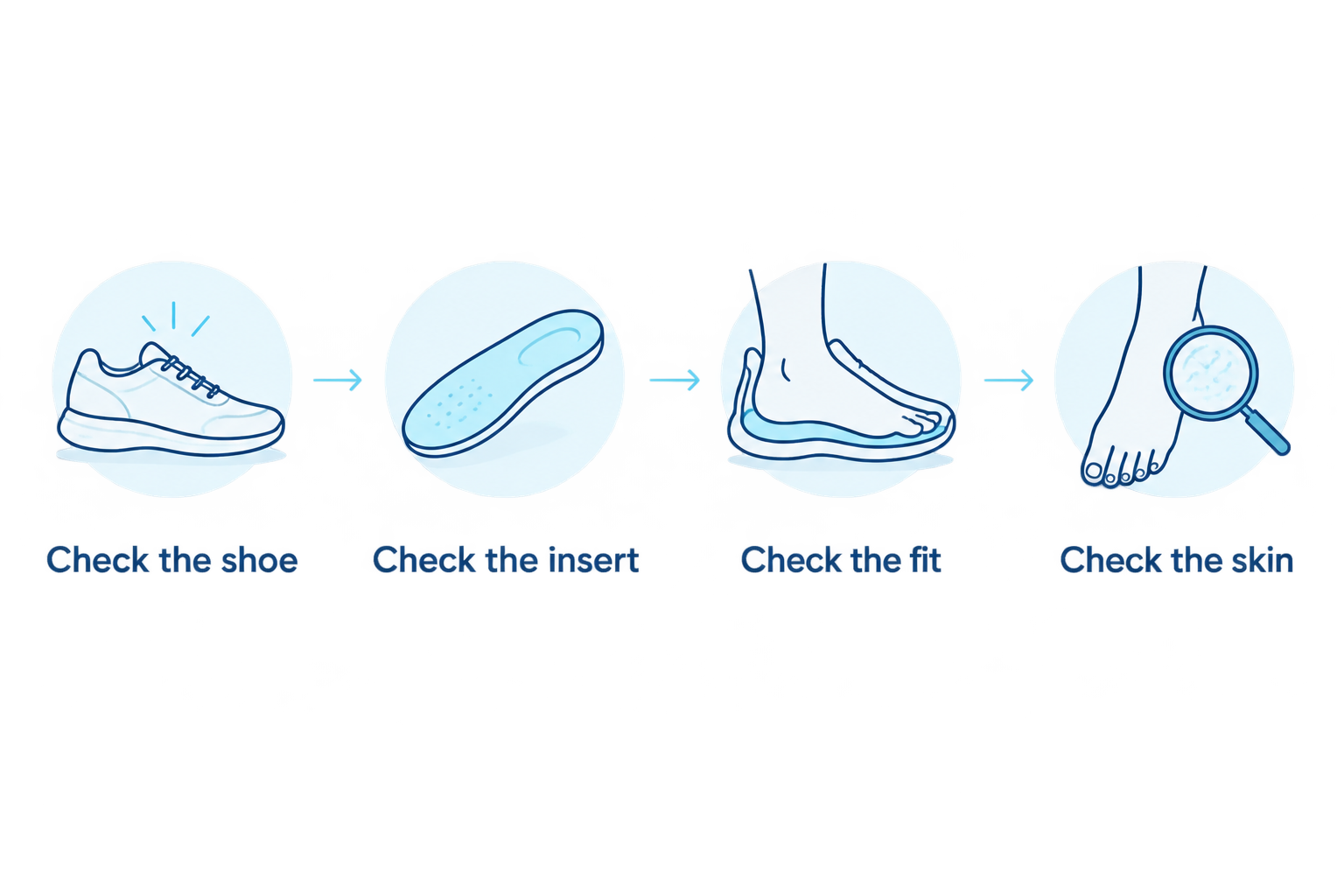
Use this fitting sequence when choosing or replacing insoles in 2026. If you have neuropathy, poor circulation, a previous ulcer, or a significant deformity, have the fit checked professionally rather than relying on a home trial.
- Check the shoe. Bring the shoes you intend to wear and your usual socks. Ask whether the existing liner should be removed; do not automatically stack inserts.
- Check the insert. It should sit flat without curling, bunching, or sliding. Keep trimming within the manufacturer's instructions; leave prescribed modifications to your care team.
- Check the fit. Confirm toe room, heel security, and the absence of pressure across the top of the foot. Check both feet because their fit can differ.
- Check the skin. Inspect after removing your shoes. New redness, blisters, broken skin, or a warm swollen area means the fit needs attention.
Do not keep wearing an insert through rubbing to “break it in.” A prescribed wearing schedule does not override a new skin problem, and numbness makes visual checks especially important.
When an evaluation comes before shopping
Achilles Foot and Ankle Center is a fit for patients who need diabetic foot care before choosing insoles. Bring your current shoes, inserts, and a description of any rubbing or skin changes to the evaluation.
Established diabetes guidance recommends at least 1 comprehensive foot evaluation per year. Clinicians commonly use a 10-gram monofilament, a small flexible testing tool, alongside other examination methods to assess protective sensation. At home, make 1 visual foot check per day part of your routine; your clinician can recommend closer monitoring based on risk.
For your 2026 visit, explain any previous wounds, numbness, changes in foot shape, or trouble seeing the bottoms of your feet. Achilles Foot and Ankle Center serves patients in the Richmond area; patients in Mechanicsville and West End should seek the same risk-based assessment rather than choose inserts by comfort alone.
Contact a clinician promptly for a new blister, cut, drainage, or broken skin. A newly warm, red, swollen foot needs prompt assessment even without pain; seek urgent care for spreading redness, fever, blackened skin, or a suddenly cold or discolored foot.
Arrange a diabetic foot evaluation
Discuss sensation, skin changes, and whether your shoes and inserts fit your foot-care needs.
How these recommendations are ranked
This 2026 guide prioritizes pressure accommodation, shoe fit, skin protection, and suitability for different foot risks. It compares insert types rather than claiming that a particular retail product works best for every patient.
The order is a decision path, not evidence that custom devices outperform every ready-made insert. Higher-risk feet need individualized assessment; lower-risk feet do not automatically need the most customized option.
Which diabetic shoe insoles should you choose?
Choose the least complicated insert that meets your assessed pressure and protection needs. Start with professionally fitted custom accommodation when your foot history requires it; consider ready-made cushioning only when your risk and shoe fit allow it.
For your 2026 decision, resolve numbness, recurring calluses, deformity, or prior wounds before selecting an insert. Achilles Foot and Ankle Center can evaluate diabetic foot concerns so your next step is based on your feet, not packaging claims.
FAQ
What’s the best insole for diabetic shoes?
The best insole matches your foot risk, shape, and shoe fit. Custom accommodative inserts suit individualized pressure-relief needs, while some lower-risk feet can use properly fitted prefabricated cushioning.
Are custom diabetic insoles better than store-bought inserts?
Custom diabetic insoles are not automatically better for everyone. They are useful when a clinician identifies pressure or shape needs that a ready-made insert does not adequately address.
Can I put diabetic insoles in regular shoes?
Only if the shoes provide sufficient depth, width, and secure fit with the inserts in place. A thick insert can crowd an otherwise comfortable shoe, so check the combination rather than the insert alone.
Should diabetic insoles feel soft or firm?
Softness or firmness alone does not determine whether an insert is suitable. The insert needs to distribute pressure appropriately without creating rubbing, unstable footing, or crowding.
Can insoles cure diabetic neuropathy?
Insoles do not cure diabetic neuropathy or restore lost sensation. Appropriate footwear can help protect vulnerable feet, but numbness still needs medical assessment and daily skin checks.
How do I know when my diabetic insoles need replacing?
Have inserts checked when they become compressed, cracked, curled, uneven, or no longer fit securely. New calluses, rubbing, or skin changes also call for reassessment rather than waiting for a fixed replacement date.
Can I use an insole over a diabetic foot ulcer?
Do not self-treat a diabetic foot ulcer with a retail insole. An ulcer needs prompt clinical assessment and a wound-specific plan to reduce pressure; ordinary inserts are not a substitute.
One last thing
Your foot can be under harmful pressure without hurting. Before your next shoe purchase, remove your current inserts and look for flattened areas, curled edges, or debris—then show anything concerning to your clinician rather than modifying a prescribed device yourself.
Related guides
- How often should people with diabetes check their feet?
- Diabetic socks for neuropathy
- When is a diabetic foot ulcer an emergency?