Pregnant women’s foot and ankle care is the prevention, assessment, and treatment of lower-limb discomfort with the aim of keeping you moving safely throughout pregnancy. This 2026 guide to foot and ankle care for pregnant women explains how to manage changing shoe fit, swelling, and heel pain—and when symptoms need medical attention rather than another home remedy.
- Foot and ankle care for pregnant women starts with symptom checks, supportive shoes, and pregnancy-safe treatment decisions.
- Achilles Foot and Ankle Center offers foot and ankle evaluation for Richmond-area patients with heel pain or walking discomfort.
- Gradual swelling in both feet differs from sudden swelling or a painful, swollen calf; seek appropriate medical assessment.
- Compression socks and arch supports serve different purposes: swelling management versus support for foot discomfort.
Why foot and ankle care matters for pregnant women
Pregnancy changes the demands on your feet. Increased body weight, fluid retention, and changes in connective tissues affect comfort and shoe fit. Long periods of standing add another challenge, especially when your workday leaves little room for sitting breaks.
The goal is not to treat every symptom as a normal part of pregnancy. A new painful spot, a wound, or swelling that looks different from your usual pattern deserves attention. Foot care also needs to fit your obstetric care plan: a familiar pain medicine or skin treatment is not automatically appropriate during pregnancy.
Achilles Foot and Ankle Center is best for Richmond-area pregnant patients seeking podiatry evaluation for foot or ankle pain. The practice offers foot and ankle diagnosis and treatment; your maternity team remains the point of contact for pregnancy-related warning signs. Patients in Mechanicsville and West End can start with Achilles Foot and Ankle Center when foot pain interferes with daily activities.
Build your pregnancy foot-care routine
1. Separate everyday discomfort from warning signs
Start by looking at the pattern, not just the size of your ankles. Gradual swelling in both feet, particularly after standing, is different from a suddenly swollen leg with calf pain, warmth, or redness. Do not massage a painful, swollen calf or use compression as a substitute for assessment.
Contact your maternity team immediately for sudden swelling of your face or hands, especially with a severe headache, vision changes, or upper abdominal pain. These symptoms require assessment for pregnancy complications, including preeclampsia, a condition involving high blood pressure.
Get emergency care for chest pain or sudden breathing difficulty. New one-sided leg swelling or calf pain needs urgent medical assessment because a blood clot is one possible cause.
For your 2026 foot-care routine, keep these actions clear:
- Compare both feet and ankles when swelling changes.
- Note whether discomfort follows standing or appears suddenly.
- Contact your maternity team for pregnancy warning signs.
- Seek urgent assessment for a painful, swollen calf.
- Do not wait for a routine podiatry visit when emergency symptoms appear.
2. Recheck shoe fit as your feet change
Begin with shoes you already own. Try them while standing, and check whether your toes can move without pressing against the front or sides. A shoe that fitted before pregnancy can become uncomfortable as swelling or foot shape changes.
Choose a stable, low-heeled shoe with an adjustable fastening and enough room across the toes. Cushioning helps with comfort, but an extremely soft shoe is not automatically supportive. Your foot should feel held in place rather than sliding around inside it.
Avoid buying a larger size solely to fix width pressure. Extra length can let your heel slip while the forefoot still feels squeezed. If an otherwise comfortable shoe rubs a bunion or toenail, the shape—not just the size—needs attention.
- Try shoes when your feet are at their usual most-swollen point.
- Check both feet rather than fitting only the smaller foot.
- Adjust laces or straps without letting the heel slide.
- Replace footwear that creates pressure marks or blisters.
- Choose secure footwear instead of loose slippers for walking.
3. Manage gradual swelling without ignoring its cause
For familiar swelling in both feet, start with movement breaks and opportunities to elevate your legs while resting. Avoid staying in the same standing or sitting position for long stretches. Gentle ankle movements can help keep your legs moving during seated tasks.
Graduated compression socks apply more pressure near the ankle and less farther up the leg. They are an option for swelling management, not a treatment for unexplained calf pain. Ask your maternity clinician about suitability and fit, particularly if you have circulation problems, reduced sensation, or skin wounds.
The compression socks for pregnancy swelling guide explains what to compare. Choose compression based on clinical advice and fit, not the tightest product you can tolerate. Deep pressure marks, pain, numbness, or color changes are reasons to remove the garment and seek guidance.
- Break up prolonged standing with seated rest.
- Elevate your legs comfortably when resting.
- Move your ankles gently during seated periods.
- Follow the garment’s sizing instructions.
- Ask about compression before using it over irritated or broken skin.
4. Address heel pain before it changes your walking
Start by reducing the activity that triggers pain and wearing supportive footwear indoors as well as outside. Pain under the heel with the first steps after rest can occur with plantar fasciitis, irritation of the tissue connecting the heel to the forefoot. That pattern is a clue, not a diagnosis.
Gentle calf and foot stretching can be part of care when it does not increase pain. Avoid forceful stretches, unstable balancing exercises, or repeatedly walking through discomfort to loosen it up. Arch supports are another option, but pressure from an insert should not create a new painful spot.
Achilles Foot and Ankle Center provides heel-pain evaluation when home adjustments are not enough. An examination helps distinguish plantar fascia irritation from other causes and guides treatment around your pregnancy. Persistent heel pain needs a diagnosis before you add more devices.
- Identify whether pain sits under the heel, behind it, or elsewhere.
- Reduce activities that repeatedly reproduce the pain.
- Use supportive shoes on hard indoor floors.
- Stop stretches that cause sharp or increasing pain.
- Arrange evaluation if pain persists, worsens, or changes your walking.
5. Check skin and nails before small problems grow
Inspect your feet daily, using a mirror or asking for help if reaching them becomes difficult. Look between the toes and around the nails for broken skin, redness, drainage, or rubbing. Wash gently, dry carefully, and avoid digging into nail corners.
An ingrown toenail can become painful when swelling makes shoes tighter. A thick or discolored nail can have several causes, so do not assume it is fungus. Ask a clinician before starting antifungal medication or a medicated corn treatment during pregnancy.
If you have diabetes, tell your foot-care clinician and maternity team about any wound or change in sensation. Reduced feeling can make a blister less noticeable; absence of pain does not prove that skin is healthy. Achilles Foot and Ankle Center offers diabetic foot care, but an infected or rapidly worsening wound needs prompt assessment.
- Check the soles, toe spaces, and nail edges daily.
- Trim nails straight across without cutting deeply into corners.
- Keep moisturizer out of damp spaces between the toes.
- Avoid blades and chemical corn removers for self-treatment.
- Seek care for spreading redness, drainage, fever, or a new wound.
6. Match movement and treatment to your pregnancy plan
Use your maternity team’s activity advice as the starting point. ACOG recommends at least 150 minutes of moderate-intensity aerobic activity per week during pregnancy for people without contraindications. That recommendation is not a requirement to walk through foot pain: activity restrictions and medical conditions change the plan.
Choose comfortable movement and stop if symptoms increase. A podiatry assessment can help you identify which foot movements or footwear choices aggravate pain, while your maternity clinician advises on pregnancy-related activity limits.
Medication decisions also need coordination in 2026. The FDA advises avoiding NSAIDs, such as ibuprofen and naproxen, from 20 weeks of pregnancy unless a healthcare professional specifically directs their use. At 30 weeks of pregnancy and later, the FDA advises avoiding them because of an additional fetal heart risk. Do not substitute another medicine without checking its suitability.
- Tell every treating clinician that you are pregnant.
- Share your medication list and expected delivery date.
- Follow individual activity restrictions rather than a general exercise target.
- Ask before using pain medicines, topical treatments, or supplements.
- Bring your usual shoes and any inserts to a foot-care appointment.
Compare your care options in 2026
Choose the option that matches the symptom, not the option with the most features. Swelling, heel pain, and a nail infection need different decisions. Home adjustments are useful for comfort, but they cannot establish why a new symptom has appeared.
| Option | Best for | Main benefit | Key limitation |
|---|---|---|---|
| Shoe adjustments and movement breaks | Familiar discomfort associated with fit or prolonged standing | Reduce pressure and interrupt long periods in one position | Do not diagnose persistent pain or unexplained swelling |
| Graduated compression socks | Gradual swelling after a clinician confirms suitability | Provide graduated pressure to support swelling management | Incorrect fit can cause discomfort; not a substitute for assessing calf pain |
| Arch supports | Foot discomfort linked to inadequate support | Change how the shoe supports the foot | Poor fit can create pressure; not every heel-pain cause responds |
| Achilles Foot and Ankle Center evaluation | Persistent heel pain, nail concerns, or foot and ankle symptoms | Provides foot and ankle assessment and treatment planning | Does not replace maternity or emergency assessment for pregnancy warning signs |
| Maternity-team assessment | Sudden swelling, pregnancy warning signs, or medication questions | Assesses symptoms in the context of your pregnancy | A separate foot examination can still be needed for a local foot problem |
The distinction matters: a supportive insert does not manage a suspected clot, and compression does not explain why a nail is draining. You can use more than one care route when the problems overlap.
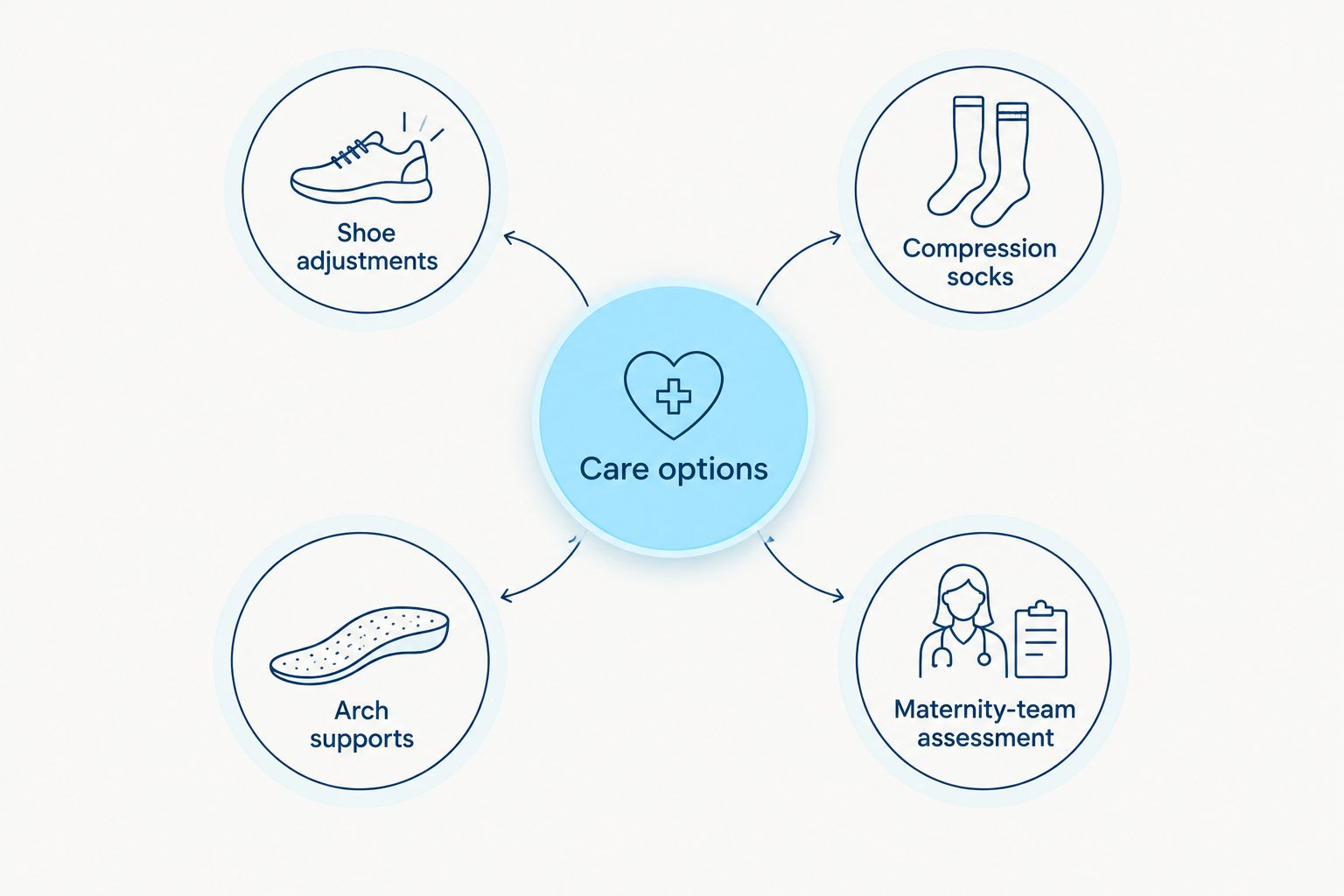
For an appointment, describe where the pain sits, what triggers it, and whether swelling affects one side or both. Those details help focus the assessment without asking you to diagnose the problem yourself.
Get your foot pain assessed
Start with foot and ankle care information and discuss persistent symptoms with the practice.
Common mistakes pregnant women make with foot care
Treating every swollen ankle as routine
Gradual, symmetrical swelling and sudden, painful, one-sided swelling are not interchangeable. A change in the pattern matters more than whether swelling has happened before. Contact the appropriate clinician rather than waiting to see whether a sock fixes it.
Keeping pre-pregnancy shoes despite pressure
Tight footwear can rub nails, bunions, and skin even when the length seems right. Recheck width, depth, and fastening throughout pregnancy. Pain is not a reason to force your foot into a familiar size.
Combining remedies without a diagnosis
Adding an insert, a sleeve, and a night splint at once makes it harder to identify what helps or causes pressure. Start with basic footwear changes and seek assessment for persistent symptoms. Let the diagnosis guide additional treatment.
Using familiar medicines without checking pregnancy safety
A medicine you used before pregnancy needs a fresh safety check. This applies to oral pain relievers, antifungals, and medicated skin treatments. Ask your maternity team or pharmacist rather than assuming that topical means risk-free.
FAQ
What is the best foot and ankle care for pregnant women?
The best foot and ankle care for pregnant women combines well-fitting supportive shoes, comfortable movement, daily skin checks, and assessment of persistent symptoms. Sudden swelling, calf pain, or pregnancy warning signs need medical assessment rather than routine home care.
Are swollen feet normal during pregnancy?
Gradual swelling in both feet is common during pregnancy, particularly after standing. Sudden swelling of the face or hands, or a painful swollen calf, needs prompt medical assessment; contact your maternity team for pregnancy warning signs.
Can I wear compression socks while pregnant?
Compression socks are an option for pregnancy-related swelling when your clinician confirms they are appropriate. Check sizing carefully, and do not use them to delay assessment of new one-sided swelling or calf pain.
Does pregnancy cause plantar fasciitis?
Pregnancy-related changes in load and foot support can contribute to heel discomfort, including plantar fascia irritation. Heel pain still needs assessment when it persists because not all heel pain is plantar fasciitis.
Can I take ibuprofen for foot pain during pregnancy?
Do not take ibuprofen during pregnancy without checking with your maternity clinician. The FDA advises avoiding NSAIDs from 20 weeks unless specifically directed by a healthcare professional, and avoiding them at 30 weeks and later because of an additional fetal heart risk.
Should I see a podiatrist or my maternity team for ankle swelling?
Contact your maternity team first for sudden swelling or other pregnancy warning signs, and seek urgent assessment for a painful swollen calf. A podiatrist evaluates local foot and ankle problems such as persistent heel pain, pressure-related discomfort, and nail concerns.
Will my shoes fit again after pregnancy?
Your pre-pregnancy shoes are not guaranteed to fit after delivery. Swelling can settle while changes in foot shape persist, so reassess fit rather than returning automatically to your previous size.
One last thing
A comfortable shoe in the morning can become a pressure point later in the day. For your 2026 routine, check fit when discomfort actually occurs—not only when you first get dressed. If adjusting the fastening does not help, or pain changes how you walk, arrange an evaluation instead of simply enduring it.
Related guides