No—Morton’s neuroma surgery is not automatically necessary; treatment usually starts with reducing pressure on the irritated nerve through footwear changes, padding, and other nonsurgical care. Surgery becomes a consideration when a confirmed neuroma continues to cause pain that limits daily life despite appropriate treatment. If you are weighing surgery in 2026, the key trade-off is potential pain relief versus risks that include lasting numbness, persistent pain, and surgical complications.
- Is Mortons neuroma surgery necessary? Not automatically; persistent symptoms after appropriate nonsurgical care are the main reason to consider it.
- Wide toe boxes and correctly placed metatarsal pads reduce pressure; they do not remove the affected nerve.
- Nerve removal causes lasting numbness in the area supplied by that nerve; pain relief is not guaranteed.
- Achilles Foot and Ankle Center provides foot and ankle evaluation for patients deciding what to do about nerve pain.
Why this matters
Burning pain in the ball of your foot can make ordinary walking uncomfortable. But pain intensity alone does not establish that surgery is the right treatment—or even that a neuroma is the cause.
Achilles Foot and Ankle Center is best suited to patients seeking a foot and ankle evaluation before deciding about surgery. An evaluation at Achilles Foot and Ankle Center offers a way to discuss the diagnosis and treatment choices; it does not commit you to a procedure.
Is Morton’s neuroma surgery necessary?
Morton’s neuroma surgery is generally considered after nonsurgical treatment has not provided adequate relief. The decision depends on whether the diagnosis fits your symptoms, what you have already tried, and how much pain disrupts your life.
The comparison below outlines treatment choices to discuss in 2026. “Best for” describes the purpose of each approach, not a personalized recommendation.
| Approach | Best for | Main benefit | Main limitation or risk |
|---|---|---|---|
| Wider shoes and lower heels | Symptoms aggravated by forefoot squeezing | Reduces pressure without a procedure | Does not remove thickened tissue around the nerve |
| Metatarsal padding or orthoses | Redistributing pressure under the forefoot | Changes how pressure loads the painful area | Incorrect placement or fit can worsen discomfort |
| Corticosteroid injection | Selected patients needing additional symptom relief | Can reduce inflammation and pain | Relief is not guaranteed; skin and fat-pad changes are possible |
| Surgical decompression | Selected patients considering a nerve-preserving operation | Releases tissue pressing on the nerve | Symptoms can persist; surgical risks remain |
| Surgical nerve removal | Persistent, limiting pain after appropriate nonsurgical care | Removes the affected segment of nerve | Causes lasting numbness in its sensory distribution; painful nerve regrowth can occur |
These treatments are not interchangeable. A clinician should explain why a particular option fits your examination rather than simply moving down a list.
What needs confirming before treatment?
A Morton’s neuroma involves thickening around a nerve supplying the toes, commonly in the space between the third and fourth toes. Symptoms can include burning, tingling, numbness, or the feeling that a pebble is trapped under your forefoot.
Other problems can cause similar pain, including a stress injury, inflammation around a toe joint, or a plantar plate injury—the tissue injury beneath a toe joint. An examination helps distinguish these conditions; imaging is used when it helps answer a specific diagnostic question.
Nonsurgical treatment: reduce pressure before choosing an operation
Start by identifying what squeezes or loads the painful area. Narrow toe boxes and elevated heels increase pressure through the forefoot, so a roomier shoe with a lower heel is a practical change to discuss.
A metatarsal pad sits behind the painful area rather than directly beneath it. Placement matters: the purpose is to redistribute pressure, not create a new pressure point under the sore spot.
- Shoe fit: Leave enough room across the toes without allowing the foot to slide excessively.
- Padding: Have pad position checked if adding a pad increases pain.
- Activity adjustment: Reduce activities that repeatedly trigger burning or sharp forefoot pain while the cause is assessed.
- Orthoses: Discuss an insert when your foot mechanics or pressure pattern make additional support appropriate.
Do not judge all nonsurgical care by one unsuccessful shoe or insert. An ill-fitting device is different from a treatment plan matched to the location and cause of your pain.
Where injections fit
A corticosteroid injection is an option for selected patients when pressure reduction alone is insufficient. It aims to reduce inflammation and symptoms; it does not remove the affected nerve.
Discuss the expected benefit and risks before proceeding. Potential adverse effects include skin color changes, thinning of the cushioning fat beneath the foot, and infection; repeated injections require particular care.
Surgical decompression: preserve the nerve while releasing pressure
Decompression releases tissue that presses on the nerve rather than removing the nerve itself. Its main appeal is a nerve-preserving approach, but preserving the nerve does not guarantee that pain will resolve.
Best for: Selected patients whose diagnosis and anatomy support a decompression procedure. Ask why decompression is appropriate for your particular symptoms and what happens if the operation does not provide enough relief.
Decompression still involves an incision, wound healing, and the possibility of scar-related discomfort or infection. Do not assume that a nerve-preserving operation has no recovery demands or no risk of altered sensation.
Surgical nerve removal: understand the numbness trade-off
Nerve removal, also called neurectomy, removes the affected portion of the nerve. Because that nerve carries sensation, lasting numbness in the area it supplies is an expected consequence—not simply a temporary effect of anesthesia.
Best for: Patients with a well-supported diagnosis and persistent, limiting symptoms despite appropriate nonsurgical treatment. The decision should include a clear discussion of where numbness is expected and whether that trade-off is acceptable to you.
Pain can persist after surgery. A cut nerve can also develop a painful stump neuroma, meaning sensitive nerve tissue at the cut end; this is one reason an operation cannot promise a cure.
Why the need for Morton’s neuroma surgery varies
A diagnosis does not come with a single surgical deadline. These factors change the discussion:
- Diagnostic certainty: A procedure aimed at a neuroma does not address pain caused by a different condition.
- Daily limitations: Pain that prevents routine walking or required work activities carries different consequences from occasional discomfort in a particular shoe.
- Response to treatment: Meaningful improvement with pressure reduction supports continuing an effective nonsurgical approach.
- Quality of the treatment trial: Correctly fitted shoes and properly positioned padding matter when judging whether conservative care has failed.
- Health and healing risks: Diabetes, circulation problems, smoking, and other health factors need consideration before an operation.
- Your preferences: Tolerance for numbness, recovery restrictions, and uncertainty about pain relief should shape the decision.
Persistent pain is a reason to reassess the plan, not an automatic instruction to operate. That reassessment includes checking the diagnosis and whether earlier treatment actually addressed the painful pressure pattern.
How should you decide about surgery in 2026?
Use a structured conversation rather than deciding from an imaging report or symptom description alone. Bring the shoes and inserts you use most often, along with notes about previous treatment.
- Confirm the diagnosis. Ask which examination findings support Morton’s neuroma and whether another problem needs investigation.
- Review prior care. Explain what changed, what helped, and what made symptoms worse. Include injections and any previous foot procedures.
- Compare procedures. Ask whether the proposed operation releases pressure or removes nerve tissue, and why that distinction matters for you.
- Plan recovery. Discuss weight-bearing instructions, wound care, driving, footwear, work demands, and return to activity.
- Set expectations. Ask what improvement the operation aims to achieve, what numbness to expect, and how persistent pain would be evaluated.
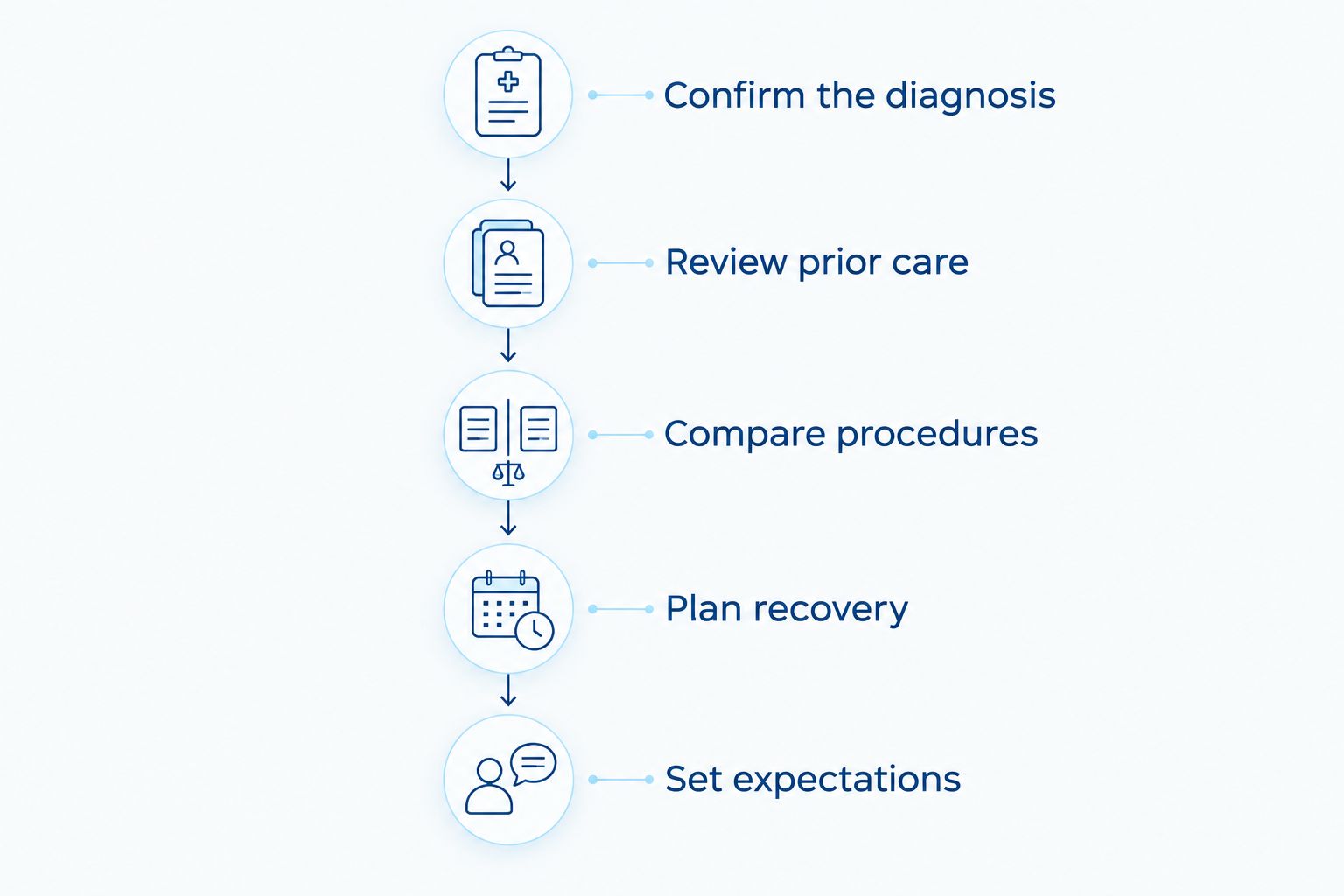
A useful consultation ends with a plan you can explain in your own words. You should know what you are treating, why the next step fits, and what would prompt a change in direction.
For patients in Mechanicsville and the West End, Achilles Foot and Ankle Center provides podiatry care for nerve pain and other foot and ankle concerns. Use the contact page to request an evaluation and discuss your symptoms.
Can Morton’s neuroma improve without surgery?
Yes—Morton’s neuroma symptoms can improve without surgery, particularly when reducing pressure controls the irritation. Improvement means you can function more comfortably; it does not necessarily mean the thickened tissue has disappeared.
Keep the measures that help and arrange reassessment if pain returns or changes. Increasing numbness, a different pain location, or new swelling deserves a fresh look rather than an assumption that the same diagnosis explains everything.
Does numbness mean I need surgery?
No—numbness alone does not establish a need for Morton’s neuroma surgery. The location, pattern, associated pain, and examination findings matter.
Numbness across both feet or extending beyond a small forefoot area can have causes other than a localized neuroma. Tell your clinician about diabetes, back symptoms, balance changes, or numbness elsewhere so the evaluation addresses the full pattern.
How long should I try nonsurgical treatment?
There is no single treatment duration that makes Morton’s neuroma surgery necessary. Your clinician should set a reassessment plan based on symptom severity, the treatments used, and whether function is improving.
Do not continue a painful device simply to complete an arbitrary trial. Equally, partial improvement deserves discussion before you abandon a treatment that is helping.
What recovery questions matter before an operation?
Before scheduling Morton’s neuroma surgery in 2026, explain your real daily demands. Standing at work, climbing stairs, caring for someone, and driving place different demands on recovery.
Ask for instructions specific to the procedure and incision location. Weight-bearing and shoe restrictions differ, so another person’s recovery story is not a substitute for your surgical plan.
Make sure you know whom to contact about worsening redness, drainage, fever, or escalating pain after surgery. Recovery planning also includes discussing how diabetes, reduced sensation, or circulation concerns affect foot protection and wound checks.
When should I seek prompt care instead of waiting?
Do not assume that a hot, swollen, discolored foot or an open wound is a Morton’s neuroma flare. Seek prompt medical assessment for these changes, especially if you have diabetes or reduced sensation.
A suddenly cold or pale foot, rapidly worsening pain, or a wound with spreading redness needs urgent assessment. These findings require attention to problems beyond a localized irritated nerve.
FAQ
Is Morton’s neuroma surgery necessary in 2026?
No—Morton’s neuroma surgery is not automatically necessary in 2026. It is generally considered when a confirmed neuroma continues to cause limiting symptoms despite appropriate nonsurgical care.
What is the best first step for Morton’s neuroma pain?
The best first step is an evaluation to confirm the cause of your forefoot pain. Roomier shoes and pressure reduction are common initial measures when the diagnosis fits.
Can I keep walking with Morton’s neuroma?
Walking should be adjusted if it repeatedly triggers pain. Discuss footwear, padding, and activity changes rather than repeatedly pushing through burning or sharp forefoot symptoms.
Will Morton’s neuroma surgery leave my toes numb?
Removing the affected nerve causes lasting numbness in the area supplied by that nerve. Ask the surgeon to explain the expected sensory change for the proposed procedure.
Is decompression better than removing the nerve?
Neither operation is automatically better for every patient. Decompression preserves the nerve, while removal has an expected numbness trade-off; both require discussion of persistent pain and surgical risks.
Can Morton’s neuroma pain return after surgery?
Yes—pain can persist or return after surgery. Possible explanations include scar-related discomfort, a painful stump neuroma, or another source of forefoot pain that needs reassessment.
Should I get a second opinion before Morton’s neuroma surgery?
A second opinion is reasonable if the diagnosis, alternatives, or expected outcome remain unclear. Bring records of previous treatment and ask how the proposed operation addresses your specific symptoms.
One last thing
The most useful question is not just whether you need surgery—it is what problem the proposed operation will fix. Before agreeing to a procedure in 2026, ask your clinician to connect the diagnosis, examination findings, and treatment choice in plain language. An explanation you understand helps you make a decision that fits your health and daily life.
Related guides
- Is neuropathy in feet reversible?
- Can bunions be treated without surgery?
- Foot X-ray to diagnosis: the podiatry workflow