No—do not try to cut out an ingrown toenail at home: digging beneath the skin or cutting away an embedded nail edge can cause bleeding, leave a sharp fragment, and increase infection risk. Gentle home care can ease mild irritation, but drainage, worsening pain, diabetes, poor circulation, or reduced feeling in your feet calls for a clinician’s assessment rather than self-removal.
- Is it safe to cut out an ingrown toenail at home? No—leave embedded nail removal to a clinician.
- Gentle soaking and roomy shoes can ease mild irritation; neither removes an embedded nail edge.
- Diabetes, poor circulation, numbness, drainage, or spreading redness make professional assessment especially important.
- Achilles Foot and Ankle Center offers foot and ankle care for Richmond-area patients who need an evaluation.
Why this matters
The painful corner you can see is not always the full problem. Cutting deeper can injure the skin beside the nail without removing the part pressing into it. A temporarily less painful toe does not prove that the problem is resolved.
This 2026 guide separates comfort measures from nail removal so you know what belongs at home and what needs an appointment. For the broader treatment pathway, see the guide to ingrown toenail home care and in-office procedures.
Is it safe to cut out an ingrown toenail at home?
No. Trimming a healthy nail’s free edge is different from cutting an edge that has grown into the surrounding skin. Once reaching the corner requires digging, pulling skin back, or cutting living tissue, stop.
Use this comparison to separate reasonable comfort measures from actions that need professional care.
| Approach | Best for | Benefit | Limitation or risk |
|---|---|---|---|
| Gentle home care | Mild irritation without infection signs or high-risk conditions | Reduces pressure and keeps the area clean | Does not reliably free an embedded nail |
| Routine straight-across trimming | Prevention when the nail edge is accessible and skin is intact | Avoids creating deeply rounded corners | Is not treatment for a buried edge |
| Podiatry assessment | Persistent, recurring, or worsening symptoms | Identifies the nail problem and appropriate treatment | Requires an examination; a procedure is not always necessary |
| Clinician-performed nail procedure | Selected cases with an embedded or recurring edge | Removes the offending nail portion when indicated | Creates a healing area that needs aftercare |
| Digging or cutting out the nail yourself | Not recommended | No dependable advantage over appropriate care | Can cause a wound, retained nail fragments, and infection |
You do not need to prove that home care has failed before asking for help. Pain that interferes with shoes, walking, work, or sleep is a reasonable reason to arrange an evaluation.
What can you safely do at home in 2026?
For mild tenderness without drainage, spreading redness, significant swelling, or a high-risk health condition, focus on comfort and protection. The goal is to reduce irritation, not perform a nail procedure.
If you have diabetes, poor circulation, reduced sensation, or a weakened immune system, contact your clinician before trying home treatment. Routine soaking and self-trimming are not appropriate substitutes for an assessment in these circumstances.
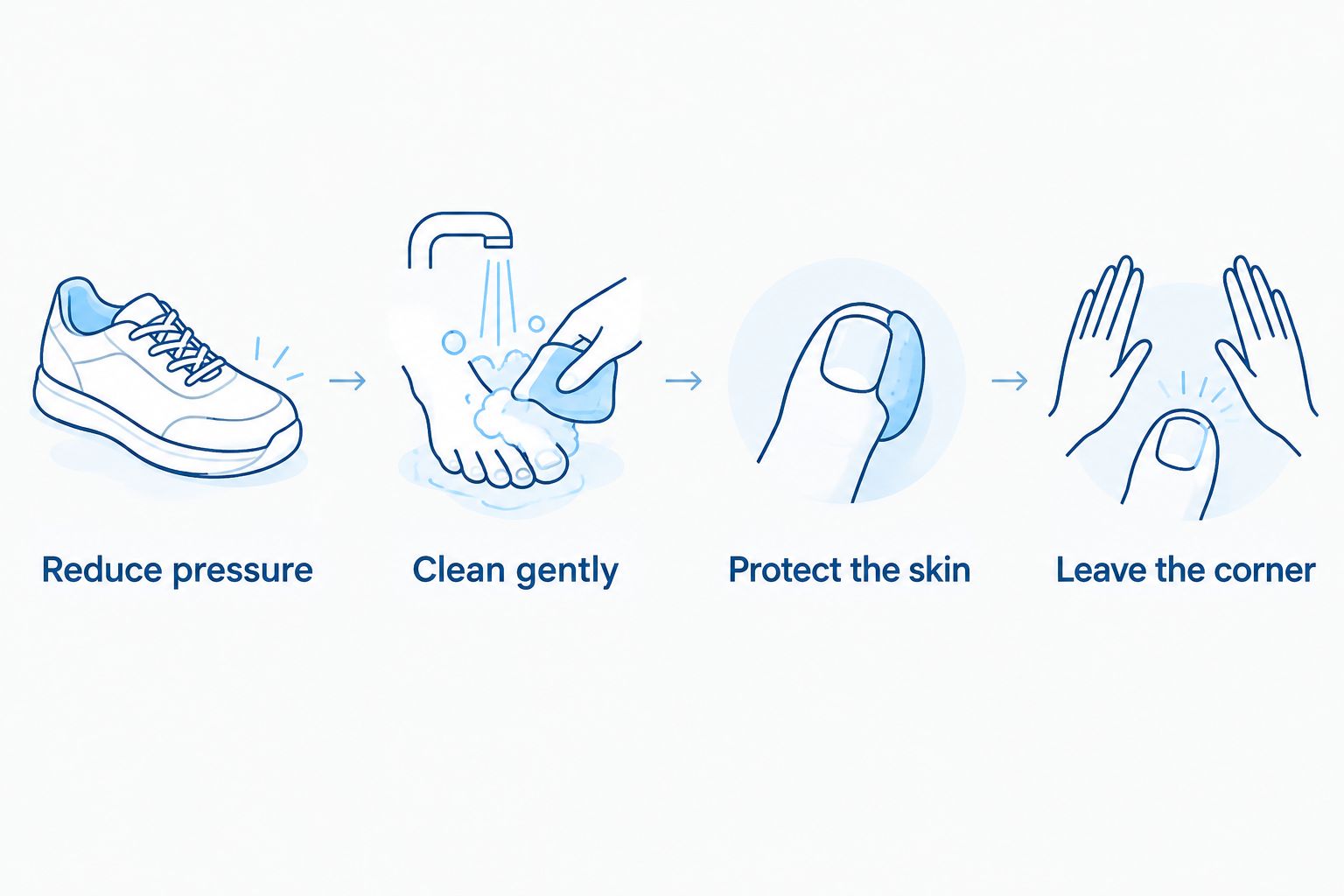
1. Reduce pressure
Choose footwear with enough room that it does not squeeze the sore toe. Pause activities that repeatedly push the toe against the front of your shoe.
Roomy footwear can reduce rubbing, but it cannot pull a buried nail edge out of the skin. If you still cannot walk comfortably, arrange care rather than simply switching shoes again.
2. Clean gently
For otherwise healthy adults with mild symptoms, a warm—not hot—water soak can soften the surrounding skin and ease discomfort. Mayo Clinic’s patient guidance describes soaking for 15–20 minutes, 3–4 times per day, followed by thorough drying.
Do not use soaking as a reason to delay care for worsening symptoms. Avoid soaking if you have diabetes or reduced sensation unless your clinician specifically recommends it; you might not recognize an unsafe water temperature or skin damage.
3. Protect the skin
Gently dry the toe after washing. If skin is broken, protect it with a clean, nonstick dressing and seek advice rather than repeatedly exposing it to shoe friction.
Change a dressing when it becomes wet or dirty. Avoid wrapping the toe tightly, and do not pour alcohol or hydrogen peroxide into the irritated area; these products can irritate healing tissue.
4. Leave the corner alone
Do not slide scissors, tweezers, a needle, or another pointed tool beneath the nail. Avoid pulling off a loose-looking strip if it remains attached.
Some clinical guidance includes lifting techniques for selected mild cases, but you should not force cotton or floss beneath an embedded, bleeding, or infected edge. Ask a clinician whether any lifting method is appropriate for your toe.
Why the risk of cutting out a nail varies
A small-looking nail problem does not carry the same risk for every person. The skin’s condition, your ability to feel an injury, and how well your foot heals all affect the next step.
- Depth of the nail edge: A corner buried beneath swollen skin is harder to reach without injuring surrounding tissue.
- Existing skin damage: Bleeding, drainage, or an open area means the skin barrier is already broken.
- Diabetes and circulation: Diabetes and reduced blood flow can complicate healing and increase the consequences of a foot wound.
- Reduced sensation: Nerve damage can make pain an unreliable measure of how much injury is present.
- Repeated episodes: A nail that repeatedly grows into the same side needs assessment of the underlying pattern, not repeated corner-cutting.
- Nail thickness or shape: A thick, curved, or difficult-to-trim nail can make controlled trimming harder.
The practical rule is simple: less pain does not always mean less risk, especially when your feet are numb. Do not use how much cutting you can tolerate as a safety test.
When should you seek medical care in 2026?
Contact a clinician promptly if the toe becomes increasingly painful, swollen, warm, or red, or if you notice pus or other drainage. Seek same-day advice for suspected infection, particularly if you have diabetes, poor circulation, or a weakened immune system.
Get urgent medical care for fever with a worsening toe infection, redness spreading up the foot, red streaks, or feeling significantly unwell. These signs need assessment beyond routine home nail care.
A foot wound does not need to look large to deserve attention. The guide explaining whether a foot wound can get infected quickly provides additional context, but do not wait to read more if symptoms are spreading.
Achilles Foot and Ankle Center is for Richmond-area patients who need a podiatry evaluation rather than home nail removal. Patients in Mechanicsville and the West End can use the same decision rule: persistent symptoms need an appointment; infection warning signs need prompt medical advice.
Arrange an evaluation for your toe
Discuss persistent nail pain, recurring irritation, or concerns about a foot wound.
What happens during a podiatry evaluation?
A clinician checks where the nail presses into the skin and looks for drainage, swelling, skin breakdown, and infection. Your history matters too, including diabetes, circulation problems, numbness, previous nail procedures, and whether the same corner keeps returning.
Not every ingrown toenail needs surgery. Depending on the examination, treatment can range from pressure relief and nail-care guidance to removing the offending nail portion.
When a procedure is appropriate, a clinician can use local anesthesia to numb the toe before removing the involved nail edge. For recurring cases, treatment of part of the nail’s growth area can help prevent that edge from returning; the clinician should explain the benefits, risks, and alternatives.
Procedures still involve aftercare. Ask about dressing changes, bathing, footwear, activity, and which symptoms should trigger a call. Healing varies, so use your clinician’s instructions rather than another person’s recovery timeline.
Does an ingrown toenail always need antibiotics?
An ingrown toenail does not automatically require antibiotics. Pressure and inflammation can cause redness and tenderness even when a spreading bacterial infection is not present.
Antibiotics do not remove a nail edge pressing into the skin. A clinician decides whether infection requires medication and whether the nail itself also needs treatment.
Do not use leftover antibiotics or assume an antibiotic ointment makes digging out the nail safe. If the toe is draining or worsening, arrange an assessment instead of repeatedly changing home products.
What if you already cut into the nail?
Stop cutting and protect the area. Gently wash the toe, apply steady direct pressure with clean gauze if it is bleeding, and cover broken skin with a clean, nonstick dressing.
Do not keep digging for a suspected fragment. Tell the clinician what you cut, whether you used any products, and when the pain, bleeding, or drainage began.
Seek urgent care if bleeding does not stop with direct pressure or the wound is deep. Diabetes, reduced circulation, numbness, or infection signs are reasons to seek prompt advice even when the cut looks minor.
How can you prevent another ingrown toenail?
For your 2026 nail-care routine, focus on trimming technique and pressure rather than cutting the corners progressively deeper. Trim accessible nails straight across, leave them long enough that the corners are not buried beneath the skin, and smooth a sharp free edge without digging into the sides.
Avoid tearing nails or cutting a V-shaped notch in the center. A notch does not redirect the sides of the nail away from the skin.
Check that shoes do not crowd your toes, especially during activities that repeatedly push your feet forward. If thick nails, limited vision, difficulty reaching your feet, or reduced sensation make trimming unsafe, ask about professional nail care.
For people with diabetes, CDC guidance recommends checking the feet at least once a day. Look for skin breaks, redness, swelling, and nail changes rather than relying on pain alone.
FAQ
Can I cut out an ingrown toenail if I sterilize the clippers?
No. Cleaning the clippers does not prevent tissue injury, a retained nail fragment, or problems caused by cutting beneath the skin. Leave an embedded edge to a clinician.
Can an ingrown toenail get better without cutting it out?
Mild irritation can settle with reduced pressure and gentle care, but a persistently embedded nail edge needs assessment. Do not continue home care if pain, swelling, redness, or drainage worsens.
Should I squeeze pus out of an ingrown toenail?
No. Do not squeeze, puncture, or try to drain the toe yourself. Pus warrants prompt medical advice, especially with diabetes, poor circulation, spreading redness, or fever.
Can I cut a V in my toenail to fix an ingrown edge?
No. Cutting a V in the center does not change the direction in which the nail edges grow. Avoid cutting the nail shorter to chase the painful corner.
What should I do about an ingrown toenail if I have diabetes?
Contact your foot-care clinician rather than cutting out the nail or starting a soaking routine yourself. Seek prompt assessment for broken skin, drainage, warmth, redness, or swelling, even if the toe does not hurt.
Will a podiatrist remove my whole toenail?
Not necessarily. Treatment depends on the examination, and some procedures remove only the involved nail edge. Ask why a particular treatment is recommended and what aftercare it requires.
Where can I get an ingrown toenail evaluated near Richmond?
Achilles Foot and Ankle Center provides foot and ankle care in the Richmond, Virginia area. Seek a podiatry evaluation for persistent or recurring nail pain; spreading infection signs require prompt medical attention.
One last thing
The nail itself has no nerves, but the skin beside and beneath it does. If reaching the painful corner requires cutting into that skin, you have crossed from grooming into creating a wound.
Make this your 2026 stopping rule: protect the toe, stop digging, and arrange an evaluation when symptoms persist or worsen. At Achilles Foot and Ankle Center, an evaluation is the appropriate next step—not a promise that every painful nail needs a procedure.
Related guides
- How often should people with diabetes check their feet?
- Toenail fungus: from unsuccessful OTC care to treatment evaluation
- Is neuropathy in the feet reversible?