

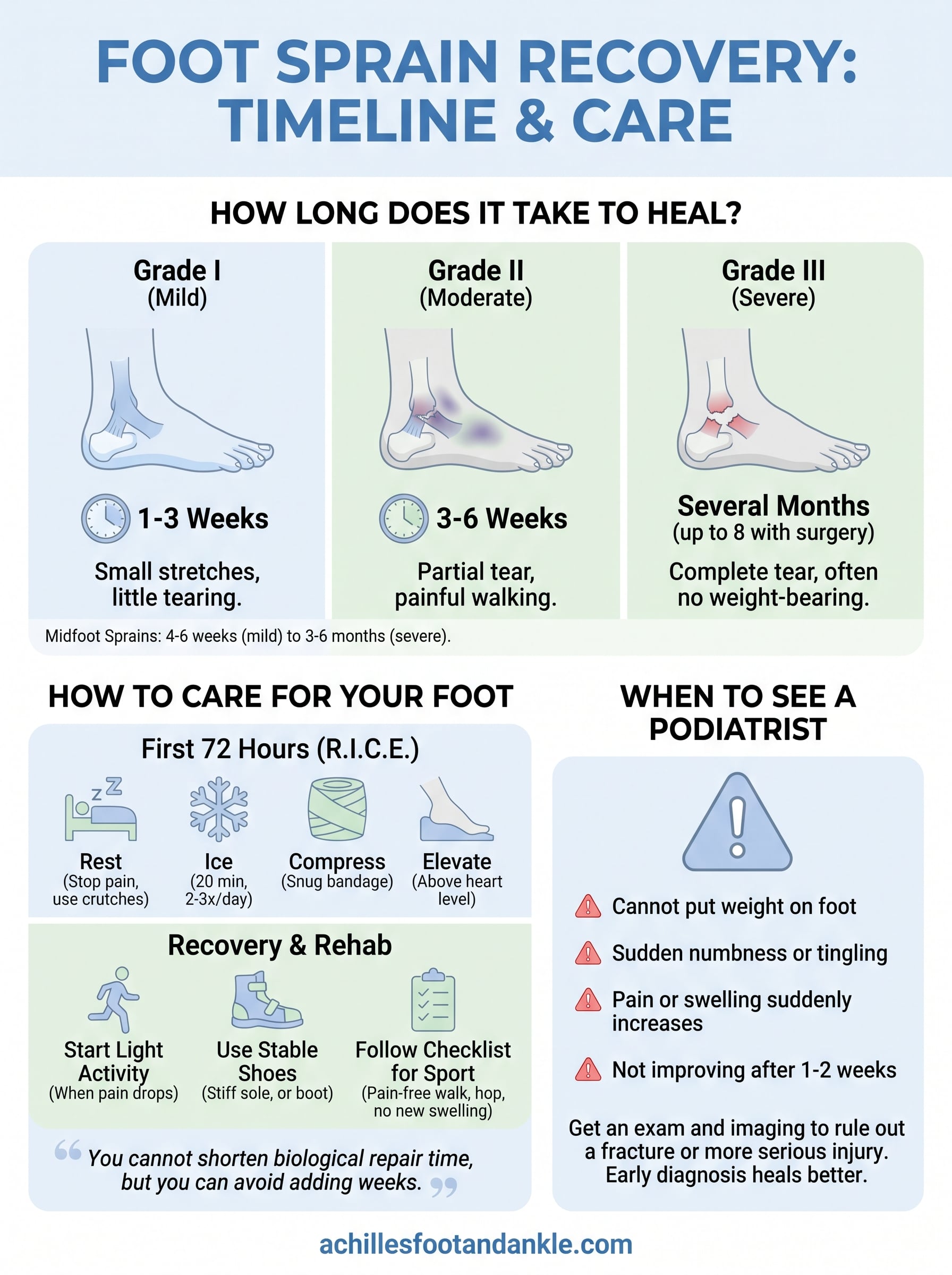
How long does a foot sprain take to heal? A mild (Grade I) sprain usually heals in 1 to 3 weeks, a moderate (Grade II) sprain in 3 to 6 weeks, and a severe (Grade III) sprain can take several months. A foot sprain is a stretch or tear in the ligaments, the tough bands that hold the many small bones of your foot together. The more of the ligament that tears, the longer the repair takes.
This article gives you the timeline for each grade, then explains why it matters, how to care for the foot, and what speeds up or slows recovery. It also shows when you can walk and return to sports, and which signs mean you need an exam. Where the answer differs for sprains on the top, side, or middle of the foot, we say so.
We treat these injuries at Achilles Foot & Ankle Center in the Richmond area, so the guidance is written for people who want a realistic plan instead of a guess. Use it to set expectations, and book a visit if your foot does not follow the timeline.
Why knowing your foot sprain timeline matters
Your timeline matters because it tells you how much load the foot can take at each stage. Loading it too early is how a three-week sprain turns into a three-month problem.
Recovery time by sprain grade
The grade of the sprain is the best single predictor of healing time. Sources overlap but do not match exactly, so the table below gives the ranges that most of them support.

| Grade | What happens to the ligament | Typical healing time |
|---|---|---|
| Grade I (mild) | Stretched, with small or microscopic tears | 1 to 3 weeks |
| Grade II (moderate) | Large or partial tears, with bruising and painful walking | 3 to 6 weeks, up to 6 to 8 weeks if you need a boot or cast |
| Grade III (severe) | Complete tear, often with no ability to bear weight | Several months, and 6 to 8 months if surgery is needed |
Midfoot sprains run slower. A mild one treated without surgery heals in about 4 to 6 weeks, a severe one needs at least 3 months, and a full return to running and jumping can take 3 to 6 months.
What rushing it costs you
Take a runner who rolls the foot on a trail and has a Grade II sprain. Walking feels normal somewhere between week 3 and week 6. Easy jogging is realistic around week 6 to 8 if progress is steady, and later if you wore a boot. That is a planning range, not a promise.
If you ignore that range, the usual result is re-injury of a ligament that is only partly healed. Repeated sprains stretch the ligament out and leave the foot or ankle feeling loose, which is why some people have recurring sprains for years. A longer, honest timeline now is the cheaper option.
Ligaments heal on their own schedule, and pain fades faster than the tissue repairs.
How to care for a sprained foot so it heals on schedule
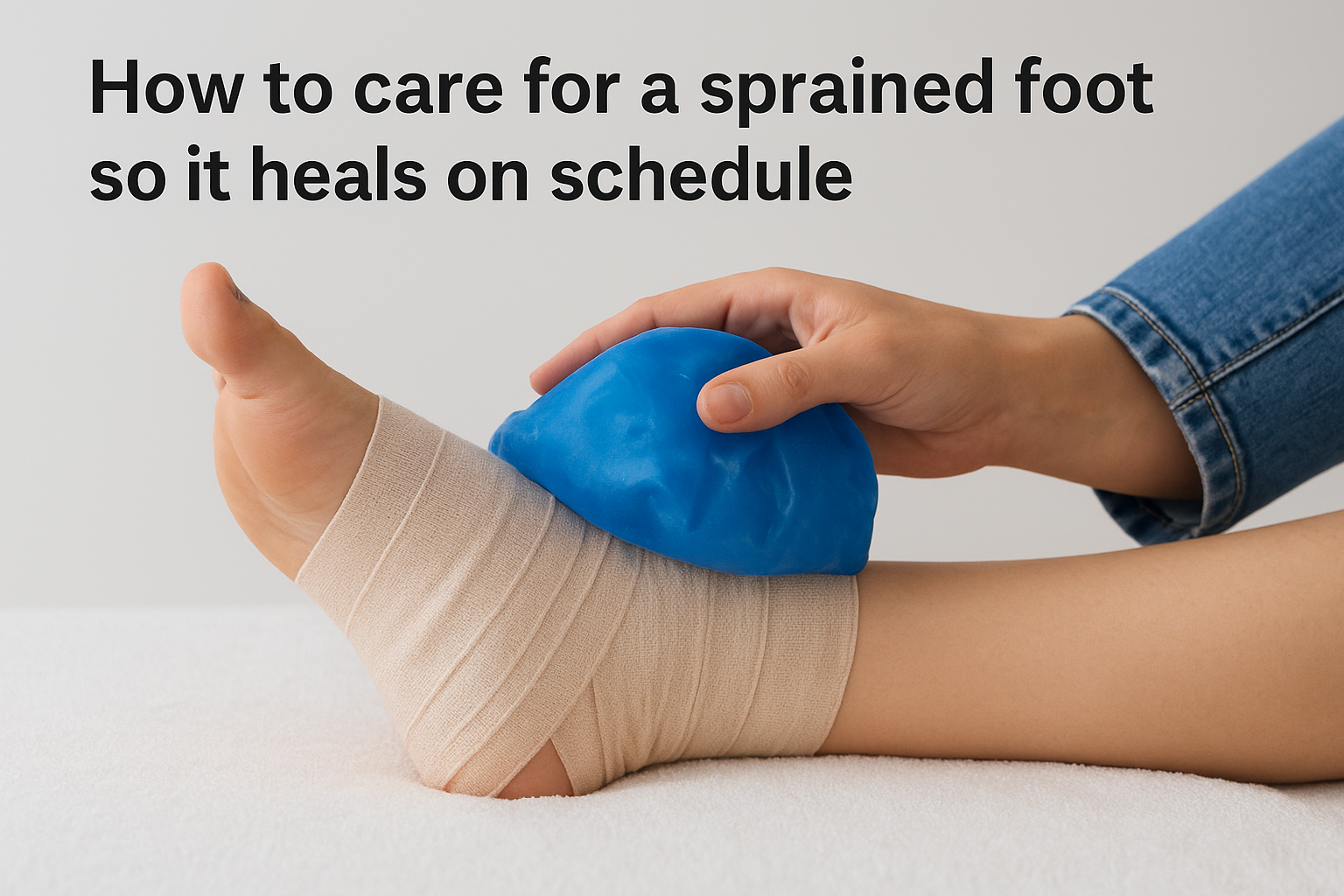
The best care is simple: protect the foot, control swelling, and add load gradually. You cannot shorten the biological repair time, but you can avoid adding weeks to it.
The first 72 hours
Follow the rest, ice, compression, and elevation routine for the first few days:
- Rest: stop any activity that causes pain and keep the foot still when you can. Use crutches if walking hurts.
- Ice: apply for about 20 minutes, 2 to 3 times a day, with a cloth or towel between the ice and your skin.
- Compression: wrap the foot with an elastic bandage, snug but not tight.
- Elevate: keep the foot raised, ideally above heart level, to limit swelling.
For pain, ibuprofen, naproxen, or acetaminophen from the store are common choices. Check with your provider first if you have heart disease, high blood pressure, kidney disease, or a history of stomach ulcers or internal bleeding. Never exceed the dose on the label.
Can you heal a sprained foot overnight?
No. Anyone promising to heal a sprained foot overnight or in two days is overselling. In 48 hours you can reduce swelling and pain by following the routine above strictly, but the ligament itself needs weeks.
The "fast" version of recovery is really the disciplined version. Rest early, keep swelling down, and do not test the foot with a run or a long walk to see if it is better.
Rehab and footwear
Once pain and swelling drop, start light activity and add a little each day. Some soreness and stiffness as you walk is normal and fades as the foot strengthens. A podiatrist or physical therapist can run an injury rehabilitation program with strengthening exercises that also lower the risk of another sprain.
Wear a stable shoe with a stiffer sole during activity, and wear a boot if your provider recommends one. Barefoot walking and flip-flops can make a sprain worse.
The fastest legitimate recovery is the one that never gets interrupted by a setback.
What affects how long a foot sprain takes to heal
Severity and location set the baseline, and your age, health, and habits move you earlier or later within the range. Two people with the same grade can differ by weeks.
Severity and location
A Grade III tear takes longer than a Grade I stretch, simply because there is more to repair. Location matters too. Sprains on the side of the foot behave like most ligament injuries. Sprains in the arch or top of the foot involve the midfoot, where many ligaments cross a stiff arch of bones, and recovery is often slower.
The worst case is a Lisfranc injury, where one or more midfoot bones shift out of position. It can look like an ordinary sprain at first and often needs surgery. If the ankle is also involved, our own ankle sprain care lists an expected recovery of at least six weeks, and significantly longer if surgery is needed to address a fracture.
Age, health, and habits
Several personal factors change the pace:
- Age: healing slows with age, partly because circulation and the inflammatory response weaken.
- Fitness: people who exercise regularly tend to have better circulation, which supports repair.
- Sleep: the body does much of its tissue repair while you sleep.
- Diabetes or neuropathy: poor circulation can slow healing, and reduced feeling can hide how bad the injury is. If you have either, get a foot sprain checked early.
- Following the plan: returning to activity before the swelling is gone is the most common reason a sprain drags on.
You control adherence, and adherence is the factor most likely to change your timeline.
When you can walk, work, and return to sports
You can usually walk on a mild sprain within days, but moderate and severe sprains need a boot, crutches, or both until you can bear weight without sharp pain. Pain is the most reliable guide for walking.
Walking and time off the foot
With a Grade I sprain you can typically bear weight and walk comfortably within 1 to 2 weeks. A Grade II sprain makes weight-bearing painful, so expect crutches or a boot at first, and comfortable walking in about 2 to 4 weeks. With a Grade III sprain you may not be able to put weight on the foot at all, so you will need a boot or cast, and walking comfortably usually takes more than a month.
How long you stay off the foot depends on the grade, but the rule is the same. Stay off it until you can stand and walk without a limp or sharp pain. Desk work is usually fine with the foot elevated. Jobs that keep you on your feet need a conversation with your provider.
A return-to-sport checklist
Time alone is not the test. Check that you can do all of these before you go back to running, jumping, or cutting sports:
- Walk normally with no limp and no pain.
- Rise onto your toes and push off without pain.
- Hop on the injured foot without pain.
- See no new swelling after a day of activity.
Even then, avoid strenuous exercise such as running for up to 8 weeks after a sprain, because the risk of further damage stays high while the ligament is still remodeling. Talk to your provider about sports injury care before returning to any high-impact sport.
Your foot is ready for sport when it passes the tests, not when the calendar says so.
How to tell a sprain from something worse
A sprain causes pain, swelling, and bruising, but so does a fracture, and you cannot tell them apart by feel alone. An exam and imaging are the only reliable way to know.
Signs of a foot sprain
Typical signs include pain and tenderness near the arch, on the top, or on the sides of the foot. You may also see swelling and bruising, and you may feel pain when walking or trouble pushing off or standing on your toes. Severe sprains can make it impossible to put weight on the foot. Bruising on the sole of the arch after a twist can point to a more serious midfoot injury.
When to see a podiatrist
Get checked promptly if you have any of these:
- You cannot put weight on the foot.
- You have sudden numbness or tingling.
- Pain or swelling suddenly increases.
- The foot is not improving after 1 to 2 weeks.
At Achilles Foot & Ankle Center, we can take x-rays and run ultrasounds at our office to check the severity of the injury and rule out a fracture. We offer same-day appointments, bookable online or by phone, at our Mechanicsville and West End offices. A fracture or ligament rupture caught early heals better than one found a month later.
If you are unsure whether it is a sprain or a break, the safe answer is to get it imaged.
Plan your recovery, then get it checked
Most foot sprains follow a predictable path. Mild ones heal in 1 to 3 weeks, moderate ones in 3 to 6, and severe or midfoot injuries can take months. Protect the foot early, add load gradually, and judge your readiness by function instead of the calendar.
If your pain is severe, you cannot bear weight, or you are not improving, get an exam instead of waiting it out. You can schedule a same-day visit and start your recovery with a clear diagnosis.