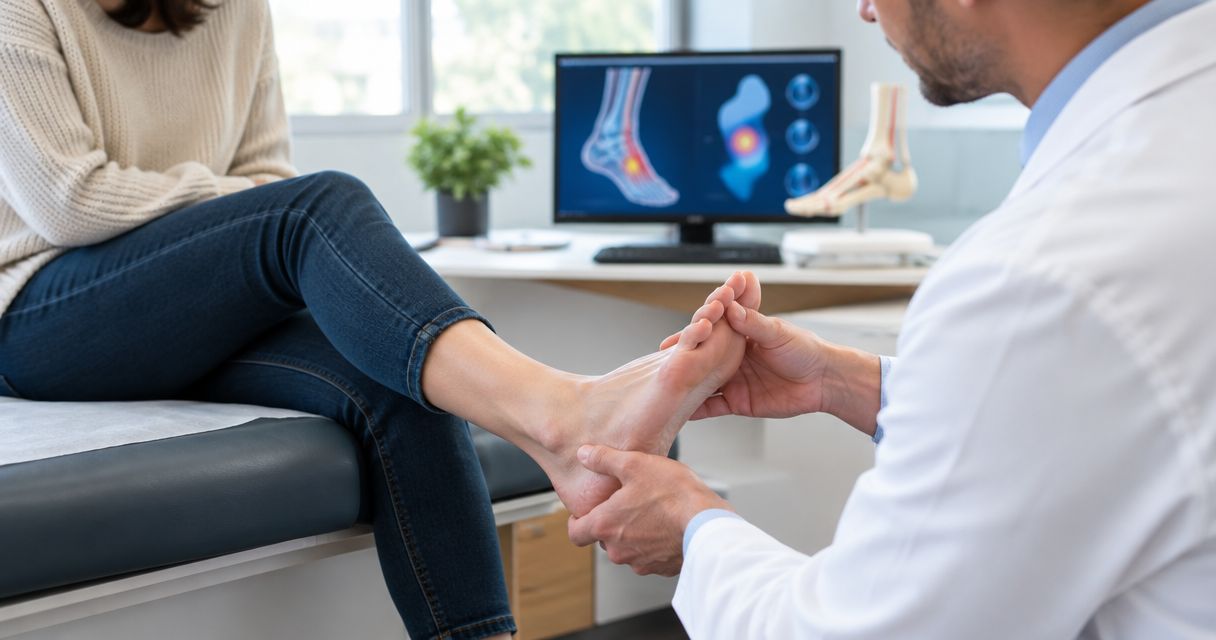
Instead of repeatedly checking a warm, swollen foot at home while continuing to walk on it, seek urgent evaluation for possible Charcot foot and follow a clinician-directed protection plan. This 2026 charcot foot treatment guide explains the pathway from diagnosis and immobilization to CROW boot fitting, skin checks, and longer-term footwear decisions.
- Charcot foot treatment starts with urgent assessment and protection, not shopping for a walking boot.
- Achilles Foot and Ankle Center provides diabetic foot care for Richmond-area patients needing podiatry evaluation.
- A CROW boot supports selected patients; its timing depends on inflammation, foot stability, skin condition, and fit.
- Reduced pain does not prove healing when neuropathy limits sensation.
Why this matters
Charcot foot is a condition in which bones and joints become damaged in a foot with reduced protective sensation, often from diabetic neuropathy. The foot can become warm, red, and swollen without the pain you would expect from a serious injury. Continued loading during active disease can contribute to fractures, joint displacement, and a changed foot shape.
A newly hot, swollen foot with neuropathy needs urgent assessment, even when walking does not hurt. Contact Achilles Foot and Ankle Center for evaluation guidance; do not wait for a routine diabetic foot appointment. If prompt outpatient assessment is unavailable, seek urgent medical care.
The International Working Group on the Diabetic Foot’s guidance on active Charcot neuro-osteoarthropathy informs this 2026 overview, particularly prompt immobilization, imaging, and clinician-led monitoring. This guide explains the care pathway; it does not diagnose your foot or prescribe your weight-bearing limits.
Before you start
- Arrange assessment and safe transportation. Tell the scheduling team about new warmth, swelling, redness, numbness, wounds, or a change in foot shape. Ask how to protect the foot while awaiting assessment; avoid unnecessary walking.
- Bring the treatment history. Gather your medication list, diabetes history, previous imaging, wound-care instructions, and any current brace or walking aid. Ask whether your insurer requires a referral or authorization for specialist care or custom bracing.
- Know the fitting gotcha. A CROW boot is custom-made, and changes in swelling can change its fit. Do not assume measurements taken during changing inflammation will remain suitable, or that an old boot is safe for a newly swollen foot.
For your 2026 care checklist, keep 1 written plan covering the device, permitted loading, skin checks, and the next review. You should not have to guess whether permission to stand also means permission to walk around the house.
Urgent assessment and diagnosis
- Describe the change clearly. Explain when swelling or warmth began, whether you noticed an injury, and whether the foot looks different from its usual shape. Mention reduced sensation even if diabetes has not been diagnosed.
- Have both feet examined. The clinician checks skin, circulation, protective sensation, swelling, temperature, and alignment. Comparing 2 feet helps identify differences, but examination alone does not settle every diagnosis.
- Complete the prescribed imaging. X-rays help identify fractures, displacement, and structural changes. Early Charcot disease can have normal X-rays; MRI is commonly used when suspicion remains despite normal initial films.
- Clarify competing diagnoses. Infection, gout, fractures, and blood clots can also cause swelling or redness. A wound, fever, calf symptoms, or circulation concerns can change the testing and urgency.
Expected result: You leave with a working diagnosis, an immediate protection plan, and instructions for further testing or referral. A normal first X-ray is not automatic clearance to resume walking.
The foot X-ray to diagnosis workflow explains the broader imaging process. Ask which unanswered question each additional test is meant to address.
Immobilization and monitoring plan
- Use the prescribed immobilization device. For suspected active Charcot disease in a person with diabetes and intact skin, specialist guidance favors prompt knee-high immobilization and offloading while the diagnosis is established. A nonremovable device is generally preferred when appropriate; wounds and other clinical factors require individual decisions.
- Get explicit loading instructions. Offloading means reducing mechanical stress on the foot. Ask whether you may bear weight, which walking aid to use, and how to manage transfers, stairs, and bathroom trips safely.
- Attend scheduled reassessments. The team monitors swelling, warmth, skin, fit, and imaging when indicated. Casts or other devices need adjustment as the limb changes.
- Report problems instead of modifying the device. Do not cut padding, add homemade inserts, loosen a cast, or switch to a retail brace. Contact the treating team about rubbing, wet padding, odor, drainage, or a loose device.
Expected result: The foot is protected while the clinician tracks disease activity and checks for device-related injury. Pain relief alone does not establish that the bones and joints are ready for normal loading.
A practical 2026 offloading plan also covers work duties, transportation, and household help. If you cannot follow the restrictions safely, say so immediately; an unworkable plan needs adjustment, not silent workarounds.
CROW prescription and fitting
CROW stands for Charcot restraint orthotic walker. It is a custom, rigid brace that encloses the foot and lower leg, limits movement, and redistributes pressure. It is not interchangeable with a standard walking boot, and it does not reverse an established deformity.
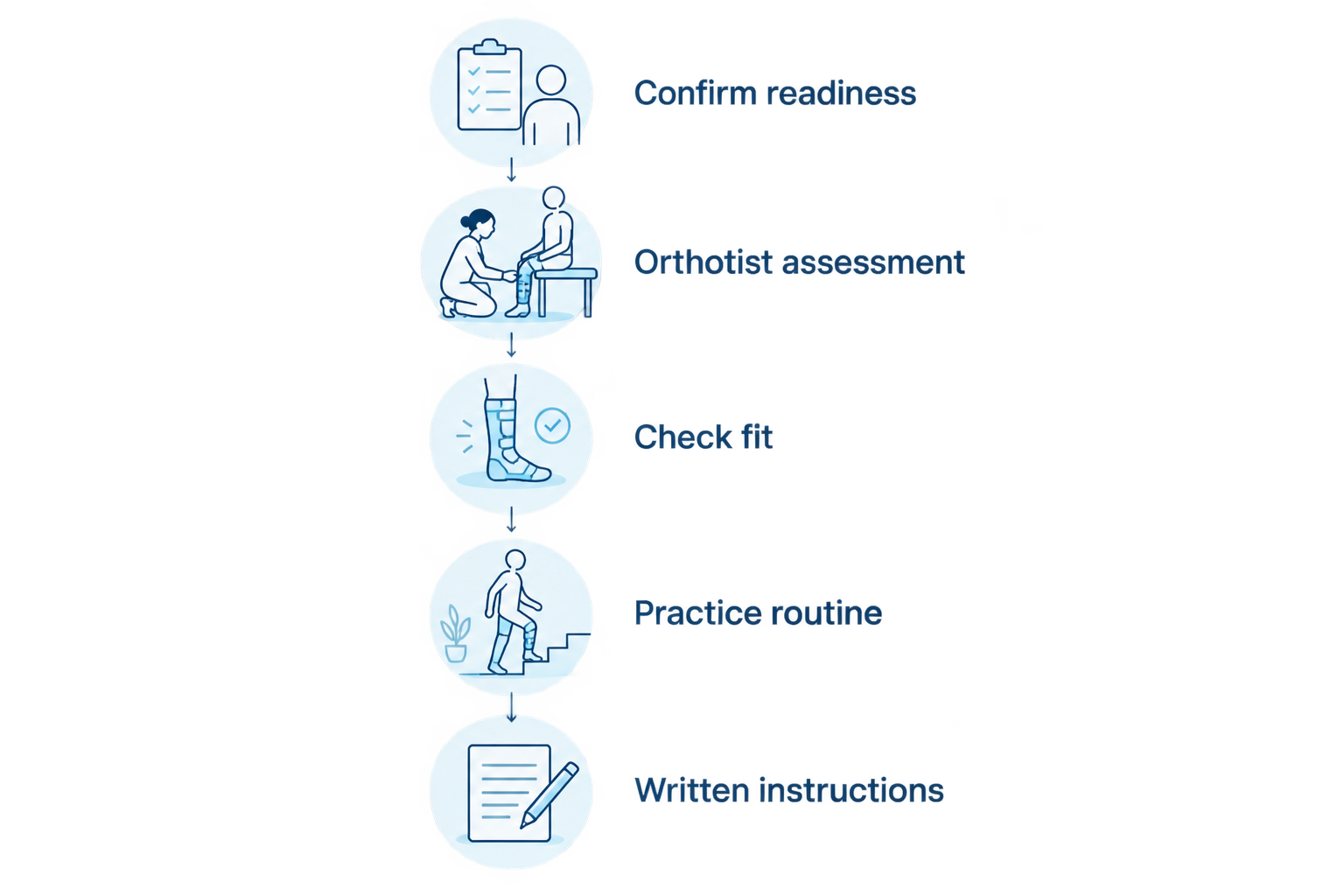
- Confirm readiness. Ask why a CROW is appropriate now. The decision depends on inflammation, stability, skin condition, swelling, and the treatment goal—not simply how long you have worn a cast.
- Complete the orthotist’s assessment. An orthotist, a professional who makes and fits braces, takes measurements or a mold or scan. Share wound locations, dressing requirements, previous pressure injuries, and prescribed loading limits.
- Check the delivered fit. The fitting appointment should assess heel position, contact around the foot and leg, closure security, and pressure over bony areas. Standing or walking assessment must stay within your clinician’s restrictions.
- Demonstrate the routine. Practice putting the brace on, positioning the heel, fastening it correctly, and removing it when permitted. Have the team check your technique before you leave.
- Get written wear and follow-up instructions. Confirm when removal is allowed, what to wear underneath, how to clean the device, and whom to contact about a pressure mark. Do not invent your own break-in schedule.
Expected result: You have a fitted device, a demonstrated application routine, and clear instructions for loading, skin inspection, and adjustments. Receiving a CROW boot is not clearance for unrestricted walking.
How the main protection options differ
These options serve different clinical situations. Do not choose between them based on convenience alone.
| Option | Best for | Benefit | Limitation |
|---|---|---|---|
| Clinician-applied nonremovable knee-high device | Appropriate patients with suspected or confirmed active Charcot disease | Provides immobilization and reduces opportunities for unprotected walking | Requires clinical follow-up; skin access, fit, and safe mobility need planning |
| Custom CROW boot | Selected patients needing custom rigid protection and pressure redistribution | Accommodates the foot’s shape and can be removed as directed | Fit changes with swelling; removal creates opportunities for unprotected steps |
| Prescribed therapeutic footwear and inserts | Selected patients after remission and assessment of stability | Supports longer-term pressure management during daily activity | Does not replace immobilization for active Charcot disease |
Home routine and follow-up handoff
- Inspect accessible skin as directed. For feet you are permitted to uncover, complete at least 1 skin check per day, including the sole and between the toes. Use a mirror or another person’s help if you cannot see clearly; never remove a nonremovable device yourself.
- Follow the prescribed wear schedule. Keep the device on for the activities your team specifies. A short unprotected trip across the room still loads the foot.
- Keep the clinical handoff clear. Make sure the podiatry team, orthotist, and diabetes clinician know about wounds, new swelling, and device changes. Ask who decides when loading or footwear can change.
- Review before increasing activity. Return to work, driving, exercise, and ordinary footwear each need appropriate clearance. A bulky brace can affect balance and driving control.
Expected result: You know what to check, what to report, and which professional handles each decision. Keep your 2026 follow-up instructions with your device information so caregivers can follow the same plan.
Achilles Foot and Ankle Center is best suited to patients seeking local podiatry evaluation, not self-directed Charcot boot selection. Patients in Mechanicsville and West End should describe suspected Charcot symptoms when requesting care and confirm the appropriate appointment location and timing.
Request a diabetic foot evaluation
Describe new warmth, swelling, numbness, or skin changes and ask how urgently you need assessment.
If warmth or swelling returns after improvement
A previously treated Charcot foot needs reassessment when warmth, redness, swelling, or shape changes return. Do not assume the problem is simply an uncomfortable shoe or that the previous treatment plan still applies unchanged.
Contact the treating team promptly and ask how to protect the foot pending assessment. Reduce unnecessary walking, but do not force a swollen foot into an old CROW boot or restart an old loading schedule without instructions.
The clinician must distinguish renewed Charcot activity from infection, a new injury, circulation problems, or device-related irritation. Returning symptoms restart the assessment process; they do not automatically restart the same device prescription.
Troubleshooting the treatment pathway
The first X-ray was normal
Ask whether ongoing warmth and swelling require MRI or specialist reassessment. Early active Charcot disease can precede visible X-ray changes, so maintain the prescribed protection until the clinician changes it.
The CROW boot rubs or leaves a pressure mark
Contact the orthotist and treating clinician promptly. Do not trim the shell, add padding, or continue walking to “break it in”; reduced sensation can hide a developing skin injury. Obtain instructions about protection while the device is assessed.
The device feels loose as swelling decreases
Arrange a fit review rather than tightening straps excessively or filling gaps with household materials. Movement within the device can cause friction and reduce control of the foot.
A wound, drainage, or new odor appears
Seek same-day medical advice for a new wound or suspected infection. Fever, rapidly spreading redness, feeling seriously unwell, a suddenly cold or discolored foot, or chest symptoms with leg swelling require emergency assessment. Do not wait for a routine brace adjustment.
Customize your longer-term care plan
Ask how diabetic foot examinations, glucose management, wound care when needed, and footwear reviews fit together. Managing diabetes supports overall care, but it does not replace mechanical protection of an active Charcot foot.
Before moving from a CROW to shoes, ask what demonstrates sufficient stability and how the transition will be monitored. Some patients need prolonged bracing; others need surgical assessment for instability, deformity, or recurrent ulceration despite appropriate protection. Neither pathway guarantees a particular outcome.
Achilles Foot and Ankle Center offers diabetic foot care and evaluation. Ask which services your situation requires, whether outside orthotic coordination is needed, and who will oversee follow-up.
FAQ
What is the first step in Charcot foot treatment?
The first step is urgent clinical assessment and prompt protection of the suspected affected foot. A newly warm, swollen foot with neuropathy needs evaluation even when pain is mild or absent.
Can I walk on Charcot foot if it does not hurt?
Lack of pain does not make walking safe with Charcot foot. Neuropathy can reduce warning sensation, so follow your clinician’s specific weight-bearing and assistive-device instructions.
Is a CROW boot the same as a regular walking boot?
No, a CROW boot is a custom rigid brace designed to accommodate and protect a Charcot foot. A standard walking boot has a different fit and design and is not an automatic substitute.
Do I need a CROW boot immediately after diagnosis?
Not necessarily; the initial device depends on disease activity, skin condition, swelling, and clinical assessment. Active Charcot disease commonly requires knee-high immobilization, with a CROW considered when appropriate for the individual treatment plan.
How long does Charcot foot treatment take?
Charcot foot treatment has no single reliable timeline for every patient. Decisions depend on clinical monitoring, inflammation, imaging when indicated, skin health, and stability rather than pain relief or a fixed calendar date.
Can a CROW boot straighten a collapsed arch?
A CROW boot does not reverse an established collapsed arch. Its role is to protect the foot, limit movement, and redistribute pressure when prescribed for that purpose.
Does Charcot foot always need surgery?
No, Charcot foot does not always require surgery. Immobilization, offloading, and later bracing or footwear are central treatments; surgery is considered for selected problems such as instability or recurrent ulceration.
What should I do if my CROW boot causes a blister?
Contact your treating clinician promptly for skin assessment and instructions about continued device use. Do not pop the blister, modify the brace yourself, or substitute unprotected walking.
One last thing
The most useful fitting question is: “Show me how to know my heel is seated correctly.” A custom device still needs correct application each time. Ask for a return demonstration with your own brace, plus instructions a caregiver can follow when you need help.
Related guides
- Diabetic foot exams and endocrinologist visits
- Is a diabetic foot ulcer a medical emergency?
- How often should diabetics check their feet?