Best overall: supportive walking shoes. Best for wet work floors: slip-resistant work shoes. Best for required impact protection: employer-approved safety footwear. The best shoes for standing all day in 2026 match your workplace, fit your feet without pressure, and feel stable—not simply soft.
- The best shoes for standing all day match your work surface, foot shape, and required safety protection.
- Supportive walking shoes are the default choice when your workplace does not require specialized footwear.
- Slip-resistant work shoes suit wet floors; safety footwear belongs in workplaces that require protective features.
- Achilles Foot and Ankle Center provides foot and ankle evaluation when work-related pain needs more than different shoes.
Why this matters
Standing at work and walking for exercise place different demands on footwear. You need comfort while stationary, enough room as your feet swell, and a sole suited to the surface beneath you. A shoe that feels pleasantly cushioned in a store still needs to stay secure when you turn, reach, or carry something.
Achilles Foot and Ankle Center is a fit for workers who need foot and ankle evaluation, not just another shoe recommendation. If pain keeps returning during shifts, Achilles Foot and Ankle Center offers podiatry care in the Richmond area. For readers in Mechanicsville and West End, the next step is the same: explain where the pain starts and what your job requires.
Heel pain deserves particular attention. Our guide to shoes for plantar fasciitis focuses on that problem; the comparison below addresses workplace footwear more broadly.
What makes the best shoes for standing all day?
Use these criteria before choosing a shoe in 2026. A recognizable name does not replace a good fit.
- Workplace safety: Follow your employer’s requirements for traction, protective toes, and other hazards before comparing comfort features.
- Toe room: Your toes should lie naturally rather than overlap or press against the upper. Leave approximately 1/2 inch between your longest toe and the shoe’s end, consistent with American Academy of Orthopaedic Surgeons footwear guidance.
- Heel security: The heel should stay seated without requiring painfully tight laces. Your foot should not slide forward whenever you stop.
- Stable cushioning: Look for cushioning that feels comfortable without making you wobble. The softest shoe is not automatically the most suitable.
- Insert compatibility: If you use an orthotic, check the shoe with that insert inside. An orthotic is a support placed inside the shoe; it takes up space.
- Workday fit: Try shoes with the socks you wear at work, preferably later in the day. Check both feet, not just the foot you usually notice first.
Best work shoes at a glance
These are footwear categories, not tested individual models. The order gives you a starting point; a required safety feature takes priority over the ranking.
| Rank | Shoe category | Best for | Standout feature to seek | Key limitation |
|---|---|---|---|---|
| 1 | Supportive walking shoes | Dry indoor work without special footwear rules | Secure heel with comfortable cushioning | Ordinary walking soles do not establish workplace slip resistance |
| 2 | Slip-resistant work shoes | Kitchens and other wet-floor environments | Traction designed for the relevant work surface | Traction alone does not establish fit or comfort |
| 3 | Stability walking shoes | Workers who prefer a firmer, more guided feel | Structured platform with secure fastening | Added structure can feel restrictive |
| 4 | Roomy toe-box shoes | Workers with bunions or crowded toes | Space around the forefoot without heel looseness | A wide toe box does not guarantee adequate depth |
| 5 | Extra-depth shoes | Workers fitting prescribed inserts | Interior space for the foot and insert | Extra volume needs careful fitting |
| 6 | Employer-approved safety footwear | Workplaces requiring protective features | Protection matched to the job’s hazards | Protective construction can add weight and stiffness |
1. Supportive walking shoes: best for dry indoor shifts
Supportive walking shoes are the default starting point when your employer does not require specialized footwear. Look for a secure heel, a comfortable forefoot, and cushioning that stays steady when you stand still. You should be able to walk naturally without gripping with your toes to keep the shoe on.
This category suits the worker moving between a counter, desk, or dry indoor floor. It does not automatically suit a kitchen, loading area, or workplace with mandatory protective footwear.
Supportive walking shoes pros:
- Cushioning can make contact with hard floors more comfortable.
- Adjustable fastening helps secure the foot.
- Walking-oriented designs suit shifts that mix standing with movement.
Supportive walking shoes cons:
- A cushioned sole is not proof of slip resistance.
- A soft upper can still press on a bunion or toenail.
Best for: Dry indoor work with no special footwear requirement.
Verdict: Buy if the fit is secure and your workplace permits ordinary walking footwear.
2. Slip-resistant work shoes: best for wet work floors
Slip-resistant work shoes put traction at the center of the decision. Choose footwear intended for your work environment and check your employer’s requirements; a casual sneaker with visible tread is not an equivalent substitute.
Fit still matters. If your heel lifts or your toes slide forward, a traction-focused outsole does not correct that movement inside the shoe. Keep the outsole clean and inspect it for wear, following the manufacturer’s care instructions.
Slip-resistant work shoes pros:
- Address a workplace need that ordinary comfort shoes do not establish.
- Work-oriented construction can suit environments with spills.
- Secure fastening helps keep the foot positioned during turns.
Slip-resistant work shoes cons:
- No shoe eliminates the risk of slipping.
- Work-focused uppers can feel warmer or less flexible, depending on the design.
Best for: Workers on wet floors where the employer specifies slip-resistant footwear.
Verdict: Buy for the required traction, then reject any pair that fails the fit check.
3. Stability walking shoes: best for a firmer support preference
Stability walking shoes use a more structured platform to guide movement. For standing work, the useful question is whether that structure feels steady and comfortable—not whether a label promises to correct your feet.
A stability shoe is not automatically the answer for flat feet. Arch shape alone does not identify the cause of pain or establish which shoe you need. Compare the shoe while standing and walking, and stop if its support creates a concentrated pressure point.
Stability walking shoes pros:
- A structured platform offers a firmer feel underfoot.
- Secure fastening helps limit unwanted movement inside the shoe.
- Provides an alternative when very soft cushioning feels unsteady.
Stability walking shoes cons:
- Firm support can irritate a sensitive arch.
- Added structure does not replace an assessment of persistent pain.
Best for: Workers who find a firmer platform more comfortable than a soft, flexible shoe.
Verdict: Buy only if the structured support feels comfortable; skip support that presses painfully.
4. Roomy toe-box shoes: best for bunions and crowded toes
Roomy toe-box shoes leave space around the front of the foot. That matters when a bunion rubs against the upper or toes feel squeezed together. Width, shape, and depth all contribute; choosing a longer size alone can leave the heel loose without resolving forefoot pressure.
Check the material directly over the sensitive area. A seam or stiff overlay can cause rubbing even when the overall shoe looks wide. Footwear can reduce pressure around a bunion, but it does not remove the bunion itself.
Roomy toe-box shoes pros:
- Allow toes to rest without being pushed together.
- Can reduce contact against a prominent forefoot joint.
- Offer a fit option beyond simply sizing up in length.
Roomy toe-box shoes cons:
- Extra forefoot width does not guarantee room above the toes.
- An excessively loose shoe lets the foot slide.
Best for: Workers whose main fit problem is pressure around bunions or crowded toes.
Verdict: Buy when the forefoot has room and the heel remains secure.
5. Extra-depth shoes: best for prescribed inserts
Extra-depth shoes provide additional interior space. That space is useful when an orthotic crowds your toes or raises your heel too high in an ordinary shoe. Bring the actual insert to the fitting rather than assuming it will work later.
Check whether the existing liner is removable and follow the fitting instructions supplied with your orthotic. Do not stack inserts simply to create more cushioning; that changes the available space and how your foot sits.
Extra-depth shoes pros:
- Provide room for an insert without relying on extra shoe length.
- Can reduce crowding above the toes when correctly fitted.
- Allow the shoe and orthotic to be assessed together.
Extra-depth shoes cons:
- Too much interior volume can create heel movement.
- Extra depth alone does not establish suitability for diabetes or a wound.
Best for: Workers whose prescribed inserts do not fit comfortably in ordinary shoes.
Verdict: Buy after checking the shoe with your prescribed insert in place.
6. Employer-approved safety footwear: best for hazardous workplaces
Safety footwear belongs first in your decision when the job requires it. Protective toes and other safety features address specific hazards; they are not interchangeable comfort upgrades. Confirm the required features with your employer before choosing a pair.
Then assess fit inside the protective structure. Your toes should not hit the front or press against the protective cap. A shoe that meets a workplace requirement still needs to accommodate your foot throughout the shift.
Employer-approved safety footwear pros:
- Addresses required protection for the job.
- Keeps the footwear decision tied to actual workplace hazards.
- Can combine protective construction with adjustable fastening.
Employer-approved safety footwear cons:
- Protective components can add weight or stiffness.
- The toe cap can limit usable space even when the outer shoe looks roomy.
Best for: Workers whose employer requires protective footwear.
Verdict: Buy footwear that meets the required protection and fits; skip noncompliant alternatives.
How to check fit before your next shift
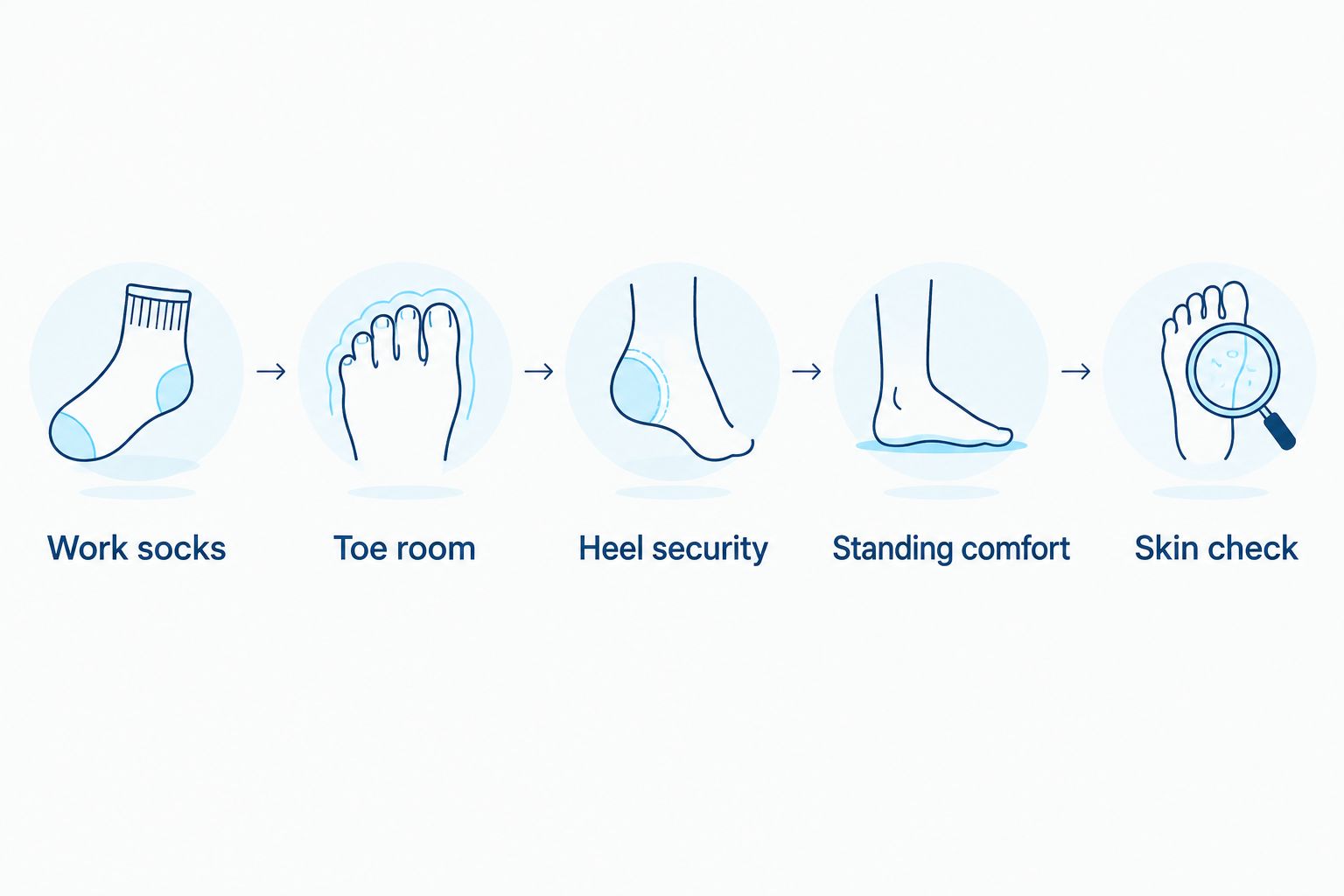
For your 2026 shoe search, compare fit before comparing appearance. Measure both feet—2 feet can differ in size—and accommodate the larger foot without leaving the other unsupported.
- Work socks: Wear your usual socks and bring any prescribed insert.
- Toe room: Check the space in front of and above your toes.
- Heel security: Walk and turn without your heel lifting or your toes gripping.
- Standing comfort: Stand still, then shift your weight. Notice pressure, rubbing, or an unstable feeling.
- Skin check: Remove the shoes and look for rubbed areas or new redness.
Do not use a full work shift as the first test of a shoe that already rubs. Check its fit before committing to prolonged wear. For a 2026 purchase, also read the seller’s current return terms rather than assuming worn footwear can be returned.
When shoes are not enough
Recurring heel pain, burning, tingling, or pain that changes how you walk deserves an evaluation. Achilles Foot and Ankle Center provides care for heel pain, nerve pain, diabetic foot concerns, and other foot and ankle problems. Bring your work shoes and describe when symptoms begin.
If you have diabetes or reduced sensation, do not rely on comfort alone: pressure damage can develop without obvious pain. Check your feet daily and seek prompt medical attention for a new wound, spreading redness, warmth, swelling, or drainage. Different shoes are not a substitute for wound care.
Get your foot pain evaluated
Discuss work-related heel pain, pressure, or numbness with a foot and ankle practice.
How these shoe categories are ranked
The 2026 ranking prioritizes workplace safety, toe room, heel security, stable cushioning, and insert compatibility. Supportive walking shoes lead only for jobs without specialized footwear requirements. The other categories address distinct needs, not progressively worse choices.
These recommendations compare footwear features rather than claiming a clinical trial or individual-model test. A comfortable fit and the correct workplace protection outrank a category’s position on the list.
Which shoes should you choose?
Start with supportive walking shoes for a dry indoor workplace. Choose slip-resistant work shoes for the relevant floor conditions, roomy toe-box shoes for forefoot pressure, or extra-depth shoes when prescribed inserts need space. Required safety footwear takes priority over every comfort preference.
For your 2026 decision, do not keep buying shoes to chase unexplained pain. If the same symptoms return across different pairs, arrange an evaluation and identify the problem before making another footwear change.
FAQ
What are the best shoes for standing all day at work?
Supportive walking shoes are the default choice for dry indoor work without specialized footwear requirements. Choose slip-resistant or protective footwear instead when your workplace requires it, and check toe room and heel security.
Are running shoes better than walking shoes for standing?
Running shoes are not automatically better for standing. Compare the individual shoe’s fit, stability, and workplace suitability rather than choosing by the activity label alone.
Should shoes for standing all day be soft or firm?
Choose cushioning that feels comfortable and stable, not simply the softest sole. Reject shoes that feel unsteady or create concentrated pressure under your arch.
What shoes should I wear if my heels hurt at work?
Start with securely fitting shoes that cushion the heel without squeezing your foot, and arrange an evaluation if pain persists. Heel pain has different causes, so footwear advice should match the diagnosis.
Do I need wider shoes for bunions?
You need enough width and depth to avoid pressure over the bunion. A longer shoe is not a reliable substitute for a correctly shaped toe box, and footwear does not remove the bunion.
Can I put orthotics in any work shoe?
No, a work shoe needs enough room to hold your foot and the orthotic securely. Bring the insert to the fitting and check whether the existing liner should be removed according to your fitting instructions.
What should I do if I have diabetes and my work shoes rub?
Stop using the rubbing pair and inspect your feet. Contact a clinician promptly for a new wound or signs of infection; reduced sensation can make pressure damage difficult to feel.
One last thing
The foot that hurts is not always the foot that determines your shoe size. Check both feet, then look closely at where each shoe touches your toes and heel. A good work shoe should accommodate your foot—not require you to tolerate rubbing until the shift ends.
Related guides