Best overall for mild ingrown-toenail discomfort in 2026: warm-water soaks and pressure relief. Best for reducing skin friction: plain petroleum jelly; best oral option when safe for you: acetaminophen—none removes a nail edge embedded in the skin.
- The best OTC treatment for ingrown toenail discomfort supports mild symptoms; no cream removes an embedded nail edge.
- Warm-water soaks and roomy shoes are the starting point for mild tenderness without infection.
- Petroleum jelly and nonstick dressings protect irritated skin but do not correct nail growth.
- Achilles Foot and Ankle Center offers podiatry evaluation when pain persists or nail problems recur.
- Diabetes, poor circulation, drainage, or spreading redness calls for medical advice rather than continued self-treatment.
Why this matters
An ingrown toenail happens when a nail edge presses into or grows into the surrounding skin. Treatment has to address that pressure—not just cover up the pain.
For your 2026 medicine-cabinet decisions, separate comfort care from correction. Mild tenderness without drainage is different from a swollen, draining toe or a nail that repeatedly grows into the same spot.
Achilles Foot and Ankle Center is the choice for patients who need an ingrown-toenail evaluation rather than another symptom-relief product. Patients in Mechanicsville and West End can contact the practice to discuss an appropriate evaluation.
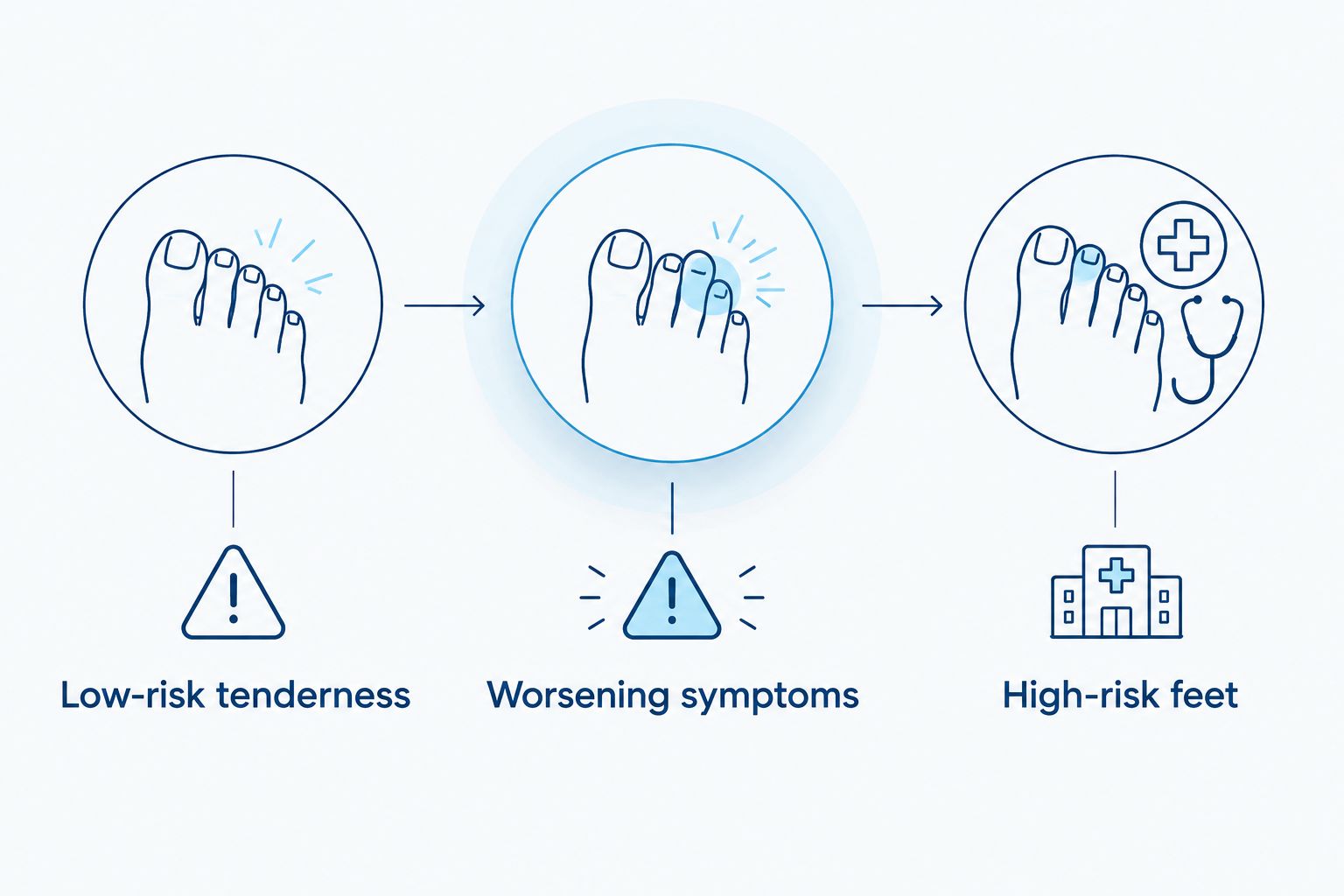
Check your toe before choosing a treatment
- Low-risk tenderness: Mild discomfort without pus, spreading redness, or a condition that increases foot risk is the situation for cautious home care.
- Worsening symptoms: Increasing redness, warmth, swelling, drainage, or pain needs prompt medical assessment. Fever, red streaks, or feeling unwell warrants urgent care.
- High-risk feet: Diabetes, poor circulation, reduced feeling, or a weakened immune system changes the advice. Contact a clinician before soaking, trimming, or treating the affected toe yourself.
What makes the best OTC treatment for an ingrown toenail?
Use these criteria when comparing options in 2026:
- Purpose: Know whether the option soothes skin, covers a sore area, or reduces pain. These are different jobs.
- Low irritation: Avoid harsh chemicals, aggressive scraping, and products that sting damaged skin.
- Pressure control: Shoes and dressings should leave room around the sore nail edge.
- Medication safety: Your health conditions and other medicines determine which pain relievers are appropriate.
- Clear limits: A useful product should not become a reason to delay evaluation when symptoms persist or worsen.
OTC ingrown-toenail options at a glance
The order below prioritizes gentle local care before oral medication. These options serve different needs; you do not need to use everything on the list.
| Option | Best for | Standout feature | Key limitation |
|---|---|---|---|
| Warm-water soaks | Mild tenderness | Gentle cleaning and temporary comfort | Does not remove an embedded nail edge |
| Plain petroleum jelly | Reducing surface friction | Simple protective barrier | Does not treat infection |
| Sterile nonstick dressing | Protection from sock friction | Covers irritated skin without ordinary gauze sticking | Tight wrapping adds pressure |
| Acetaminophen | Pain relief without an anti-inflammatory medicine | Oral pain relief | Does not reduce the mechanical pressure |
| Ibuprofen | Pain with inflammation in eligible adults | Reduces pain and inflammation | More medication restrictions and interaction concerns |
1. Warm-water soaks: best for mild tenderness
Warm-water soaks are a reasonable first step when an ingrown toenail is only mildly sore and you have no high-risk foot condition. Soaking softens the surrounding skin and helps clean the area without digging around the nail.
Use comfortably warm—not hot—water for 15–20 minutes, 3–4 times a day. Dry the toe carefully afterward and choose footwear that does not squeeze the front of your foot.
Warm-water soak pros:
- Requires no medicated ingredient.
- Cleans without scrubbing the irritated nail fold.
- Fits into a simple routine alongside pressure relief.
Warm-water soak cons:
- Does not lift out a deeply embedded nail edge.
- Repeated soaking without thorough drying leaves skin overly moist.
Best for: Otherwise healthy people with mild tenderness and no drainage or spreading redness.
Stop home care if symptoms worsen. If mild symptoms are not beginning to improve after 2 days, contact a clinician rather than extending the routine indefinitely.
Verdict: Skip specialty soak additives; plain warm water is enough for this step.
2. Plain petroleum jelly: best for reducing surface friction
A thin layer of plain petroleum jelly helps protect irritated skin from friction. Its role is to provide a barrier, not to straighten the nail or pull an embedded corner free.
Apply it to clean skin around the irritated area, then use a loose nonstick dressing when protection is needed. Do not push jelly, an applicator, or another object underneath the nail edge.
Plain petroleum jelly pros:
- Provides a simple barrier over irritated skin.
- Contains no antibiotic when you choose a plain formulation.
- Works with a nonstick dressing to reduce surface rubbing.
Plain petroleum jelly cons:
- Does not treat an infection or correct the nail edge.
- A thick, covered layer can keep the area excessively moist.
Best for: Mild surface irritation that needs protection from rubbing, without signs of infection.
Check the ingredient list rather than choosing by package claims. Added fragrance or multiple active ingredients do not solve the pressure causing an ingrown toenail.
Verdict: Buy a plain formulation for skin protection, not as a cure.
3. Sterile nonstick dressing: best for sock friction
A sterile nonstick dressing creates a protective layer between irritated skin and your sock. Unlike ordinary dry gauze, its contact surface is designed to reduce sticking when you remove it.
Keep the dressing light and loose. Change it daily and whenever it becomes wet or dirty; a bulky wrap inside a snug shoe can increase the pressure you are trying to reduce.
Nonstick dressing pros:
- Shields tender skin from direct sock friction.
- Reduces sticking compared with ordinary dry gauze.
- Lets you inspect the toe during each dressing change.
Nonstick dressing cons:
- A tight wrap increases discomfort and pressure.
- A dressing can hide worsening redness if you leave it in place without checking.
Best for: A mildly irritated nail fold that rubs against socks during ordinary activities.
Do not use a dressing to keep walking through increasing pain. If you develop pus, spreading redness, or increasing warmth, seek assessment instead of repeatedly covering the area.
Verdict: Buy a nonstick dressing when protection is needed; skip tight wrapping.
4. Acetaminophen: best for pain relief without an NSAID
Acetaminophen reduces pain but does not treat the pressure or inflammation at the nail edge. It is an option when you need temporary comfort and it is safe with your health history and other medicines.
Follow the package directions. Ask a pharmacist or clinician before use if you have liver disease, drink heavily, or take other medicines containing acetaminophen—including some cold and flu products.
Acetaminophen pros:
- Provides oral pain relief.
- Is not a nonsteroidal anti-inflammatory drug, or NSAID.
- Offers an alternative when an NSAID is unsuitable, subject to individual advice.
Acetaminophen cons:
- Does not reduce inflammation or correct nail growth.
- Taking too much, including through duplicate ingredients, can seriously harm the liver.
Best for: Temporary pain relief when acetaminophen is appropriate for your circumstances.
Pain relief is not proof that the toe is healing. Check the skin for redness, swelling, and drainage even when the medicine makes walking more comfortable.
Verdict: Buy only after checking the label and your other medicines.
5. Ibuprofen: best for pain with inflammation when appropriate
Ibuprofen is an NSAID that reduces pain and inflammation. It can ease discomfort around an irritated nail fold, but it does not remove the nail edge or treat an infection.
Use only as directed on the package and for the shortest necessary time. Ask a clinician or pharmacist first if you have kidney disease, stomach ulcers, heart disease, take blood thinners, or are pregnant.
Ibuprofen pros:
- Treats pain and inflammation together.
- Offers temporary symptom relief without applying another product to sore skin.
- Can support comfort while you arrange an evaluation.
Ibuprofen cons:
- Carries risks including stomach bleeding and kidney problems.
- Is unsuitable with certain conditions and medicines; do not combine it with another NSAID without medical advice.
Best for: Adults with inflammatory discomfort who can safely take an NSAID.
Do not take ibuprofen to push through running, sports, or shoes that compress the toe. Continued pressure leaves the underlying problem in place.
Verdict: Buy only if an NSAID is safe for you; otherwise skip it.
What to leave off your shopping list
Skip corn removers and wart treatments on an ingrown toenail. Their ingredients target different problems and can damage the surrounding skin. Also avoid using peroxide or rubbing alcohol repeatedly on irritated or broken skin; gentle cleaning is preferable.
Do not assume an antibiotic ointment fixes an ingrown nail. It cannot remove the mechanical cause, and some topical antibiotics cause contact dermatitis—an itchy skin reaction that adds irritation.
Nail-lifting tools, sharp picks, and home nail-removal kits introduce a different risk: injuring the nail fold while trying to reach the corner. Do not dig, cut down the side, or cut a V into the nail. Read why cutting out an ingrown toenail at home is unsafe before attempting a procedure yourself.
How these options were ranked
This 2026 ranking puts gentle care for mild symptoms first, followed by skin protection and then oral pain relief. The criteria are purpose, irritation risk, pressure control, medication safety, and clear limits—not claims that a product permanently changes nail growth.
The options are not interchangeable. Choose the smallest amount of care that matches your symptoms, and stop self-treatment when the problem needs examination.
Which treatment should you choose?
For a mild, uncomplicated ingrown toenail, start with warm-water soaks, careful drying, and roomy footwear. Add a thin protective barrier or loose nonstick dressing only when rubbing is a problem. Oral pain medicine is optional and depends on what is safe for you.
For 2026, the practical buying rule is simple: buy for a specific symptom, not for a promise to fix the nail. Recurrent pain, an embedded edge, drainage, or worsening swelling needs an evaluation rather than a larger collection of products.
Achilles Foot and Ankle Center provides foot and ankle care for patients in the Richmond area. An examination can establish whether conservative care is appropriate or whether the troublesome nail edge needs a procedure; not every sore toenail requires surgery.
FAQ
What’s the best OTC treatment for ingrown toenail pain?
Warm-water soaks and pressure relief are a reasonable starting point for mild ingrown-toenail discomfort without infection or high-risk medical conditions. Acetaminophen or ibuprofen can provide temporary pain relief when safe for you, but neither removes an embedded nail edge.
Does antibiotic ointment get rid of an ingrown toenail?
No, antibiotic ointment does not correct an ingrown toenail. An embedded nail edge remains a mechanical problem, and drainage or spreading redness needs clinical assessment rather than reliance on ointment.
Are Epsom salts necessary for soaking an ingrown toenail?
No, Epsom salts are not necessary for a warm-water soak. Use comfortably warm water, dry the toe thoroughly afterward, and avoid soaking without medical advice if you have diabetes, poor circulation, or reduced feeling.
Can I put cotton or dental floss under the nail?
Do not force cotton or dental floss beneath a painful or embedded nail edge. Clinicians sometimes recommend nail-lifting techniques for selected mild cases, but attempting them yourself can injure irritated skin; ask whether the method is appropriate first.
Can I treat an ingrown toenail myself if I have diabetes?
Contact a clinician before treating an ingrown toenail yourself if you have diabetes. Reduced feeling or circulation problems can make an injury harder to notice and healing more difficult, even when pain seems mild.
When should I stop trying OTC treatments?
Stop self-treatment and seek assessment for drainage, increasing pain, spreading redness, or worsening swelling. Fever, red streaks, or feeling unwell warrants urgent care; mild symptoms that do not begin improving after a short period of gentle care also need review.
Can an ingrown toenail come back after the pain settles?
Yes, an ingrown toenail can recur if the nail edge continues pressing into the skin. Repeated episodes deserve an evaluation of nail shape, trimming habits, footwear pressure, and treatment options.
One last thing
Less pain does not always mean less pressure. Before returning to your usual shoes, check whether the toe box presses against the sore nail fold while you stand and walk.
For persistent or recurring ingrown-toenail symptoms, Achilles Foot and Ankle Center can help you choose an appropriate next step. The goal is to address the cause so you can move comfortably and confidently again—not keep covering the same sore spot.
Related guides
- Can an ingrown toenail heal without a doctor?
- Ingrown toenail home care to an in-office procedure
- Recovery after ingrown toenail surgery