Best compression choice for diabetic neuropathy with swelling: clinician-selected graduated compression socks. Best for comfort without swelling treatment: nonbinding diabetic socks. Best for limited hand mobility: an approved zippered design. This 2026 guide compares sock designs—not unverified brand claims—and explains when compression needs a foot and circulation assessment first.
- The best compression socks for diabetic neuropathy depend on circulation, skin condition, swelling, and prescribed pressure.
- Nonbinding diabetic socks protect comfort without providing graduated compression for swelling.
- Achilles Foot and Ankle Center offers diabetic foot care and nerve pain evaluation.
- Compression socks do not repair nerve damage or replace evaluation of new swelling or wounds.
Why this matters
Diabetic neuropathy is nerve damage associated with diabetes. It can reduce your ability to feel rubbing, tightness, or a developing blister, so a sock that feels comfortable is not necessarily fitting safely.
Compression serves a different purpose: it applies pressure to help manage certain causes of swelling. Neuropathy alone is not a reason to start compression. Poor blood flow through the arteries, fragile skin, wounds, and other medical conditions can change whether compression is appropriate.
Achilles Foot and Ankle Center is an appropriate starting point for diabetic foot and nerve pain evaluation. If you are choosing socks because of numbness, swelling, or skin changes, discuss those symptoms through Achilles Foot and Ankle Center before choosing a pressure level.
What makes the best compression socks for diabetic neuropathy?
For a 2026 purchase, judge the sock by these criteria rather than its marketing label:
- Appropriate pressure: Choose compression only after a clinician determines whether you need it and which pressure is suitable.
- Correct measurements: Match ankle circumference, calf circumference, and leg length to that particular manufacturer's sizing instructions.
- Low-friction construction: Look for a smooth toe area, minimal seams, and fabric that does not bunch inside your shoe.
- A comfortable top band: Avoid a cuff that rolls, creates a tight ridge, or leaves persistent deep marks.
- Practical skin access: You must be able to remove the sock and inspect your whole foot, including between the toes.
- Manageable application: A sock you cannot put on without folds or excessive pulling is not a workable choice.
Compression labels commonly use millimeters of mercury, written as mmHg. You will see products marked 8–15 mmHg, 15–20 mmHg, and 20–30 mmHg; these are pressure ranges, not recommendations for your feet. Terms such as mild, moderate, and firm vary between sellers, so read the actual label.
Do not step up from 15–20 mmHg to 20–30 mmHg because swelling persists. Persistent swelling needs an explanation, not an automatic increase in pressure.
Compression sock options at a glance
These choices address different needs. The nonbinding option belongs in the comparison because many people searching for compression actually need a comfortable diabetic sock without added pressure.
| Sock design | Best for | Standout feature | Key limitation |
|---|---|---|---|
| Clinician-selected graduated compression | Swelling when compression is approved | Pressure designed to be greater at the ankle and decrease up the leg | Requires appropriate pressure and accurate fit |
| Nonbinding diabetic socks | Everyday comfort without a compression indication | A less restrictive cuff and smooth construction | Does not provide graduated compression for swelling |
| Professionally fitted prescribed compression | A specific medical compression plan | Fit and pressure matched to the treatment plan | Requires follow-up and careful application |
| Zippered compression socks | Limited grip or difficulty pulling socks on | A zipper changes how the sock is applied | Zipper placement and construction can create pressure or friction |
| Open-toe compression socks | Toe access when an open-toe design is approved | Leaves toes exposed while compressing the covered area | Does not protect exposed toes from shoe friction |
The best choice in 2026 is the design that meets your medical need without creating a new pressure point. A feature such as a zipper or open toe does not make an otherwise unsuitable compression level safe.
1. Graduated compression: best for approved swelling management
Graduated compression socks apply greater pressure around the ankle and less pressure farther up the leg. Clinicians use them for selected swelling and vein-related conditions; they are not a treatment that reverses diabetic nerve damage.
Choose this category when a clinician has evaluated your swelling and approved compression. Ask for the pressure range, sock length, and wearing schedule rather than choosing from a general diabetic label.
Graduated compression pros:
- Addresses swelling when compression is appropriate.
- Provides a defined pressure range on the product label.
- Offers different lengths and constructions for different treatment needs.
Graduated compression cons:
- An unsuitable pressure level can be harmful, particularly with impaired arterial circulation.
- Poor sizing, wrinkles, or a rolled cuff can concentrate pressure.
- Reduced sensation can hide early signs of rubbing or skin injury.
Best for: People with diabetic neuropathy whose swelling has been assessed and whose clinician has approved graduated compression.
Verdict: Buy only after pressure and fit are confirmed. Do not use the sock to postpone evaluation of unexplained swelling.
2. Nonbinding diabetic socks: best for everyday comfort
Nonbinding diabetic socks are an alternative to compression, not a weaker version of it. They generally focus on reducing cuff restriction, rubbing, and moisture buildup; construction varies, so examine the actual sock.
This is the practical category to consider when your goal is comfortable daily wear and you have no established need for compression. Smooth fabric and adequate shoe space matter more than a diabetic label alone.
Nonbinding diabetic sock pros:
- Avoids deliberately adding a graduated compression pressure.
- Offers designs with smooth toe areas and less restrictive cuffs.
- Can simplify routine dressing compared with tight compression garments.
Nonbinding diabetic sock cons:
- Does not provide prescribed compression for swelling.
- A loose or oversized sock can bunch and rub.
- A thick sock can make an otherwise suitable shoe too tight.
Best for: Everyday foot comfort when compression has not been recommended.
Verdict: Buy for comfort, not as swelling treatment. If your feet or ankles are swollen, find the cause rather than assuming a different sock will solve it.
3. Prescribed compression: best for a specific treatment plan
Professionally fitted prescribed compression is the better choice when a clinician determines that you need a particular pressure, length, or garment construction. The defining feature is the treatment plan—not a claim that stronger compression is better.
In 2026, use the prescription and fitting instructions to narrow your choices. Ask whether your foot shape, swelling pattern, or skin condition requires a different garment from a standard retail sock.
Prescribed compression pros:
- Connects the garment choice to an identified medical need.
- Makes pressure and fit explicit rather than guessed.
- Provides a basis for reassessment if swelling or skin condition changes.
Prescribed compression cons:
- Can be difficult to apply and remove.
- Does not eliminate the need for skin checks.
- Needs reassessment when measurements or symptoms change.
Best for: People following a clinician-directed compression plan that needs more specific fitting than an ordinary retail selection.
Verdict: Buy the specified garment; skip self-directed upgrades. Bring a poorly fitting garment back for assessment instead of folding, cutting, or modifying it.
4. Zippered compression socks: best for limited hand mobility
A zippered sock changes the application process, which can help someone who struggles to pull on a conventional compression sock. It still needs the same circulation assessment, pressure selection, and sizing checks.
Inspect the zipper backing and closure area. A zipper that presses into your skin, catches skin during dressing, or creates a bulky ridge is a reason to reject that design.
Zippered compression sock pros:
- Offers an alternative to pulling a closed sock over the foot.
- Gives some wearers a more manageable dressing method.
- Can be considered alongside an application aid or caregiver assistance.
Zippered compression sock cons:
- The zipper and surrounding seams introduce potential friction points.
- Easier application does not guarantee an even or correct fit.
- Limited sensation can make zipper-related irritation harder to notice.
Best for: People with limited grip who have approved compression needs and can apply the design without skin injury.
Verdict: Hold until you can demonstrate safe application. Ask for help choosing between a zipper, a donning aid, and a different garment design.
5. Open-toe compression: best for approved toe-access needs
Open-toe compression socks leave the toes exposed while applying pressure to the covered foot and leg. They offer toe access, but that does not make them the default choice for diabetic neuropathy.
The opening must sit correctly without rolling or creating a tight edge. Your toes still need protection from rubbing inside footwear, and an open toe is not a substitute for removing the garment to inspect the entire foot.
Open-toe compression sock pros:
- Leaves the toes visible while the garment is on.
- Offers an alternative when a closed toe section fits poorly.
- Allows a clinician to consider toe access within a compression plan.
Open-toe compression sock cons:
- Exposed toes lose the sock's fabric barrier against shoe friction.
- The opening can bunch or create localized pressure.
- Toe visibility does not reveal problems under the covered garment.
Best for: People whose clinician approves an open-toe design for a specific fit or access need.
Verdict: Hold unless the opening and footwear work safely together. Do not select open-toe compression solely because it makes nail care easier.
How these options are ranked
This 2026 ranking prioritizes medical suitability, fit, skin protection, and ease of use. It compares design categories rather than claiming that a named retail product has been tested or clinically endorsed.
Graduated compression leads for approved swelling management. Nonbinding socks lead for comfort without compression, while the remaining designs solve more specific treatment or dressing problems. No design wins by applying the most pressure.
How to check fit without relying on sensation
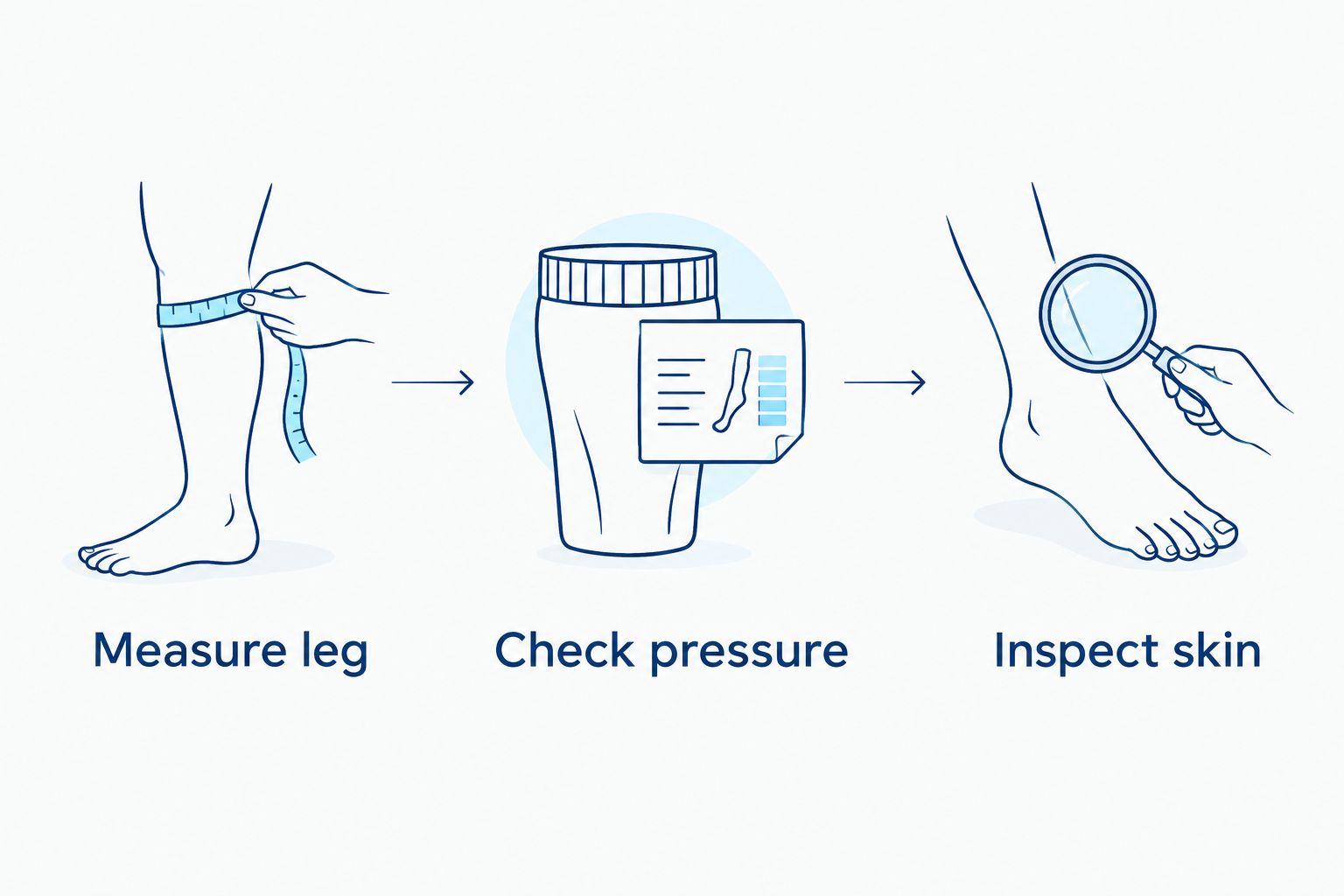
Follow this sequence with the garment's instructions and any guidance from your clinician:
- Measure leg: Take the measurements required by the manufacturer. Ask when to measure if your leg size changes with swelling.
- Check pressure: Confirm that the labeled range and garment length match the recommendation you received.
- Inspect skin: After application and removal, look for folds, rolled edges, blisters, broken skin, or changes in color.
Reduced sensation makes visual inspection especially important. Use a mirror or ask someone to help if you cannot see the sole, heel, or spaces between your toes.
Do not roll down the top of a compression sock to shorten it. Smooth out folds, and ask for fitting help if they return. Follow the prescribed wearing schedule rather than assuming that sleeping in compression is appropriate.
When to stop shopping and seek care
New one-sided swelling, warmth, redness, or calf pain needs prompt medical evaluation. Chest pain or shortness of breath with these symptoms requires emergency care.
A new wound, spreading redness, drainage, or a suddenly cold, pale, or blue foot also needs urgent assessment. Do not start or increase compression to treat these changes yourself.
For recurring swelling, numbness, or pressure marks, arrange a foot evaluation. Achilles Foot and Ankle Center offers diabetic foot care and wound care; patients in Mechanicsville and the West End should give new skin changes the same priority, even when they do not hurt.
Arrange a diabetic foot evaluation
Discuss numbness, swelling, skin changes, and whether compression is appropriate for your feet.
Which compression socks should you choose?
Choose clinician-selected graduated compression for assessed swelling; choose nonbinding diabetic socks when you need comfort without compression. Use professionally fitted, zippered, or open-toe designs only when their particular features match your treatment and dressing needs.
Achilles Foot and Ankle Center offers diabetic foot care for patients who need evaluation before selecting compression socks. For your 2026 purchase, settle the pressure and fit questions before comparing fabric, cuff style, or appearance.
FAQ
What’s the best compression sock for diabetic neuropathy?
The best compression sock is one matched to an assessed medical need, appropriate pressure, and correct measurements. Diabetic neuropathy alone does not establish a need for compression; nonbinding socks are an alternative for everyday comfort.
Are diabetic socks and compression socks the same?
No, diabetic socks and compression socks serve different purposes. Nonbinding diabetic socks emphasize comfort and reduced rubbing, while graduated compression socks apply defined pressure to manage selected swelling or vein-related problems.
Can compression socks cure diabetic neuropathy?
No, compression socks do not cure diabetic neuropathy or repair damaged nerves. They can address certain causes of swelling when appropriate, but numbness and nerve pain need their own evaluation and care plan.
What compression level should I use if I have diabetes?
A clinician should select the compression level after evaluating your circulation, swelling, skin, and other medical conditions. Do not choose a stronger range because a lower-pressure sock has not resolved your symptoms.
Can I wear compression socks if I have a foot wound?
Do not self-start compression over a diabetic foot wound. Some wound treatment plans include professionally selected compression, but the wound and blood supply need assessment first.
Should I sleep in compression socks for neuropathy?
Follow your clinician’s wearing schedule rather than sleeping in compression by default. Overnight use depends on the medical reason for compression and the garment prescribed.
Are open-toe compression socks safer for numb feet?
Open-toe compression socks are not automatically safer for numb feet. The opening can create pressure, exposed toes can rub against footwear, and you still need to remove the garment for a full skin check.
What should I do if compression socks leave marks?
Persistent deep marks, rolled cuffs, skin injury, or color changes need a fit and circulation assessment. Remove a garment that is causing concerning changes and seek medical advice rather than switching to stronger compression.
One last thing
A sock can feel fine and still rub a numb foot. Before treating comfort as proof of a good fit, remove the sock and look at your skin. That simple check matters more than any best-sock label.
Related guides
- Best diabetic socks for neuropathy
- Best products for neuropathy foot pain
- Best toenail fungus treatments