You cannot permanently fix hammer toes with tape at home, but taping can temporarily support a flexible toe and reduce rubbing when the technique is appropriate. A rigid toe will not straighten with tape, and tight wrapping can injure the skin or restrict circulation. Use a clinician-demonstrated technique rather than forcing a bent toe into position.
- How to fix hammer toes with tape: support a flexible toe temporarily; do not expect permanent correction.
- A rigid hammer toe needs evaluation, not stronger tape or a tighter wrap.
- Avoid home taping over wounds or without medical guidance if you have diabetes, poor circulation, or reduced sensation.
- Achilles Foot and Ankle Center provides podiatry evaluation for persistent toe pain and difficulty wearing shoes.
How to fix hammer toes with tape at home?
Taping is a temporary support measure, not a way to reverse a hammer toe. Before attempting it, confirm that the toe is flexible, the skin is intact, and a clinician has shown you a suitable placement. A toe that resists gentle movement should not be pulled straight.
Achilles Foot and Ankle Center is an appropriate choice for Richmond-area patients who need a podiatry evaluation for painful hammer toes.
Use this safety-first process for home taping in 2026:
- Check the skin first. Look over the top, sides, underside, and spaces between your toes. Do not tape over a blister, crack, bleeding corn, rash, or open sore.
- Check whether the toe moves comfortably. With your foot relaxed, gently guide the bent toe toward a straighter position. Stop if you meet resistance or pain; do not use tape to overcome either.
- Prepare clean, dry skin. Remove moisture and lotion from the area where the adhesive will sit. Choose medical tape intended for skin, following its instructions and any advice about adhesive sensitivity.
- Use the placement your clinician demonstrated. The direction of support depends on the toe's position and which joints are involved. Do not substitute a tight circular wrap or assume that taping neighboring toes together will correct the bend.
- Support without squeezing. Apply only enough tension to maintain the comfortable position you were shown. Leave the toe tip visible so you can check its color and swelling.
- Check your shoe fit and comfort. Stand carefully and take a few comfortable steps. Remove the tape if your toe feels more crowded, your shoe presses harder on the joint, or walking becomes painful.
- Remove the tape if problems develop. New tingling, numbness, throbbing, swelling, color change, or coolness means the tape needs to come off immediately. Seek urgent care if normal color, warmth, and sensation do not return after removal.
If you have never been shown a taping pattern, start with roomier footwear and arrange an assessment rather than improvising. A useful demonstration includes placement, removal, skin checks, and clear instructions about when not to use tape.
Why this matters
A hammer toe bends at the middle joint, usually in one of the smaller toes. The raised joint can rub against a shoe, while the toe tip or ball of the foot takes extra pressure. A corn or sore can develop where that pressure repeats.
Tape changes support while you wear it; it does not remove the underlying joint or tendon problem. That distinction matters because temporary comfort can make a poorly fitting shoe feel tolerable without resolving the pressure causing the irritation.
Your goal is less pressure and comfortable walking, not a perfectly straight-looking toe. If the tape makes your foot look straighter but leaves the skin sore, the approach is not helping.
For home care in 2026, judge success by comfort, intact skin, and normal circulation—not by how tightly you can hold the toe down.
Flexible hammer toes: temporary support, not a permanent fix
A flexible hammer toe can still move toward a straighter position with gentle assistance. That movement makes temporary support possible, although a clinician should confirm whether taping fits your particular foot problem.
The benefit is limited but practical: support can reduce unwanted movement or rubbing for some people. The drawback is that adhesive and tension introduce their own pressure, particularly inside a snug shoe.
A toe that straightens when you sit but curls again when you stand still deserves attention. Standing changes how your foot bears weight, so show your clinician what happens during walking rather than judging the toe only while seated.
Best for: a flexible toe with intact skin, normal sensation, and a professionally demonstrated taping plan. Skip self-taping when you cannot comfortably position the toe or cannot reliably check the skin.
Rigid hammer toes: do not force the joint straight
A rigid hammer toe stays bent when you gently try to reposition it. Pulling harder or adding stronger tape does not safely restore its movement and can create pressure over the joint or beneath the toe.
Roomier shoes and carefully selected padding can reduce rubbing, but they do not straighten a fixed deformity. Persistent pain, recurrent corns, or trouble finding wearable shoes are reasons to discuss treatment with a podiatrist.
An evaluation does not automatically mean surgery. The decision depends on your symptoms, skin condition, flexibility, medical history, and response to nonsurgical measures.
Best for: professional assessment when the toe is stiff or daily activities are becoming uncomfortable. Avoid using tape as a substitute for that assessment.
Tape, padding, or roomier shoes: what should you try?
These options address different parts of the problem. For your 2026 home-care plan, choose an approach that reduces pressure without adding a new pressure point.
| Option | Best for | Main benefit | Main limitation |
|---|---|---|---|
| Clinician-guided taping | A flexible hammer toe with healthy skin | Temporarily supports a comfortable position | Can irritate skin or constrict the toe; does not permanently correct the bend |
| Nonmedicated protective padding | Intact skin that rubs against footwear | Cushions a specific friction point | Adds bulk and can worsen pressure in a tight shoe |
| Deeper, wider toe-box shoes | Toes crowded or pressed from above | Gives bent toes more room | Does not straighten a fixed joint |
| Podiatry evaluation | Persistent pain, stiffness, recurring corns, or skin changes | Identifies the problem and guides treatment | Requires an appointment; treatment depends on examination findings |
Avoid stacking tape, pads, and tight socks inside shoes that already squeeze your toes. More material does not necessarily mean more protection.
Try shoes while standing, with the socks and any prescribed supports you normally wear. Check both the width around your toes and the space above the raised joint; a wide shoe can still be too shallow.
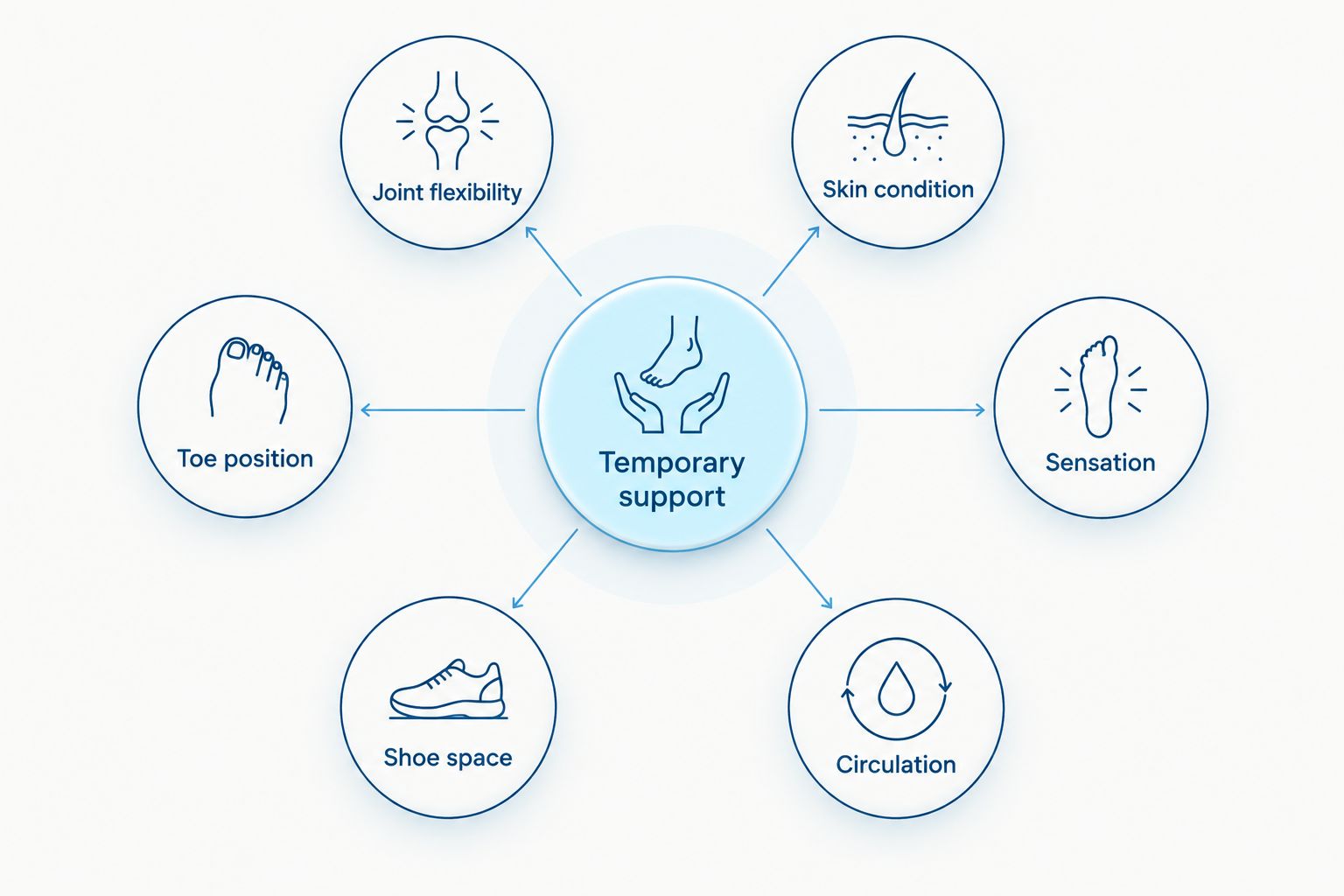
Why taping results vary
The same tape pattern does not suit every bent toe. These factors determine whether temporary support is appropriate and whether it stays comfortable:
- Joint flexibility: a movable toe can accept gentle support; a fixed joint cannot be forced straight safely.
- Skin condition: adhesive can irritate fragile skin, and tape should not cover an untreated wound.
- Sensation: reduced feeling can prevent you from noticing excessive pressure or skin injury.
- Circulation: poor blood flow increases concern about compression and healing problems.
- Shoe space: a shallow or narrow toe box can press tape and padding into the foot.
- Toe position: overlapping, sideways drift, or pain at the toe base can require a different approach from an isolated middle-joint bend.
A toe that crosses over its neighbor or feels unstable at its base should not be treated as a simple taping problem. Describe those changes during your appointment because they help guide the examination.
Who should avoid taping hammer toes without medical guidance?
Get medical guidance before taping if you have diabetes, reduced sensation, poor circulation, fragile skin, or a history of foot ulcers. These conditions change how safely you can detect and respond to pressure from tape.
Do not tape a toe with an open wound, drainage, unexplained swelling, or signs of infection. Increasing redness, warmth, tenderness, or pus needs prompt assessment, especially if you have diabetes.
Seek same-day medical advice for a new foot wound if you have diabetes or poor circulation. Rapidly spreading redness, fever with a foot infection, or a suddenly cold, pale, blue, or numb toe requires urgent medical attention.
For anyone with reduced sensation, the absence of pain is not proof that taping is safe. A visual skin check matters because pressure damage can occur without the warning you would normally feel.
When should you arrange a hammer toe evaluation?
Arrange an appointment when toe pain keeps returning, shoes become difficult to wear, or a corn comes back despite reducing pressure. A toe that is becoming less flexible also deserves assessment rather than repeated attempts to tape it straighter.
At Achilles Foot and Ankle Center, podiatry care includes foot and ankle diagnosis, treatment, and surgery. An evaluation can help establish whether the bend, footwear pressure, or another problem is responsible for your symptoms.
For patients in Mechanicsville and West End, the next step is the same: request a foot and ankle evaluation and explain what happens when you stand, walk, and wear your usual shoes. Bring the shoes that cause trouble and describe any taping you have tried.
A useful 2026 appointment checklist includes:
- Where the pain sits: on top of the joint, at the toe tip, between toes, or under the forefoot.
- Whether the toe moves comfortably or stays fixed.
- Any blistering, bleeding, numbness, drainage, or color change.
- What footwear and activities make symptoms better or worse.
- Diabetes, circulation problems, adhesive reactions, and previous foot wounds.
Can tape permanently straighten a hammer toe?
Tape cannot permanently straighten a hammer toe. It can temporarily support a flexible toe, but it does not reverse a fixed joint deformity or reliably remove the forces causing the bend.
If symptoms return whenever you remove the tape, do not respond by wrapping more tightly. Reassess footwear pressure and seek advice about a longer-term treatment plan.
Is buddy taping the same as hammer toe taping?
Buddy taping is not the same as an individualized hammer toe taping technique. Buddy taping joins one toe to a neighboring toe, while hammer toe support must account for the direction of the bend and the joints involved.
Do not assume instructions for a toe injury apply to a longstanding hammer toe. A newly painful or swollen toe after an injury needs assessment for the injury itself.
Can you sleep with hammer toe tape on?
Do not leave hammer toe tape on overnight unless your treating clinician specifically instructs you to do so. While asleep, you are less able to notice tightening, skin irritation, or a change in sensation.
Follow the wear and removal plan given for your skin and taping method. There is no single wear schedule that is right for everyone.
FAQ
What’s the safest way to tape a hammer toe at home?
The safest approach is to use a technique demonstrated for your toe by a qualified clinician. Tape only intact skin, avoid tight circular wrapping, and remove the tape if pain, numbness, swelling, or color changes develop.
Can I fix a hammer toe without surgery?
Nonsurgical care can reduce discomfort and pressure, but it does not reliably reverse the deformity. Roomier footwear, appropriate padding, and clinician-guided support are options; persistent symptoms need evaluation.
Should I pull my hammer toe straight before taping?
Do not force a hammer toe straight. A flexible toe should move comfortably with gentle assistance; pain or resistance is a reason to stop and arrange an assessment.
Can I tape my toes if I have diabetes?
Get medical guidance before taping your toes if you have diabetes. Reduced sensation, circulation problems, or fragile skin can make pressure and adhesive injuries harder to detect and heal.
Is padding better than tape for a hammer toe?
Padding and tape serve different purposes: padding cushions friction, while tape temporarily supports position. Either can worsen pressure if it crowds your shoe, so choose based on the problem and your clinician’s advice.
What should I do if my toe turns numb after taping?
Remove the tape immediately if your toe becomes numb. Seek urgent medical care if normal sensation, warmth, or color does not return after removal, or if the toe remains cold, pale, or blue.
When should I see a podiatrist instead of trying more tape?
See a podiatrist for persistent pain, a stiff toe, recurring corns, or difficulty wearing shoes. An open sore, drainage, or increasing redness needs prompt medical attention rather than another taping attempt.
One last thing
Before adding more tape, check the space above your toe. A shoe can feel roomy at the sides while its upper still presses directly on the bent joint.
For your 2026 foot-care plan, make intact skin and comfortable movement the priorities. Achilles Foot and Ankle Center offers podiatry evaluation when temporary measures are not enough; the aim is to help you understand the cause and choose appropriate care, not to promise a particular outcome.
Related guides
- Can bunions be treated without surgery?
- How often should diabetics check their feet?
- Can a foot wound get infected quickly?