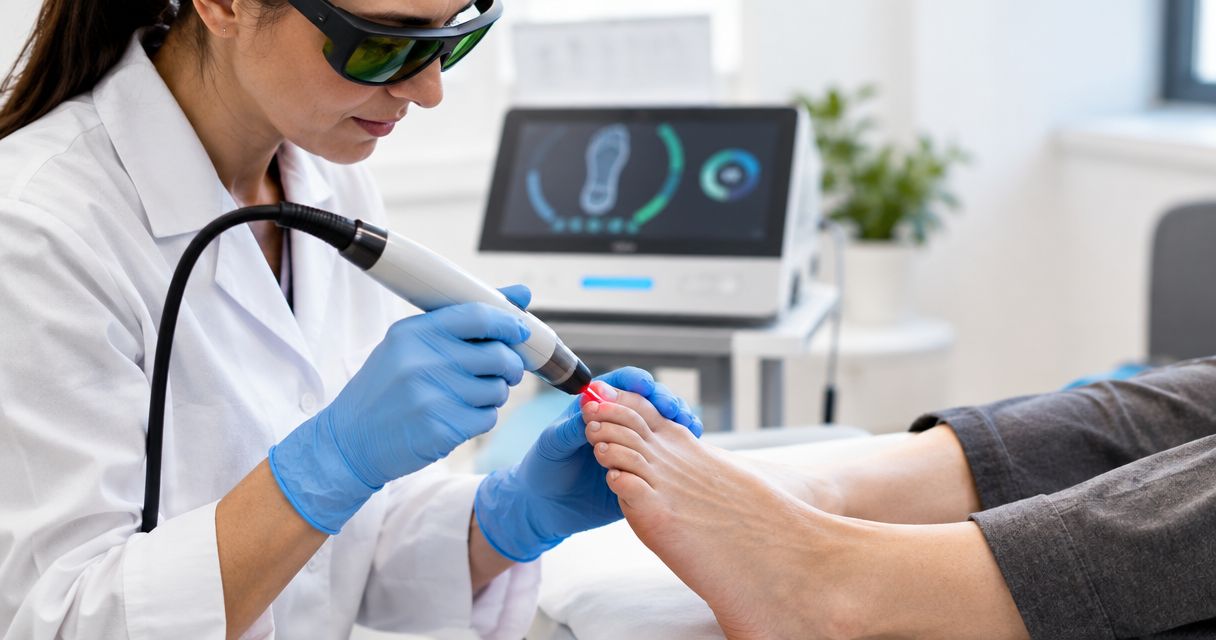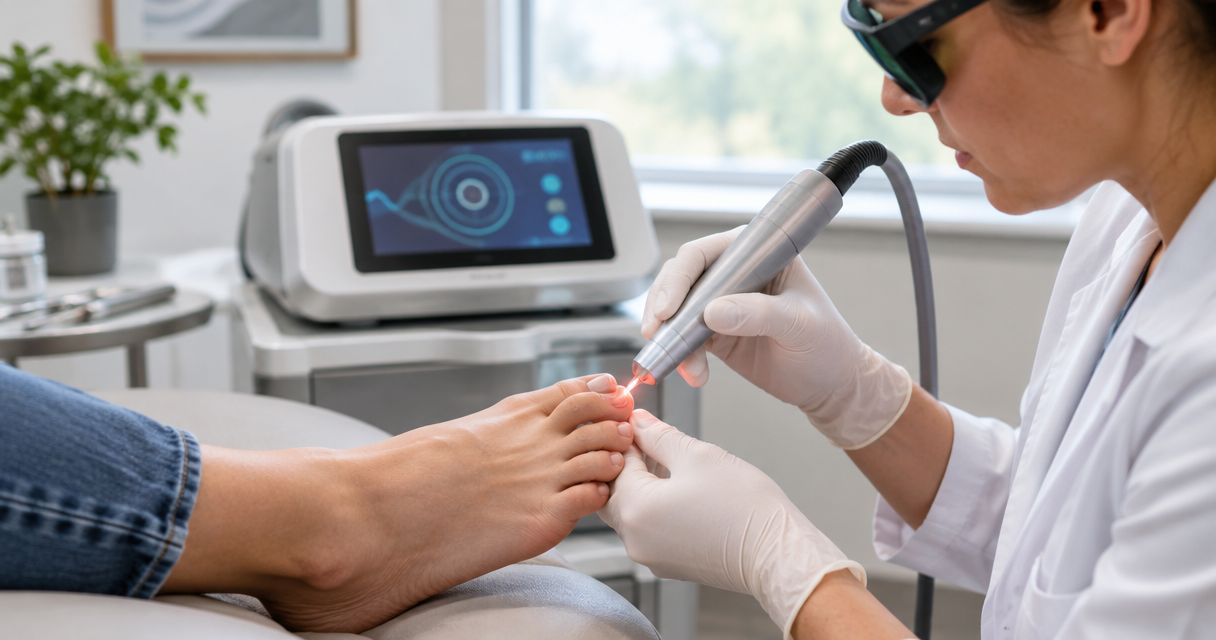

Yes, toenail fungus can come back after laser treatment because the original infection can persist or a new infection can develop. A clearer-looking nail does not prove that the fungus is gone, and an older damaged nail can remain discolored while it grows out. If your nail changes again, confirm the cause before repeating treatment.
- Can toenail fungus come back after laser treatment? Yes—persistent infection and reinfection are different reasons for recurring changes.
- Laser treatment does not guarantee fungal clearance; nail appearance alone cannot confirm success.
- Achilles Foot and Ankle Center provides foot and ankle care for patients seeking evaluation of recurring nail changes.
- Treat athlete’s foot, keep feet dry, and avoid sharing nail tools to reduce opportunities for reinfection.
Can toenail fungus come back after laser treatment?
Yes. Laser treatment does not provide permanent protection against toenail fungus. A nail that looks better after treatment can develop changes again, but those changes need a diagnosis rather than an automatic repeat procedure.
Your next step depends on whether the infection never cleared, returned after clearing, or was never the cause of the nail changes. The guide to toenail fungus treatments explains the broader treatment choices to discuss with a podiatrist.
| Possible explanation | What it means | What helps clarify it |
|---|---|---|
| Persistent infection | Fungus remains despite treatment | Review the original diagnosis, treatment, and need for nail testing |
| Recurrent infection | Fungal infection develops after apparent improvement | Reassess the nail and possible sources of exposure |
| Old nail damage | Previously damaged nail has not finished growing out | Examine new growth near the nail base and follow its progress |
| Another nail condition | Injury, psoriasis, or another problem resembles fungus | Examine the nail and test when appropriate |
Appearance alone cannot reliably separate these explanations. A yellow or thick nail is a reason to investigate, not proof that laser treatment failed.
Why this matters
Repeating treatment without confirming the diagnosis can leave the actual problem untreated. Nail injury, pressure from shoes, and inflammatory skin conditions can all produce changes that resemble a fungal infection.
For a treatment decision in 2026, separate cosmetic improvement from fungal clearance. The U.S. Food and Drug Administration describes certain laser devices as cleared for a temporary increase in clear nail—not as proof of permanent eradication of the infection.
That distinction helps you ask a useful question: what outcome is the proposed treatment intended to achieve, and how will your clinician assess it? Ask about both the appearance of the nail and evidence that the infection has cleared.
Why toenail fungus returns or appears to return
Recurring nail changes do not necessarily mean you did something wrong. Several factors can keep an infection present, create another exposure, or make recovery difficult to judge.
- Incomplete clearance: A nail can look better while fungal infection remains. Visual improvement and fungal clearance are different outcomes.
- Athlete’s foot: Fungal infection on the surrounding skin can act as a source of infection for the nails. Peeling or itchy skin between the toes deserves attention too.
- Damp footwear: Fungi thrive in warm, moist environments. Repeatedly wearing damp shoes or socks creates conditions that favor fungal growth.
- Shared exposure: Communal changing areas, shared nail tools, and inadequately cleaned pedicure equipment provide opportunities for exposure.
- Repeated nail injury: Pressure from tight footwear or repeated impact can damage the nail and make it more susceptible to infection.
- Health conditions: Diabetes, poor circulation, and a weakened immune system can make fungal nail problems harder to manage and change the safest treatment approach.
Prevention reduces opportunities for reinfection; it does not guarantee that fungus will never return. Your plan should address the nail, the surrounding skin, and everyday sources of moisture or injury.
Does a thick or yellow nail mean laser treatment failed?
A thick or yellow nail does not, by itself, prove treatment failure. Toenails grow slowly, and the damaged portion must grow out rather than instantly become normal.
The American Academy of Dermatology explains that a toenail can take 12 to 18 months to grow out. That interval describes nail replacement, not a promise that treatment will work or a reason to ignore worsening symptoms.
Look at the nail near its base, where new growth appears. A clearer section that gradually moves toward the tip is useful information for your clinician, but it does not replace an examination or testing when needed.
Photos can help you describe change at a 2026 follow-up visit. Use similar lighting and angles, and record the date rather than judging the nail from memory.
New dark pigmentation, bleeding, increasing pain, or a change that does not fit the expected pattern needs assessment. Do not assume every unfamiliar nail change is fungus.
What should you do when nail changes return?
Arrange an evaluation before scheduling another laser course. A structured review can distinguish ongoing infection from reinfection, slow nail growth, or a different nail disorder.
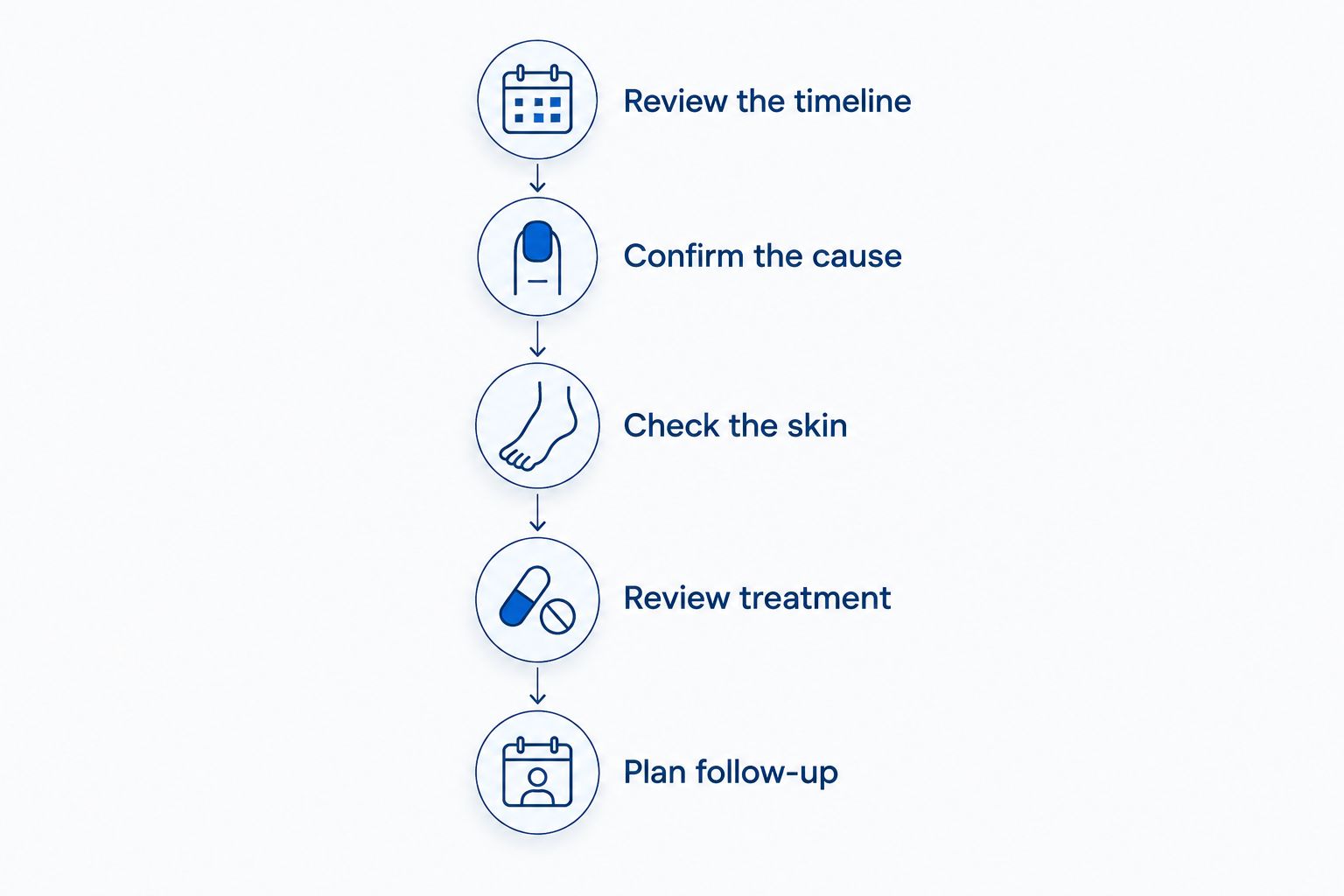
- Review the timeline. Note when treatment ended, whether clear nail appeared near the base, and when discoloration or thickening changed again.
- Confirm the cause. A clinician examines the nail and surrounding skin. A nail clipping or scraping can help confirm fungus when the diagnosis is uncertain or before treatment decisions that require confirmation.
- Check the skin. Mention itching, peeling, cracks, or scaling between the toes. Treating the nail alone leaves associated athlete’s foot unaddressed.
- Review treatment. Bring the names of prescription medicines, nonprescription products, and previous procedures. Explain how you used them and any side effects.
- Plan follow-up. Agree on what improvement should look like, when to reassess it, and which changes warrant earlier contact.
Bring a medication list, including supplements, even if you expect to discuss only laser treatment. Previous testing results and treatment records also help your clinician understand what has already been tried.
The path from unsuccessful OTC care to a laser discussion provides more context for preparing that conversation. It is a discussion pathway, not a reason to assume laser is your required next step.
What treatments can you discuss after laser?
Your treatment choice depends on confirmed infection, how much of the nail is involved, other health conditions, and your preferences. A recurring problem does not automatically require the same treatment again.
Use this 2026 discussion checklist to compare the purpose and limitations of each approach. These are categories to review with your clinician, not instructions to start treatment yourself.
| Approach | Best for discussion when | Main advantage | Main limitation |
|---|---|---|---|
| Prescription topical antifungal | Infection is limited and the nail pattern is suitable | Treats the nail without an oral medicine | Requires consistent use; penetration into thick nail is limited |
| Oral antifungal | Infection is more extensive or other treatment has not worked | Generally more effective than topical treatment for suitable patients | Requires review of interactions, liver health, and monitoring needs |
| Laser treatment | You want to understand a device’s specific role | Some devices are cleared for temporary improvement in clear nail | Does not establish permanent fungal clearance; supporting evidence varies |
| Nail thinning or debridement | Thick nail causes pressure or complicates nail care | Reduces nail bulk and can support other care | Does not reliably eliminate fungal infection by itself |
Debridement means carefully reducing thickened or damaged nail. It is not the same as removing the entire nail, and it should not be attempted with sharp household tools.
The best next treatment is the one that fits a confirmed diagnosis and your health history. Ask what the clinician expects each option to accomplish, what its limitations are, and how success will be assessed.
How can you reduce reinfection after treatment?
A practical prevention plan focuses on dry skin, clean tools, and less nail trauma. You do not need an elaborate routine, but you do need habits you can maintain.
- Dry between your toes. After washing, dry the spaces between your toes rather than leaving moisture trapped there.
- Change damp socks. Replace socks after sweating or whenever they become wet. Let footwear dry between uses.
- Protect your feet in shared wet areas. Wear suitable footwear in communal showers and changing rooms.
- Keep nail tools personal. Do not share clippers or files. Clean tools according to their instructions.
- Address athlete’s foot. Ask about treatment for persistent itching, scaling, or peeling rather than treating only the nail.
- Reduce shoe pressure. Choose enough toe room to avoid repeated rubbing or impact against the affected nail.
For your 2026 prevention plan, choose changes that match your actual exposures. Someone who spends the workday in sweaty boots needs a moisture-management plan; someone with repeated shoe pressure needs a fit review.
Avoid cutting deeply into nail corners, digging beneath a lifted nail, or applying bleach and other household chemicals. These actions can injure the surrounding skin without reliably treating the infection.
When should you seek care sooner?
Spreading redness, warmth, swelling, drainage, or increasing pain needs prompt medical assessment. These changes can signal a bacterial infection or another problem beyond uncomplicated nail fungus.
Seek urgent medical attention for rapidly spreading redness, fever, red streaking, or feeling unwell. An open sore or a newly blackened area also deserves prompt assessment, particularly if you have diabetes or circulation problems.
If you have diabetes, inspect your feet at least 1 time each day. Reduced sensation can make a cut or pressure injury difficult to notice, so pain is not a dependable warning sign.
Do not aggressively trim a thick nail if you have reduced sensation, poor circulation, or difficulty seeing your feet. Ask for help with safe nail care instead.
Where can you get recurring toenail changes evaluated?
Achilles Foot and Ankle Center is appropriate for Richmond-area patients seeking podiatry evaluation of recurring nail changes. An examination can guide the next discussion without assuming that another laser treatment is necessary.
Patients in Mechanicsville and West End should bring the same essentials: a medication list, previous nail-test results if available, and a brief treatment timeline. Mention diabetes, circulation problems, reduced sensation, and any broken skin when arranging care.
Achilles Foot and Ankle Center provides foot and ankle care; the purpose of evaluation is to identify the problem and discuss suitable next steps. No examination or treatment can guarantee permanent protection against reinfection.
Discuss recurring toenail changes
Learn about foot and ankle care before deciding whether to repeat treatment.
FAQ
Can toenail fungus come back after laser treatment even if my nail looked clear?
Yes, toenail fungus can return after a nail looks clear. Infection can persist despite cosmetic improvement, or a new infection can develop after treatment.
How long does a toenail take to look normal after fungus treatment?
A toenail can take 12 to 18 months to grow out, according to the American Academy of Dermatology. That is a nail-growth timeframe, not a guaranteed treatment result; persistent injury or another nail condition can also affect appearance.
Should I book another laser session if my toenail turns yellow again?
Have the nail reassessed before booking another laser session. Yellowing can reflect persistent fungus, new infection, old damage, or another nail disorder, and the next step depends on the cause.
Can athlete’s foot spread fungus back to my toenails?
Yes, athlete’s foot can act as a source of fungal infection for the toenails. Tell your clinician about peeling, itching, or cracking so the surrounding skin is addressed along with the nail.
Does FDA clearance mean a nail laser permanently cures fungus?
No, FDA clearance for a temporary increase in clear nail does not mean a laser permanently cures fungal infection. Ask what the specific device is cleared to do and how your clinician will assess the result.
Should I treat recurring toenail fungus myself if I have diabetes?
Arrange professional advice rather than cutting deeply into the nail or applying harsh chemicals if you have diabetes. Seek prompt assessment for broken skin, drainage, redness, warmth, or swelling.
Can Achilles Foot and Ankle Center evaluate a toenail that changed after treatment?
Achilles Foot and Ankle Center provides podiatry care for foot and ankle concerns, including recurring nail changes. Bring your treatment history and mention any pain, skin changes, diabetes, or reduced sensation.
One last thing
Watch where the change starts, not just what color the nail is. Old discoloration moving toward the tip tells a different story from new discoloration appearing near the base, although neither observation confirms a diagnosis by itself.
Before your next appointment in 2026, take a clear, dated photo and write down whether the change is spreading, painful, or affecting other nails. That record gives your clinician more useful information than a general impression that the fungus is back.
Related guides
- How often should diabetics check their feet?
- Can diabetics get pedicures safely?
- Is it safe to cut out an ingrown toenail at home?