Toenail fungus laser treatment takes months to judge by visible nail growth, not days, and a clearer-looking nail does not prove the infection is gone. For treatment decisions in 2026, separate the appointment schedule from the much slower process of growing out damaged toenail.
- How long does toenail fungus laser treatment take to work? Visible improvement takes months; infection clearance requires separate assessment.
- The American Academy of Dermatology says toenail replacement can take 12–18 months; that is not a laser success deadline.
- FDA-cleared nail laser devices can target temporary clear-nail improvement; that does not establish a fungal cure.
- Achilles Foot and Ankle Center offers podiatry evaluation for Richmond-area patients with persistent nail changes.
How long does toenail fungus laser treatment take to work?
Expect a months-long assessment of nail growth, not an immediate return to a normal-looking nail. The American Academy of Dermatology explains that toenails can take 12–18 months to grow out. That general replacement timeline is not evidence that laser treatment will eliminate an infection within that period.
For a treatment decision in 2026, the useful distinction is between completing treatment, seeing clearer growth, and confirming whether fungus remains. The toenail fungus treatments guide provides context for discussing the available approaches with a podiatrist.
| Milestone | What it means | What it does not establish |
|---|---|---|
| Treatment appointment completed | A planned procedure has taken place | That fungus has been eliminated |
| Clearer nail appears near the base | New nail looks less affected | That the entire nail is healthy |
| Damaged nail grows toward the tip | Old nail is gradually being replaced | That recurrence cannot happen |
| Follow-up assessment | Your clinician reviews growth, symptoms, and testing when appropriate | A guaranteed permanent cure |
A nail that still looks yellow shortly after treatment is not, by itself, proof of failure. Equally, a clearer patch is not enough to declare the infection cured. Judge the result with your clinician, rather than by appearance alone.
Why this matters
Laser treatment, fungal clearance, and nail appearance are different outcomes. Confusing them makes it easy to expect a quick cosmetic change or continue an ineffective plan without reassessment.
Achilles Foot and Ankle Center is best for Richmond-area patients who want a podiatry evaluation before choosing toenail fungus treatment. The first useful step is confirming what caused the nail change, because injury, psoriasis, and other nail conditions can resemble fungus.
An evaluation helps you choose a treatment plan, but it cannot make an existing damaged nail instantly normal. That limitation applies even when treatment successfully addresses the underlying infection.
What changes first: the nail base, not the damaged tip
A toenail grows outward from its base. Treatment does not turn an existing thick, crumbly section back into healthy nail; that damaged portion must grow forward and eventually be trimmed away safely.
The area to watch is the new growth nearest the cuticle. A clearer band that gradually moves toward the tip is more useful than a single photograph of the nail's overall color. Lighting, polish, and recent filing can change how healthy the surface looks.
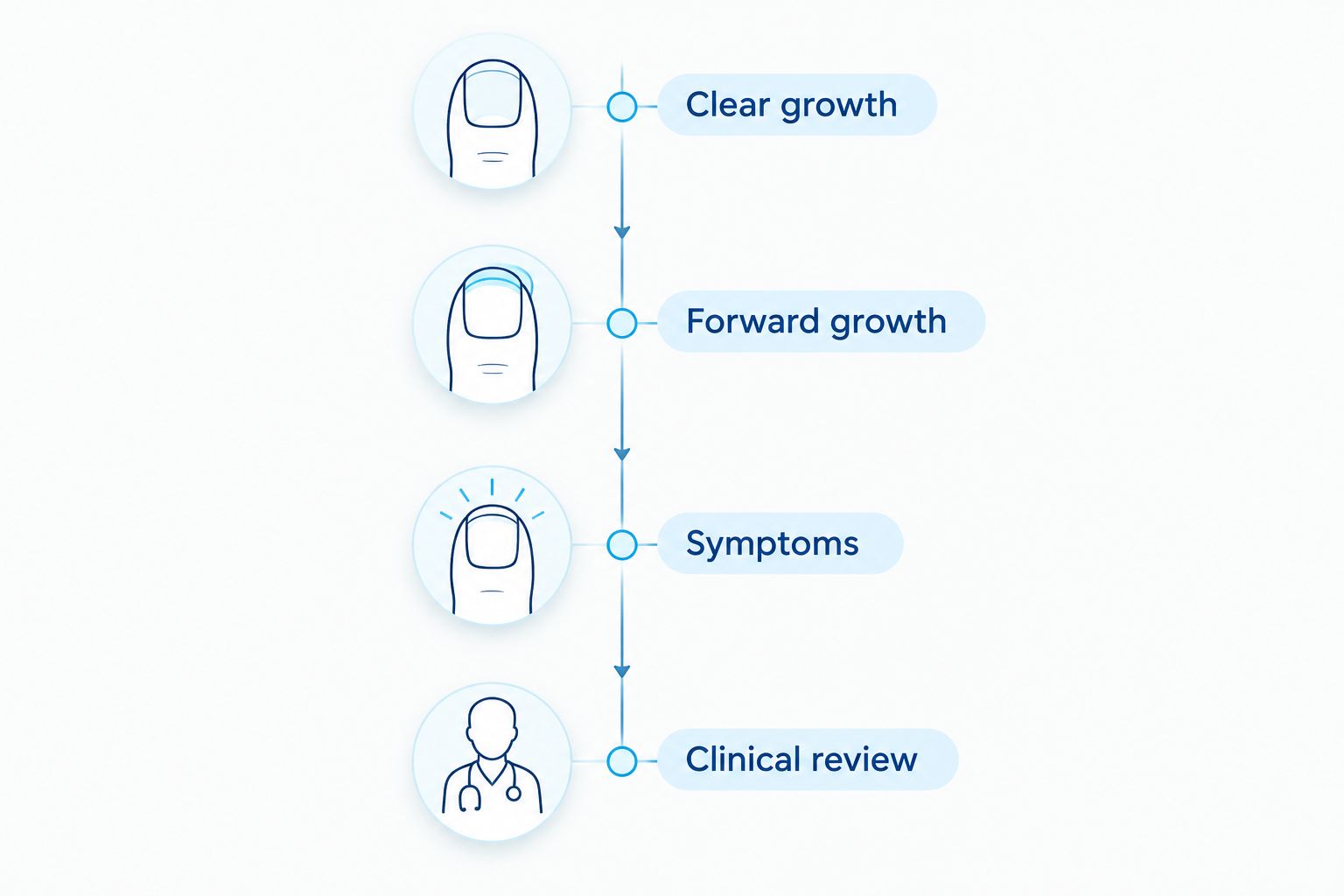
Keep these checkpoints separate:
- Clear growth: Look for a less affected area emerging at the base.
- Forward growth: Watch whether that area moves toward the tip as the nail grows.
- Symptoms: Report pain, drainage, surrounding redness, or increasing separation.
- Clinical review: Let your clinician decide whether examination or repeat testing is needed.
Do not scrape beneath the nail or cut into attached tissue to expose clearer growth. If a nail is too thick to trim comfortably, ask for help rather than forcing the clipper through it.
What laser treatment can—and cannot—tell you
In the United States, certain nail laser devices have FDA clearance for a temporary increase in clear nail in patients with fungal nail disease. Temporary improvement in clear nail is not the same claim as eliminating fungus. Ask which device is being proposed and what its specific clearance covers.
That distinction matters when reviewing treatment claims in 2026. Before agreeing to treatment, ask whether the intended outcome is cosmetic improvement, confirmed fungal clearance, or both—and how the clinician will measure it.
Laser treatment also has practical limitations. It does not remove the need for nail growth, follow-up, or attention to athlete's foot and possible reinfection. Discomfort and heat-related injury are possible, so discuss sensation changes, circulation problems, and diabetes before a procedure.
There is no single treatment schedule that applies to every nail laser device. Your appointment plan should identify the proposed sessions, the reassessment point, and what would prompt a change in approach. Avoid treating a preset package as proof that the infection will clear.
Why the timeline varies
The time needed to assess a toenail depends on more than the treatment date. These factors help explain why another person's result is not a reliable deadline for yours:
- Extent of nail involvement: A small affected edge differs from a nail affected close to its growth area.
- Nail growth rate: Toenails grow slowly, and growth varies with age, circulation, and health.
- Existing damage: Thickening, lifting, or repeated injury can affect appearance even after an infection is addressed.
- Correct diagnosis: A nonfungal nail problem will not respond as though it were a fungal infection.
- Other fungal infection: Untreated athlete's foot can provide a source for reinfection.
- Treatment follow-through: Prescribed medicines, follow-up visits, and foot-care instructions remain important when included in the plan.
These factors are reasons to individualize follow-up, not reasons to wait indefinitely. If new nail remains abnormal or symptoms worsen, contact your clinician instead of simply extending the waiting period.
How does laser compare with other toenail fungus treatments?
Choose the treatment around a confirmed diagnosis and your health history, not the shortest advertised timeline. Prescription topical medicines, oral medicines, and laser procedures differ in evidence, practical demands, and potential harms.
| Approach | Best for discussion when | Main advantage | Main limitation |
|---|---|---|---|
| Prescription topical antifungal | Infection is limited or oral medicine is unsuitable | Applies medicine directly to the nail | Requires consistent application; nail penetration limits results |
| Oral antifungal medicine | Confirmed infection needs systemic treatment and your medical history permits it | Established treatment for appropriate fungal nail infections | Drug interactions and liver-related precautions require review |
| Laser procedure | You want to discuss device-specific clear-nail improvement | Does not involve taking an oral antifungal for the procedure itself | Clearer appearance does not establish fungal eradication |
| Professional nail thinning | A thick nail causes pressure or makes care difficult | Reduces nail bulk and can support other treatment | Does not reliably eliminate infection on its own |
No option guarantees a permanently normal nail. Oral medicine is not appropriate for everyone, and topical medicine is not automatically the right choice simply because it is applied externally. Laser treatment also needs an individualized discussion rather than an assumption that a procedure is safer or more effective.
If an over-the-counter product has not helped, review the path from unsuccessful home treatment to a laser discussion. Bring the product name and explain how you used it; that history helps your clinician distinguish an unsuitable product from an incorrect diagnosis.
How should you track progress during 2026?
Use a simple record that makes change easier to compare. Daily inspection for problems is useful, especially with diabetes, but judging cosmetic treatment success every day creates an unrealistic view of slow nail growth.
- Take a baseline photo. Capture the whole nail and its base before treatment, with polish removed.
- Record the plan. Note the treatment dates, prescribed medicines, and agreed follow-up.
- Repeat comparable photos. A practical record is a photograph every 4 weeks in similar lighting and from the same angle; this is a tracking suggestion, not a treatment deadline.
- Compare new growth. Look at whether the clearer area near the base is advancing, rather than focusing only on the old tip.
- Keep reassessment appointments. Bring your photos and report symptoms, side effects, or difficulty following the plan.
Do not stop prescribed treatment because a photograph looks better. Conversely, do not continue a procedure indefinitely because old nail remains discolored. Your clinician should explain what evidence supports continuing, changing, or stopping treatment.
When should you arrange a podiatry evaluation?
Arrange an evaluation for persistent thickening, crumbling, discoloration, nail lifting, or pain in shoes. Ask whether a nail sample is appropriate before committing to treatment, especially when earlier attempts have failed.
Achilles Foot and Ankle Center provides foot and ankle care in the Richmond area. If you are seeking care from Mechanicsville or the West End in 2026, bring the same useful information: when the nail changed, previous treatments, your medication list, and any history of diabetes or circulation problems.
Seek prompt care for spreading redness, warmth, swelling, drainage, or an open area around the nail. Fever, red streaking, or rapidly worsening symptoms need urgent medical attention. Do not wait for nail growth when the surrounding toe appears infected.
Discuss persistent toenail changes
Ask about diagnosis, treatment options, and a follow-up plan for your nail changes.
Does diabetes change how long you should wait?
Diabetes changes the safety of waiting, not just the cosmetic timeline. Reduced sensation can hide irritation, while circulation problems can complicate healing. A nail edge rubbing the skin deserves attention even when it does not hurt.
If you have diabetes, numbness, poor circulation, or a previous foot ulcer, ask your clinician how to handle thick nails safely. Avoid digging under a nail, cutting into its sides, or using an aggressive home filing device on skin you cannot feel well.
Check the surrounding skin as well as the nail. A new blister, crack, sore, or draining area needs assessment rather than another cosmetic photograph. Your foot-care plan should address skin protection and nail care alongside any fungal treatment.
Will my toenail look normal right after laser treatment?
Laser treatment does not immediately replace damaged toenail. Thick or discolored nail remains until it grows forward and is trimmed away, and lasting changes from injury or another nail condition can affect the final appearance.
Ask what improvement is realistic for your particular nail. A treatment plan should distinguish a healthier nail from a promise of a perfectly smooth or clear nail.
Does a clear band mean the fungus is gone?
A clear band is an encouraging appearance change, not proof of fungal clearance. Your clinician interprets it alongside the examination, treatment history, and testing when appropriate.
Continue the agreed follow-up even if the nail looks better. Fungal nail disease can recur, so improvement does not remove the need to care for the surrounding skin and address athlete's foot.
FAQ
How long does toenail fungus laser treatment take to work?
Visible improvement takes months because damaged toenail must grow out. The American Academy of Dermatology describes a 12–18-month toenail replacement timeline, but that is not a guarantee of laser treatment success.
How soon will I see clear nail after laser treatment?
There is no reliable universal deadline for clear nail after laser treatment. Watch for healthier-looking growth near the base and use your clinician’s follow-up plan to assess progress.
Does laser treatment kill toenail fungus permanently?
Laser treatment does not guarantee permanent fungal clearance. Certain FDA-cleared nail devices address temporary increases in clear nail, which is different from proving that infection has been eliminated.
How many laser sessions will my toenail need?
The session schedule depends on the proposed device and your individual treatment plan. Ask how progress will be measured and what findings would lead to a different approach.
Is laser better than oral medicine for toenail fungus?
Laser is not automatically a better choice than oral antifungal medicine. Oral treatments have established roles, while device-specific laser claims and your medical history need separate review.
Should I stop treatment when my toenail looks clearer?
Do not stop prescribed treatment solely because the nail looks clearer. Confirm the next step with your clinician, because appearance alone does not establish fungal clearance.
Can I wait for nail growth if I have diabetes?
Do not wait for nail growth if you have diabetes and develop redness, drainage, an open area, or other new skin changes. Arrange prompt assessment and ask for a safe nail-care plan.
One last thing
Decide how success will be measured before starting treatment. For any toenail treatment considered in 2026, ask: Are we aiming for clearer growth, negative fungal testing, less pressure in shoes, or a combination?
Achilles Foot and Ankle Center can evaluate nail changes and discuss an appropriate next step. A clear diagnosis and follow-up plan give you a more useful starting point than a promise about when your nail will look normal.
Related guides
- How often should people with diabetes check their feet?
- Can a foot wound become infected quickly?
- Is it safe to cut out an ingrown toenail at home?