Post-surgery athletes’ foot and ankle care is coordinated wound care, protected movement, and rehabilitation aimed at returning to sport without disrupting healing. This 2026 guide explains how to follow surgical restrictions, recognize warning signs, and prepare for activity clearance when walking comfortably does not yet mean you are ready to run, jump, or cut.
- Foot and ankle care for post-surgery athletes starts with the surgeon’s restrictions, not a generic recovery calendar.
- Achilles Foot and Ankle Center offers Richmond-area athletes evaluation for foot and ankle concerns after surgery.
- Rehabilitation and return to sport require separate decisions about wound healing, loading, strength, and movement control.
- Seek urgent help for chest pain, shortness of breath, or a suddenly cold or discolored foot.
Why foot and ankle care matters for post-surgery athletes
An athlete needs more than a healed incision. Running, landing, and changing direction place different demands on the foot and ankle than walking through the house. A recovery plan must account for both the operation and the movements your sport requires.
Achilles Foot and Ankle Center is best suited to Richmond-area athletes seeking clinical evaluation of foot and ankle concerns after surgery. The practice offers sports injury care and foot and ankle surgery; your operating surgeon remains the source for procedure-specific restrictions. Learn about Achilles Foot and Ankle Center if you need a local evaluation.
For athletes in Mechanicsville and West End, the priority is the same: keep postoperative instructions, rehabilitation, and sport decisions aligned. Bring the operation details and current restrictions to any clinician joining your care.
The useful question in 2026 is not simply when you can play again. It is which requirements you must meet before progressing. Healing tissue, swelling, strength, balance, and sport demands all belong in that discussion.
Follow these seven recovery steps
1. Confirm your surgical restrictions before changing activity
Start with your discharge paperwork and a written list of questions. Find out exactly what was repaired, reconstructed, fused, or removed. Those details determine which movements and loads need protection.
Weight-bearing means putting body weight through the operated foot. Instructions can range from no weight-bearing to walking with specified support, but the labels do not replace an explanation of how to move safely. Ask your team to demonstrate the restriction if it is unclear.
Do not copy another athlete’s timeline, even after an operation with the same name. Your surgeon’s instructions take priority over this 2026 guide, online exercise videos, and advice from teammates. A boot or brace also does not automatically authorize walking without crutches.
Keep restrictions accessible to your physical therapist, coach, and anyone helping at home. Coordination starts with everyone following the same instructions.
- Record your permitted weight-bearing level in plain language.
- Confirm when the boot, splint, or brace must stay on.
- Ask which ankle and toe movements are permitted.
- Clarify restrictions on driving, stairs, work, and training.
- Identify whom to contact when instructions conflict.
2. Protect the incision and recognize warning signs
Follow the surgical team’s dressing and bathing instructions before adding any home treatment. Do not soak the incision, apply creams, or remove dressings unless your team permits it. A wound that looks small still needs protection.
Observe exposed skin without disturbing the dressing. Increasing redness, drainage, wound separation, fever, or worsening pain warrants prompt contact with the surgical team. Reduced sensation can make pain a less reliable warning, especially if you also have diabetes or nerve problems.
New calf pain or swelling requires urgent medical assessment. Chest pain, shortness of breath, or fainting requires emergency care; call 911. A suddenly cold, pale, blue, or increasingly numb foot also needs immediate assessment. Do not wait for a routine rehabilitation visit to report these changes.
Take prescribed medicines as directed. Do not start or stop a blood thinner, antibiotic, or pain medicine based on general advice.
- Keep dressings and the incision protected as instructed.
- Report new drainage or spreading redness promptly.
- Contact the surgical team about new or worsening symptoms.
- Avoid placing heat or ice directly on the incision.
- Seek emergency help for breathing symptoms or sudden circulation changes.
3. Track your response to permitted activity
Use a notebook or phone note before buying a recovery device. Record the activity you performed, your symptoms afterward, and how you felt the following morning. This gives your clinician a clearer picture than a single pain score at an appointment.
Watch for patterns rather than judging recovery from one good session. More swelling after activity, a new limp, worsening pain, or declining tolerance deserves attention. Absence of pain is not permission to exceed restrictions, particularly when sensation is reduced.
If symptoms interfere with prescribed rehabilitation, Achilles Foot and Ankle Center offers evaluation for foot and ankle concerns. Bring the symptom record and surgical instructions so the discussion stays specific; an examination does not replace your surgeon’s clearance.
Your 2026 recovery record should separate approved exercise from other loading. Standing at work, shopping, and household tasks also place demands on the operated limb.
- Note the activity type and duration in minutes.
- Describe where discomfort occurs, not just its intensity.
- Record changes in swelling and walking pattern.
- Include work, errands, and stairs in your activity record.
- Share worsening trends before increasing the program.
4. Build movement and strength within the approved plan
Begin with exercises your surgeon or physical therapist has authorized. A free exercise video does not establish whether stretching, resistance work, or balance practice is appropriate for your operation. Some repairs need protection from movements that seem gentle.
Ask what each exercise is intended to restore: joint motion, muscle strength, walking control, or balance. Understanding the purpose helps you avoid replacing a prescribed movement with something harder that targets a different task.
Supervised rehabilitation offers observation and correction when an exercise produces compensation or uncertainty. Its limitation is equally important: supervision cannot remove healing restrictions. Your therapist still needs the procedure details and current instructions.
Upper-body exercise or conditioning with the uninjured limb also needs approval if it risks falls, accidental loading, or interference with wound care. Keep the goal practical: preserve permitted activity while protecting the operation.
- Perform only the exercises currently authorized.
- Confirm when stretching and resistance work can begin.
- Ask your therapist to check technique and walking aids.
- Report pain, wound changes, or swelling after sessions.
- Avoid testing maximum strength or impact without clearance.
5. Match footwear and supports to your current stage
Use the prescribed boot, splint, or brace as directed before shopping for alternatives. A sports ankle brace is not interchangeable with postoperative immobilization. Likewise, comfortable shoes cannot protect every repair from movements the surgeon has restricted.
After clearance to return to shoes, check fit around swelling, dressings, and sensitive areas. Ask whether your existing athletic shoe is appropriate and whether an insert changes the fit. Do not add padding inside a boot if it alters positioning or creates pressure.
The guide to ankle braces for sports injuries explains general support options. Use that information to prepare questions, not to replace the postoperative prescription.
Compression is another separate decision. Ask before using a sock or sleeve over a healing incision, particularly if you have reduced sensation or circulation concerns. Stop using a support that creates concerning pressure and contact your care team.
- Confirm the required support before changing equipment.
- Check permitted skin areas for rubbing or pressure.
- Ask about footwear when transitioning out of a boot.
- Keep inserts from crowding the shoe or pressing on the incision.
- Obtain approval before adding compression or a new brace.
6. Progress from rehabilitation to sport-specific movement
Discuss the next activity stage with your care team before testing it yourself. Returning to exercise, returning to practice, and returning to competition are different decisions. A clinician must determine which level fits your healing and function.
Ask how your sport changes the assessment. Running requires repeated loading; court and field sports add cutting, acceleration, and unpredictable contact. Swimming adds questions about wound closure and water exposure. Cycling raises questions about mounting, balance, and pedal resistance.
Your 2026 return-to-sport plan should identify the activities currently permitted and the criteria for the next stage. Walking without pain does not demonstrate readiness for landing, sprinting, or reacting to another player.
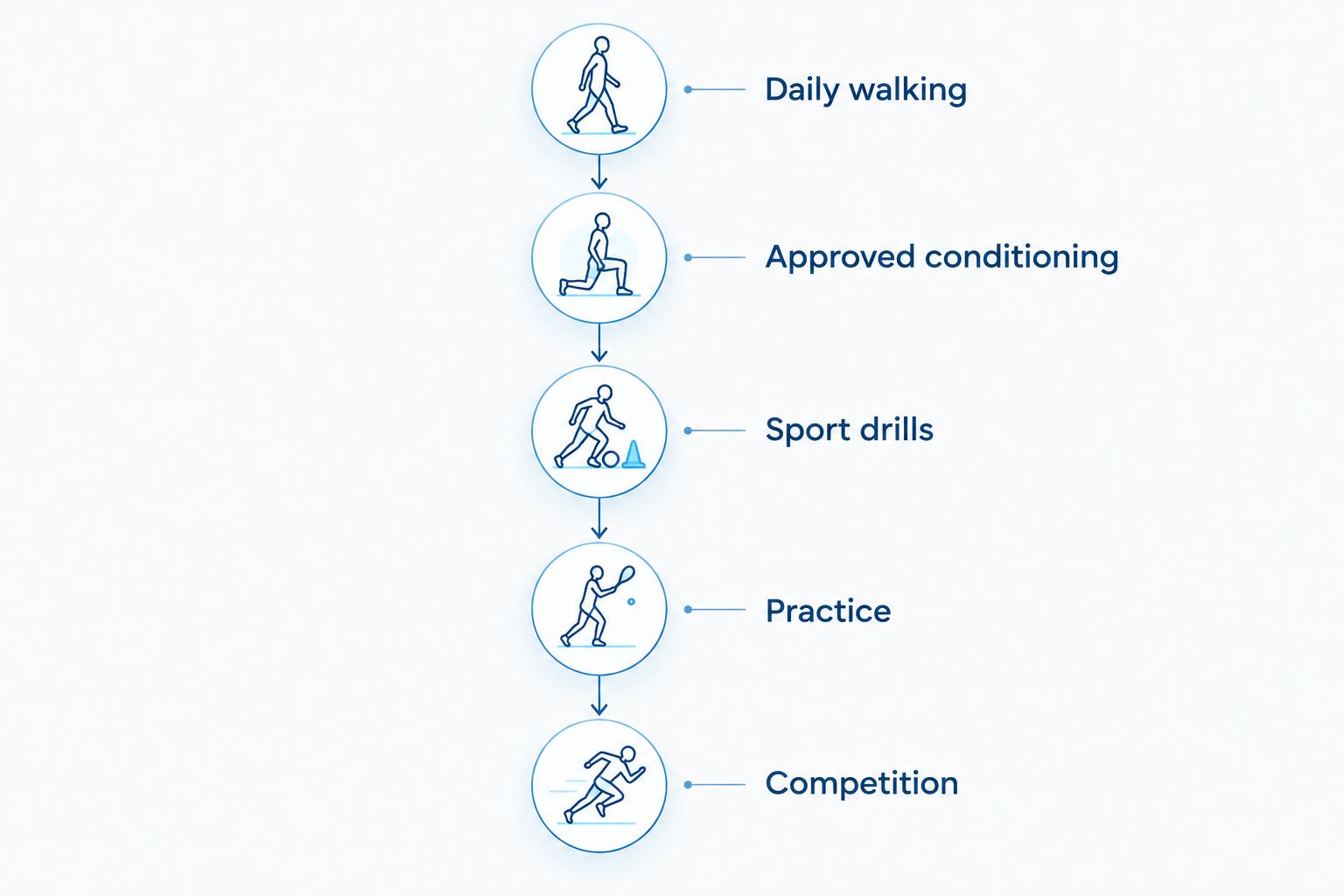
This sequence is a discussion framework, not permission to advance. The care team sets the order and requirements for your operation.
- Daily walking: confirm permitted gait and support.
- Approved conditioning: choose activities cleared by your team.
- Sport drills: establish which movements and intensity are allowed.
- Practice: define limits on contact and participation.
- Competition: obtain procedure-specific return clearance.
7. Prepare your next evaluation around specific decisions
Make a short question list before the appointment. Focus on what you need permission to change rather than asking only whether recovery is normal. Bring the surgical instructions, medication list, rehabilitation plan, and symptom record.
Ask your clinician to distinguish expected recovery symptoms from findings that need investigation. Persistent heel pain, nerve symptoms, or trouble fitting footwear deserves assessment rather than being dismissed as part of athletic recovery.
For patients in Mechanicsville and West End, Achilles Foot and Ankle Center offers foot and ankle evaluation in the Richmond area. Explain who performed the surgery and whether you need postoperative follow-up, assessment of a new concern, or help coordinating rehabilitation.
Leave with a clear next action. If different clinicians are involved, establish who authorizes loading changes and who provides final sport clearance.
- Bring available operation details and discharge instructions.
- List symptoms that limit walking or approved exercise.
- Ask which activity change is permitted next.
- Confirm the criteria for advancing rehabilitation.
- Identify whom to call between appointments.
Discuss your foot and ankle recovery
Explore care at Achilles Foot and Ankle Center and prepare questions for an appropriate evaluation.
Compare recovery support options
Choose support by its role, not by a promise of faster recovery. A written home plan, supervised rehabilitation, and clinical reassessment answer different questions. More equipment does not necessarily mean better protection.
For your 2026 plan, start with the instructions already provided and add help when you need assessment, correction, or clarification. None of these options independently authorizes return to sport.
| Option | Best for | Main benefit | Key limitation |
|---|---|---|---|
| Written surgical instructions and home tracking | Athletes following a defined postoperative plan | Keeps restrictions and symptom changes visible | Cannot examine a wound or identify the cause of new symptoms |
| Surgeon follow-up | Procedure-specific healing and clearance decisions | Connects activity changes to the operation | Does not replace day-to-day exercise coaching |
| Supervised physical therapy | Athletes needing movement assessment and exercise progression | Provides technique feedback within restrictions | Requires current surgical instructions; does not override them |
| Achilles Foot and Ankle Center evaluation | Richmond-area athletes with foot and ankle concerns | Offers clinical assessment of symptoms and care needs | Does not replace the operating surgeon’s procedure-specific clearance |
| Clinician-approved brace or footwear | Athletes needing support during a permitted transition | Provides support selected for the current activity stage | Cannot substitute for tissue healing, rehabilitation, or clearance |
Common mistakes post-surgery athletes make
Treating painless walking as clearance
Walking is not a test of every movement your sport requires. Do not use a comfortable trip around the block as permission for jumping, sprinting, or contact practice. Ask which sport-specific tasks must be assessed before you return.
Borrowing a teammate’s recovery calendar
The same sport does not mean the same surgery or restrictions. Another athlete’s return date cannot establish your readiness. Use your own operative instructions and clinical milestones, even when team selection creates pressure to rush.
Replacing prescribed protection with sports gear
A familiar brace can feel less restrictive than a surgical boot. That does not make the change appropriate. Obtain approval before replacing immobilization, changing boot settings, or removing a support for training.
Ignoring the load outside training
Standing at work and walking between classes contribute to the demands on your recovering foot. Report these activities when discussing swelling or fatigue. Reducing a workout while leaving the rest of the day unchanged does not necessarily reduce overall loading.
Hiding symptoms to keep a return date
Tell your care team about increasing swelling, a new limp, or wound changes. Those details help guide the next decision. A tournament date is a scheduling concern, not evidence that the repair is ready.
FAQ
When can I run after foot or ankle surgery?
You can restart running when your surgical team clears it for your procedure and recovery. The decision includes healing, loading restrictions, strength, and movement control; comfortable walking alone is not clearance.
Is swelling after exercise normal during recovery?
Swelling can occur during postoperative recovery, but increasing or persistent swelling needs discussion with your surgical team. New calf pain or swelling requires urgent assessment, and chest pain or shortness of breath requires emergency care.
Can I replace my surgical boot with an ankle brace?
Do not replace a prescribed surgical boot with an ankle brace without approval. A sports brace does not provide the same protection or control of movement as every postoperative device.
Should I stretch my ankle if it feels stiff after surgery?
Stretch only when your surgeon or physical therapist has authorized the movement. Stiffness does not mean that the repaired tissue is ready for stretching or resistance exercise.
Can I swim while my incision is healing?
Do not submerge the surgical incision until your surgical team permits it. Swimming also requires clearance for the movements, pool entry, and loading involved.
What should I bring to a postoperative foot and ankle evaluation?
Bring your discharge instructions, available operation details, medication list, and current rehabilitation plan. Include a record of symptoms, activity, swelling, and the changes you want permission to make.
Where can Richmond-area athletes seek foot and ankle evaluation after surgery?
Achilles Foot and Ankle Center offers foot and ankle care in the Richmond, Virginia area. Athletes in Mechanicsville and West End should explain their operation and current concerns, while keeping procedure-specific decisions coordinated with the operating surgeon.
One last thing
Separate your target return date from your clearance criteria. Put both on the same page: the event you hope to attend and the requirements your care team says you must meet. This keeps your athletic goal visible without turning the calendar into medical permission.
For a useful 2026 recovery plan, ask what you are cleared to do today, what comes next, and what finding would change the plan. Clear answers help you work toward the activities you love without guessing about the next step.
Related guides
- Foot and ankle care for runners
- Sports injury care for youth athletes
- Shoes for standing all day at work