Best overall: a cushioned neutral running shoe. Best for walking: a cushioned walking shoe. Best for uneven ground: a neutral trail running shoe. This 2026 guide to the best shoes for supination ranks shoe types by activity, fit, and support—not promises to correct your feet.
- The best shoes for supination start with neutral cushioning, secure heel fit, and enough room for your toes.
- Choose walking shoes for walking and trail shoes for uneven terrain; match the shoe to your activity.
- Achilles Foot and Ankle Center evaluates foot and ankle pain when footwear changes are not enough.
- High arches and outer-edge shoe wear do not diagnose underpronation on their own.
Why this matters
Supination describes an outward rolling movement of the foot. When your foot stays toward its outside edge instead of rolling inward enough during a step, the pattern is often called underpronation. Some supination is normal; the concern is a movement pattern associated with pain, repeated ankle injuries, or difficulty staying comfortable.
Achilles Foot and Ankle Center is a fit for readers who need evaluation of painful supination, not just another shoe recommendation. You can explore Achilles Foot and Ankle Center if foot or ankle symptoms are limiting your activities.
A shoe cannot establish why you hurt. Outer-edge pain can involve tendons, joints, nerves, or bone, and buying more cushioning does not address every cause. Use this guide to choose a sensible starting point, then seek an examination when symptoms persist or keep returning.
What makes the best shoes for supination?
For your 2026 shortlist, prioritize these features before brand names or appearance:
- Neutral construction: Start with a shoe that does not add strong inward-roll control unless your clinician recommends that feature.
- Comfortable cushioning: Look for cushioning that feels comfortable under both the heel and forefoot, without making you feel unsteady.
- Secure heel fit: Your heel should stay seated without squeezing or needing excessively tight laces.
- Enough toe room: Your toes should spread naturally without rubbing the sides or pressing against the front.
- Activity-specific grip: Choose the outsole for the surface you actually use, rather than expecting one shoe to handle every activity.
- Compatible support: If you use prescribed orthotics, check the shoe with those inserts in place before deciding.
Softness is not the same as support. A shoe that feels plush while standing can feel unstable once you turn or walk across a slope. Choose cushioning you can control comfortably, not the softest shoe on the shelf.
Best shoes for supination at a glance in 2026
These recommendations rank footwear categories, not individual models. Construction varies within each category, so the final choice depends on how the actual shoe fits and feels on your foot.
| Rank and shoe type | Best for | Feature to prioritize | Key limitation |
|---|---|---|---|
| 1. Cushioned neutral running shoe | Everyday exercise and road running | Neutral cushioning with secure heel fit | Running designs are not automatically suited to lateral gym movements |
| 2. Cushioned walking shoe | Walking-focused routines | Comfortable walking transition and stable base | A walking label does not guarantee enough cushioning or toe room |
| 3. Neutral trail running shoe | Uneven outdoor terrain | Surface-appropriate tread and secure fit | Trail tread can feel unnecessary on smooth indoor floors |
| 4. Orthotic-compatible neutral shoe | People using prescribed inserts | Removable liner and sufficient interior space | An insert can crowd an otherwise comfortable shoe |
| 5. Roomy, supportive everyday shoe | Work and casual settings | Toe room, heel retention, and suitable outsole | Appearance can take priority over functional fit |
1. Cushioned neutral running shoe: best for everyday exercise
A cushioned neutral running shoe is the default starting point for road running and general exercise when you underpronate. Neutral describes a design that does not emphasize controlling excessive inward rolling; it does not mean the shoe has no support.
Focus on the actual fit rather than the category label. A comfortable heel, enough forefoot space, and cushioning that feels steady during movement matter more than choosing a model because someone else has high arches.
Cushioned neutral running shoe pros:
- Provides a straightforward starting point without strong pronation-control features.
- Lets you compare heel and forefoot comfort within the same shoe.
- Suits road-running needs when the model fits your stride and foot shape.
Cushioned neutral running shoe cons:
- A soft or tall platform can feel unstable to some wearers.
- A narrow forefoot can still cause pressure despite comfortable cushioning.
- Running footwear is not necessarily appropriate for court sports or sideways drills.
Best for: People choosing a first shoe for road running or everyday exercise, without a specific prescription for another design.
Try the shoe at a walking pace before testing a jog. If your heel slips or your foot feels pushed toward the outside edge, do not assume it needs breaking in.
Verdict: Buy if the shoe feels secure, comfortable, and steady during your intended activity.
2. Cushioned walking shoe: best for walking-focused routines
A walking shoe is a practical option when your main activity is walking rather than running. Look for a comfortable transition from heel contact through push-off and a base that feels stable when you turn.
The word walking is not a medical recommendation. Some walking shoes feel firm, some feel soft, and some have shapes that do not suit your foot. Judge the shoe while moving, not by pressing a thumb into the sole.
Cushioned walking shoe pros:
- Keeps the selection focused on your primary activity.
- Offers an alternative when a running shoe's shape feels awkward during walking.
- Lets you prioritize secure fit and a steady walking platform.
Cushioned walking shoe cons:
- A stiff design can feel uncomfortable during push-off.
- A walking label does not establish cushioning quality or suitability for underpronation.
- The same pair is not automatically appropriate for running or sports.
Best for: People whose exercise consists mainly of neighborhood walks, errands, or walking-based routines.
Try a normal pace, a slower pace, and a turn. Check whether the shoe bends and rolls comfortably without forcing your foot into an awkward position. Stop the trial if it causes pain.
Verdict: Buy for walking when the transition feels natural and your heel stays secure.
3. Neutral trail running shoe: best for uneven outdoor terrain
A neutral trail running shoe combines a running-oriented design with an outsole intended for outdoor terrain. It earns this slot because the surface matters: loose paths and uneven ground require different traction considerations than a smooth sidewalk.
Tread does not prevent ankle sprains. If your ankle repeatedly gives way, shoe selection belongs alongside a clinical assessment rather than replacing one.
Neutral trail running shoe pros:
- Provides a terrain-focused option for off-road running.
- Allows you to prioritize secure fit on uneven routes.
- Avoids choosing road footwear solely because its cushioning feels comfortable indoors.
Neutral trail running shoe cons:
- Tread that suits a trail can feel awkward on smooth floors.
- A trail label does not guarantee comfort on every surface.
- Footwear alone does not address recurrent ankle instability.
Best for: Runners using uneven paths who need terrain-appropriate traction and neutral construction.
Consider the route you actually use. A well-maintained path and a rocky trail present different demands, and neither calls for a shoe chosen only by its appearance. Check heel retention carefully because sliding inside the shoe undermines a secure fit.
Verdict: Buy for trail use; hold if repeated ankle rolling needs evaluation first.
4. Orthotic-compatible neutral shoe: best for prescribed inserts
An orthotic-compatible neutral shoe has room for the insert your clinician recommends. A removable factory liner is useful, but the shoe also needs enough depth and width to accommodate your foot with the orthotic installed.
Do not stack inserts unless your clinician directs you to do so. Adding material changes the space inside the shoe and can lift your heel, crowd your toes, or create pressure against the upper.
Orthotic-compatible neutral shoe pros:
- Allows you to assess footwear and prescribed support together.
- A removable liner makes it easier to check interior space.
- Helps you avoid choosing a shoe that only fits without your orthotic.
Orthotic-compatible neutral shoe cons:
- A removable liner alone does not establish compatibility.
- An insert can alter heel position and fit.
- Buying a generic high-arch insert does not establish what support your foot needs.
Best for: People already using orthotics prescribed for their individual foot mechanics or symptoms.
Bring the actual orthotics to the fitting. Put them in both shoes and check toe room, heel retention, and pressure across the top of your foot. An insert that fits inside the shoe is not necessarily comfortable with your foot above it.
Verdict: Buy only after checking the complete shoe-and-orthotic combination.
5. Roomy, supportive everyday shoe: best for work and casual settings
A roomy everyday shoe is the practical choice when your setting calls for something other than athletic footwear. Prioritize sufficient toe space, secure heel retention, and an outsole appropriate to your workplace or daily surroundings.
Do not assume a dressier shoe needs to hurt. Equally, do not assume a comfort label means its shape will suit your foot or that its outsole meets workplace requirements.
Roomy, supportive everyday shoe pros:
- Fits the needs of work and casual environments.
- Keeps toe room and heel security central to the decision.
- Gives you an alternative to choosing footwear on appearance alone.
Roomy, supportive everyday shoe cons:
- A tapered shape can crowd the forefoot.
- A hard sole can feel uncomfortable even when the upper fits.
- Casual footwear is not a substitute for sport-specific shoes.
Best for: People selecting work or casual shoes who need comfort without a running-shoe design.
Check the fit while standing and walking. If keeping the shoe on requires gripping with your toes, choose a more secure design. For workplaces with protective-footwear requirements, those requirements remain part of the selection.
Verdict: Buy when fit and workplace needs align; skip shoes that pinch or slip.
How to check your fit before committing
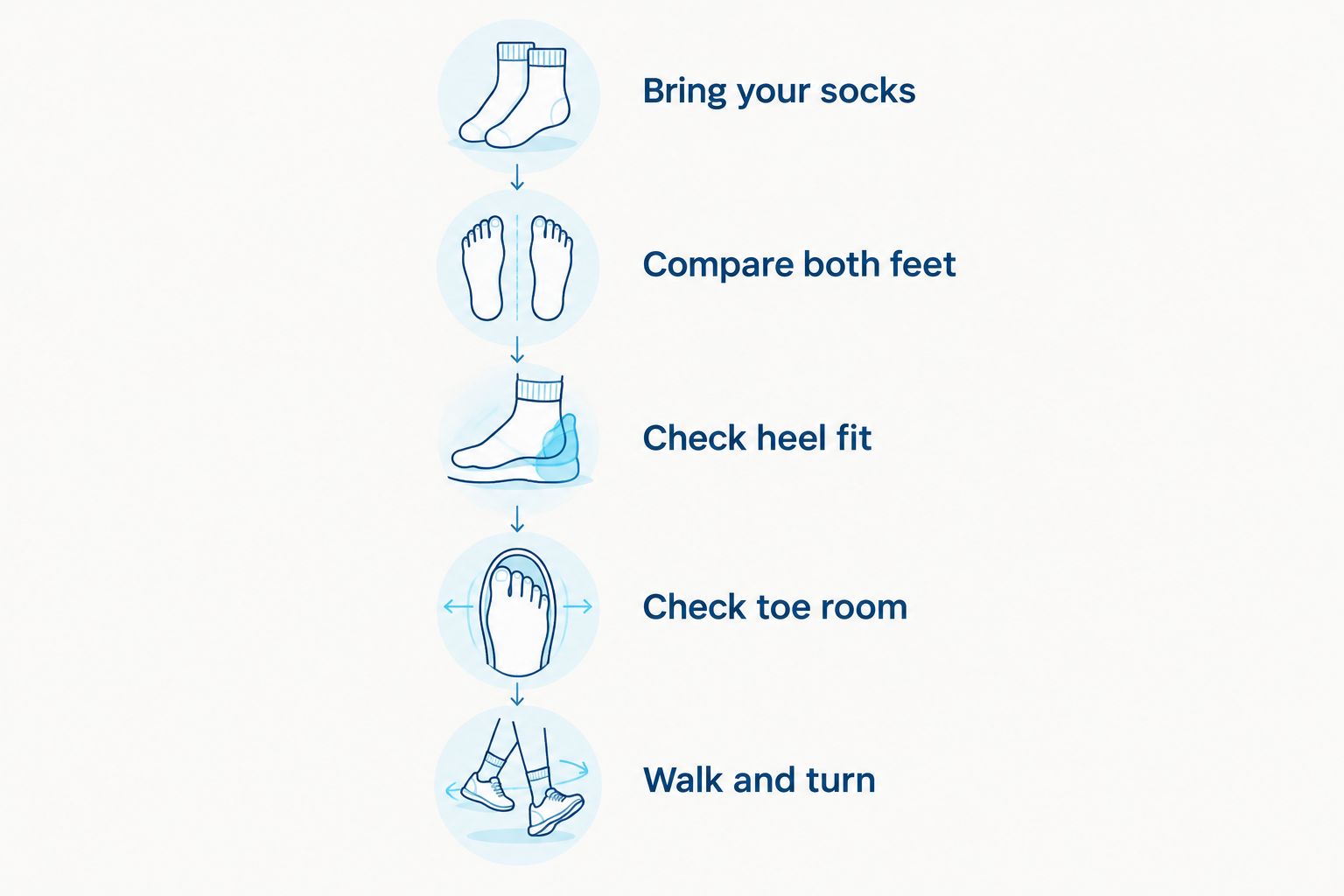
Use this fitting sequence for your 2026 shoe search. The times and quantities below are practical shopping instructions, not clinical tests or guarantees of comfort.
- Bring your socks: Bring 1 pair of the socks you expect to wear for the activity, along with any prescribed orthotics.
- Compare both feet: Try 2 candidate pairs on both feet. Do not judge a shoe from a single-foot fitting.
- Check heel fit: Lace the shoe normally and confirm your heel stays seated without excessive pressure.
- Check toe room: Stand up and make sure your toes are not crowded at the front, sides, or top.
- Walk and turn: Spend about 5 minutes walking and making gentle turns if the setting allows. Stop sooner if discomfort begins.
This sequence catches obvious fit problems; it does not predict every symptom during a longer outing. Avoid deliberately walking through pain to complete the trial.
When a shoe change is not enough
Arrange an evaluation if pain persists, changes your walking, or returns whenever you resume activity. Repeated ankle sprains, ongoing outer-foot pain, numbness, or a new pressure spot also deserve attention rather than repeated shoe purchases.
If you have diabetes or reduced sensation, do not rely on pain to identify shoe rubbing. Check your skin, and contact a clinician promptly for a new wound, redness, warmth, or swelling. Seek urgent care for an injury that leaves you unable to bear weight or for signs of a serious infection.
Achilles Foot and Ankle Center provides foot and ankle care in the Richmond area. Readers in Mechanicsville and West End can seek an appropriate evaluation for pain or footwear concerns without assuming that underpronation is the diagnosis.
Get your foot pain evaluated
Discuss persistent foot or ankle symptoms and the role of footwear in your care.
How we ranked these shoe types
The ranking follows the criteria above: neutral construction, cushioning, heel fit, toe room, activity-specific grip, and compatibility with prescribed support. Everyday exercise receives the default slot; walking, trails, orthotics, and work each receive a separate use-case recommendation.
This is a feature-based buying guide, not a clinical trial or a claim that one category treats everyone. Your symptoms and actual fit take priority over the order of the list.
Which shoes for supination should you choose?
Start with a cushioned neutral running shoe if you need a general exercise option. Choose a walking shoe for walking, a trail shoe for off-road routes, an orthotic-compatible shoe for prescribed inserts, or a roomy everyday shoe for work.
For your 2026 purchase, the deciding question is whether the shoe feels secure and comfortable during your activity. If pain keeps returning, Achilles Foot and Ankle Center can evaluate your symptoms instead of leaving you to keep guessing between shoes.
FAQ
What’s the best shoe type for supination?
A cushioned neutral running shoe is a sensible starting point for road running and everyday exercise. Walking, trail, and work footwear should match their respective activities, with secure heel fit and enough toe room.
Is supination the same thing as having high arches?
No, supination is a movement pattern, while high arches describe foot shape. High arches can occur with underpronation, but arch appearance alone does not establish how your foot moves.
Should I buy stability shoes if I underpronate?
Do not choose strong pronation-control features solely because you underpronate. Start by assessing neutral footwear unless a clinician recommends a different design for your individual needs.
Can shoes cure supination?
Shoes do not guarantee correction of supination or relief from pain. Suitable footwear can improve comfort, but persistent symptoms require evaluation of their cause.
Does wear on the outside of my shoe mean I supinate?
Outer-edge wear alone does not diagnose supination. Wear patterns also reflect how the shoe contacts the ground, its construction, and your activities.
Do I need orthotics for supination?
Supination alone does not establish that you need orthotics. A clinician can assess your symptoms and foot mechanics before recommending an insert or another treatment.
When should I see a podiatrist instead of buying new shoes?
See a podiatrist when pain persists, repeatedly returns, changes your walking, or accompanies recurring ankle injuries. Achilles Foot and Ankle Center also evaluates foot concerns involving diabetes, wounds, and nerve symptoms.
One last thing
Check the upper as carefully as the sole. Comfortable cushioning cannot compensate for a seam rubbing your toe, a heel slipping with each step, or laces pressing across the top of your foot. Your best 2026 choice is the shoe that fits the whole foot—not just the arch.
Related guides
- Best shoes for high arches
- Best shoes for standing all day at work
- Best ankle braces for sports injuries
- Shoes for plantar fasciitis