
Best overall: an adjustable walking sandal with a broad footbed and heel strap. Best for a sensitive bunion: a soft-upper sandal with adjustable forefoot straps. Best for changing foot volume: a multi-strap sandal. Best for brief, easy-on wear: an adjustable slide. This 2026 guide compares the best sandals for bunions by fit and construction rather than an orthopedic label.
- The best sandals for bunions accommodate the forefoot without placing a strap edge across the painful joint.
- Choose adjustable walking sandals for everyday wear; reserve slides for brief use when they stay secure.
- Wide feet need a broad footbed, not just longer straps or a larger shoe size.
- Achilles Foot and Ankle Center provides bunion care when footwear changes do not adequately address your symptoms.
Why this matters
A bunion is a bony prominence at the base of the big toe, associated with changes in joint alignment. Sandals can reduce pressure from footwear, but they do not straighten the underlying deformity. The best choice makes room for your foot without making you grip with your toes to keep the sandal on.
That distinction matters when you compare orthopedic sandals in 2026. A supportive footbed cannot compensate for a strap rubbing directly against a tender joint. If pain continues after changing footwear, learn about bunion treatment without surgery rather than repeatedly buying a different style.
What makes the best sandals for bunions?
Use these criteria before choosing a brand or design. A sandal needs to work with your bunion, foot width, and intended activity—not just look roomy on the shelf.
- Forefoot room: Your toes and bunion should sit within the footbed without hanging over its edges.
- Strap placement: Keep stiff edges, seams, and hardware away from the prominent joint.
- Independent adjustment: Forefoot and heel adjustments let you change width without losing rearfoot security.
- Walking security: Your heel should remain controlled without constant toe gripping or repeated repositioning.
- Comfortable support: Cushioning and arch contours should feel comfortable, not create a new pressure point.
- Skin protection: Look for smooth contact surfaces and check for rubbing during a fitting trial.
Choose fit over the word orthopedic. That label alone does not establish whether a sandal accommodates your particular foot shape or medical needs.
Best sandals for bunions at a glance
These are construction-based recommendations, not a ranking of specific retail models. In 2026, compare the actual pair you try against these features; different sandals within the same style can fit very differently.
| Sandal type | Best for | Standout feature to look for | Key limitation |
|---|---|---|---|
| Adjustable walking sandal | Everyday walking | Broad footbed with adjustable forefoot and heel straps | A poorly placed strap can still press on the bunion |
| Soft-upper sandal | Sensitivity to rubbing | Smooth, pliable material around the prominent joint | Soft material does not guarantee secure support |
| Multi-strap sandal | Changing foot volume | Separate adjustment across several areas | Extra straps add potential rubbing points |
| Adjustable slide | Brief, easy-on wear | Forefoot adjustment without a fixed toe post | No heel strap to help retain the sandal |
1. Adjustable walking sandal: best for everyday walking
An adjustable walking sandal is the strongest starting point for everyday use because you can seek both forefoot space and rearfoot security. Look for a broad platform, an adjustable front section, and a heel strap that holds without digging in.
The important feature is where the front strap sits. A wide sandal still fails the fit test if its edge crosses the most sensitive part of your bunion. Open the straps fully, position your foot on the footbed, and then fasten them without pulling the forefoot inward.
Adjustable walking sandal pros:
- Separate adjustments help accommodate a broad forefoot and a narrower heel.
- A heel strap helps retain the sandal during walking.
- An open design removes the enclosed toe box found in shoes.
Adjustable walking sandal cons:
- Thick straps or hardware can irritate the bunion.
- An unsuitable arch contour creates pressure even when the width fits.
- An open sandal offers less protection from debris than an enclosed shoe.
Best for: Everyday walking on suitable surfaces when you want an open design that stays attached to your foot.
Try walking, stopping, and turning before deciding. If you need to curl your toes to control the sandal, adjust it or choose another construction. Verdict: Buy only when the footbed contains your foot and no strap presses on the bunion.
2. Soft-upper sandal: best for a bunion sensitive to rubbing
A soft-upper sandal prioritizes the material touching your foot. Look for smooth, pliable straps with adjustment around the forefoot, rather than assuming that leather, fabric, or stretch material will automatically feel comfortable.
Check the underside of each strap. A soft outer surface can hide a firm seam or binding directly against the joint. Material should accommodate the bunion without requiring you to tighten another part of the sandal excessively.
Soft-upper sandal pros:
- Pliable contact surfaces can accommodate an uneven forefoot outline.
- Smooth construction avoids a hard edge directly against sensitive skin.
- Adjustable straps let you control contact around the joint.
Soft-upper sandal cons:
- Softness alone does not provide walking security.
- Seams and trim can remain irritating despite a flexible upper.
- Stretchy material does not correct a footbed that is too narrow.
Best for: A bunion irritated by stiff footwear when the skin is intact and the sandal remains secure.
Do not use soft material to cover up a persistent pressure problem. If the joint still feels squeezed, the construction is wrong for your foot. Verdict: Buy for comfortable contact, not simply because the upper feels soft in your hand.
3. Multi-strap sandal: best for changing foot volume
A multi-strap sandal lets you adjust different areas independently. That makes it a useful design to try when your forefoot needs more room than your midfoot, or when your usual footwear feels tighter later in the day.
Adjustability has limits. If swelling is new, unexplained, or substantially different between feet, seek medical advice rather than treating a looser sandal as the solution. Sudden swelling with pain, redness, or warmth deserves prompt assessment.
Multi-strap sandal pros:
- Separate closures let you adjust fit in different areas.
- Forefoot room does not depend entirely on loosening the whole sandal.
- A heel strap can preserve retention while the front remains accommodating.
Multi-strap sandal cons:
- More straps create more possible contact points.
- Closures still need enough overlap to fasten securely.
- Adjustment cannot make a narrow sole wider.
Best for: Feet that need different amounts of room across the forefoot and midfoot, provided swelling has been appropriately assessed.
Check that every closure remains secure at your comfortable setting. A strap barely reaching its fastening point is not a successful fit. Verdict: Buy when independent adjustment solves the fit problem; skip when the footbed remains too narrow.
4. Adjustable slide: best for brief, easy-on wear
An adjustable slide removes the heel strap and allows you to step into the sandal. Choose a broad base and an adjustable upper rather than a fixed band that squeezes the bunion.
The trade-off is retention. Without a heel strap, the sandal must stay on without toe gripping, shuffling, or repeated repositioning. If you feel less steady, a secured walking sandal is a better starting point.
Adjustable slide pros:
- Easy to put on without fastening a heel strap.
- An adjustable upper can create room across the forefoot.
- A design without a toe post avoids contact between the toes.
Adjustable slide cons:
- No heel strap helps hold the sandal in place.
- A loose fit can lead to toe gripping or an altered walking pattern.
- An open design leaves skin exposed to knocks and debris.
Best for: Brief wear on even surfaces when you walk comfortably and the slide stays in place.
Slides are not the default choice for balance difficulties, reduced foot sensation, or a clinician-prescribed footwear plan. Verdict: Hold for occasional use; skip if you need to grip with your toes.
How to check sandal fit before you commit
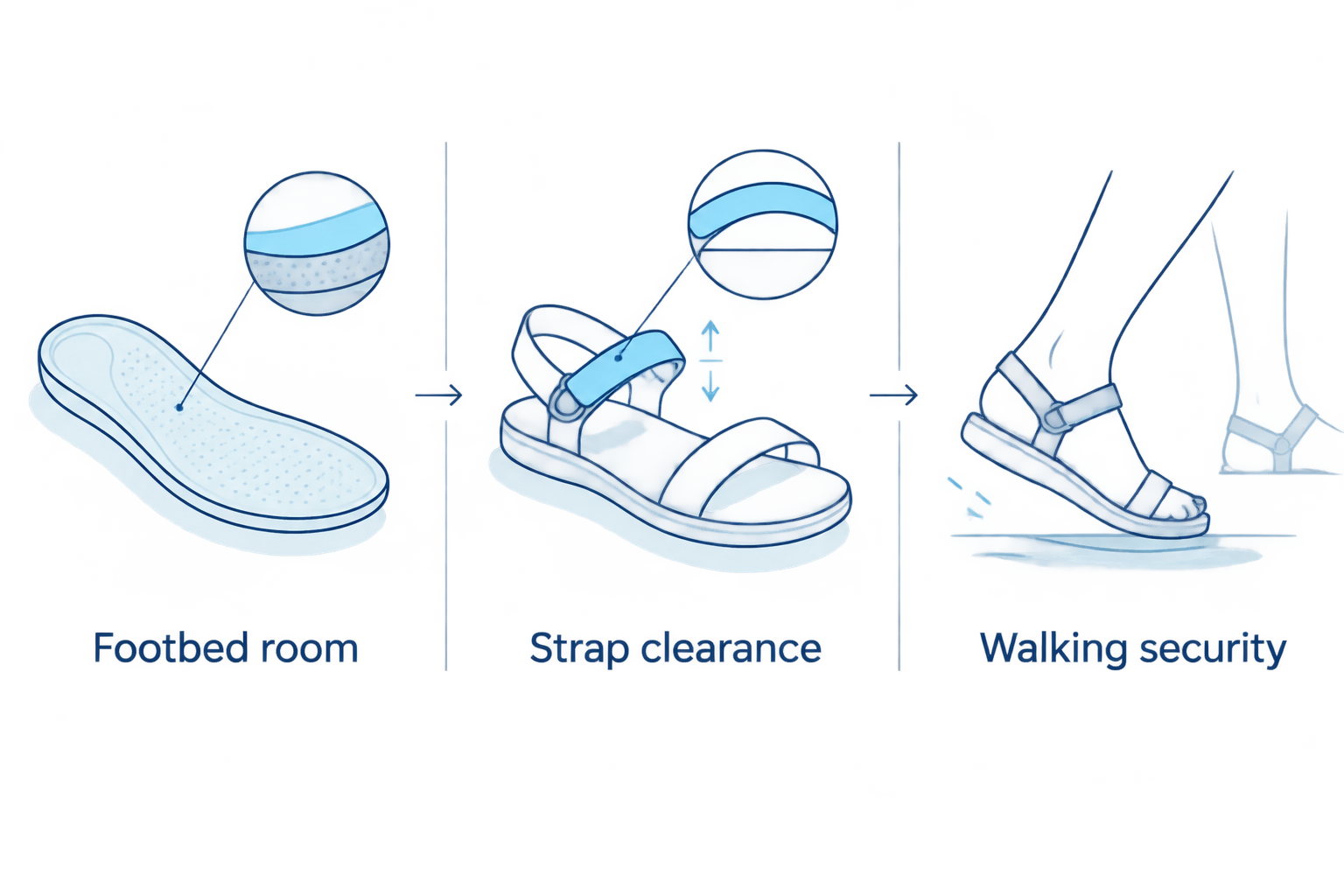
For your 2026 sandal fitting, assess the pair while standing and walking—not just while seated. Use 3 fit checks on both feet, and judge 1 pair by the foot that needs more room.
Footbed room
Place your feet on the footbeds with the straps loose. The bunion, little-toe side, and toes should remain supported rather than hanging over an edge. Sizing up is not a reliable substitute for choosing the correct width and shape.
Strap clearance
Fasten the straps and inspect where their edges meet your skin. Check the bunion itself, the area between the toes, and the top of your foot. You should not need a tight strap elsewhere to compensate for an oversized or poorly shaped sandal.
Walking security
Walk, turn, and stop in a safe indoor area. Notice sliding, toe gripping, rubbing, or a change in your usual stride. Remove the sandals afterward and check your skin; pain or persistent irritation is a reason to stop wearing the pair.
Do not plan to break in a sandal by enduring bunion pain. Materials can change with wear, but a painful fit is not a treatment strategy. Bring the pair to an evaluation if you cannot tell whether the problem is width, strap placement, joint stiffness, or another source of pain.
When a sandal change is not enough
Achilles Foot and Ankle Center is an option for bunion care when footwear changes do not adequately relieve your symptoms. An evaluation can distinguish pressure from footwear from pain involving the joint or another foot condition.
Arrange an assessment when pain limits walking, the big toe crowds neighboring toes, or repeated rubbing damages your skin. Bring your usual shoes and the sandals you are considering so you can discuss the actual fit problem.
If you have diabetes, reduced sensation, poor circulation, or a history of foot wounds, ask about appropriate footwear before choosing open sandals. Lack of pain does not prove that a strap is safe. Seek prompt care for a new wound, drainage, spreading redness, or a hot, swollen foot; seek emergency care for fever with a worsening foot wound or a suddenly cold, pale foot.
For patients in Mechanicsville and West End, Achilles Foot and Ankle Center offers foot and ankle care in the Richmond area. You can contact the practice to arrange an appropriate evaluation.
Get your bunion pain evaluated
Discuss painful footwear, walking limits, and your foot care needs.
How these sandal types were ranked
This 2026 guide prioritizes forefoot room, strap clearance, independent adjustment, walking security, comfortable support, and skin protection. Adjustable walking sandals lead because their construction lets you look for room and retention together. Each remaining category addresses a different fitting need.
The ranking does not establish that every sandal in a category is suitable. Individual fit and medical needs take priority over the order of the list.
Which sandals should you choose?
Start with an adjustable walking sandal on a broad footbed. Choose a soft-upper design if contact irritates the joint, or independent multi-strap adjustment if different parts of your foot need different amounts of room. Keep slides for brief wear only when they stay secure.
For your 2026 purchase, reject any pair that requires a trade-off between bunion pressure and walking control. You need both comfort and stability—not one at the expense of the other.
FAQ
What are the best sandals for bunions and wide feet?
An adjustable walking sandal with a broad footbed and secure heel strap is a practical starting point. Choose a pair that contains your whole forefoot and keeps strap edges away from the bunion.
Are orthopedic sandals better for bunions?
The orthopedic label alone does not make a sandal better for bunions. Forefoot room, comfortable strap placement, and secure walking matter more than the label.
Can sandals straighten a bunion?
Sandals do not straighten the underlying bunion deformity. A well-fitting pair can reduce pressure from footwear, but persistent pain needs assessment rather than increasingly loose sandals.
Should I size up in sandals if I have a bunion?
Choose the correct width and shape rather than automatically sizing up. Extra length can leave the sandal loose while the footbed remains too narrow across the bunion.
Are slides or heel-strap sandals better for bunions?
A heel-strap sandal is generally the better starting point for everyday walking because it provides additional retention. A slide is reasonable for brief wear only when it stays on without toe gripping.
Can I wear sandals if I have diabetes and bunions?
Ask your clinician about sandal suitability if you have diabetes, especially with reduced sensation, poor circulation, or previous wounds. Open footwear exposes skin, and reduced sensation can prevent you from noticing rubbing.
When should I see a podiatrist about bunion pain?
Arrange an evaluation when bunion pain limits walking, persists despite footwear changes, or causes repeated skin irritation. Achilles Foot and Ankle Center provides bunion care and can assess symptoms that footwear alone does not address.
One last thing
A sandal can look wide because its straps open far while its footbed remains narrow. Check the platform before the closures. If your foot extends beyond the base, extra strap length does not solve the fit problem.
Related guides