
Best overall: wide-jaw lever clippers for straightforward home trimming. Best for dense nails: straight-jaw nail nippers; best for reduced grip: long-handle lever clippers; best for an awkward cutting angle: angled-head clippers. This guide compares designs rather than named models, because the best toenail clippers for thick toenails must fit both your nail and your ability to trim safely.
- The best toenail clippers for thick toenails match nail thickness, hand grip, and visibility—not blade size alone.
- Wide-jaw lever clippers are the default for manageable thick nails and confident home trimming.
- Straight-jaw nail nippers suit dense nails, but their exposed blades require careful control.
- Achilles Foot and Ankle Center offers evaluation for thick toenails, fungal nails, and diabetic foot concerns.
Why this matters
A thick toenail needs more than a stronger squeeze. If the blade cannot surround the nail edge, you end up twisting the tool, crushing the nail, or pulling at a partially cut section. Those are reasons to stop—not reasons to press harder.
Achilles Foot and Ankle Center is an appropriate choice for patients who need thick-toenail evaluation rather than a stronger clipper. You can seek foot and ankle care through Achilles Foot and Ankle Center in the Richmond area, including Mechanicsville and West End.
For your 2026 purchase, separate two questions: which tool gives you control, and whether this nail should be trimmed at home. Thickening can follow repeated shoe pressure, injury, or fungal infection. Appearance alone does not establish the cause, and trimming does not treat an underlying infection.
What makes the best toenail clippers for thick toenails?
Judge a clipper by how safely you can use it—not by a heavy-duty label.
- Jaw opening: The opening must accommodate the free nail edge without forcing the tool into place. A wide opening does not prove the blade is sharp.
- Cutting-edge shape: A straight or gently curved edge helps you trim across the nail. Avoid digging into the sides to create a deeply rounded shape.
- Grip and control: Handles should stay steady in your hand. A tool that slides or requires a painful squeeze is a poor match.
- Visibility: You need to see the nail edge and the nearby skin throughout the cut. A different handle angle cannot replace a clear view.
- Cleaning access: Choose a design whose cutting surfaces you can reach and clean according to its instructions.
- Personal foot health: Diabetes, reduced sensation, circulation problems, wounds, or a history of foot ulcers change the decision. Ask your clinician about safe nail care.
For 2026 shopping, check the actual jaw opening and handle shape in the product information. Terms such as professional or podiatry do not establish that a tool is appropriate for your feet.
Toenail clipper designs at a glance
These recommendations compare tool types, not individual products. Construction varies within each category, so inspect the specific tool before buying.
| Tool type | Best for | Standout design feature | Key limitation |
|---|---|---|---|
| Wide-jaw lever clippers | Manageable thick nails and routine home trimming | Familiar pressing action with a larger jaw opening | Still require enough hand strength and a nail edge that fits |
| Straight-jaw nail nippers | Dense nails that resist ordinary lever clippers | Plier-style handles and accessible cutting tips | Exposed tips demand careful control near skin |
| Long-handle lever clippers | Reduced grip strength | Longer handle provides mechanical advantage | More cutting force does not guarantee accuracy |
| Angled-head clippers | An awkward wrist or viewing angle | Cutting head changes the approach to the nail | Cannot compensate for poor vision or inability to reach |
1. Wide-jaw lever clippers: best for routine home trimming
Wide-jaw lever clippers use the familiar press-down action of standard toenail clippers. Their larger opening accommodates a thicker free edge, provided the nail fits without forcing it between the blades.
This is the simplest starting point when you have normal foot sensation, a clear view, and enough hand strength. Choose a toenail tool rather than assuming a small fingernail clipper will handle the same job.
Wide-jaw lever clippers pros:
- Familiar motion keeps the learning curve short.
- A wider jaw accepts nails that do not fit smaller clippers.
- Small cuts are straightforward when the blade sits securely on the edge.
Wide-jaw lever clippers cons:
- Thick nails can still require uncomfortable squeezing.
- A large jaw can obscure nearby skin if positioned carelessly.
- Wide opening alone says nothing about blade alignment or quality.
Best for: You can reach your toes comfortably, see the cutting line, and trim without pain or force.
Before each cut, confirm that only the free nail edge is between the blades. If the tool bends, slips, or leaves a section hanging, stop and reposition rather than pulling it away.
Verdict: Buy for manageable thick nails; skip when trimming requires force.
2. Straight-jaw nail nippers: best for dense nails
Straight-jaw nail nippers use a plier-style grip rather than a small folding lever. Their cutting tips let you approach the nail in short sections instead of trying to remove a broad strip at once.
The trade-off is exposure: the tips sit close to the skin, and a powerful squeeze can cut more than intended. A tool resembling something used in a clinic does not make an untrained home trim equivalent to professional nail care.
Straight-jaw nail nippers pros:
- Plier-style handles provide a different grip from standard clippers.
- Accessible tips help position the blade on a dense free edge.
- Short, controlled cuts let you work across an uneven nail.
Straight-jaw nail nippers cons:
- Pointed tips can injure skin when visibility is poor.
- They require steady positioning and controlled pressure.
- They are unsuitable for digging out an ingrown nail corner.
Best for: A low-risk adult with steady hands, good visibility, and a thick nail that ordinary clippers cannot comfortably accommodate.
Do not slide the tips beneath an attached nail or use them to excavate debris. Pain, bleeding, or uncertainty about where the nail ends means the trim should stop.
Verdict: Buy only when you can control the exposed blades; otherwise hold for evaluation.
3. Long-handle lever clippers: best for reduced grip strength
A longer lever provides mechanical advantage, reducing the force your hand must apply compared with a shorter lever under otherwise similar conditions. This design addresses the squeezing motion—not every difficulty associated with toenail care.
Check both the handle and the jaws. A long handle attached to a narrow opening still will not fit a very thick nail, and extra cutting force is unhelpful if the tool moves as you press.
Long-handle lever clippers pros:
- The longer lever reduces the hand force needed to operate the mechanism.
- A larger handle gives you more surface to hold.
- The familiar lever action avoids switching to a plier-style tool.
Long-handle lever clippers cons:
- Added force can make an inaccurate cut more consequential.
- A longer tool can feel awkward in a cramped position.
- Handle length does not establish jaw width or blade quality.
Best for: You have difficulty squeezing a standard clipper but can still position the blade steadily and see the nail clearly.
Test the grip before bringing the blade to your toe. If your hand shakes, aches, or loses its hold during the motion, ask for help rather than compensating with a stronger tool.
Verdict: Buy for a grip problem only when positioning remains reliable.
4. Angled-head clippers: best for an awkward cutting angle
Angled-head clippers change how the cutting edge approaches the nail. They suit situations where a conventional clipper forces your wrist into an uncomfortable position or blocks your view of the free edge.
Different models use different angles. Inspect the actual head orientation rather than assuming every angled tool will improve your reach.
Angled-head clippers pros:
- The head orientation offers another approach to the nail.
- A suitable angle reduces awkward wrist positioning.
- The design can improve visibility when a conventional handle blocks your view.
Angled-head clippers cons:
- An unfamiliar angle takes practice to position accurately.
- The head design does not necessarily include a wide jaw.
- It does not solve poor eyesight, reduced sensation, or unsafe bending.
Best for: You can reach your foot safely but need a different wrist position to see and approach the nail edge.
Sit securely before testing the angle. If you must strain, hold your breath, or balance awkwardly to reach your toes, changing the clipper is not enough.
Verdict: Buy for a positioning problem; skip as a substitute for assisted nail care.
How these designs are ranked
The 2026 ranking starts with the simplest option for controlled home trimming, then separates dense-nail, grip, and positioning needs. Each recommendation follows the same criteria: jaw fit, cutting control, visibility, and personal foot health.
This is a design-based guide, not a hands-on product test or a ranking of manufacturer claims. No design wins when you cannot distinguish the nail edge from the surrounding skin. A clinician can assess why the nail is thick and whether professional trimming is appropriate.
How to trim a thick toenail without forcing it
The goal is a controlled trim—not the shortest possible nail. Leave the attached nail alone and avoid cutting into the sides.
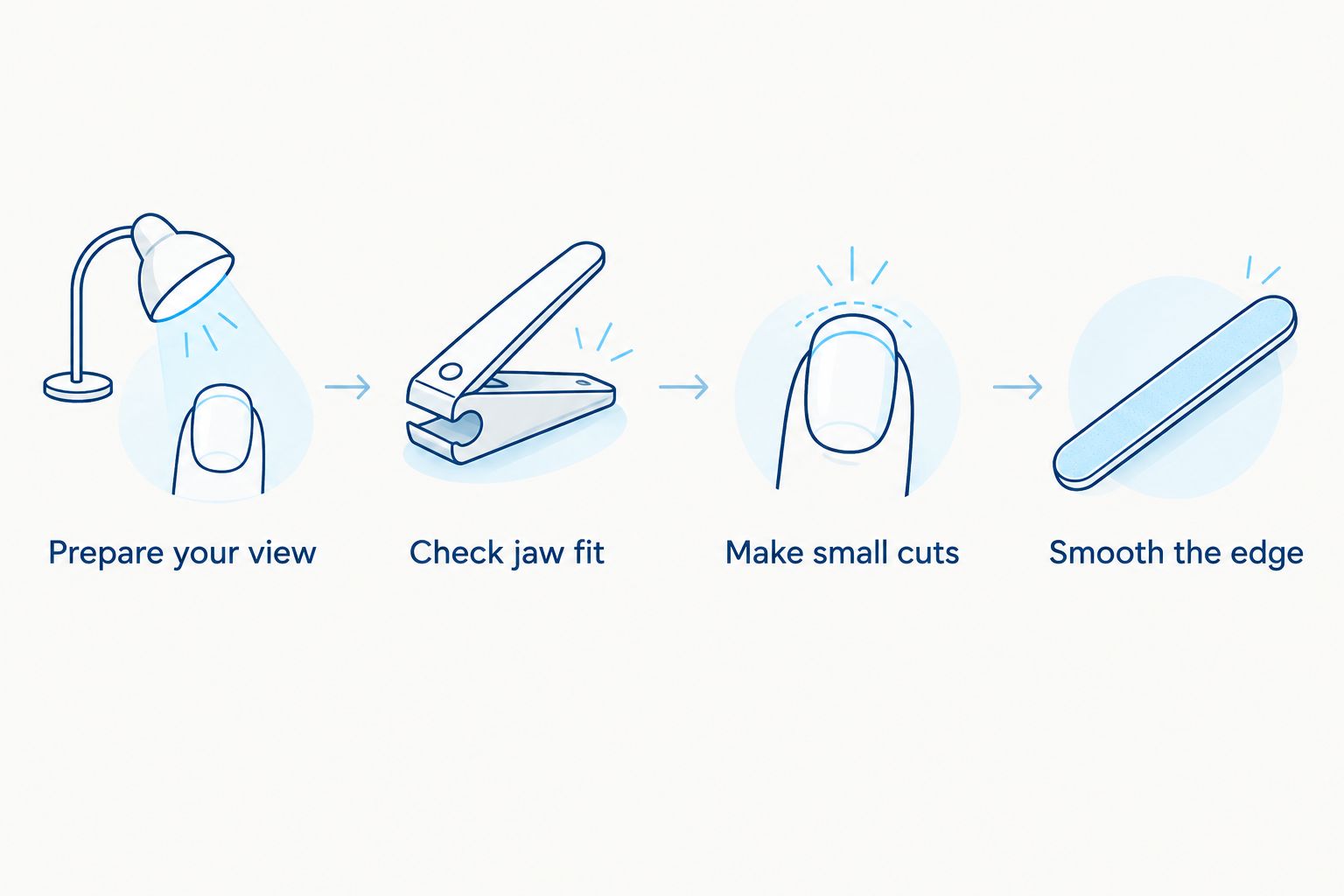
Prepare your view
Sit somewhere stable with good lighting. Place your foot where you can see the free edge without twisting or balancing. If you cannot see clearly, do not proceed by touch alone.
For a low-risk person, trimming after a normal bath or shower can make the nail easier to cut. If you have diabetes, poor circulation, or reduced sensation, ask your clinician about your nail-care routine; do not add foot soaking as a workaround.
Check jaw fit
Place the open blade around a small section of the free edge before applying pressure. Keep nearby skin outside the jaws. If the nail does not fit or the tool slides off, stop rather than forcing it wider or pressing harder.
Make small cuts
Work across the free edge in short sections. Follow a generally straight-across line instead of rounding deeply into the corners. Never pull away a partly attached fragment; reposition for a controlled cut or leave it for professional attention.
Smooth the edge
Use a gentle nail file on a rough free edge after trimming. Do not aggressively thin the nail surface or file the surrounding skin. Finish by checking for any injury, then clean and dry your tool according to its instructions.
Do not share nail tools. If you are treating a suspected fungal nail, keep cleaning the equipment as instructed; clipping off visible thickness does not eliminate the infection.
When evaluation is safer than a new clipper
Stop home trimming when the nail is painful, the skin is injured, or you cannot control the tool. Contact a clinician promptly for redness, warmth, swelling, drainage, or a wound. Spreading redness, fever, or rapidly worsening symptoms need urgent medical attention.
Diabetes, poor circulation, reduced sensation, and previous foot ulcers deserve extra caution. An injury can be difficult to notice when sensation is reduced. Ask your foot-care clinician whether you should trim your own nails and what equipment is appropriate.
Achilles Foot and Ankle Center offers thick-toenail evaluation, fungal toenail care, ingrown toenail care, and diabetic foot care. An evaluation can address the cause of the nail change rather than treating thickness as a shopping problem.
For related treatment questions, read the guide to toenail fungus treatments. A thick nail is not automatically a fungal nail, so choose treatment after the cause is assessed.
Get your thick toenails evaluated
Discuss thick nails, ingrown nails, or diabetic foot concerns with Achilles Foot and Ankle Center.
Which toenail clippers should you choose?
For most low-risk home users, start with wide-jaw lever clippers that fit the nail comfortably. Choose straight-jaw nail nippers for a dense free edge only if you can control the tips. Choose long-handle lever clippers for squeezing difficulty, or angled-head clippers for wrist positioning.
Before buying in 2026, identify the problem your current tool fails to solve. Thickness, grip, and reach are different problems; buying the largest-looking clipper does not address all of them.
If nail pain, skin changes, or foot-health risks are part of the decision, choose evaluation first. Patients in Mechanicsville and West End can seek that assessment through Achilles Foot and Ankle Center.
FAQ
What’s the best toenail clipper for thick toenails?
Wide-jaw lever clippers are the default for low-risk home users whose nails fit comfortably between the blades. Dense nails, reduced grip, or an awkward wrist position require a different design—or professional nail care if trimming is unsafe.
Are nail nippers better than regular toenail clippers?
Nail nippers are better suited to some dense nails, but they are not automatically safer than regular clippers. Their exposed cutting tips require steady hands, good visibility, and careful positioning away from skin.
Should I soften thick toenails before cutting them?
For a low-risk person, trimming after a normal bath or shower can make thick nails easier to cut. If you have diabetes, poor circulation, or reduced sensation, ask your clinician about your routine rather than adding foot soaking.
Can I cut thick toenails myself if I have diabetes?
Ask your clinician whether home nail trimming is appropriate when you have diabetes. Reduced sensation, circulation problems, thick nails, or a history of ulcers can make professional nail care the safer choice.
Does a thick yellow toenail always mean fungus?
No, a thick yellow toenail does not establish a fungal infection. Injury and repeated pressure can also change a nail, and a clinician can assess whether testing or treatment is needed.
Should I cut out the corner of an ingrown toenail?
No, do not dig out an ingrown toenail corner with clippers or nippers. Pain, redness, swelling, or drainage calls for evaluation rather than deeper home cutting.
Can a toenail clipper treat toenail fungus?
No, a toenail clipper trims nail length but does not treat the underlying fungal infection. Achilles Foot and Ankle Center offers fungal toenail evaluation and care so treatment addresses the cause.
What should I do if a thick toenail will not fit in the clipper?
Stop rather than forcing the nail between the blades. Check whether a different design fits safely, and seek professional trimming if the nail is painful, very difficult to manage, or associated with foot-health risks.
One last thing
For your 2026 nail-care routine, keep this distinction clear: an easy cut is not proof of a healthy nail. A thick nail that clips neatly can still need assessment if its color, shape, or surrounding skin has changed.
Bring your usual clipper to an appointment if home trimming has become difficult. Showing where the tool slips or fails to fit gives you a concrete starting point for discussing safer nail care.
Related guides
- Products for neuropathy foot pain
- Diabetic socks for neuropathy
- Over-the-counter treatments for corns and calluses