

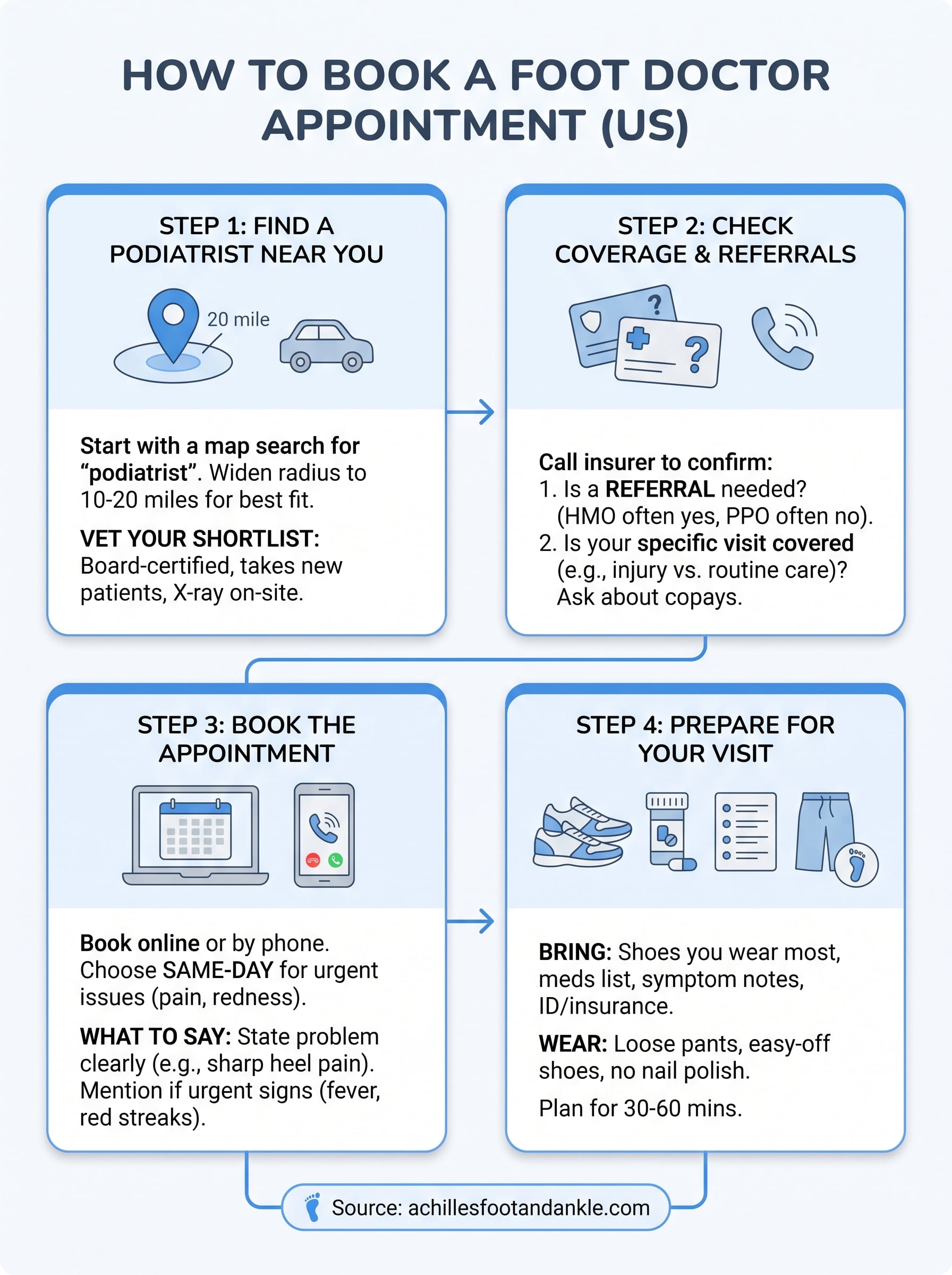
To book a foot doctor appointment, find a podiatrist within a drive you can handle, confirm they take your insurance and whether your plan wants a referral, then book online or by phone. Bring a short list of symptoms, medications, and the shoes you wear most. A first visit usually takes 30 to 60 minutes, and many practices can see you the same day when the problem is urgent.
The hard part is rarely the visit itself. A search for "podiatrist near me" gives you a map of pins at 0.2 miles, 1 mile, or 20 miles, and nothing tells you who is taking new patients, who accepts your plan, or whether anyone actually takes walk-ins. Meanwhile your foot hurts, and you are not sure if this calls for a specialist, urgent care, or the emergency room.
This guide gives you four steps, in order: find a podiatrist, check referral and coverage rules, book the visit, and prepare for it. It is written for patients in Central Virginia, and we use Achilles Foot and Ankle Center’s two Richmond-area offices as the working example. The steps apply anywhere.
Know when a podiatrist is the right call
A podiatrist is the right call for almost any pain, injury, or skin or nail problem in your foot or ankle. Knowing which kind of appointment you need, urgent or routine, saves you hours of calling around.
What a podiatrist treats
A podiatrist is a doctor of podiatric medicine (DPM) who diagnoses and treats problems of the foot, ankle, and lower leg, including surgery. They can order X-rays and other imaging, prescribe medication, and prescribe orthotics, braces, and casts. Yes, they treat foot and ankle fractures too.
Typical reasons people book include heel and arch pain, bunions and hammertoes, ingrown toenails, fungal nails, sports injuries, nerve pain, and wounds that heal slowly. People with diabetes also need a full foot checkup at least once a year, even with no symptoms.
Foot symptoms you should not ignore
Book soon if you notice any of these five signs:
- Pain that lasts more than a few days or keeps you from normal activity
- Swelling that does not go down
- Redness, warmth, or discoloration in the skin
- Numbness, tingling, or burning
- A sore, blister, or cut that is slow to heal
Do not start treating these at home first. Self-treating an ingrown nail or a sore can turn a small problem into a bigger one.
Walk-in, same-day, or emergency room
Most podiatry offices run on schedules, so a true walk-in podiatrist is uncommon. The realistic version is a same-day appointment, which you get by calling or booking online first. Use this table to match the situation to the right door.

| Situation | Best option |
|---|---|
| Sharp pain, swelling, an infected ingrown nail, or a new sore, and you can still walk | Same-day podiatry appointment |
| Ongoing heel pain, bunion, nail fungus, or a yearly diabetic checkup | Standard scheduled appointment |
| Foot looks out of shape after an injury, you cannot bear any weight, or bleeding will not stop | Emergency room |
| Spreading redness or red streaks with fever | Emergency room or urgent medical evaluation |
Call before you go: a same-day slot beats a walk-in, and a bleeding or misshapen foot beats both with an emergency room visit.
Step 1. Find a podiatrist near you
Start with a map search for "podiatrist", then narrow it by distance, hours, and fit. A short shortlist of two or three offices is enough to move forward.
Set your search radius
Drive time matters more than the number on the map. Searches like "podiatrist near me within 1 mi" or "within 0.2 mi" only help in dense areas where a foot clinic sits a few blocks away. In most of Central Virginia you will widen to a 10 or 20 mile radius, and that is fine.
| Radius | When it makes sense |
|---|---|
| 0.2 mile | You can walk there, and it is realistic only in a dense downtown. Good for an urgent problem you can walk on. |
| 1 mile | A short drive or bus ride in a town center. |
| 20 miles | The practical net for suburbs, and the right choice if you expect follow-up visits and want the best fit. |
Here is a worked example. If the office is a 30 minute drive, you travel 60 minutes round trip, arrive 15 minutes early, and spend 30 to 60 minutes in the room. Block about two hours for the whole trip.
Vet your shortlist
Open each office’s website and check five things before you call. A short list beats a long review hunt.
- Doctors are board-certified in podiatry
- The office takes new patients and offers same-day slots
- Your insurance is listed
- X-ray or ultrasound is done on site, so you do not need a second trip
- Hours match your schedule
Achilles Foot and Ankle Center, for example, has offices in Mechanicsville and the West End of Richmond, board-certified specialists, and X-ray, ultrasound, and fluoroscopy in the office. It has a 4.7 average rating from more than 1,700 reviews. Hours are listed by office and day, such as Mechanicsville on Monday and Wednesday and West End on Tuesday and Thursday, both 8:00 AM to 5:00 PM, so check which office is open on your day.
Pick the office by drive time and on-site imaging, not by the smallest number on the map.
Step 2. Check insurance and referral rules
You usually need to check two things before your foot doctor appointment: whether your plan requires a referral, and whether it covers your reason for the visit. A five-minute call to your insurer settles both.
Do you need a referral?
Whether you need a referral to a podiatrist depends on your plan, not on the podiatrist. The usual pattern looks like this, but your own plan document is what counts.
| Plan type | Referral usually needed? |
|---|---|
| HMO | Often yes, from your primary care doctor |
| PPO or similar | Usually no |
| Original Medicare | No |
| Medicare Advantage | Varies by plan |
| No insurance (self-pay) | No |
Call the number on your insurance card and ask: "Do I need a referral or prior authorization to see a podiatrist?" Ask the same question about the specific office, so you are not surprised later.
Confirm what your plan covers
Coverage can differ by reason for the visit. A painful injury, an ingrown toenail, and a diabetic exam are normally medical. Routine foot care, such as trimming or corn removal, is limited under Original Medicare unless you have a qualifying condition such as diabetes with nerve damage, so ask before you book.
Ask your insurer three things: your copay for a specialist visit, whether X-rays and in-office procedures are included, and whether you have a deductible left to meet. Achilles Foot and Ankle Center accepts all major insurance companies and offers flexible payment options, but always verify your own plan first.
Referral rules come from your insurance plan, so a quick call to the number on your card beats guessing.
Step 3. Book the appointment
Booking takes a few minutes once you know your plan and your reason for the visit. Choose the channel that matches how urgent the problem is.
Choose how to book
Most practices let you book by phone, online, or both. At Achilles Foot and Ankle Center, same-day appointments can be booked online or by phone, which is the nearest thing to a walk-in without the waiting room gamble.
- Online: use the same-day appointments page and pick an office
- Phone: 804-273-1717
- Text: 804-234-4019
Telemedicine is available as well. Ask whether your problem can start with a video visit, which often works for follow-ups and questions but not for every injury.
What to say when you call
Have your insurance card in hand and lead with the problem, not your whole history. A short script keeps the call under five minutes. Copy and adapt it.
Hi, I'd like to book a foot doctor appointment as a new patient.
My problem: [for example, sharp heel pain for two weeks / an ingrown toenail that is red and sore].
I have [insurance name and plan type], member ID [number].
Can I be seen today or tomorrow? Which office is closest to [your town]?
Do I need a referral, and are there forms I can fill out online first?
How long should I plan to be there?
If you have red streaks, fever, or a wound that is draining, say so at the start. That tells the scheduler to move you up. Write down the date, time, office address, and the name of the person you spoke to.
Say what hurts, since that single sentence decides whether you get a same-day slot or a routine one.
Step 4. Prepare for and get through the visit
Preparation makes the visit shorter and the diagnosis more accurate. You do not need to do much, but a few small things help the podiatrist see your feet as they really are.
What to bring and wear
Bring these to the foot doctor appointment:
- Insurance card and photo ID
- A list of your medications and supplements
- Notes on when symptoms started and what makes them better or worse
- Any earlier X-rays, MRI reports, or records about the foot
- The shoes you wear most, plus your work or sport shoes if the problem shows up there
Dress for an exam. Wear loose pants or shorts that roll above the knee, and slip-on shoes that are easy to remove. Take off nail polish and skip the pedicure, because the doctor needs to see your nails and skin as they are. Do not trim your nails short beforehand.
What happens in the room
A first visit follows a predictable order. Plan for 30 to 60 minutes.
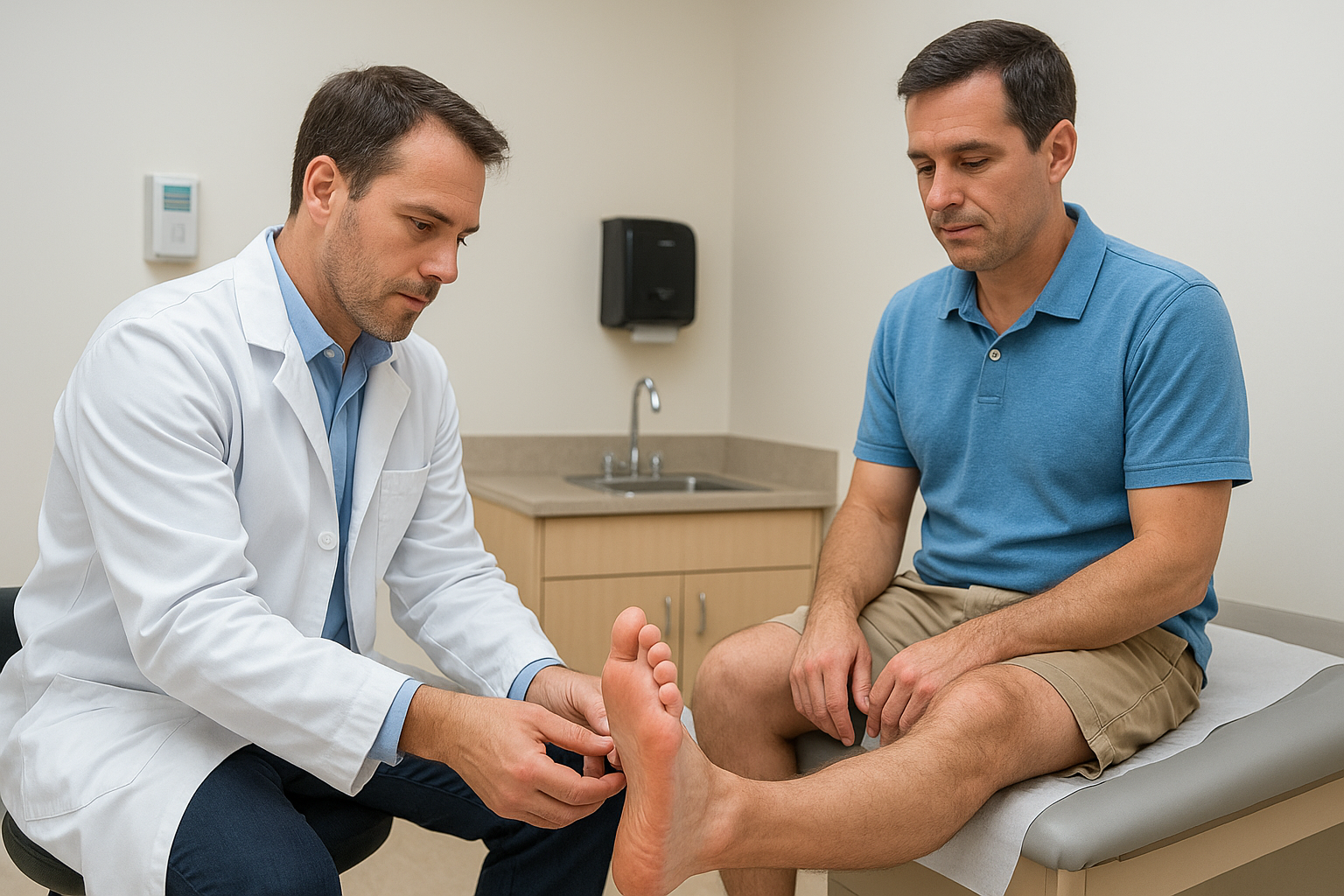
- Check-in and forms. Confirm insurance and fill in your history. Arrive 15 minutes early.
- Conversation. The podiatrist asks about your symptoms, work, activities, and shoes.
- Exam. They look at skin, nails, joints, and circulation, and may watch you stand and walk.
- Testing if needed. Offices with imaging on site, like Achilles with X-ray, ultrasound, and fluoroscopy, can often do it during the same visit.
- Plan. You leave with a diagnosis and options, from custom orthotics and bracing to injections, and in some cases, surgery.
Some problems, such as an ingrown toenail, can often be treated at that first visit. The exam itself is generally not painful, and if a procedure is needed, you will get pain control.
Questions to ask before you leave
Ask what is causing the problem, what all your options are, and how long improvement should take. Ask which warning signs mean you should call back right away, and when your follow-up should be. If you have diabetes, ask how often you need a foot checkup.
The best first visit ends with a diagnosis, a plan, and a date for follow-up, so do not leave without all three.
Your next step
Booking a foot doctor appointment comes down to four moves: find an office within a realistic drive, check referral and coverage, call or book online with a clear description of the problem, and arrive prepared. For urgent pain, ask for a same-day slot rather than waiting for a walk-in, and go to the emergency room for severe injuries.
If you live in the Richmond area and want to be seen quickly, you can book a same-day appointment with Achilles Foot and Ankle Center online or by phone.