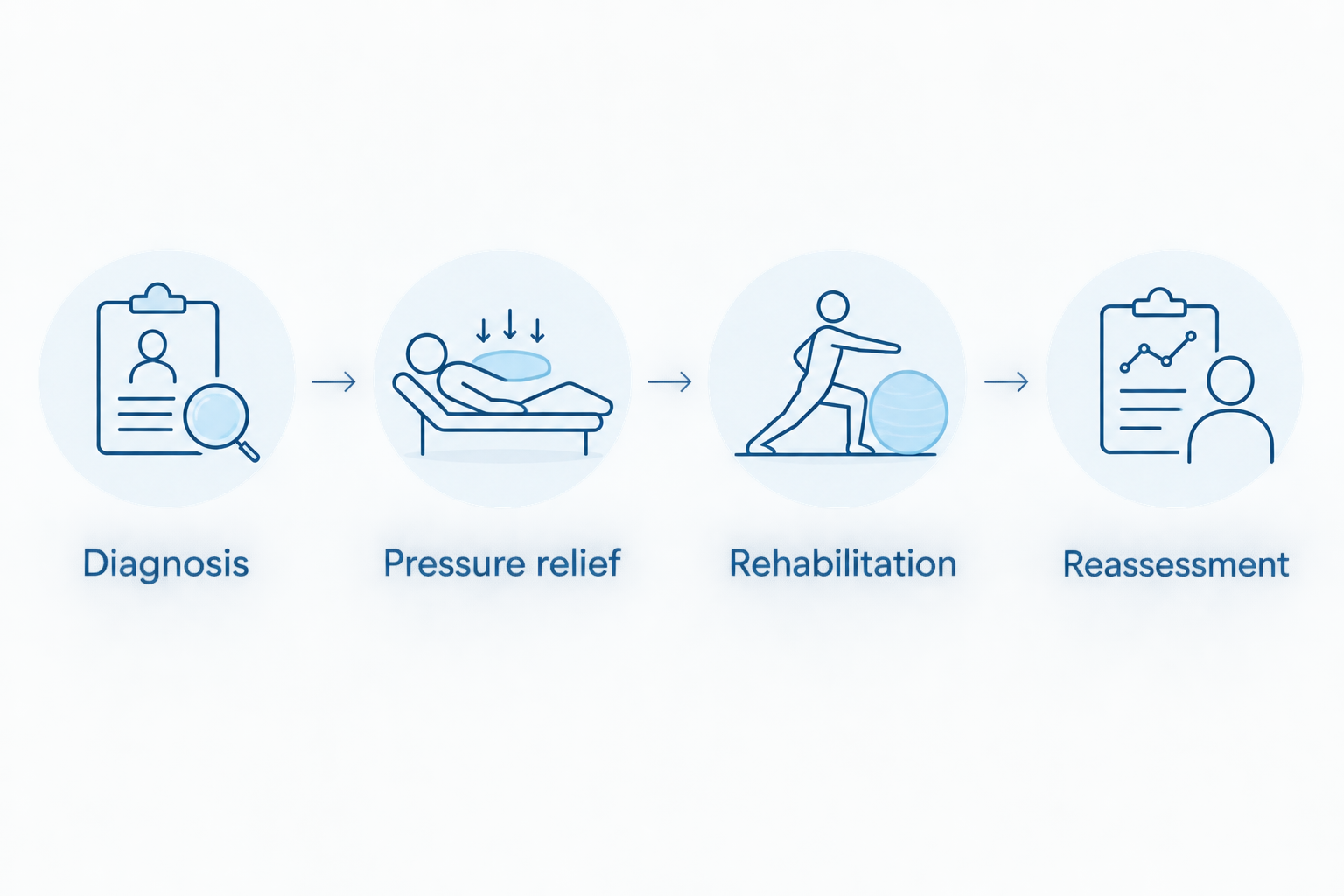
Instead of repeatedly changing shoes around a painful heel bump, start with an examination for Haglund’s deformity, then match pressure relief, rehabilitation, or surgery to the tissues causing pain. This 2026 workflow explains how a “pump bump” is diagnosed, when nonsurgical care comes first, and what changes if the Achilles tendon needs repair.
- Haglund’s deformity pump bump care starts with identifying bone prominence, shoe irritation, and possible Achilles tendon involvement.
- Achilles Foot and Ankle Center evaluates heel pain; a visible bump alone does not establish the diagnosis.
- Nonsurgical treatment reduces pressure and symptoms but does not remove the underlying bony prominence.
- Pump bump surgery is considered when appropriate nonsurgical treatment fails and examination findings match persistent symptoms.
Why this matters
Haglund’s deformity is a bony prominence at the upper back of the heel bone, near the Achilles tendon attachment. Shoe pressure can irritate the overlying tissues or nearby bursa, a small fluid-filled cushion. Achilles tendon disease can occur alongside it, but these are not interchangeable diagnoses.
Achilles Foot and Ankle Center is a fit for Richmond-area patients who need a foot-and-ankle evaluation for persistent heel pain. Patients in Mechanicsville and West End can start by requesting an evaluation through Achilles Foot and Ankle Center.
The important distinction is between the bump you can see and the tissue that hurts. Treatment should address that tissue—not simply the appearance of the heel.
Before you start
- Bring your history and footwear. Take your usual walking shoes and work shoes, medication list, previous imaging, and notes about treatments already tried. Record when symptoms began and whether pressure, walking, or exercise triggers them.
- Flag healing and sensation concerns. Tell the clinician about diabetes, reduced feeling, circulation problems, smoking, wounds, and previous Achilles injuries. These affect treatment decisions and surgical planning.
- Avoid the stretching trap. Do not assume every Achilles exercise suits pain at the heel attachment. Dropping your heel below a step increases compression at that attachment and can aggravate insertional Achilles symptoms.
For your 2026 appointment, write down your main functional goal: comfortable work shoes, walking the dog, or returning to a particular sport. A clear goal gives the treatment plan a practical target.
Diagnosis and imaging
Establish the pain source
- Point to the pain. Show whether discomfort is directly over the bump, deeper beside the Achilles tendon, or underneath the heel. Describe morning stiffness, swelling, shoe rubbing, and any sudden injury.
- Describe function. Explain whether you limp, avoid stairs, or struggle to push off. Rate pain on a 0–10 scale and describe the activity behind that score; the number alone misses how the heel limits you.
- Complete the examination. The clinician checks tenderness, skin, ankle movement, tendon function, and other possible causes. A prominent heel without matching tenderness does not automatically explain your symptoms.
- Discuss imaging when indicated. X-rays show bone shape and calcification. Ultrasound or MRI can help assess tendon or other soft-tissue problems when the examination leaves questions or surgery is being planned.
Expected result: You should leave with an explanation of whether symptoms come mainly from shoe pressure, bursitis, insertional Achilles tendinopathy, or another condition. Tendinopathy means a painful tendon problem involving changes in its structure and load tolerance.
An X-ray finding needs clinical context. The foot X-ray to diagnosis workflow explains how imaging fits into the examination rather than replacing it.
Questions to settle before treatment
Ask which findings explain your pain, whether the Achilles attachment is involved, and what would trigger a change in treatment. Do not use bump size alone to decide whether you need surgery. A visible prominence and significant symptoms do not always travel together.
Keep copies of the diagnosis and activity instructions. They help you avoid receiving conflicting advice about stretching, footwear, and exercise.
Pressure relief and rehabilitation
Build the nonsurgical plan
- Remove direct rubbing. Choose footwear whose heel collar does not press on the tender spot. A softer or differently shaped collar helps some people, but a loose shoe that slips can create new friction.
- Adjust aggravating activity. Reduce the hills, running, jumping, or repeated stair climbing that reliably provoke symptoms. Discuss tolerable alternatives rather than assuming complete inactivity is necessary.
- Use supports selectively. A clinician can advise whether heel lifts, padding, or orthoses suit your mechanics. Poorly placed padding can increase pressure, and a lift changes shoe fit.
- Follow a tendon-specific exercise plan. When the Achilles attachment is involved, rehabilitation should account for compression and gradually rebuild loading tolerance. Do not copy an aggressive heel-drop program intended for pain higher in the tendon.
- Review symptom-control options safely. Ask whether cold application or medication is appropriate for your health history. Anti-inflammatory medicines are not suitable for everyone, including some people with kidney disease, stomach ulcers, or interacting medications.
Expected result: Your plan should identify what to change, what activity remains acceptable, and when to reassess. Improvement means better walking and shoe tolerance—not disappearance of the bone.
Compare the treatment routes
The treatment choices below serve different purposes. None guarantees relief, and the appropriate choice depends on the examination.
| Treatment route | Best for | Main benefit | Main limitation |
|---|---|---|---|
| Footwear and pressure changes | Symptoms clearly aggravated by shoe contact | Reduces direct irritation without a procedure | Does not remove bone or treat every tendon problem |
| Individualized rehabilitation | Achilles-related pain and reduced activity tolerance | Builds capacity through adjusted activity and exercise | Requires consistency; unsuitable loading can worsen symptoms |
| Temporary immobilization | Selected painful flares requiring protected loading | Reduces stress while the clinician reassesses symptoms | Can cause stiffness and weakness; needs a transition plan |
| Surgery | Persistent limiting symptoms despite appropriate nonsurgical care | Addresses the implicated bone and, when needed, damaged tendon | Involves wound, nerve, tendon, anesthesia, and recovery risks |
For your 2026 treatment plan, agree on a reassessment point rather than repeatedly buying another insert. Track walking comfort, swelling, and next-morning symptoms so the clinician can judge response.
Surgical planning and recovery
Establish whether surgery fits
- Review the nonsurgical trial. Bring a record of footwear changes, activity adjustments, rehabilitation, and the response to each. Persistent symptoms deserve reassessment, not an automatic operation.
- Match the procedure to the findings. Ask whether the proposal involves removing the bony prominence, treating the bursa, removing damaged tendon tissue, or detaching and reattaching part of the Achilles tendon. These procedures have different recovery demands.
- Review personal risks. Discuss wound healing, infection, nerve irritation, persistent pain, blood clots, and tendon complications. Diabetes, circulation, sensation, and smoking history belong in this discussion.
- Get written recovery instructions. Confirm weight-bearing restrictions, mobility aids, wound care, follow-up, driving, work duties, and rehabilitation. Arrange practical help before the procedure.
Expected result: You should understand what the surgeon plans to treat, why it matches your symptoms, and what daily life will require afterward. If tendon repair is involved, do not assume recovery follows the same course as bone removal alone.
Questions for a 2026 surgical consultation
Ask these 3 questions: What is causing my pain? What exactly will surgery change? What restrictions follow the proposed procedure? Request explanations in plain language before consenting.
Surgical planning should include work realities. Standing all shift, climbing ladders, and driving for work create different demands from seated duties. Discuss those demands before choosing a date, not after the incision has healed.
Recovery checkpoints
Your surgeon’s instructions take priority over a general timeline. Early recovery focuses on protecting the incision and any tendon repair; later rehabilitation addresses ankle movement, strength, walking mechanics, and activity tolerance.
Return to sport depends on more than skin healing. A safe progression through rehabilitation after orthopedic surgery connects protection, progressive loading, and functional assessment rather than treating a calendar date as clearance.
Ask how the team will assess readiness for your specific activity. Walking comfortably around the house does not establish readiness for repeated jumping, sprinting, or a full standing shift. Use functional progress and clinician clearance—not comparison with someone else’s recovery.
When heel pain returns after improvement
A returning flare needs a review of what changed. It does not, by itself, mean nonsurgical care failed or that surgery is now necessary.
- Identify the trigger. Note new shoes, longer shifts, hills, faster running, or a sudden increase in exercise. Check whether the heel collar now contacts the bump differently.
- Return to the agreed activity level. Follow the adjustment plan your clinician provided rather than pushing through a worsening limp. Do not restart leftover prescription medicines or borrow a boot without advice.
- Record the response. Keep a 7-day log of activities, footwear, swelling, and next-morning symptoms if your clinician recommends monitoring. Seek earlier help for worsening symptoms or warning signs.
- Arrange reassessment when needed. Persistent or changing pain can require another examination, especially after an injury or when weakness develops.
Expected result: You either identify a manageable trigger or provide a clearer history for reassessment. In 2026, your follow-up plan should still be based on symptoms and function, not an assumption that every flare has the same cause.
Troubleshooting stalled progress
The shoe is softer, but the heel still hurts
Check whether the collar still presses on the tender area and whether the shoe slips. Pain during push-off or stiffness without shoe contact also warrants review for tendon involvement. Softer material alone does not solve every source of posterior heel pain.
Stretching makes the pain worse
Stop the movement that increases pain and contact the treating clinician or physical therapist. Ask whether deep ankle bending is compressing an irritated Achilles attachment. Exercise range and resistance need to fit the diagnosis.
The bump remains despite less pain
Nonsurgical treatment does not remove the bony prominence. If walking and footwear tolerance improve, the remaining bump alone does not establish treatment failure. Discuss any ongoing skin pressure or activity limitation at follow-up.
There is a pop, new weakness, or sudden difficulty pushing off
Seek prompt assessment for a possible Achilles injury. Some people can still walk with a torn Achilles tendon, so walking ability does not exclude a tear. Avoid stretching or testing the tendon repeatedly while awaiting care.
The skin breaks down or redness spreads
Seek prompt medical care for an open area, drainage, spreading redness, or increasing warmth, especially with diabetes or reduced sensation. Fever or feeling unwell increases urgency. Do not treat a possible wound infection as ordinary shoe rubbing.
Customize your workflow
Bring 2 pairs of frequently worn shoes to your evaluation so the clinician can compare heel contact and fit. Also explain your work surface, usual walking demands, and exercise goals. These details help turn general advice into usable instructions.
At Achilles Foot and Ankle Center, request an evaluation for persistent heel pain rather than requesting a particular operation before the diagnosis is established. Patients in Mechanicsville and West End should describe the same practical details: pain location, duration, activity limits, and any skin changes.
Request a heel pain evaluation
Discuss persistent heel pain, shoe irritation, and the next appropriate step in care.
FAQ
What is Haglund’s deformity pump bump?
Haglund’s deformity is a bony prominence at the upper back of the heel, often called a pump bump. Shoe pressure can irritate nearby tissues, and Achilles tendon problems can coexist.
Does every bump on the back of my heel need surgery?
No, a heel bump alone does not establish a need for surgery. Treatment depends on the diagnosis, symptoms, activity limitations, and response to appropriate nonsurgical care.
Can a pump bump go away without surgery?
Symptoms can improve without surgery, but nonsurgical care does not remove the underlying bony prominence. The goal is comfortable function and reduced irritation, not necessarily a change in heel shape.
Are heel drops safe for Haglund’s deformity?
Heel drops below a step can aggravate pain when the Achilles attachment is involved. Ask your clinician or physical therapist to prescribe an exercise range appropriate to your examination.
How long does recovery take after pump bump surgery?
Recovery depends on the procedure, particularly whether the Achilles tendon needs detachment and repair. Ask your surgeon for individualized weight-bearing, work, driving, and rehabilitation instructions rather than relying on a general deadline.
Is pain under the heel the same as Haglund’s deformity?
No, pain under the heel has a different location from the back-of-heel prominence associated with Haglund’s deformity. Plantar fasciitis and other conditions require their own examination and treatment plan.
When should I get urgent help for a painful heel bump?
Seek prompt assessment for a sudden pop, new push-off weakness, an open wound, drainage, or spreading redness. Fever, feeling unwell, diabetes, or reduced sensation make timely assessment particularly important.
One last thing
A less painful heel with the same visible bump can still represent meaningful progress. Before your next visit to Achilles Foot and Ankle Center, write down one activity that has become easier and one that remains difficult. That comparison says more about treatment response than another photograph of the bump.
Related guides
- Can you walk on a torn Achilles tendon?
- Shoes for Achilles tendonitis
- Foot and ankle care for runners