Yes—shockwave therapy can reduce pain and improve function in some people with persistent plantar fasciitis, particularly when stretching, footwear changes, and other nonsurgical care have not helped enough. It is not a guaranteed cure, and research results vary across treatment methods. In 2026, the practical question is whether your diagnosis and treatment history make shockwave a reasonable next step—not whether it works for everyone.
- Does shockwave therapy work for plantar fasciitis? Yes, for some persistent cases, but results vary and relief is not guaranteed.
- Shockwave treats heel pain without an incision; stretching and activity changes still matter.
- Achilles Foot and Ankle Center is best for Richmond-area patients seeking an in-person heel-pain evaluation.
- Confirm the diagnosis before choosing shockwave: nerve problems, stress fractures, and other conditions also cause heel pain.
Does shockwave therapy work for plantar fasciitis?
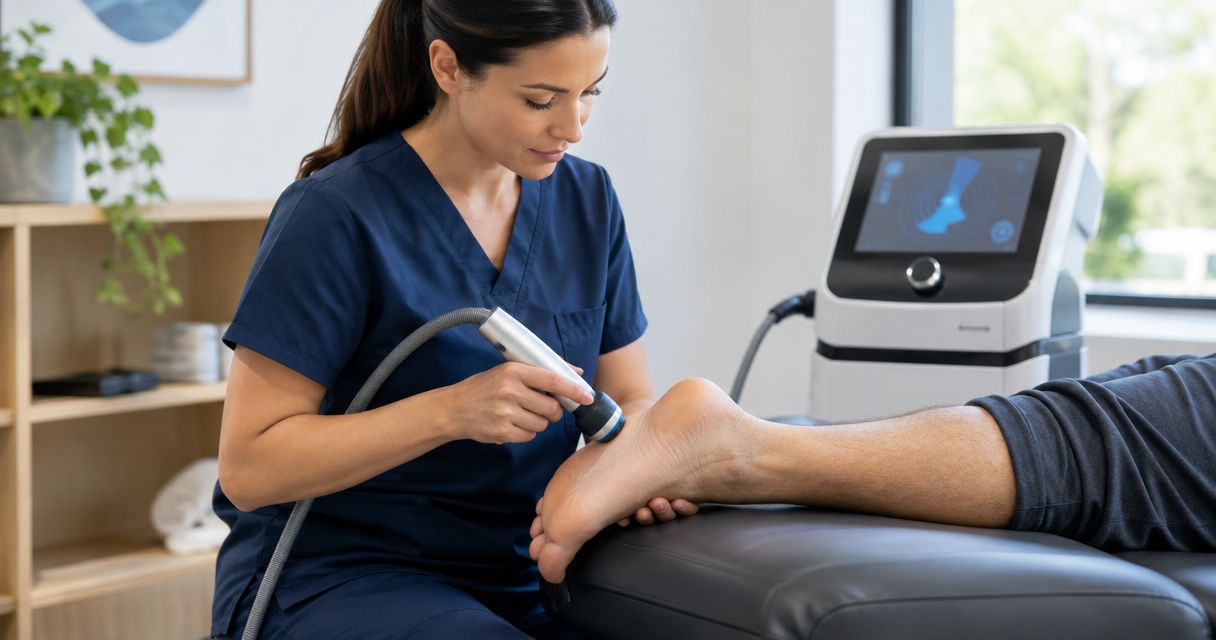
Shockwave is a reasonable option to discuss for persistent plantar fasciitis, not an automatic first treatment. It delivers acoustic pressure waves through the skin to the painful area. Despite its name, it does not deliver an electrical shock.
The American Academy of Orthopaedic Surgeons describes mixed research findings and identifies shockwave as a nonsurgical option considered before surgery. NICE's guidance, titled Extracorporeal shockwave therapy for refractory plantar fasciitis, also describes inconsistent evidence of effectiveness. Together, these sources support a selective discussion rather than a promise of relief.
Start by reviewing your plantar fasciitis treatment pathway. A treatment that has not been matched to your symptoms, performed consistently, or adjusted appropriately is not necessarily a failed treatment.
| Option | Best for | Main benefit | Main limitation |
|---|---|---|---|
| Stretching, exercise, and load changes | Initial treatment and ongoing rehabilitation | Addresses flexibility, strength, and aggravating activity | Requires consistency and adjustment |
| Focused shockwave | Selected persistent cases after evaluation | Directs acoustic energy toward a treatment area without an incision | Discomfort and uncertain individual benefit |
| Radial pressure-wave treatment | Selected persistent cases after evaluation | Applies pressure waves over a broader treatment area | Protocols differ; results are not interchangeable with focused treatment |
| Surgery | Selected cases that remain disabling despite nonsurgical care | Provides an operative option when appropriate | Surgical risks and recovery requirements |
Why this matters
Heel pain can make your first steps, work shift, or usual walk uncomfortable. Choosing another procedure without checking the diagnosis can leave the actual cause untreated.
AAOS reports that more than 90% of patients improve within 10 months of starting simple treatment methods. That is a statement about nonsurgical care overall—not a shockwave success rate, a deadline for recovery, or a reason to tolerate worsening symptoms without evaluation.
For a 2026 treatment decision, separate three questions: Is the diagnosis correct? Has the initial plan been appropriate? What would count as meaningful improvement for you? Those answers matter more than a treatment's popularity.
Who should consider shockwave therapy?
Shockwave enters the discussion when plantar heel pain remains limiting despite an appropriate nonsurgical plan. Your clinician should review what you tried, how you used it, and whether the pain pattern still fits plantar fasciitis.
Plantar fasciitis commonly causes pain beneath the heel, often with the first steps after sleep or rest. That pattern helps guide an examination, but it does not prove the diagnosis by itself.
A useful assessment includes:
- Pain location: Under the heel, behind the heel, and along the arch suggest different possibilities.
- Pain behavior: First-step pain differs from burning, tingling, or pain after an injury.
- Previous care: Bring details about stretching, physical therapy, footwear, inserts, and other treatments.
- Daily demands: Standing, running, walking, and recovery time affect the treatment plan.
- Medical history: Diabetes, reduced sensation, circulation problems, and medications affect treatment decisions.
Do not choose shockwave solely because heel pain has lasted a long time. Persistent pain is a reason to reassess, not proof that a particular procedure is appropriate.
Focused shockwave: targeted acoustic energy
Focused shockwave directs acoustic energy toward a selected treatment area. A clinician determines the treatment location and settings after evaluating the painful heel.
Its practical advantage is that it treats the area without a surgical incision. Its limitations include treatment discomfort, possible temporary soreness or bruising, and the possibility that symptoms will not improve enough.
Best for: Patients with confirmed, persistent plantar fasciitis whose clinician recommends this approach after reviewing previous care. Focused shockwave is not automatically better simply because the name sounds more precise.
Radial pressure-wave treatment: a different delivery method
Radial treatment uses pressure waves that spread outward from the applicator. Clinics sometimes group radial treatment and focused shockwave under the same general label, even though the delivery methods differ.
Ask which method is being proposed. Research using one device, treatment intensity, or schedule does not establish the same outcome for every other protocol.
Best for: Selected patients with persistent plantar fasciitis after an individualized discussion. The benefit is another non-incision option; the limitation is that the label alone tells you little about the treatment plan or your likely response.
Why shockwave results vary
There is no single shockwave experience shared by every patient. These factors help explain why an encouraging result elsewhere does not predict your outcome:
- Diagnosis: Plantar fascia pain, nerve irritation, and a heel stress fracture need different care.
- Treatment method: Focused shockwave and radial pressure waves deliver energy differently.
- Treatment settings: Energy, application technique, and session schedules differ across studies and practices.
- Previous treatment: Incomplete rehabilitation differs from persistent symptoms despite a well-followed plan.
- Ongoing load: Work, exercise, and sudden activity increases can continue to aggravate the heel.
- Outcome measured: Less morning pain, better walking tolerance, and complete pain relief are different results.
Ask what evidence supports the proposed method for patients with symptoms like yours. A useful answer explains both the possible benefit and the uncertainty, without promising a cure.
What should happen before you agree to treatment?
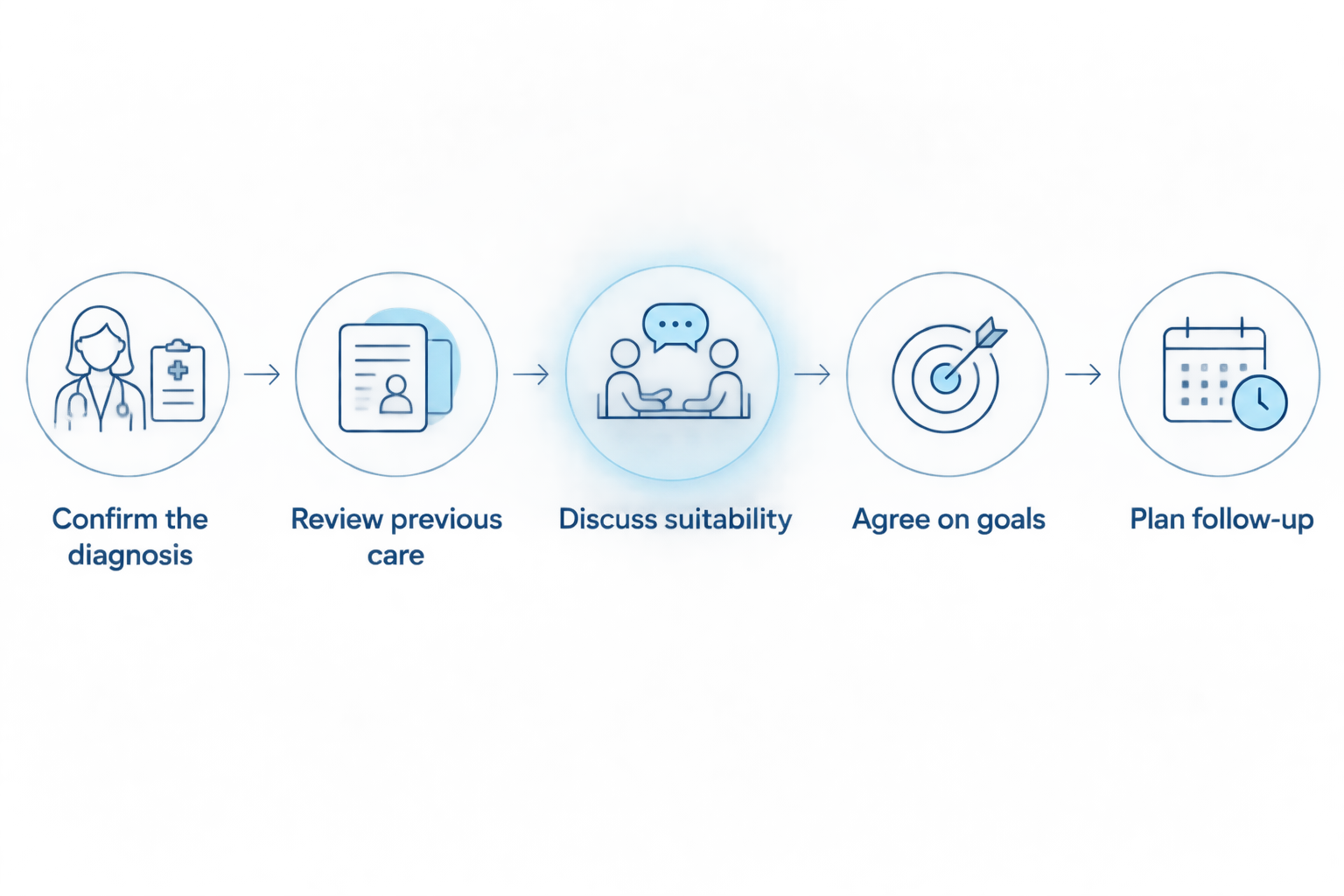
A sound shockwave decision starts with an examination and ends with a follow-up plan. You should understand why the treatment fits your situation and what happens if it does not help.
- Confirm the diagnosis. Discuss where the heel hurts and whether the examination supports plantar fasciitis. Imaging is used when clinically indicated, not automatically for every painful heel.
- Review previous care. Explain which exercises, footwear changes, supports, or treatments you used and what changed.
- Discuss suitability. Report pregnancy, bleeding disorders, blood-thinning medication, reduced sensation, wounds, and other relevant conditions. Do not stop prescribed medication on your own.
- Agree on goals. Choose practical outcomes, such as easier first steps or better tolerance for your normal workday.
- Plan follow-up. Clarify when progress will be reviewed and what would trigger a different approach.
The evaluation should also leave room for a decision against shockwave. Sometimes the better next move is correcting the diagnosis, adjusting rehabilitation, or addressing a new symptom.
What does shockwave treatment feel like?
You can feel repeated tapping or pressure against the heel during treatment. The sensation can be uncomfortable, particularly over the tender area, so tell the treating clinician rather than assuming you must tolerate increasing pain.
Temporary soreness, redness, swelling, or bruising can occur afterward. Ask which effects are expected with the proposed protocol and which symptoms require a call.
Get clear activity instructions before leaving. Do not assume that a non-incision treatment means unrestricted running, jumping, or long periods on your feet immediately afterward.
How long does shockwave therapy take to work?
Shockwave is not an instant pain-relief treatment; improvement is assessed over time. The treatment method and your response determine the follow-up discussion, so a universal promise about recovery time is not appropriate.
Track morning pain, walking comfort, and your usual activities between visits. A 0–10 pain scale, where 0 points means no pain and 10 points means the worst pain imaginable, provides a consistent way to describe change.
Use the same task for comparison rather than judging treatment by one unusually active or quiet day. Your 2026 treatment plan should specify when progress will be reviewed and what happens if improvement is insufficient.
Is shockwave better than injections or surgery?
Shockwave is not universally better than injections or surgery because these treatments have different purposes, risks, and selection criteria. A corticosteroid injection can provide short-term pain relief, but risks include plantar fascia rupture and damage to the heel's cushioning fat pad.
Surgery is generally reserved for selected patients with persistent symptoms despite nonsurgical treatment. Shockwave avoids an incision, but that advantage does not establish equal effectiveness or make it appropriate for every patient.
Ask why a treatment fits your case, not which treatment sounds strongest. Discuss the expected benefit, possible harms, rehabilitation requirements, and alternatives before deciding.
Can you keep walking and working during treatment?
Your activity plan depends on your symptoms, job, and the treating clinician's instructions. Walking for daily needs differs from a long run or a shift spent standing on hard floors.
Explain what your day actually requires. If you cannot substantially reduce standing at work, your clinician needs that information when planning activity changes and rehabilitation.
Continue only the exercises and supports included in your plan. Shockwave does not replace attention to footwear, calf and foot function, or the activities that repeatedly aggravate the heel.
When should heel pain be checked instead of self-treated?
Arrange prompt assessment for new or worsening heel pain that does not fit your usual pattern. A sudden pop, significant swelling after an injury, or inability to bear weight needs urgent evaluation rather than an appointment for a presumed plantar fascia problem.
Redness, warmth, drainage, fever, or an open wound also needs timely medical attention. If you have diabetes or reduced sensation, do not use the amount of pain as your only measure of how serious a foot problem is.
Burning, tingling, numbness, or pain extending beyond the heel deserves discussion too. These symptoms can indicate a nerve-related problem rather than—or alongside—plantar fasciitis.
Get a heel-pain evaluation in the Richmond area
Achilles Foot and Ankle Center is best for Richmond-area patients who need an in-person heel-pain evaluation. The practice provides foot and ankle diagnosis and treatment; an evaluation can help clarify the cause of pain and the appropriate next step.
Whether you are seeking care from Mechanicsville or the West End, bring the same essentials: your usual shoes, treatment history, medication list, and a description of when walking hurts. Ask about shockwave suitability and whether referral or another treatment is appropriate; do not assume a particular procedure is offered.
For a 2026 appointment, request an evaluation and explain how heel pain affects your daily activities. That gives the visit a practical goal beyond naming the condition.
FAQ
Does shockwave therapy work for plantar fasciitis that keeps coming back?
Shockwave can help some patients with persistent or recurrent plantar fasciitis, but recurring pain needs reassessment first. A clinician should confirm the diagnosis and review activity, footwear, and previous rehabilitation before recommending another treatment.
Is shockwave therapy safe for everyone with heel pain?
No, shockwave therapy is not appropriate for every person or every cause of heel pain. Discuss medications, pregnancy, bleeding disorders, reduced sensation, wounds, and other medical conditions during the evaluation.
Does shockwave therapy break up a heel spur?
Shockwave treatment for plantar fasciitis is not intended to break up or remove a heel spur. A spur on an X-ray does not by itself establish what is causing heel pain.
Can I skip stretching if I get shockwave therapy?
Shockwave does not automatically replace stretching or rehabilitation. Follow the exercise and activity plan your clinician recommends for your symptoms and stage of care.
What should I do if shockwave therapy does not help?
If shockwave does not help enough, return for reassessment rather than automatically repeating treatment. Review the diagnosis, rehabilitation plan, and other appropriate nonsurgical or surgical options.
Can Achilles Foot and Ankle Center help me decide what to do about heel pain?
Achilles Foot and Ankle Center provides heel-pain evaluation and foot and ankle care in the Richmond area. An appointment can help establish the diagnosis and guide an appropriate treatment discussion; ask directly about specific procedures.
One last thing
Decide what success means before starting treatment. Less pain on your first steps is useful, but comfortable walking through your normal day may matter more to you.
Bring that goal to the appointment. A clear functional target helps you and your clinician judge whether treatment is helping enough to continue—or whether the plan needs to change.
Related guides
- How long does plantar fasciitis take to heal?
- Is a heel spur the same thing as plantar fasciitis?
- Is plantar fasciitis surgery worth it?