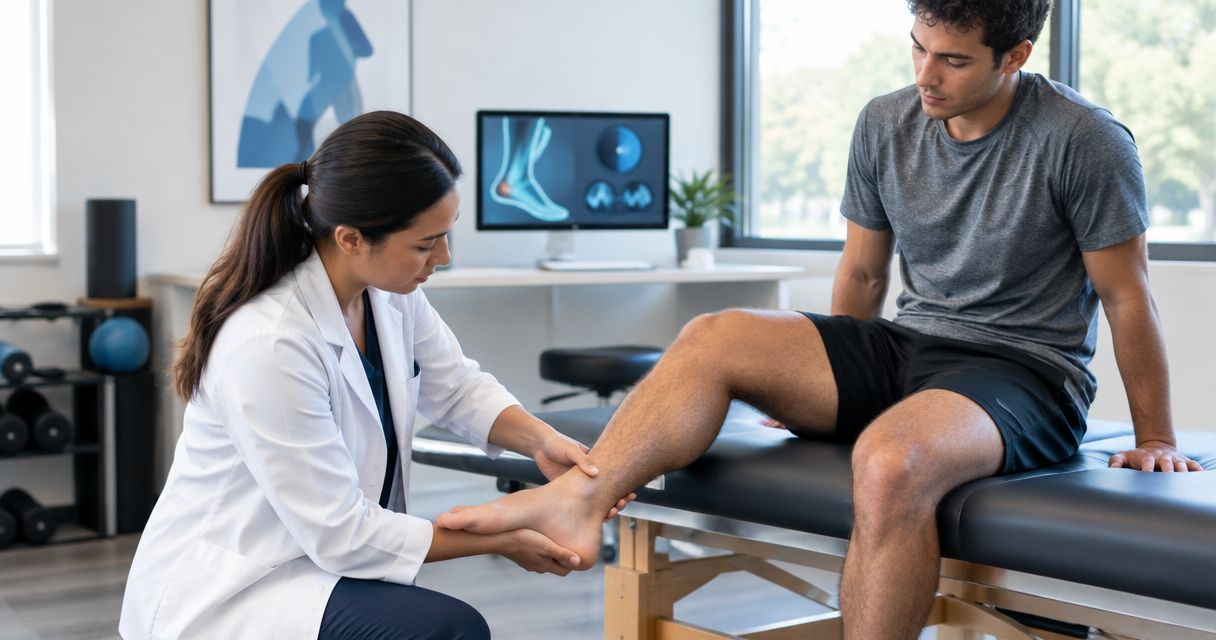

Tibial stress fracture symptoms usually start as a dull ache in the shin that gets worse with running or jumping. Over days or weeks, the ache narrows to one tender spot you can cover with a fingertip. The pain builds during activity, lingers afterward, and eventually shows up at rest or at night. Mild swelling over the spot is common. If pressing on the bone hurts and rest isn’t settling the pain, get it examined.
A tibial stress fracture is a tiny crack in the tibia, the larger of the two lower leg bones. It is also called a hairline fracture. It forms when repeated impact outpaces the bone’s ability to repair itself. The first stage is a stress reaction, similar to a deep bone bruise, and the crack follows if you keep loading the same spot.
This article explains why catching it early matters, how to recognize the symptoms and where they show up on the leg, and how to separate them from shin splints. It also covers what diagnosis, walking, healing time and treatment look like. Achilles Foot & Ankle Center diagnoses and treats stress fractures and overuse sports injuries, so the guidance is built around the questions runners and athletes bring us.
Why tibial stress fracture symptoms matter early
Tibial stress fracture symptoms matter because the injury gets more expensive the longer you ignore it. Caught as a stress reaction, it may need a few weeks of reduced impact. Caught as a full crack, it needs about six to eight weeks of healing.
What a tibial stress fracture actually is
Your tibia carries most of your body weight through the lower leg, so it absorbs every step, landing and jump. Bone is living tissue that constantly remodels itself. When your training load climbs faster than that repair can keep up, the surface of the bone becomes inflamed. That stage is a stress reaction, and continued pounding on the same spot deepens it into a hairline crack.
Overuse causes almost every case, not one bad landing. That is why symptoms creep in gradually instead of arriving with a snap. A sudden, sharp pain after a fall or twist is a different problem, covered in the last section.
Why pushing through the pain backfires
Many active people try to work through shin pain, and that is the most common way a manageable bone injury becomes a long one. The bone stays weak while you keep loading it, so the crack can widen. In more severe cases, pushing through a bone stress injury can lead to a fracture that needs surgery.
Location also matters. A stress fracture on the front of the tibia tends to heal more slowly than one on the inner edge, and it gets checked more cautiously for that reason.
Stopping early is the cheapest treatment a tibial stress fracture ever offers.
Who is most at risk
Anyone who repeatedly loads the lower leg can develop one, but some factors raise the odds:

- Sports built on running or jumping, such as distance running, basketball, tennis, gymnastics and dance
- A sudden jump in mileage, intensity or training days without rest
- A change of surface, such as moving from a treadmill or indoor track to road running
- Low bone density, vitamin D deficiency or osteoporosis
- Flat feet, high arches or bunions
- An eating disorder or too little fuel for your training
- Female sex: women are two to three times more likely to develop a stress fracture than men
How to recognize tibial stress fracture symptoms
You can recognize a tibial stress fracture by its pattern: pain you can point to, tenderness when you press, and pain that gets worse with impact instead of easing. Each symptom alone can have other causes, so the combination is what matters.
The core symptoms
These are the signs to check for in your own shin:
- Pain at one spot. You can cover it with a fingertip, not a whole hand.
- Tenderness to touch. Pressing on the bone reproduces the pain, sometimes with a very light touch.
- Pain that builds with impact. It begins as an ache late in a run, then arrives earlier and gets sharper.
- Pain that lingers. It doesn’t fade soon after you stop, and it can ache at rest or at night.
- Swelling. You may see or feel mild puffiness over the painful spot. Bruising is rare.
If you only remember three, make them pinpoint tenderness, pain that worsens as you keep going, and pain at rest. Those separate a bone injury from ordinary soreness better than any others.
How the pain progresses
Take a runner who goes from 10 to 20 miles a week over a month to prepare for a 10K. A typical sequence looks like this:
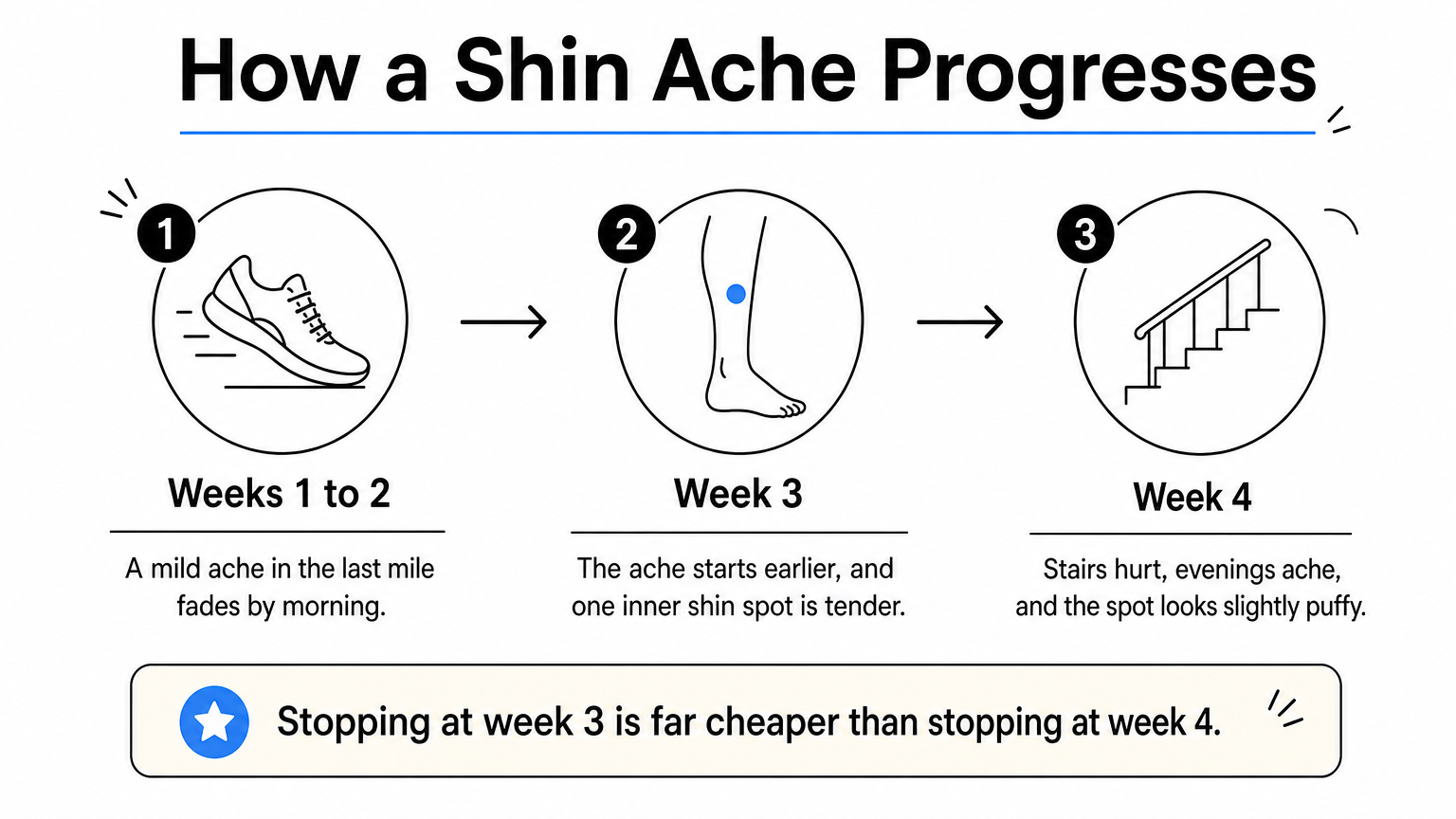
- Weeks 1 to 2: a mild ache in the shin during the last mile that disappears by the next morning.
- Week 3: the ache starts earlier in each run, and one spot on the inner shin is now tender to press.
- Week 4: walking downstairs hurts, there’s a dull ache in the evening, and the spot looks slightly puffy.
By week 3 the bone is already telling you something. Stopping then is far cheaper than stopping at week 4.
Where on the leg it hurts
The location changes how seriously the pain is treated, though only an exam can confirm the diagnosis:
| Location | What it feels like | Why it matters |
|---|---|---|
| Inner edge of the shin | Tender spot along the inner edge of the tibia | Common in runners, and usually responds to rest and activity changes |
| Front of the shin | Tender ridge at the front, worse with jumping | Heals slowly and tends to be treated more cautiously |
| Outer lower leg (fibula) | Pain on the outside, often a few inches above the ankle | Same pattern of building pain and point tenderness as the tibia |
One painful spot that gets worse with impact is the signature of a bone injury.
Stress fracture or shin splints: how to tell
The fastest way to tell them apart is the pain’s footprint. Shin splints spread along a stretch of the shin and often ease as you warm up. A tibial stress fracture stays in one spot and gets worse the longer you keep going.
Side-by-side comparison
| Feature | Shin splints | Tibial stress fracture |
|---|---|---|
| Pain area | Broad stretch along the inner or outer shin | One small spot on the bone |
| Pressing on the shin | Tender over a wide area | Sharp tenderness at a single point |
| During exercise | Often eases as you warm up | Gets worse as you continue |
| After exercise | Fades with rest | Lingers, and may ache at rest or at night |
| Swelling | Uncommon | Mild, over the painful spot |
| Time off high-impact activity | At least one to two weeks | About six to eight weeks to heal |
A simple at-home check
This check can raise or lower your suspicion, but it can’t replace an exam:
- Run a fingertip slowly down the inner edge of your shin and mark any spot that is sharply tender.
- Walk across the room and note whether it hurts to put weight on that leg.
- Think back through your last three workouts. Did the pain ease or worsen as you went on?
- Ask whether it aches when you’re sitting or lying in bed.
Hopping on one leg is a test clinicians use, but skip it if walking already hurts. If you answer yes to a single tender spot, pain that worsens with exercise, or rest pain, treat it as a possible stress fracture until someone examines it.
Can shin splints cause a stress fracture?
Shin splints don’t turn into a fracture on their own, but both injuries come from the same repeated load, so they sit on a spectrum of bone stress. People diagnosed with shin splints can also show bone stress changes on MRI. When the pain overstays, the question is whether the bone is involved.
That makes persistence the warning sign. Shin splints should settle with a week or two off high-impact activity and a slow return. If your pain doesn’t improve with rest, or it narrows to one spot, ask for an exam.
How a tibial stress fracture is diagnosed and treated
A provider diagnoses a tibial stress fracture through an exam and your history, then confirms it with imaging when needed. Treatment is mostly about taking load off the bone for long enough to heal.
How a diagnosis works
The provider asks what you were doing when the pain began and presses along the bone to find the tender spot. They may also watch how you stand or hop on one leg. Imaging then confirms the picture:
- X-ray: often normal in the first weeks, so a clear X-ray doesn’t rule out a stress fracture.
- MRI: picks up early bone stress that X-rays miss.
- CT scan: shows the crack in detail when the bone needs a closer look.
- Bone scan: a whole-body option in some cases.
At our office we perform X-rays, ultrasound and fluoroscopy. When a case needs an MRI or CT, we refer you to an imaging center based on your insurance.
Can you walk on it, and can you heal faster?
You may be able to walk on a tibial stress fracture, depending on where it is and how severe it is, but pain is the guide. If walking hurts or makes you limp, the bone is still taking too much load. A walking boot or crutches may be used to offload the leg. Jogging, running and jumping are off the table until your provider clears them.
There is no reliable way to heal a shin stress fracture fast. Healing usually takes six to eight weeks, and as long as the area hurts, the bone is still fragile. What helps is removing the load, getting enough calories and protein, and correcting low vitamin D or calcium if a doctor finds a deficiency. Returning early is the surest way to lose time.
What treatment looks like
Care follows the location and severity of the fracture. The usual steps are:

- Rest from the activity that caused it. Stop running and jumping.
- Ice. Use a cold pack wrapped in a thin towel, as much as four times per day.
- Compression and elevation. Keep the leg raised above your heart when you can.
- Immobilization. A boot or special shoe, and sometimes crutches, to reduce pressure.
- Fix the cause. Review your footwear, running mechanics, training load and bone health.
- Return gradually. Build back on a schedule your provider sets.
Most tibial stress fractures heal without surgery. It comes up when a fracture isn’t healing or sits in a bone prone to complications. The surgeon then uses pins, screws or a plate to hold the bone together while it heals.
Stopping the load is the treatment, and everything else supports it.
When to get shin pain checked and how to prevent it
Get shin pain checked when it narrows to one tender spot, hurts at rest, or doesn’t improve after a week or two of reduced activity. Go to the emergency room for the red flags below.
Signs you need care now
Book a visit soon if you notice:
- Pain you can point to that persists after rest and a slow return to activity
- Pain at rest or at night
- Tenderness when you press on the shin bone
- Swelling over the painful area
Go to the emergency room if you have intense pain, can’t put weight on the leg, see a visible deformity, or can see bone through the skin. The same goes for any pain that follows a fall or other trauma.
For non-emergency pain, we try to make room for urgent issues, though same-day appointments aren’t guaranteed. You can call us at 1-804-273-1717.
How to prevent a repeat
Prevention is mostly training management, and these habits cover most of it:
- Increase mileage and intensity gradually instead of in jumps.
- Cross-train with swimming, cycling or strength work so the tibia isn’t taking the same load every day.
- Replace worn shoes. A common guideline is every 300 to 500 miles of running.
- Eat enough to fuel your training, and ask your doctor about vitamin D and calcium.
The most important habit is acting on the first ache. Stop at the first warning and see a provider before it becomes a crack.
Take shin pain you can point to seriously
Tibial stress fracture symptoms follow a clear pattern: one tender spot on the bone, pain that builds with impact, lingering or night pain, and mild swelling. Shin splints spread along the shin and usually ease as you warm up. If your pain is narrow, persistent and sore to the touch, stop the activity that causes it and get an exam instead of testing the bone with another run.
Early action keeps the recovery short, and a proper diagnosis keeps you from guessing. If your shin pain fits this pattern, you can book a same-day appointment with Achilles Foot & Ankle Center and get a clear answer on what is going on.