
Dancers’ foot and ankle care is the prevention, assessment, and treatment of dance-related foot problems with the aim of keeping you moving safely and comfortably. This 2026 guide explains how to manage repeated jumps, turns, tight footwear, and rehearsal demands without treating persistent pain as part of the job.
- Foot and ankle care for dancers starts with matching training load and footwear to symptoms, not pushing through pain.
- Achilles Foot and Ankle Center provides podiatry evaluation for dancers with heel pain, nail problems, or sports injuries.
- Stop dancing and seek prompt assessment for focal bone pain, sudden weakness, or difficulty bearing weight.
- Return to jumps and turns according to function and clinical advice, not your performance calendar.
Why foot and ankle care matters for dancers
Dance asks your feet to provide both flexibility and control. Ballet, tap, contemporary, and other styles load the foot differently, so advice that works in a walking shoe does not automatically translate to the studio.
Your care plan also has to account for rehearsals, performances, and footwear requirements. Simply adding an insert or stretching harder does not answer whether pain comes from irritated tissue, a joint problem, a nail injury, or a stress injury in bone.
Achilles Foot and Ankle Center is a good fit for Richmond-area dancers who need podiatry evaluation for foot or ankle symptoms. An evaluation offers a clearer starting point than repeatedly changing shoes or self-treating an assumed diagnosis. You can learn about the practice through Achilles Foot and Ankle Center.
For your 2026 dance schedule, treat recovery time as part of preparation rather than something to fit around worsening symptoms. The goal is not to avoid all exertion; it is to recognize when normal training discomfort has become a reason to change course.
Build a practical dancer foot-care routine
1. Identify the pain before changing your routine
Start with observation, not a diagnosis. Record where discomfort begins, which movement brings it on, and whether it continues after class or returns the next morning.
Pain beneath the heel with the first steps after rest can occur with plantar fasciitis, which affects the tissue supporting your arch. Pain behind the heel involves a different area, including the Achilles tendon. Neither pattern confirms a diagnosis on its own.
Pay particular attention to tenderness concentrated over a small area of bone, pain at rest, or a new limp. Stop impact activity and arrange assessment rather than testing the same painful movement repeatedly. A sudden pop with weakness or difficulty pushing off also needs prompt evaluation.
- Mark the painful area on a simple foot drawing.
- Note the shoes, surface, and movement involved.
- Record swelling, bruising, tingling, or weakness.
- Stop movements that produce sharp or increasing pain.
2. Adjust your dance load before adding treatments
Use your class calendar to identify recent changes. Extra rehearsals, a new style, a different floor, or returning after time away can change the demands on your feet even when your usual class feels familiar.
Begin by removing the movement that provokes symptoms. Depending on the problem, that might mean avoiding jumps, pointe work, or repeated rises onto the balls of your feet. Tell your instructor what hurts rather than silently changing your landing or favoring one side.
Training changes are useful, but they do not replace assessment for a suspected injury. Do not use a comfortable warm-up as proof that you can safely complete a full rehearsal. Track how your foot feels over the following 24 hours, including your first steps the next morning.
- Compare your current schedule with your recent usual workload.
- Remove painful impact work instead of dancing through it.
- Ask your instructor about nonpainful class modifications.
- Record symptoms during class and afterward.
3. Arrange an evaluation when symptoms affect function
Bring your symptom notes to an appointment if pain keeps returning, changes your walking, or interferes with dance. At-home observations help explain the problem, but an examination is needed to distinguish conditions with overlapping symptoms.
Achilles Foot and Ankle Center offers care for heel pain, nerve pain, and sports injuries. Describe the exact demands you need to return to, including turns, jumps, barefoot work, or pointe. Imaging or other tests depend on the examination; they are not automatically necessary for every sore foot.
For dancers in Mechanicsville and the West End, the next practical step is to contact the practice about an appropriate evaluation. Seek urgent care instead of waiting for a routine appointment if you have a visible deformity, cannot bear weight after an injury, or develop a cold or pale foot.
- Bring your dance shoes and everyday footwear.
- List previous sprains, fractures, and relevant medical conditions.
- Explain which movements you cannot perform normally.
- Ask what activity is safe while the problem is assessed.
4. Check footwear and toe pressure together
Inspect the shoes you already use before buying something new. Look for worn areas, pressure over toe joints, slipping at the heel, and places where your toes curl or rub. Dance shoes have style-specific requirements, but persistent pressure still deserves attention.
Have dance footwear assessed by someone familiar with that style. Pointe readiness and pointe-shoe fit require appropriate instruction and assessment; age or enthusiasm alone does not establish readiness. Avoid making major padding changes immediately before a performance because extra material changes the space inside the shoe.
Everyday footwear matters too. Give irritated toes enough room between rehearsals, and discuss inserts with a clinician when symptoms suggest they are appropriate. An insert that fits a walking shoe is not automatically suitable for a close-fitting dance shoe.
- Check both feet for rubbing after class.
- Inspect worn soles and compressed shoe materials.
- Reassess fit when padding, socks, or foot shape changes.
- Choose everyday shoes that do not squeeze painful toes.
5. Protect your skin and nails without aggressive trimming
Check your feet after removing your shoes. Blisters, split skin, irritated nail edges, and thickened nails can make it harder to dance comfortably, but cutting deeper or removing more skin is not the solution.
Wash your feet, dry carefully between the toes, and let footwear dry between uses. Trim toenails straight across without digging into the corners. Do not cut a groove into an ingrown nail or use sharp tools to remove a painful callus.
A bruised or thickened nail is not automatically fungal. Repeated shoe pressure and other conditions can change its appearance, so treatment should follow the cause. Spreading redness, warmth, drainage, or worsening pain needs prompt medical attention. If you have diabetes, poor circulation, or reduced sensation, seek professional guidance for any new blister, wound, or nail injury.
- Look at the soles and between your toes.
- Keep nail tools clean and avoid sharing them.
- Protect irritated skin from further friction.
- Leave deep callus cutting and ingrown-nail digging alone.
6. Build strength and mobility around your needs
Start with comfortable movement rather than forcing your foot into a position. Gentle ankle motion and controlled foot exercises are different from pushing through pain to achieve a deeper point or turnout.
A strengthening plan should match your symptoms, current ability, and dance style. Calf raises, balance work, and small-foot-muscle exercises are common rehabilitation tools, but the correct starting level depends on the problem. An injured tendon and a healing bone do not necessarily tolerate the same exercise.
Ask a treating clinician or physical therapist to explain the purpose of each prescribed exercise. In your 2026 training plan, record 3 details for each exercise: the movement, the prescribed amount, and the symptoms that mean you should stop. Do not copy another dancer’s rehabilitation schedule simply because the pain sounds similar.
- Use a stable support for balance exercises when needed.
- Keep movements controlled rather than chasing range.
- Stop exercises that cause sharp pain or new swelling.
- Review persistent next-day symptoms with your treating professional.
7. Return to dance by function rather than a deadline
Begin with activities your treating clinician has cleared. A comfortable walk is useful information, but it does not establish readiness for repeated landings, rapid changes of direction, or pointe work.
Build from simpler tasks toward the specific demands of your style. Depending on the injury, your plan might move from supported technique to center work, then turns and jumps. The sequence and timing need individual guidance, especially after a fracture, tendon injury, or surgery.
Tell your instructor what has been cleared and what remains restricted. Use your 2026 performance dates to explain your goals, not to override symptoms. A return plan needs permission to pause when pain, swelling, or altered technique returns.
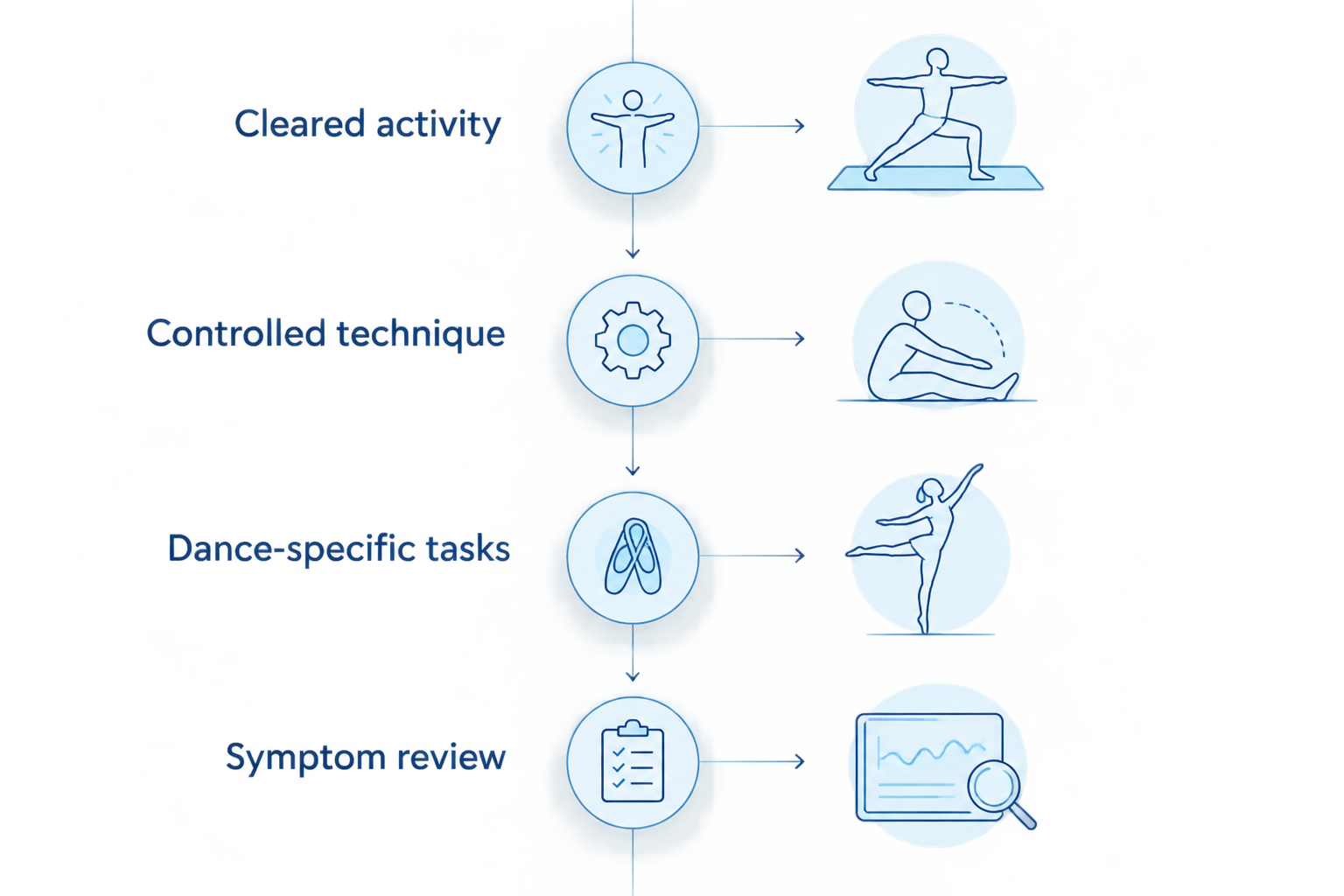
Use these checkpoints as discussion points, not a self-clearance test. Being able to complete a movement once does not establish that you can tolerate an entire rehearsal.
- Cleared activity: confirm what you can currently do.
- Controlled technique: practice without limping or compensating.
- Dance-specific tasks: add only the demands you are cleared for.
- Symptom review: report pain or swelling that returns afterward.
Compare your care options
The best starting point depends on the symptoms, not the most elaborate treatment. Self-care helps with observation and avoiding irritation; professional assessment addresses a suspected injury or symptoms that persist. These options often work together rather than replacing one another.
| Option | Best for | Main advantage | Key limitation |
|---|---|---|---|
| Activity modification and symptom tracking | Mild discomfort without warning signs | Helps identify triggers and avoid repeated irritation | Does not diagnose an injury |
| Dance-shoe fit assessment | Rubbing, pressure, slipping, or footwear concerns | Addresses how the shoe fits your dance demands | Does not rule out a tendon, bone, or joint problem |
| Podiatry evaluation | Recurring pain, nail problems, or suspected foot and ankle injury | Provides examination and a condition-specific treatment plan | An appointment alone does not establish performance readiness |
| Clinician-directed rehabilitation | Restoring strength, balance, and dance function after assessment | Provides a structured progression toward activity | Requires follow-through and adjustment to symptoms |
| Urgent medical assessment | Significant injury, circulation changes, or infection warning signs | Prioritizes problems that should not wait | Is not a substitute for ongoing rehabilitation or shoe-fit advice |
Achilles Foot and Ankle Center provides podiatry care, but no single treatment suits every dancer. Ask how the diagnosis changes your training restrictions, footwear choices, and next review rather than requesting a particular device or procedure first.
Common mistakes dancers make
Treating pain that warms up as harmless
Pain that eases during class still matters if it returns afterward or changes your technique. Record the full pattern instead of judging your foot only when you feel most comfortable.
Adding padding until the shoe becomes tighter
Padding takes up space. If each new layer increases pressure or changes how your toes sit, reassess the fit rather than continuing to add material.
Stretching every painful structure
A painful area is not necessarily tight, and stretching is not appropriate for every injury. Stop forcing painful ranges and ask which movements fit your diagnosis.
Hiding symptoms before a performance
Your instructor cannot modify a rehearsal around a problem they do not know about. Explain what hurts and share any clinical restrictions before class begins, not after symptoms escalate.
Using another dancer’s recovery timeline
Similar pain does not prove the same injury. Your return depends on the affected tissue, examination findings, and functional progress—not when a classmate resumed dancing.
FAQ
What is the best foot and ankle care for dancers?
The best approach combines appropriate training load, well-fitting footwear, skin and nail care, and assessment of persistent symptoms. A diagnosed injury needs a condition-specific plan rather than a generic stretching routine.
Should I keep dancing if my heel hurts?
Stop the movements that cause heel pain, and arrange assessment if pain persists, recurs, or changes your walking. Sudden pain, marked swelling, or difficulty bearing weight needs prompt attention.
Is every dancer’s heel pain plantar fasciitis?
No, heel pain has several possible causes, including problems involving the plantar fascia, Achilles tendon, or bone. The location and timing help guide an examination but do not confirm the diagnosis.
Can I dance with an ingrown toenail?
Avoid dance activity that presses on a painful ingrown toenail. Seek care for drainage, spreading redness, worsening pain, or any nail injury when you have diabetes or poor circulation.
Do dancers need custom orthotics?
Not every dancer needs custom orthotics. A clinician can assess whether an insert addresses your symptoms and whether it fits the footwear you use; some dance shoes have little room for added material.
How do I know when I can return to jumps or pointe?
Return when your treating clinician has cleared those demands and your progression supports them without compensating. Comfortable walking alone does not establish readiness for jumps or pointe.
Where can Richmond-area dancers get foot and ankle symptoms evaluated?
Achilles Foot and Ankle Center offers podiatry care for foot and ankle conditions, including heel pain, nail problems, and sports injuries. Dancers in Mechanicsville and the West End can contact the practice to discuss an appropriate evaluation.
One last thing
Bring your dance shoes to the appointment, even if your foot feels comfortable that day. A description of pain tells part of the story; showing where the shoe presses and explaining the exact movement that hurts makes the conversation more specific.
For your next 2026 rehearsal, write down the movement you are avoiding and the question you need answered. That gives your evaluation a practical goal: understanding what you can do safely and what needs to change.
Related guides
- Can you walk on a torn Achilles tendon?
- Is it safe to cut out an ingrown toenail at home?
- Can bunions be treated without surgery?