
Golfers’ foot and ankle care is the prevention, assessment, and treatment of foot problems with the aim of keeping walking and swinging comfortable. Golf combines prolonged time on your feet with rotation over a planted foot, so your 2026 care plan should address shoe fit, walking tolerance, skin health, and symptoms that need evaluation.
- Foot and ankle care for golfers starts with comfortable shoes, manageable walking, and attention to heel pain or skin changes.
- Achilles Foot and Ankle Center provides foot and ankle evaluation for Richmond-area golfers with pain, injuries, or diabetic foot concerns.
- Choose inserts or braces for an identified problem, not simply because a product is labeled for golf.
- Stop playing through a limp, an open wound, or sudden tendon pain; seek appropriate medical assessment.
Why foot and ankle care matters for golfers
Golf asks your feet to support walking, balance on uneven ground, and transfer weight during a swing. A shoe that feels comfortable while standing in a store can still rub your toes or allow your heel to slide on the course.
Achilles Foot and Ankle Center provides foot and ankle care for Richmond-area golfers who need a clinical evaluation. The practice treats heel pain, nerve pain, sports injuries, and diabetic foot problems. Learn about Achilles Foot and Ankle Center when symptoms interfere with your game or everyday walking.
Your goal for the 2026 season is not simply to finish a round. It is to finish without worsening symptoms, changing your stride, or overlooking skin damage that needs attention.
Build your golf foot-care routine
Check your symptoms before choosing a fix
Start by identifying where discomfort occurs and what brings it on. Pain beneath the heel with the first steps after rest can fit plantar fasciitis, irritation of the tissue supporting your arch. Pain behind the heel involves a different area and needs a different assessment.
Burning, tingling, and numbness deserve attention too. Do not assume that every sore foot needs more cushioning or that every swollen ankle is a simple sprain.
A brief symptom record is useful for a visit. Record what happens during 1 round, including whether discomfort begins while walking, swinging, or afterward. Do not repeat a painful round just to collect information.
- Mark the exact location of pain rather than writing only “sore foot.”
- Note whether symptoms affect your lead foot, trail foot, or both.
- Record swelling, bruising, numbness, or changes in your stride.
- Identify recent changes in shoes, practice, or walking volume.
- Stop and seek assessment if you cannot bear weight or develop sudden severe pain.
Fit your shoes around your feet, not the label
Try golf shoes with the socks you actually wear on the course. Your toes need room without your foot sliding inside the shoe; a wide label alone does not establish a good fit. Check the heel, forefoot, and areas over bunions or prominent toe joints.
For your 2026 shoe check, look beyond the upper. Worn traction, a compressed footbed, or a heel counter that no longer holds its shape can change how a shoe feels during walking and rotation.
Golf-specific footwear offers course-oriented traction, but no traction pattern compensates for painful fit. Follow course footwear rules and choose a shoe that stays comfortable during normal movement.
- Walk, turn, and make a gentle practice swing during fitting.
- Check both feet; do not judge fit from only the more comfortable side.
- Keep seams and stiff edges away from tender skin or toe joints.
- Inspect the inside for debris, rough lining, or a folded insole.
- Replace damp socks rather than continuing with wet fabric against your skin.
Match support to the problem you actually have
Begin with a well-fitting shoe and a review of your activity. If discomfort persists, a podiatry evaluation can help distinguish heel pain, tendon trouble, joint irritation, and nerve symptoms before you buy another support product.
Achilles Foot and Ankle Center offers evaluation and treatment for these foot and ankle concerns. For golfers in Mechanicsville and West End, the next move is an appropriate assessment—not automatically a stronger insert or tighter brace.
An insert changes how your foot contacts the shoe. A brace supports the ankle. Neither establishes a diagnosis, and either can create pressure if the fit is wrong.
- Bring your golf shoes and current inserts to the appointment.
- Explain whether pain occurs during walking, rotation, or both.
- Ask what problem a recommended support is intended to address.
- Check that an insert does not crowd your toes or lift your heel excessively.
- Report rubbing, new numbness, or worsening pain after a support change.
Adjust walking before discomfort changes your swing
Reduce the activity that provokes symptoms rather than trying to overpower pain. When ordinary walking is comfortable and no clinician has restricted activity, a 9-hole round is a smaller walking commitment than an 18-hole round. A cart reduces walking but still leaves standing, short walks, and rotational demands.
Use your response during play and afterward to guide the next outing. Pain that increases, a new limp, or worsening next-morning symptoms means the current load needs review—not another attempt to “walk it off.”
Your 2026 return-to-golf plan should reflect your diagnosis and baseline activity. An injury, recent procedure, or diabetic wound requires individualized guidance rather than a fixed calendar.
- Reduce walking, practice volume, or both when symptoms increase.
- Avoid adding longer rounds and more range sessions at the same time.
- Choose more even walking routes when available and safe.
- Stop if you begin protecting one foot or changing your stride.
- Ask about return-to-play criteria after an injury or procedure.
Warm up without forcing a painful movement
Start with comfortable walking and gentle ankle movement before full swings. The purpose is to prepare for the movements you are about to perform, not to test how much discomfort you can tolerate.
Calf flexibility, ankle motion, and foot strength can matter to your care plan, but exercises should match the condition. A movement used for one type of heel pain can irritate another, especially when the Achilles tendon is involved.
Do not force a stretch into sharp pain. If you have an acute injury, reduced sensation, or postoperative restrictions, ask your clinician which movements are appropriate before starting a routine.
- Begin with easy movement rather than immediate full-power swings.
- Move your ankles through a comfortable, controlled range.
- Use prescribed exercises as directed instead of adding harder versions yourself.
- Stop exercises that cause sharp pain, new swelling, or numbness.
- Discuss repeated stiffness or balance difficulty during your evaluation.
Inspect skin and nails after play
Take off your shoes and socks after golf and check for rubbing, blisters, nail pressure, and skin breaks. Look between the toes and under the foot; use a mirror if reaching or seeing the sole is difficult.
Diabetes, poor circulation, and reduced sensation change the safety threshold. A blister or wound can need prompt care even when it does not hurt. Do not treat the absence of pain as evidence that the skin is healthy.
Thickened or discolored nails are not always fungal, and an ingrown nail needs more than wider shoes when infection or persistent inflammation is present. Avoid digging into nail corners or cutting away damaged skin.
- Wash and carefully dry your feet, including between the toes.
- Inspect both feet daily if you have diabetes.
- Change out of damp socks and allow shoes to dry.
- Leave blisters intact and protect them from further rubbing.
- Seek prompt advice for drainage, spreading redness, warmth, or an open wound.
Prepare for an evaluation before returning to full play
Bring a clear account of the problem rather than trying to name the diagnosis yourself. Explain how far you usually walk, whether a cart changes symptoms, and what happens when you rotate through a swing.
Achilles Foot and Ankle Center treats foot and ankle conditions that affect daily activity and sports. An evaluation can guide treatment choices, but it does not guarantee immediate clearance or a particular recovery timeline.
For the rest of your 2026 season, leave with practical boundaries: what activity is acceptable, what symptoms mean stop, and when reassessment is needed. Those instructions are more useful than a general promise to rest.
- Bring your golf shoes, inserts, and a medication list.
- Mention diabetes, circulation problems, nerve symptoms, and previous injuries.
- Describe treatments already tried and whether they helped.
- Ask whether testing is needed and what question it would answer.
- Confirm how to progress walking and practice safely.
Get your golf-related foot pain evaluated
Discuss heel pain, ankle symptoms, nail problems, or diabetic foot concerns before they limit more activity.
Compare your options for staying comfortable
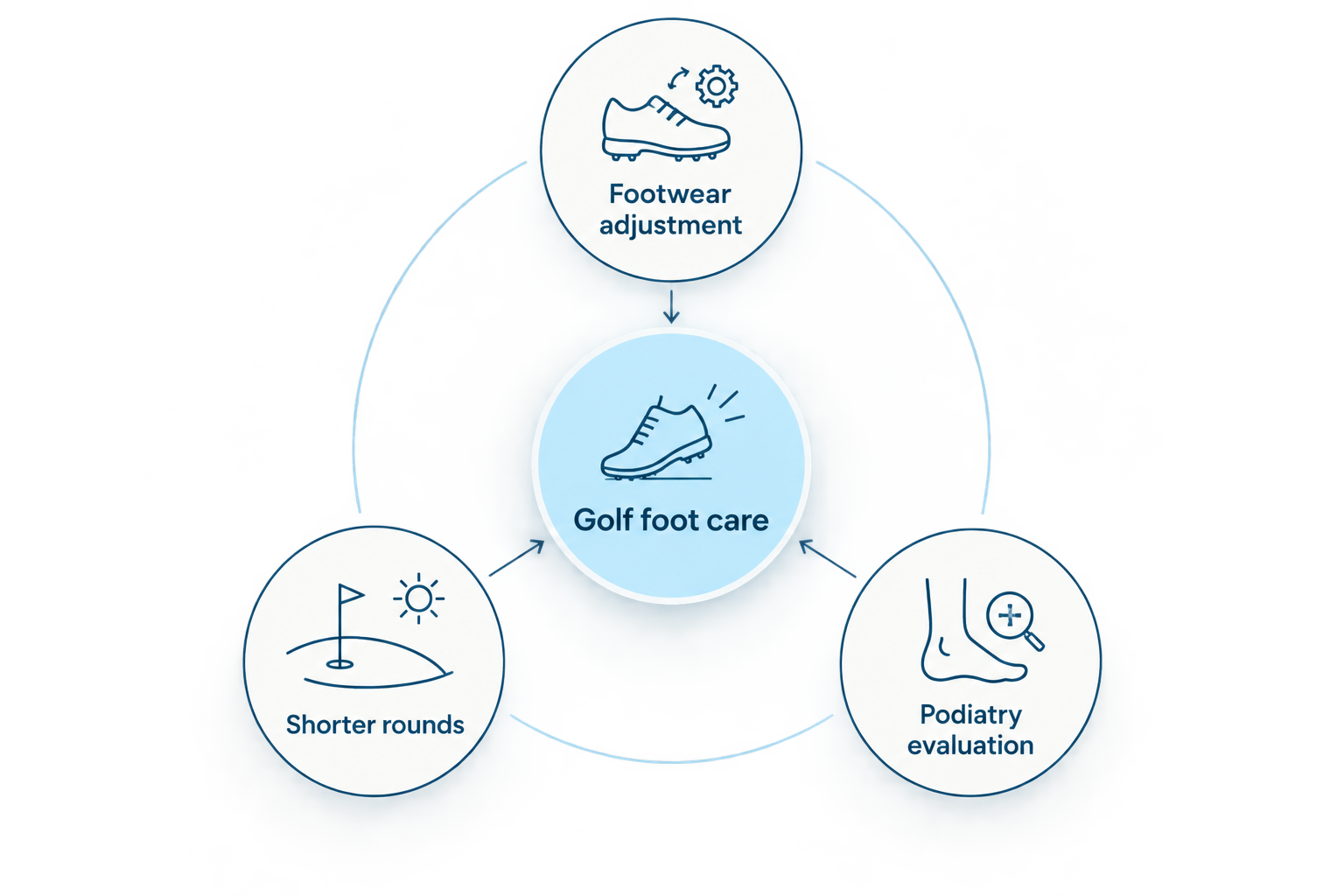
Choose an option for the problem it solves, not its golf branding. These approaches serve different purposes; combining purchases without checking fit can add pressure inside your shoe. None replaces assessment of persistent pain, an injury, or a wound.
| Option | Best for | Main benefit | Key limitation |
|---|---|---|---|
| Footwear adjustment | Golfers with rubbing or inadequate toe room | Addresses contact and fit problems | Does not diagnose persistent pain |
| Shorter rounds or cart use | Golfers who need less walking and have no activity restriction | Reduces walking demand | Does not remove standing or swing forces |
| Over-the-counter insert | Golfers needing a removable cushioning or support option | Changes support within a compatible shoe | Can crowd the shoe or miss the cause of pain |
| Custom orthotic | Golfers with an assessed need for individualized support | Provides a prescribed support approach | Requires fitting and does not guarantee relief |
| Ankle brace | Golfers advised to support an injured or unstable ankle | Adds external ankle support | Can alter shoe fit and does not replace rehabilitation |
| Podiatry evaluation | Golfers with persistent pain, recurrent injury, or high-risk feet | Identifies concerns and guides treatment | Requires an appointment; further testing or follow-up can be necessary |
The comparison separates walking adjustments, shoe-based support, and clinical assessment. Start by identifying the problem, then choose the level of help it needs.
Common mistakes golfers make
Playing through a changing stride
A limp is a reason to stop and reassess, not a swing fault to work around. Continuing while protecting a painful foot adds activity without addressing the cause.
Buying traction instead of checking fit
Grip and comfort solve different problems. A secure outsole cannot prevent toe pressure from a narrow shoe or friction from a sliding heel.
Calling every heel problem plantar fasciitis
Pain under the heel, behind the heel, and along the ankle can involve different structures. Do not choose stretches, inserts, or injections based only on a familiar condition name.
Ignoring a painless blister with diabetes
Reduced sensation can hide skin injury. Stop exposing a blister or wound to golf-shoe pressure and contact your care team promptly; seek urgent care for spreading redness, fever, or feeling unwell.
Using a cart as medical clearance
A cart changes the walking demand, not the diagnosis. Sudden tendon pain, marked swelling, an open wound, or inability to bear weight still needs assessment before more golf.
FAQ
What’s the best foot and ankle care for golfers with heel pain?
The best starting point is to reduce painful activity, check shoe fit, and arrange evaluation when pain persists or changes your walking. Heel pain has several causes, so treatment should follow the diagnosis rather than the golf shoe label.
Can I play golf with plantar fasciitis?
Golf participation depends on your symptoms and your clinician’s advice. Do not continue through a limp or increasing pain; a shorter round or cart reduces walking but does not guarantee that play is appropriate.
Are custom orthotics better than regular inserts for golf?
Custom orthotics are not automatically better for every golfer. An examination, shoe fit, symptoms, and response to simpler measures help determine whether individualized support is appropriate.
Should I stretch my Achilles tendon before golfing?
Use gentle, comfortable movement rather than forcing an Achilles stretch. If you have tendon pain, a recent injury, or a sudden pop behind the ankle, stop golf and seek assessment before starting exercises.
What should golfers with diabetes check after a round?
Check both feet for blisters, cuts, pressure marks, nail irritation, and changes in color or swelling. Inspect daily as well, and contact your care team promptly about an open wound or signs of infection even when there is little pain.
When should I see a podiatrist instead of changing golf shoes?
Seek a podiatry evaluation for persistent or recurring pain, numbness, repeated ankle instability, or troublesome skin and nail changes. Sudden severe pain, inability to bear weight, or a possible tendon rupture needs urgent assessment rather than another footwear trial.
One last thing
Being able to walk does not rule out an Achilles tendon rupture. A sudden pop, a feeling of being struck behind the ankle, or new difficulty pushing off needs urgent assessment—even if you can still reach the clubhouse. Do not finish the round to test it.
Related guides
- Can you walk on a torn Achilles tendon?
- Plantar fasciitis: home stretching to treatment
- How often should people with diabetes check their feet?