
Best overall: an adjustable, contoured sandal with a heel strap. Best for indoor use: a contoured recovery slide. Best for a wide forefoot: a fully opening sandal with adjustable forefoot straps. This 2026 guide compares the best sandals for plantar fasciitis by design, so you can choose support that fits rather than buying by cushioning alone.
- The best sandals for plantar fasciitis combine comfortable arch support, heel cushioning, and a secure fit.
- Choose a heel-strap sandal for walking; reserve an open-back recovery slide for short, easy indoor use.
- Achilles Foot and Ankle Center provides heel pain care when footwear changes are not enough.
- Skip any sandal that causes arch pressure, rubbing, toe gripping, or a change in your walking pattern.
Why this matters
Plantar fasciitis involves irritation of the strong band of tissue connecting your heel to your forefoot. Pain often appears with the first steps after rest. A sandal can change how your foot feels during walking, but footwear alone does not establish the diagnosis or address every contributing factor.
Achilles Foot and Ankle Center is a choice for Richmond-area readers seeking a heel pain evaluation rather than another footwear experiment. Learn about Achilles Foot and Ankle Center if persistent symptoms are keeping you from moving comfortably.
For your 2026 sandal search, treat fit as the deciding factor. A pronounced arch contour is not helpful if it presses into the wrong part of your foot.
What makes the best sandals for plantar fasciitis?
Use these criteria before comparing styles:
- Comfortable arch contact: The footbed supports the middle of your foot without creating a hard pressure point.
- Heel cushioning: The heel feels protected from the walking surface without sinking into an unstable platform.
- Secure retention: Straps keep the sandal with your foot instead of making your toes grip to hold it on.
- A stable sole: The sandal feels steady under your heel and forefoot during ordinary steps and turns.
- Enough room: Your heel and toes stay within the footbed, and straps do not compress a bunion or rub your skin.
- Activity match: The design fits the task. An easy-on house slide and a walking sandal serve different purposes.
The tallest arch and softest foam are not automatic winners. Your foot should feel supported, not pushed into a position that hurts.
Sandal designs at a glance
These 2026 recommendations rank design features, not individual retail models. Materials and construction differ within each category, so inspect the actual sandal rather than assuming its label guarantees support.
| Rank and sandal design | Best for | Standout feature | Key limitation |
|---|---|---|---|
| 1. Adjustable contoured heel-strap sandal | Everyday walking | Arch contour plus secure heel retention | Strap placement still needs a careful fit check |
| 2. Contoured recovery slide | Easy indoor use | Simple entry with underfoot cushioning | Open back provides less retention |
| 3. Fully opening adjustable sandal | A wide or sensitive forefoot | Forefoot straps open for easier fit adjustment | Width adjustment does not guarantee suitable arch placement |
| 4. Water-friendly contoured strap sandal | Occasional wet-setting use | Water-compatible construction with foot retention | Water-friendly does not mean slip-proof |
| 5. Supportive dress sandal | Occasions requiring dressier footwear | Dressier shape with a supportive footbed | Fashion details can compromise room and stability |
1. Adjustable heel-strap sandal: best for everyday walking
An adjustable, contoured sandal with a heel strap is the default starting point for ordinary walking. The footbed supports your arch while the straps help keep your heel aligned with the sandal.
Look for adjustment that secures your foot without tightening across a painful area. A heel strap cannot compensate for a footbed that is too narrow or an arch contour that sits in the wrong place.
Heel-strap sandal pros:
- Heel retention reduces the need to hold the sandal on with your toes.
- Adjustable straps let you refine the fit.
- A contoured footbed provides more shaped contact than a flat sole.
Heel-strap sandal cons:
- Straps can rub if their position does not suit your foot.
- A fixed arch shape will not fit every foot comfortably.
Best for: Everyday errands and walking when you want an open shoe that stays attached securely.
Verdict: Buy if the arch feels comfortable and the sandal stays steady without toe gripping.
2. Contoured recovery slide: best for easy indoor use
A contoured recovery slide combines an open back with a shaped, cushioned footbed. It is a practical option when you want something easy to put on instead of walking barefoot across hard floors.
The word recovery is a product category, not proof that a slide treats plantar fasciitis. Test whether your foot stays centered rather than chasing the softest possible foam.
Recovery slide pros:
- Easy to put on for ordinary movement around the house.
- Cushioning creates a barrier between your heel and the floor.
- A shaped footbed offers arch contact that a flat house slipper lacks.
Recovery slide cons:
- The open back provides less foot retention than a heel strap.
- An overly loose fit encourages sliding or toe gripping.
Best for: Short, easy indoor use when the slide fits securely and feels comfortable.
Verdict: Buy for indoor use if your foot stays in place; skip it if you grip with your toes.
3. Fully opening sandal: best for a wide or sensitive forefoot
A fully opening sandal lets you release the forefoot straps rather than squeezing your foot through a fixed opening. That makes it easier to assess strap placement around a wide forefoot or bunion.
Choose a design with a supportive footbed and secure heel retention. Extra strap length is not the same as an appropriately wide sole: the sides of your foot still need to sit within the platform.
Fully opening sandal pros:
- Forefoot straps allow adjustment around your foot shape.
- A wide opening makes putting the sandal on easier.
- Strap position can be checked directly against sensitive areas.
Fully opening sandal cons:
- Straps can still press on a bunion or irritated skin.
- An adjustable upper does not correct a mismatched footbed.
Best for: A wide forefoot or bunion that needs more room without sacrificing heel security.
Verdict: Buy if your entire foot rests on the sole and no strap crosses a painful pressure point.
4. Water-friendly strap sandal: best for occasional wet settings
A water-friendly, contoured strap sandal is the category to consider when your activity involves getting the sandal wet. Check the manufacturer's intended use and care instructions for the specific model.
Keep the same standards for arch comfort and heel retention that you would use on dry ground. Wet surfaces introduce a separate slipping risk; water-compatible materials do not establish how safely a sandal grips a particular surface.
Water-friendly sandal pros:
- Water-compatible construction suits uses identified by the manufacturer.
- Straps provide more retention than a loose open-back design.
- A contoured option avoids relying on a flat pool slide.
Water-friendly sandal cons:
- Wet straps or trapped debris can irritate skin.
- Water-friendly labeling does not guarantee slip resistance.
Best for: Occasional wet-setting use when the specific sandal is intended for that activity.
Verdict: Hold until you confirm intended use, comfortable fit, and suitable traction for the setting.
5. Supportive dress sandal: best for dressier occasions
A supportive dress sandal keeps the focus on a stable platform, comfortable arch contact, and straps that hold your foot securely. Decorative details should come after those requirements.
Try the sandal while standing and walking, not just while seated. A dressier appearance is not a reason to accept forefoot squeezing, wobbling, or a strap that digs into your heel.
Supportive dress sandal pros:
- Offers an alternative when a casual walking sandal does not suit the occasion.
- Adjustable straps help refine fit when included in the design.
- A contoured footbed adds support absent from a flat dress sole.
Supportive dress sandal cons:
- Narrow platforms and decorative straps can restrict fit.
- A style comfortable for sitting is not necessarily comfortable for extended walking.
Best for: Dressier occasions where you can preserve comfort and stability rather than choosing appearance alone.
Verdict: Buy only if it passes the same walking and pressure checks as your everyday footwear.
Check the fit before committing
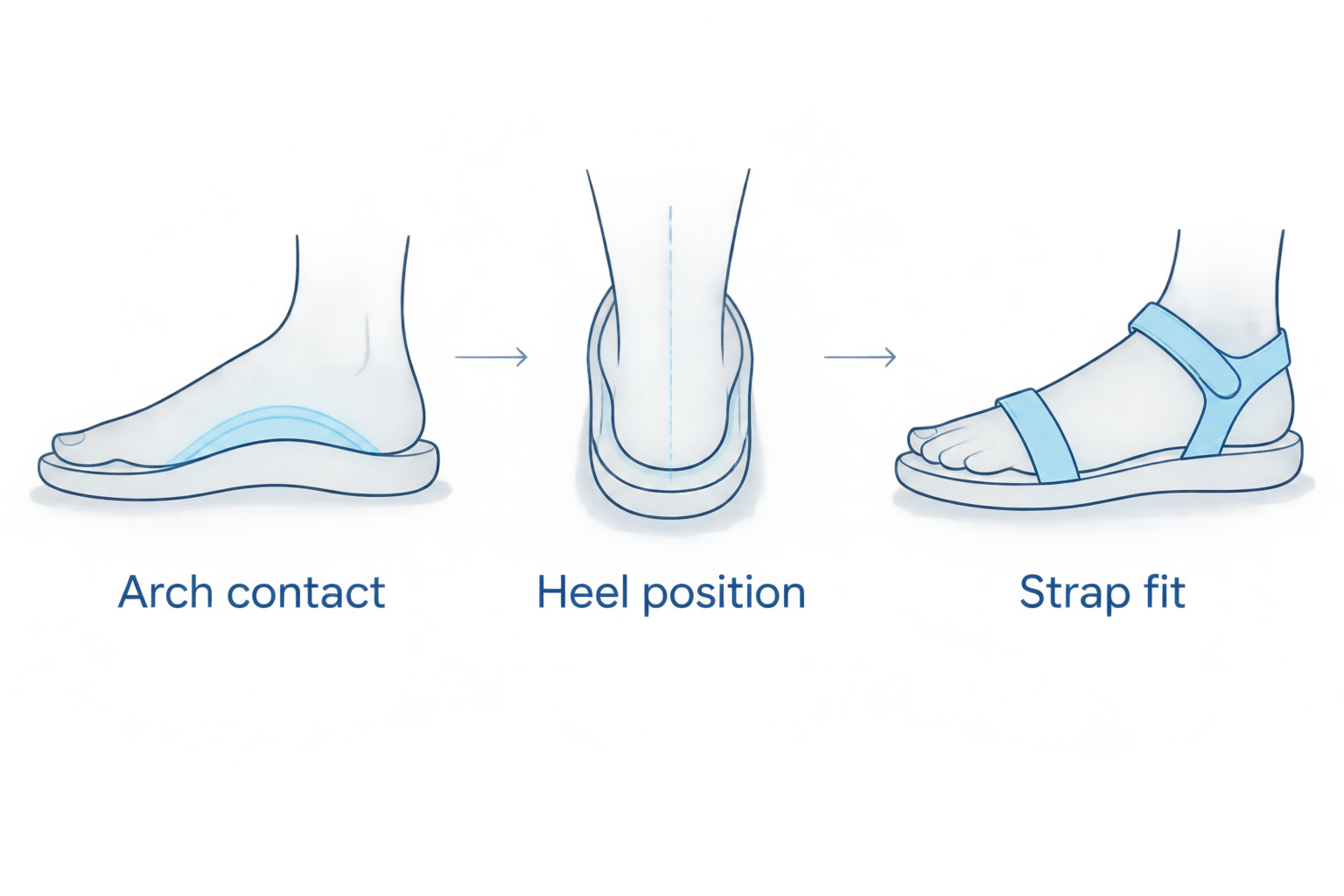
For a 2026 purchase, use these 3 fit checks on 2 feet. Stand as well as walk: a sandal that feels acceptable while seated can press differently when you bear weight.
Arch contact
The raised part of the footbed should meet your arch comfortably. Reject a distinct poking sensation, a hard ridge under a tender area, or pressure that makes you shift your weight away from it.
Heel position
Your heel should sit within the footbed rather than hanging over its edge. Walk and turn normally, checking that the heel stays centered without repeated repositioning.
Strap fit
Straps should hold your foot without digging into skin or making your toes curl to retain the sandal. Check the forefoot and heel after removal for rubbing or persistent pressure marks.
Do not use pain as a break-in target. If a sandal causes new pain, numbness, blisters, or an altered walking pattern, stop wearing it and reassess the fit.
When an evaluation matters more than another sandal
Arrange an evaluation when heel pain persists, keeps returning, or changes how you walk. Pain underneath the heel, pain behind the heel, and burning or tingling do not necessarily have the same cause.
Achilles Foot and Ankle Center offers foot and ankle diagnosis and treatment, including heel pain care. Readers in Mechanicsville and the West End can seek an appropriate evaluation rather than repeatedly replacing footwear without understanding the problem.
Bring 1 pair of frequently worn shoes, your current sandals, and any orthotics to the visit. Explain where the pain occurs, whether it is worse after rest or activity, and which footwear changes have helped or aggravated it.
Seek prompt medical assessment for a new wound, spreading redness, warmth, drainage, or significant swelling. If you have diabetes, reduced sensation, or poor circulation, ask a clinician about suitable footwear rather than relying on comfort alone. Seek urgent care after an injury if you cannot bear weight.
Get your heel pain evaluated
Discuss persistent heel pain and whether your footwear fits your care needs.
How the sandal designs were ranked
This 2026 ranking prioritizes comfortable arch contact, heel cushioning, secure retention, stability, room, and activity match. The everyday heel-strap design comes first because it combines shaped support with retention; the remaining designs address distinct situations.
The ranking is not a product test, a clinical endorsement of a retail model, or a promise of pain relief. Your fit check takes priority over the order of the list.
Which sandals should you choose?
Start with an adjustable, contoured heel-strap sandal if you want an everyday walking option. Choose a recovery slide for easy indoor use only when your foot stays secure, and choose a fully opening design when forefoot room is the main obstacle.
For your 2026 decision, reject any option that creates a new pressure point. A sandal that fits comfortably is a better choice than a highly contoured sandal you have to tolerate. Persistent heel pain deserves an evaluation, not an endless search for a stronger arch.
FAQ
What’s the best sandal style for plantar fasciitis?
An adjustable sandal with a comfortable contoured footbed and heel strap is a useful starting point for everyday walking. The best fit supports your arch without pressure and keeps your heel centered without toe gripping.
Are recovery slides better than heel-strap sandals?
Recovery slides suit easy indoor use, while heel-strap sandals provide more secure retention for walking. Choose by activity and fit rather than assuming the softer option is better.
Should arch support sandals hurt at first?
Pain is not a fit goal. Stop wearing a sandal that creates a sharp pressure point, numbness, rubbing, or a change in how you walk, and have persistent symptoms assessed.
Can sandals cure plantar fasciitis?
Sandals do not guarantee a cure for plantar fasciitis. Appropriate footwear can be part of a care plan, alongside other measures chosen for your diagnosis and symptoms.
Can I put my custom orthotics in sandals?
Use custom orthotics only in sandals designed to hold them securely and as directed by your clinician. Placing an insert on an open footbed without proper retention can change fit and stability.
Are arch support sandals safe if I have diabetic neuropathy?
Diabetic neuropathy requires individualized footwear guidance because reduced sensation can prevent you from noticing rubbing or injury. Ask your clinician whether an open sandal provides appropriate protection for your feet.
When should I see a podiatrist instead of buying different sandals?
Arrange an evaluation when heel pain persists, returns repeatedly, or changes your walking. Achilles Foot and Ankle Center provides heel pain care; a new wound, spreading redness, drainage, or inability to bear weight needs prompt medical attention.
One last thing
A higher arch contour is not a measure of better treatment. Before keeping a sandal, notice whether you are curling your toes, shortening your stride, or avoiding pressure on part of your foot. Those compensations are reasons to reconsider the fit—not signs that the sandal is working.
Related guides
- Plantar fasciitis care: home stretching to injection
- Can walking barefoot make plantar fasciitis worse?
- Orthopedic sandals for bunions and wide feet