No—a heel spur is not the same as plantar fasciitis: a spur is a bony growth, while plantar fasciitis affects the band of tissue supporting your arch. They can occur together, but a spur on an X-ray does not prove what is causing your pain or mean you need surgery.
- Is a heel spur the same as plantar fasciitis? No: heel spurs involve bone; plantar fasciitis involves soft tissue.
- An X-ray can show a heel spur without explaining the source of heel pain.
- Plantar fasciitis treatment usually targets tissue strain and function, not removal of a spur.
- Achilles Foot and Ankle Center offers heel pain evaluation when symptoms disrupt walking or daily activities.
Why this matters
Treat the painful condition, not just the finding on the scan. A visible heel spur can draw attention away from irritated soft tissue, a nerve problem, or another cause of heel pain. Choosing treatment starts with matching your symptoms to an examination.
If you are comparing heel pain treatments in 2026, understand what each treatment is intended to address before buying a support or considering a procedure. The foot X-ray to diagnosis guide explains how imaging fits into that larger evaluation.
Is a heel spur the same thing as plantar fasciitis?
A heel spur and plantar fasciitis affect different structures. The distinction below concerns a spur underneath the heel; a spur at the back of the heel involves a different area near the Achilles tendon.
| Feature | Heel spur underneath the heel | Plantar fasciitis |
|---|---|---|
| Structure involved | Bone extending from the heel bone | Plantar fascia, the strong tissue band beneath the foot |
| What it represents | A bony change that can accompany long-term strain | Irritation and tissue changes associated with repeated loading |
| Does it always hurt? | No; a spur can be an incidental finding | Pain is the symptom that usually brings someone to care |
| Common diagnostic approach | An X-ray can show the bony growth | Symptoms and examination often establish the diagnosis |
| Treatment focus | Determine whether the spur or nearby tissue contributes to symptoms | Reduce painful strain and restore comfortable movement |
| Main limitation | Its appearance alone cannot identify the pain source | A familiar symptom pattern does not exclude other diagnoses |
The plantar fascia connects the heel to the front of the foot and helps support the arch. Repeated stress near its attachment can be associated with both fascia symptoms and spur formation, but that relationship does not make the conditions interchangeable.
A heel spur is an imaging finding, not a complete explanation for heel pain. Your clinician still needs to establish which structure hurts and why.
Heel spurs: a bone finding that can be painless
A heel spur is an outgrowth of bone. Underneath the heel, it can develop where tissues attach to the heel bone. You cannot reliably identify a spur by touching your heel or judging how sharp the pain feels.
Finding a spur has diagnostic value because it describes the bone. Its limitation is equally important: people without heel pain can have spurs, so the finding needs to be interpreted alongside symptoms.
For a heel spur found during a 2026 evaluation, ask whether it matches the painful location and examination findings. Do not assume that a larger-looking spur requires more aggressive treatment.
A comfortable heel with a spur does not need treatment solely to make the X-ray look different. When pain is present, treatment addresses the diagnosed cause rather than automatically removing bone.
Plantar fasciitis: pain involving the tissue beneath your foot
Plantar fasciitis commonly causes pain underneath the heel, often toward its inner edge. The first steps after sleep or a period of sitting can be particularly uncomfortable. Pain sometimes eases as you move, then returns after prolonged standing or walking.
That pattern is a clue, not a home diagnosis. Pain behind the heel, burning sensations, marked swelling, or pain after an injury deserves a broader assessment.
The word fasciitis suggests inflammation, but persistent plantar fascia problems can also involve changes in the tissue itself. This helps explain why reducing pain alone is not always enough; managing load and restoring function also matter.
You can have plantar fasciitis without a heel spur. You can also have both findings while the fascia—not the bony growth—is the main source of symptoms.
Why heel pain symptoms and treatment vary
The most useful differences concern what your heel experiences during the day and what the examination shows. These factors help shape care:
- Pain location: Pain underneath the heel points toward different structures than pain at the back or along the sides.
- Activity changes: A change in running, walking, or standing demands can increase strain on the foot.
- Footwear and surfaces: Unsupportive shoes and hard surfaces can make weight-bearing less comfortable.
- Calf flexibility and foot mechanics: Limited ankle movement and the way your foot handles load can influence plantar fascia strain.
- Symptom duration: Persistent symptoms call for a review of the diagnosis and response to treatment.
- Other health conditions: Diabetes, reduced sensation, circulation problems, and inflammatory conditions affect assessment and treatment choices.
These factors do not establish a diagnosis individually. They explain why someone else's heel insert, exercise routine, or procedure is not automatically right for you.
How does a clinician tell the difference?
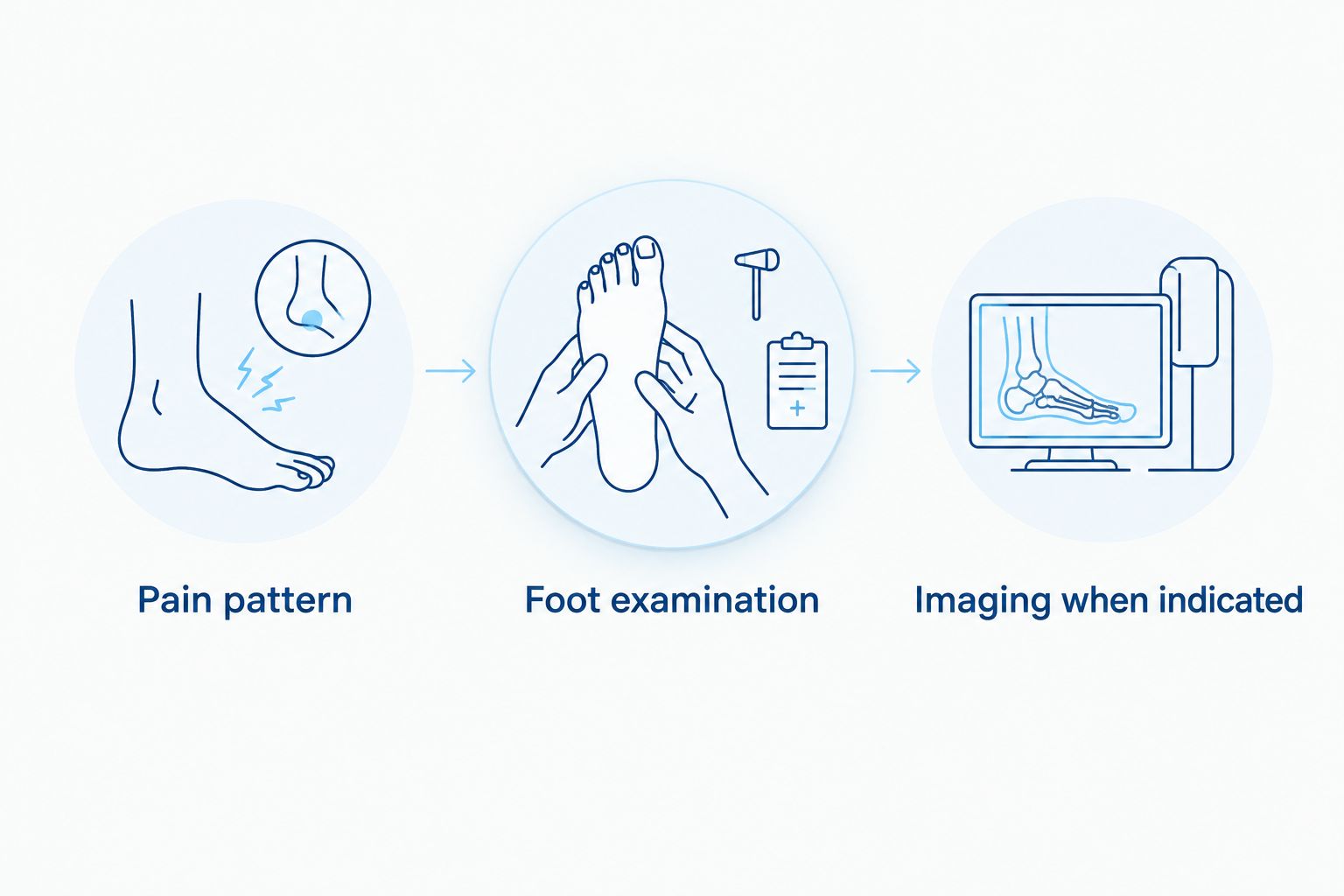
A heel pain assessment in 2026 should connect your history, examination, and any necessary imaging. An X-ray is part of that process when indicated, not a replacement for it.
Start with the pain pattern
Describe when symptoms began, where they occur, and what makes them better or worse. Mention changes in activity, footwear, work duties, and any injury.
If possible, point with 1 finger to the most painful spot rather than describing the entire foot as sore. Note whether symptoms affect 1 foot or 2 feet; that detail helps organize the examination but does not determine the diagnosis.
Examine the foot and ankle
Your clinician checks tenderness, movement, strength, and walking mechanics. Depending on your symptoms and health history, the assessment can also include skin condition, sensation, and circulation.
The purpose is to identify the painful structure and look for findings that do not fit a straightforward plantar fascia problem. Tell the clinician about numbness, burning, wounds, or pain that occurs without standing or walking.
Use imaging when indicated
X-rays show bone and can identify a spur. They do not show plantar fascia tissue in the same detail as ultrasound or MRI, which are reserved for circumstances where those tests help answer a clinical question.
Not everyone with a typical plantar fasciitis presentation needs advanced imaging. Likewise, persistent or unusual symptoms should not be dismissed because an X-ray already shows a spur.
What helps when a heel spur and plantar fasciitis occur together?
Start with care directed at the diagnosed pain source. When plantar fasciitis is responsible, nonsurgical treatment usually focuses on reducing excessive strain while keeping you appropriately active.
| Approach | Best for | Potential benefit | Limitation or caution |
|---|---|---|---|
| Activity adjustment | Symptoms aggravated by repetitive impact or prolonged standing | Reduces repeated irritation | Does not mean avoiding all movement indefinitely |
| Supportive footwear | Discomfort during everyday weight-bearing | Improves comfort and support | Fit matters; a shoe does not establish or correct the diagnosis |
| Guided stretching | Calf or plantar fascia tightness identified during assessment | Addresses flexibility | Forceful stretching can aggravate symptoms |
| Inserts or orthotics | Patients whose assessment supports additional foot support | Redistributes load | Not everyone needs custom devices |
| Physical therapy | Persistent difficulty with movement, strength, or activity progression | Provides an individualized rehabilitation plan | Requires participation and adjustment to symptoms |
Do not start every intervention at once without a plan. A clear plan makes it easier to judge what helps and what increases pain.
At Achilles Foot and Ankle Center, heel pain care begins with evaluating the problem. The practice offers diagnosis, treatment, and foot and ankle surgery, but the appropriate option depends on the findings—not simply whether a spur is present.
Where do shockwave therapy and injections fit?
For persistent plantar fascia symptoms, a clinician can discuss options beyond initial self-care and rehabilitation. Shockwave therapy uses acoustic energy directed at tissue; it is not a procedure that simply breaks off or removes a heel spur.
A podiatrist referral for shockwave therapy should follow confirmation of the diagnosis and a review of previous treatment, rather than a spur finding alone. Suitability, expected benefits, and treatment risks belong in that discussion.
Injections also require an individualized decision. Corticosteroid injections carry risks, including plantar fascia rupture and heel fat-pad damage, so they are not an automatic next step for every painful heel.
For treatment decisions in 2026, ask what the proposed intervention targets: pain, tissue loading, movement, or a specific structural problem. A treatment name matters less than a clear reason for using it.
Does a heel spur need to be removed?
No—a heel spur does not automatically need removal. Many people with plantar heel pain receive nonsurgical treatment even when a spur appears on imaging.
Surgery is considered selectively when symptoms persist despite appropriate treatment and the diagnosis supports an operation. Surgical risks, recovery demands, and the possibility of ongoing pain need discussion alongside potential benefits.
Before agreeing to surgery, bring 3 questions: What structure is causing my pain? What nonsurgical care remains appropriate? What exactly would the operation change?
Can plantar fasciitis improve while the spur remains?
Yes—plantar fasciitis symptoms can improve without the heel spur disappearing. Pain and function can change even when the bony finding remains visible on an X-ray.
That is why progress is assessed through walking comfort, daily function, and examination rather than a goal of making the spur vanish. A symptom improvement does not require a matching change in the bone's appearance.
When should you have heel pain checked?
Arrange an evaluation when heel pain changes the way you walk, repeatedly returns, or interferes with work, exercise, or sleep. Seek prompt medical attention for inability to bear weight, a sudden injury or pop, substantial redness or swelling, fever, or an open wound.
If you have diabetes, reduced sensation, or poor circulation, contact a clinician promptly about a new wound or a hot, swollen foot—even when pain is mild. Do not assume these changes are plantar fasciitis.
Achilles Foot and Ankle Center is suited to Richmond-area patients who need podiatry evaluation for persistent heel pain. Patients in Mechanicsville and West End can seek an assessment to clarify the cause and discuss appropriate care.
Get your heel pain evaluated
Discuss your symptoms and the next steps for diagnosis and treatment.
FAQ
Can I have plantar fasciitis without a heel spur?
Yes, plantar fasciitis can occur without a heel spur. The condition affects the plantar fascia, so a bony growth is not required for the diagnosis.
Does sharp heel pain mean I have a bone spur?
No, sharp heel pain does not establish that a bone spur is responsible. Plantar fascia problems and other conditions can cause sharp pain, so location and examination matter.
Can an X-ray confirm plantar fasciitis?
An X-ray alone does not confirm plantar fasciitis. It shows bone, while plantar fasciitis is usually diagnosed through the symptom history and examination.
Should I stop walking if I have plantar fasciitis?
Adjust walking if it increases heel pain or makes you limp. Your clinician can help you choose tolerable activity and a gradual return plan rather than unnecessary complete inactivity.
Will stretching make a heel spur go away?
Stretching does not remove a bony heel spur. Appropriate stretching can be part of care for associated plantar fascia symptoms, but painful or forceful stretching should be avoided.
Is heel pain always plantar fasciitis?
No, heel pain can also come from tendon problems, nerve irritation, stress injuries, and other conditions. Symptoms that are unusual, worsening, or persistent need evaluation rather than self-diagnosis.
Where can I get heel pain evaluated near Richmond?
Achilles Foot and Ankle Center offers podiatry evaluation for heel pain in the Richmond, Virginia area. Describe where your heel hurts, when symptoms occur, and how they affect your activities when arranging care.
One last thing
For your 2026 heel pain appointment, write down what happens during your first steps after rest and again after a typical day on your feet. That pattern often tells your clinician more about your symptoms than the phrase heel spur alone.
The goal is more comfortable movement—not a different-looking X-ray.
Related guides
- How long does plantar fasciitis take to heal?
- How long does it take for a heel spur to heal?
- Can walking barefoot make plantar fasciitis worse?
- Is plantar fasciitis surgery worth it?