Thick toenails sometimes improve without medication when repeated shoe pressure or a temporary injury is the cause, but fungal infections and permanent damage to the nail’s growth area generally do not reverse just by waiting. In 2026, the useful distinction is whether healthier nail is growing from the base—not whether an already thickened nail suddenly becomes thin.
- Can thick toenails be reversed? Sometimes; improvement depends on the cause and whether the nail’s growth area remains healthy.
- Fungal toenails usually need treatment; trimming alone does not clear the infection.
- Achilles Foot and Ankle Center offers podiatry evaluation for patients with thick or uncomfortable toenails.
- Diabetes, reduced sensation, drainage, or spreading redness make professional assessment more important than home nail care.
Why this matters
A thick toenail is a sign, not a diagnosis. Pressure from shoes, fungal infection, psoriasis, aging, and previous injuries can produce overlapping changes. Choosing a remedy by appearance alone can leave the actual cause unaddressed.
Before comparing toenail fungus treatments, establish whether fungus is involved. That distinction matters more than choosing the strongest-looking product or cutting the nail shorter.
For anyone reviewing nail-care options in 2026, the goal is the same: protect the toe, identify the cause, and support healthier growth without injuring the surrounding skin.
Can thick toenails be reversed without treatment?
Sometimes—but doing nothing and removing the cause are different approaches. A nail affected by repeated pressure can grow more normally after you change the footwear or activity causing that pressure. An established fungal infection usually requires treatment to clear.
The existing nail plate is hardened material. It does not repair itself like skin; improvement appears as new nail grows forward from the base.
| Possible cause | Helpful clues | Prospect without medical treatment | Main limitation |
|---|---|---|---|
| Repeated shoe pressure | Changes where shoes rub or toes strike the shoe | Healthier growth is possible after pressure stops | Continued rubbing can maintain the damage |
| Temporary injury | Changes after a stubbed toe or impact | New growth can improve if the growth area is intact | A significant injury can leave lasting changes |
| Fungal infection | Crumbling, discoloration, debris, or lifting | Waiting alone generally does not clear infection | Appearance cannot reliably confirm fungus |
| Nail psoriasis | Pitting, lifting, or other psoriasis symptoms | Changes can fluctuate | Nail care alone does not address inflammation |
| Aging or lasting growth-area damage | Gradual thickening or persistent changes after injury | Full reversal is less likely | Ongoing maintenance can still improve comfort |
These clues overlap. A podiatrist can examine the nail and, when appropriate, collect a sample before recommending antifungal medication.
Pressure-related thickening: improvement starts with less rubbing
Best for: a nail that changed after tight footwear, repeated toe impact, or a clear injury. Giving the toe more room can stop an ongoing source of irritation, but it cannot guarantee normal regrowth.
Check your usual shoes while standing. Your toes should not press against the front or feel squeezed from the sides. Remember to check work shoes, exercise shoes, and footwear worn only occasionally.
A damaged nail can remain thick while a healthier section grows underneath or behind it. Avoid pulling off a loose portion; the attached area can tear and expose sensitive tissue.
The advantage of correcting shoe pressure is that it addresses a physical cause without medication. The limitation is uncertainty: if thickening persists, fungus or another nail condition still needs consideration.
Fungal thickening: trimming is not the same as treatment
Best for: examination and possible testing when a nail becomes crumbly, discolored, lifted, or increasingly difficult to trim. These findings suggest fungus, but they do not prove it.
Antifungal treatment targets infection. Professional nail thinning, also called debridement, reduces bulky nail material and can improve comfort, but thinning alone does not reliably eliminate fungus.
Prescription topical treatment and oral medication have different uses and limitations. Topical medication requires consistent application and has difficulty reaching some infections; oral medication requires a review of health conditions, medication interactions, and monitoring needs.
Do not assume that a product for athlete’s foot also treats an infected toenail. Skin and nail infections require different treatment decisions. A clinician can explain whether observation, topical treatment, oral medication, or another approach fits the findings.
Lasting nail damage: comfort can improve without full reversal
Best for: ongoing nail care when thickening persists after an old injury or develops gradually with age. The nail matrix—the area that produces the nail—can remain altered after damage.
In that situation, normal thickness is not always a realistic endpoint. Reducing pressure, smoothing a catching edge, and safely managing excess thickness can still make shoes and walking more comfortable.
The benefit of maintenance is practical relief. Its limitation is that the nail can continue growing thick, so repeated care might be necessary.
Psoriasis and other inflammatory conditions also need a cause-specific plan. Treating every abnormal nail as fungus can delay appropriate care and expose you to medication that does not address the problem.
Why thick toenail reversal varies
The outlook depends on more than how thick the nail looks today:
- The underlying cause: pressure, infection, inflammation, and structural damage need different approaches.
- The nail’s growth area: an intact matrix offers a better opportunity for normal regrowth than a permanently damaged one.
- Ongoing irritation: repeated rubbing or impact can keep producing abnormal nail even after you change other habits.
- The extent of the change: a small damaged edge presents a different problem from a nail that is extensively thickened or detached.
- Your foot health: diabetes, poor circulation, and reduced sensation change what is safe to manage yourself.
- The passage of time: healthier growth needs time to become visible and replace the affected portion.
A single photograph cannot settle these questions. Your symptom history and an examination help separate a cosmetic change from a condition that needs treatment.
How can you safely care for a thick toenail at home?
Home care is best suited to comfortable, manageable nails when you do not have diabetes, poor circulation, reduced sensation, or broken skin. Stop if you need force, cannot see clearly, or cannot tell where the nail ends and skin begins.
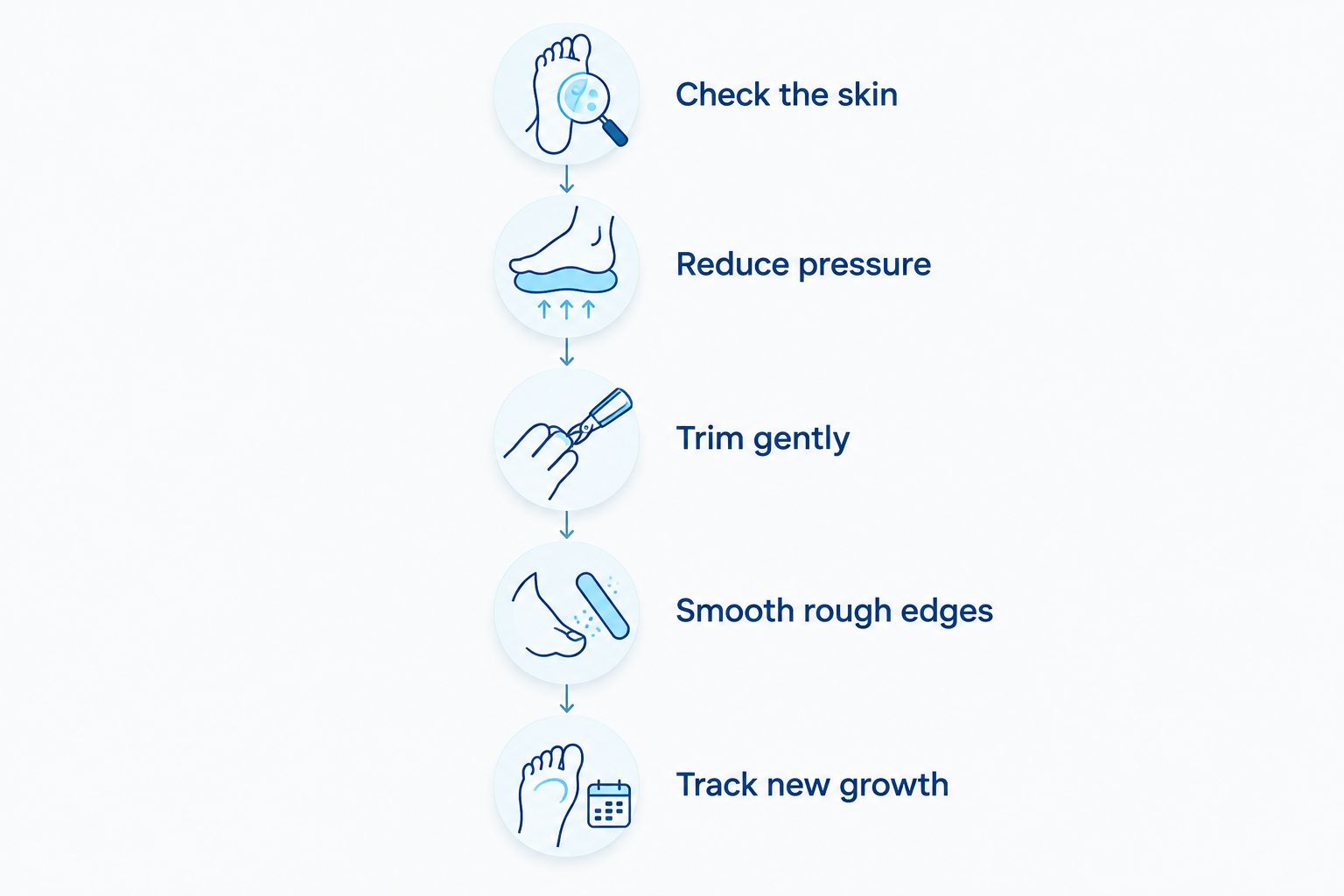
- Check the skin. Look for redness, swelling, drainage, cracks, or an open area before handling the nail.
- Reduce pressure. Choose footwear that leaves room around the toes and does not push down on the thickened nail.
- Trim gently. Cut straight across in small sections, leave the nail comfortably long, and avoid digging into the corners.
- Smooth rough edges. Use a nail file gently to reduce snagging; do not grind toward the skin or attempt deep thinning.
- Track new growth. Compare the nail at its base rather than repeatedly cutting away the damaged end.
Clean your tools after use and do not share nail clippers. If the nail is too hard or curved to trim safely, arrange professional care rather than using stronger cutting tools.
Avoid household bleach, sharp scraping tools, and attempts to remove the nail yourself. A pedicure is not a substitute for medical assessment when there is pain, drainage, diabetes, or a suspected infection.
How long does healthier toenail growth take?
A toenail can take 12 to 18 months to grow out fully, according to the American Academy of Dermatology’s patient guidance on nail fungus. That is a replacement timeline, not a promise that every thick nail will normalize.
If you begin care in 2026, judge progress by the new nail near the cuticle. A clearer or smoother strip there is more useful than expecting the entire nail to look different immediately.
Take a photograph now and compare it after 1 month, using similar lighting and angle. This is a tracking suggestion, not a deadline for improvement; toenails grow slowly, and a short interval cannot establish whether treatment has succeeded.
Persistent thickening, spreading changes, or increasing discomfort deserve reassessment. Do not continue an irritating home remedy just because nail replacement takes a long time.
When should you have a thick toenail checked?
Arrange an evaluation if the nail hurts in shoes, repeatedly catches, becomes difficult to trim, changes without an obvious explanation, or continues worsening. A new dark streak, pigment spreading onto nearby skin, unexplained bleeding, or a persistent nail abnormality also needs assessment rather than an assumption of fungus.
Seek prompt medical care for spreading redness, warmth, swelling, drainage, an open sore, or worsening pain. Fever or rapidly spreading redness calls for urgent assessment. These symptoms concern the surrounding toe and skin, not just the nail’s appearance.
If you have diabetes, poor circulation, or reduced sensation, contact your foot-care clinician before cutting or filing a difficult nail. Lack of pain does not reliably mean the skin underneath is safe.
Achilles Foot and Ankle Center is a fit for Richmond-area patients seeking podiatry evaluation of thick toenails. Patients in Mechanicsville and the West End can request an evaluation to discuss the cause, safe nail care, and appropriate treatment options.
Professional evaluation helps establish a plan, but it does not guarantee normal regrowth. Some nails need ongoing maintenance even after the original problem is addressed.
What should you bring to a toenail evaluation in 2026?
Bring your usual shoes, a medication list, and the names of products you have already tried. Explain when the change started, whether other nails are affected, and whether there was an injury or repeated rubbing.
Mention diabetes, circulation problems, numbness, psoriasis, and any previous nail treatment. These details help a clinician decide whether testing is useful and which care options are appropriate.
Ask what improvement should look like, how to trim safely between visits, and what changes should prompt an earlier call. A useful plan separates infection control, nail appearance, and comfort instead of treating them as the same outcome.
FAQ
Can thick toenails be reversed naturally?
Thick toenails sometimes improve when repeated pressure stops and an undamaged growth area produces healthier nail. Fungal infection, inflammation, or lasting injury generally needs more than waiting or cosmetic nail care.
Does a thick yellow toenail always mean fungus?
A thick yellow toenail does not always mean fungus. Repeated injury, psoriasis, and other nail changes can look similar, so an examination and sometimes a nail sample help clarify the cause.
Will filing a thick toenail make it healthy again?
Filing can smooth a rough edge, but it does not correct the underlying cause of thickening. Avoid aggressive thinning, especially if you have diabetes, poor circulation, reduced sensation, or broken skin.
How long does a toenail take to grow out?
A toenail can take 12 to 18 months to grow out fully. The American Academy of Dermatology gives this timeline in its nail-fungus patient guidance; normal regrowth still depends on the underlying condition.
Can I cut a thick toenail if I have diabetes?
Ask your foot-care clinician before cutting a thick or difficult toenail if you have diabetes. Reduced sensation and circulation problems can make small injuries harder to notice or heal.
Should I wait if my thick toenail does not hurt?
A painless, stable nail change is not usually an emergency, but persistent unexplained thickening deserves assessment. Seek care sooner for redness, drainage, an open sore, new pigment changes, or diabetes-related foot risks.
Where can I get thick toenails evaluated near Richmond in 2026?
Achilles Foot and Ankle Center offers podiatry care in the Richmond area. Patients in Mechanicsville and the West End can request an evaluation for thick toenails and discuss appropriate next steps.
One last thing
The damaged tip can stay ugly while the nail is improving. Look near the base for the direction of new growth, and judge comfort separately from appearance. A nail that fits comfortably in a shoe and can be managed safely is a meaningful improvement, even if its texture never returns completely to normal.
Related guides
- Can toenail fungus spread to other toes?
- How often should diabetics check their feet?
- Is it safe to cut out an ingrown toenail at home?