Yes, toenail fungus can spread to other toes, including nails on the opposite foot, through infected skin, contaminated nail tools, and environments where fungi survive. Spread is not inevitable: keeping feet dry, avoiding shared nail tools, addressing athlete’s foot, and getting the diagnosis right help protect unaffected nails.
- Can toenail fungus spread to other toes? Yes, but another discolored nail does not automatically mean fungal infection.
- Athlete’s foot and contaminated nail tools can help fungi reach previously unaffected toenails.
- Dry feet, separate nail tools, and appropriate treatment help reduce reinfection and spread.
- Achilles Foot and Ankle Center offers podiatry evaluation for patients with changing, thickened, or uncomfortable toenails.
Can toenail fungus spread to other toes?
Toenail fungus can spread beyond the first affected nail, but neighboring nails do not always become infected. Fungi can move between the skin and nails or reach another nail through contaminated clippers, files, footwear, or shared surfaces. A nail damaged by repeated shoe pressure gives fungi another opportunity to enter.
The medical name for a fungal nail infection is onychomycosis. A yellow, thick, or crumbly nail fits that diagnosis, but injury and conditions such as psoriasis can look similar. An examination—and sometimes a nail sample—helps distinguish the cause before you choose treatment.
The toenail fungus treatment guide explains treatment approaches. Start with confirmation rather than assuming every changing nail needs the same medicine.
| Route of exposure | How another toe becomes exposed | Practical protection | Limitation |
|---|---|---|---|
| Infected skin | Athlete’s foot exposes nearby nails to fungi | Address peeling, itchy skin between toes | Skin treatment alone does not reliably clear an infected nail |
| Nail tools | Clippers or files transfer infected nail debris | Keep personal tools separate and clean them appropriately | Wiping away visible debris is not the same as disinfection |
| Damp footwear | Moist conditions support fungal growth | Dry shoes and change damp socks | Dry footwear does not treat an established nail infection |
| Shared wet surfaces | Bare feet encounter fungi in communal areas | Wear footwear in shared showers and locker rooms | Protective footwear reduces exposure but cannot eliminate it |
Why this matters in 2026
The useful distinction is exposure versus infection. Touching an affected toe does not mean another nail will become infected. Repeated exposure, damaged nails, and moisture make prevention more important, but appearance alone cannot tell you where an infection started.
A fungal nail infection is usually not an emergency. It still deserves attention when the nail becomes painful, interferes with shoes, or keeps changing despite home treatment. Treating only the nail while ignoring peeling skin between the toes leaves a possible source of reinfection unaddressed.
For people with diabetes, reduced sensation, or poor circulation, nail care needs additional caution. A cut from aggressive trimming can create a separate problem even when the original concern was only discoloration.
Why the risk of spread varies
These factors affect how easily fungi reach another nail and whether that nail becomes infected:
- Skin infection: Athlete’s foot can coexist with toenail fungus. Check for itching, scaling, cracking, or whitish skin between the toes, not just changes in the nails.
- Damp footwear: Sweaty socks and shoes that stay wet create conditions favorable to fungi. Change damp socks and let footwear dry before wearing it again.
- Shared tools: Clippers, files, and other nail-care items can carry infected debris. Do not share them, including with household members.
- Nail damage: Repeated pressure from tight shoes, sports, or an injured nail can disrupt the nail’s protective barrier. Choose shoes that do not press against your toes.
- Health conditions: Diabetes, poor circulation, and a weakened immune system increase concern about foot infections and affect which self-care steps are appropriate.
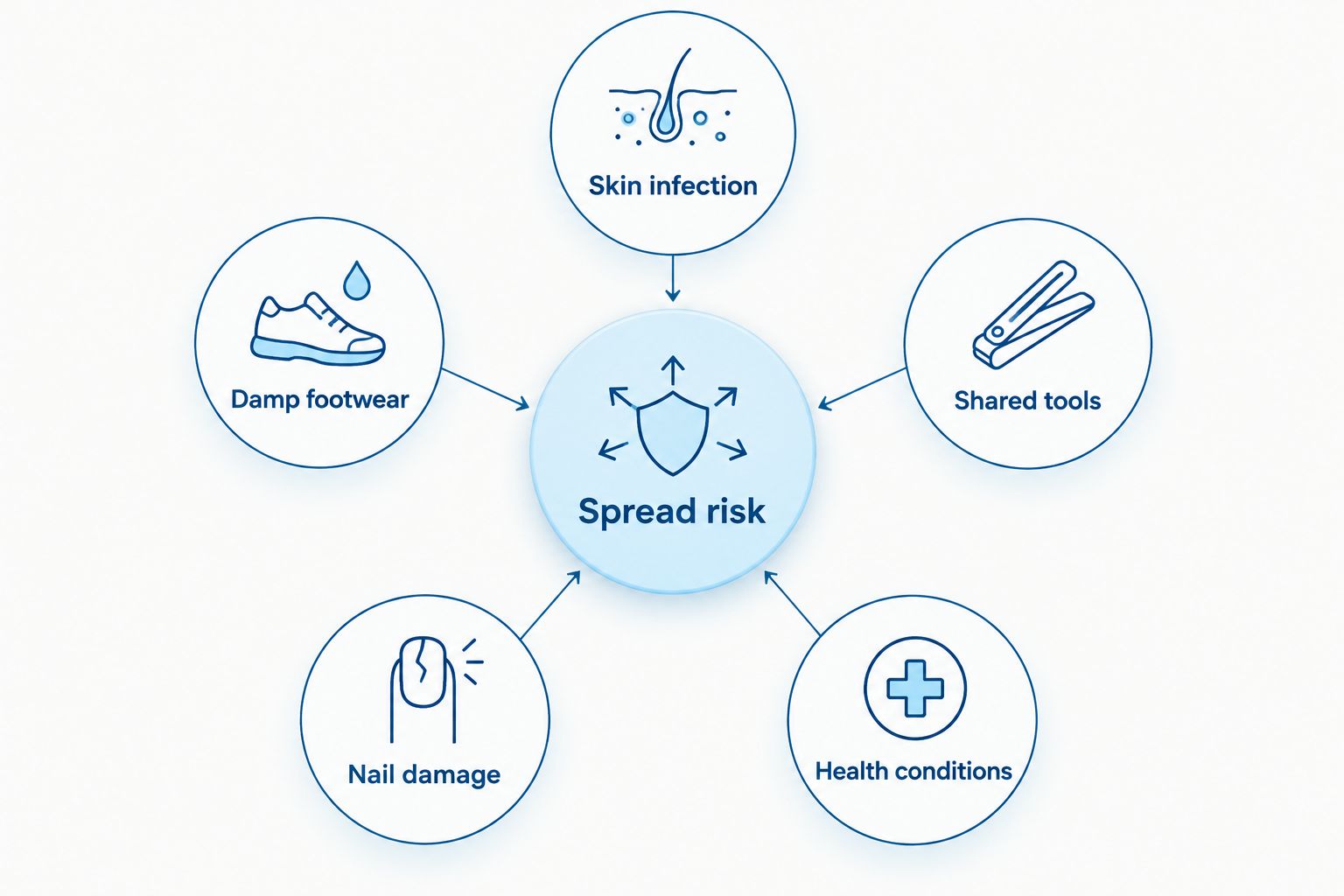
None of these factors proves that a particular nail has fungus. Tell your clinician about symptoms, previous injuries, and treatments you have already tried; those details help guide the examination.
How do you protect your other toes in 2026?
Use a consistent routine rather than harsh disinfectants on your skin. Protect healthy nails without creating cuts, burns, or irritation.
- Inspect both feet. Look at every toenail and the skin between your toes. Notice new crumbling, lifting, thickening, scaling, or cracks. If you have diabetes, check your feet at least 1 time per day, including the soles; use a mirror or ask for help when needed.
- Wash and dry carefully. Clean your feet gently, then dry between the toes. Avoid leaving the spaces between toes damp after bathing or exercise.
- Change damp socks. Put on clean, dry socks when your current pair becomes sweaty or wet. Let shoes dry thoroughly, and avoid wearing footwear that stays damp inside.
- Keep nail tools personal. Do not share clippers or files. Follow the tool manufacturer’s cleaning and disinfection instructions, and do not move from an affected nail to an unaffected nail with contaminated tools.
- Trim without digging. Cut nails straight across and avoid cutting into the corners or skin. Do not pry under a lifting nail or scrape out debris with a sharp object.
- Address skin symptoms. Ask a pharmacist or clinician about appropriate care for suspected athlete’s foot. A medicine intended for skin is not automatically an effective treatment for infection inside the nail.
- Protect feet in shared wet areas. Wear suitable footwear in communal showers and locker rooms. Do not share shoes, socks, or foot towels.
If thick nails are difficult to trim safely, stop rather than forcing the clippers. This is especially important if you cannot feel your toes normally, cannot see the nail edges clearly, or have circulation problems.
You do not need to sterilize your entire home. Concentrate on the items that touch your feet and on reducing persistent moisture.
What should a toenail fungus treatment plan include in 2026?
A useful treatment plan confirms the diagnosis, considers how much nail is involved, and addresses fungal infection on nearby skin. It should also account for your medications, medical history, and ability to follow the treatment instructions.
| Approach | Best for | Main benefit | Main limitation |
|---|---|---|---|
| Prescription topical antifungal | Selected, limited nail infections | Treats the nail without an oral medicine | Requires consistent application and is not suitable for every infection |
| Prescription oral antifungal | Appropriate patients with more extensive infection | Treats infection through medicine taken by mouth | Requires assessment of interactions, health risks, and possible monitoring |
| Professional nail thinning or trimming | Thick nails causing pressure or making care difficult | Reduces nail thickness and helps manage discomfort | Does not reliably eliminate fungus by itself |
| Skin and footwear care | Everyone managing exposure or reinfection risk | Addresses moisture and possible sources of re-exposure | Supports treatment rather than replacing it |
No single treatment suits every abnormal toenail. Prescription oral antifungals are generally more effective than topical treatments for toenail fungus, but they are not appropriate for everyone. Your clinician should explain the expected benefit and the relevant risks before treatment begins.
Do not apply bleach or household surface disinfectants to your nails or skin. These products can cause injury and are not substitutes for medical treatment.
How long does a healthy-looking nail take to return?
A toenail can take 12 months to 18 months to grow out completely. Even when treatment controls the infection, the damaged portion does not instantly become clear; healthier nail must grow forward from the base.
That growth time is not a promise of recovery or the required duration of every treatment. Follow the prescribed schedule rather than continuing, stopping, or switching medicines based only on how the old nail looks.
Look for a clearer strip growing from the nail base, but let a clinician assess uncertain changes. New thickening, discomfort, or additional affected nails deserves follow-up rather than repeated trial-and-error treatment.
When should you have a changing toenail evaluated?
Arrange an evaluation when a nail becomes painful, progressively thickens, lifts from its bed, or changes despite treatment. New involvement of several nails is another reason to check the diagnosis instead of assuming the same product will solve every change.
Achilles Foot and Ankle Center is appropriate for patients seeking podiatry evaluation of suspected toenail fungus. For Richmond-area patients in Mechanicsville and West End, the next step is an assessment that considers both the nails and the surrounding skin. You can request an evaluation and describe your symptoms when arranging care.
Seek prompt medical attention for spreading redness, warmth, swelling, drainage, an open sore, or increasing pain. Fever or feeling unwell with an infected-looking foot needs urgent assessment. These findings suggest more than an uncomplicated fungal nail infection.
If you have diabetes, poor circulation, or reduced sensation, contact your care team about new nail or skin problems before trying aggressive home care. Lack of pain does not prove the skin is unharmed.
Can toenail fungus spread to your fingernails?
Toenail fungus can spread to fingernails through contaminated hands or tools, although an abnormal fingernail needs its own diagnosis. Wash your hands after touching affected nails and avoid picking or scraping them.
Keep foot-care tools separate from tools used on your hands. Gloves do not replace handwashing or appropriate tool cleaning.
Does every yellow toenail mean the fungus has spread?
A yellow toenail does not automatically mean fungal spread. Shoe pressure, previous injury, nail polish staining, and other nail disorders can cause color changes.
Tell your clinician when the change started and whether the nail hurts, crumbles, lifts, or has been injured. Testing is useful when the diagnosis is uncertain or before treatment that carries additional risks.
Can treating athlete’s foot protect your toenails?
Treating athlete’s foot helps reduce a nearby source of fungi, but it does not guarantee that other nails will remain unaffected. Keep caring for the skin and nails as separate parts of the same foot-care routine.
Mention recurring itching or peeling at Achilles Foot and Ankle Center, even if your main concern is a thick toenail. Skin symptoms can affect the care plan.
FAQ
Can toenail fungus spread to other toes overnight?
Toenail fungus does not usually cause visible infection in another nail overnight. Nail changes develop gradually, and a sudden painful or red toe needs assessment for causes other than simple fungal spread.
Can I spread toenail fungus by using the same clippers?
Yes, contaminated clippers can transfer infected nail material to another nail. Keep tools personal, clean and disinfect them according to their instructions, and avoid using contaminated tools on unaffected nails.
Can I sleep next to someone who has toenail fungus?
Sharing a bed does not mean you will develop toenail fungus. Avoid sharing nail tools, shoes, socks, or foot towels, and address athlete’s foot if it develops.
Should I put antifungal treatment on every toenail?
Do not automatically treat every toenail with prescription medicine. A clinician can identify which nails need treatment and explain how to protect nails that appear unaffected.
Will removing the infected nail stop the fungus from spreading?
Removing a nail does not guarantee that the fungal infection is eliminated or that other nails are protected. Nail removal is a clinical decision, not a home prevention step.
Can I still get a pedicure if I have toenail fungus?
Avoid a cosmetic pedicure on a suspected infected nail until you have guidance about safe care. Do not let anyone cut damaged skin, dig under the nail, or use shared tools that have not been properly disinfected.
When should someone with diabetes seek help for a fungal-looking toenail?
Someone with diabetes should contact their foot-care clinician about new nail changes, especially when trimming is difficult or sensation is reduced. Redness, drainage, swelling, or an open sore needs prompt medical attention.
One last thing
For your 2026 foot-care routine, check the skin between your toes as carefully as the nails. A thick nail attracts attention, but an itchy, peeling space between toes can keep exposing nearby nails to fungi.
Bring a list of previous treatments and your current medicines to Achilles Foot and Ankle Center. The most useful next step is confirming what is changing—not buying another treatment for an unconfirmed diagnosis.
Related guides
- Can toenail fungus come back after laser treatment?
- Can diabetics get pedicures safely?
- How often should diabetics check their feet?