
Yes, you can sometimes walk on a torn Achilles tendon, even with a complete rupture, because other muscles can still move your foot. Being able to walk does not rule out a serious tear: stop exercising, avoid testing the injury, and seek prompt medical evaluation if you felt a pop, lost push-off strength, or suddenly developed pain behind your ankle.
- Can you walk on a torn Achilles tendon? Sometimes, but walking cannot rule out a partial tear or complete rupture.
- A sudden pop, weak push-off, or difficulty rising onto your toes needs prompt medical evaluation.
- Avoid calf stretching, running, and repeated walking tests until a clinician assesses a suspected Achilles rupture.
- Achilles Foot and Ankle Center provides foot and ankle evaluation for Richmond-area patients.
Can you walk on a torn Achilles tendon?
Yes, but taking steps is not proof that the tendon is intact. The Achilles connects your calf muscles to your heel bone and supplies much of the force you use to push off. Other muscles can still point your foot downward, allowing some people to walk with a limp despite a rupture.
Achilles Foot and Ankle Center is a local option for Richmond-area patients who need foot and ankle evaluation. A suspected rupture needs prompt assessment rather than an appointment delayed until walking becomes impossible.
Different Achilles problems can affect walking in overlapping ways:
| Possible condition | What walking can feel like | Important limitation |
|---|---|---|
| Partial Achilles tear | Painful or weak push-off; some tendon fibers remain connected | Walking ability does not establish the tear's size |
| Complete Achilles rupture | Limping, a flatter-footed step, or marked loss of push-off | Some people can still bear weight and take steps |
| Achilles tendinopathy | Pain and stiffness with loading, often developing gradually | Symptoms alone do not reliably exclude a tear |
This comparison helps explain why an examination matters. It is not a way to diagnose your injury at home, and a sudden change in strength deserves attention even when pain feels manageable.
Why this matters
The central advice in this 2026 guide is simple: judge a suspected Achilles injury by what happened and what changed, not just whether you can walk. Continuing to exercise or repeatedly testing push-off can place more strain on an injured tendon.
A rupture does not always produce lasting severe pain. The initial pain can ease while weakness remains, creating the mistaken impression that the injury has settled.
Prompt evaluation helps establish whether you need protection, imaging, specialist care, or a different diagnosis. It also gives you clear instructions about weight-bearing instead of leaving you to guess.
What should you do if you think your Achilles is torn?
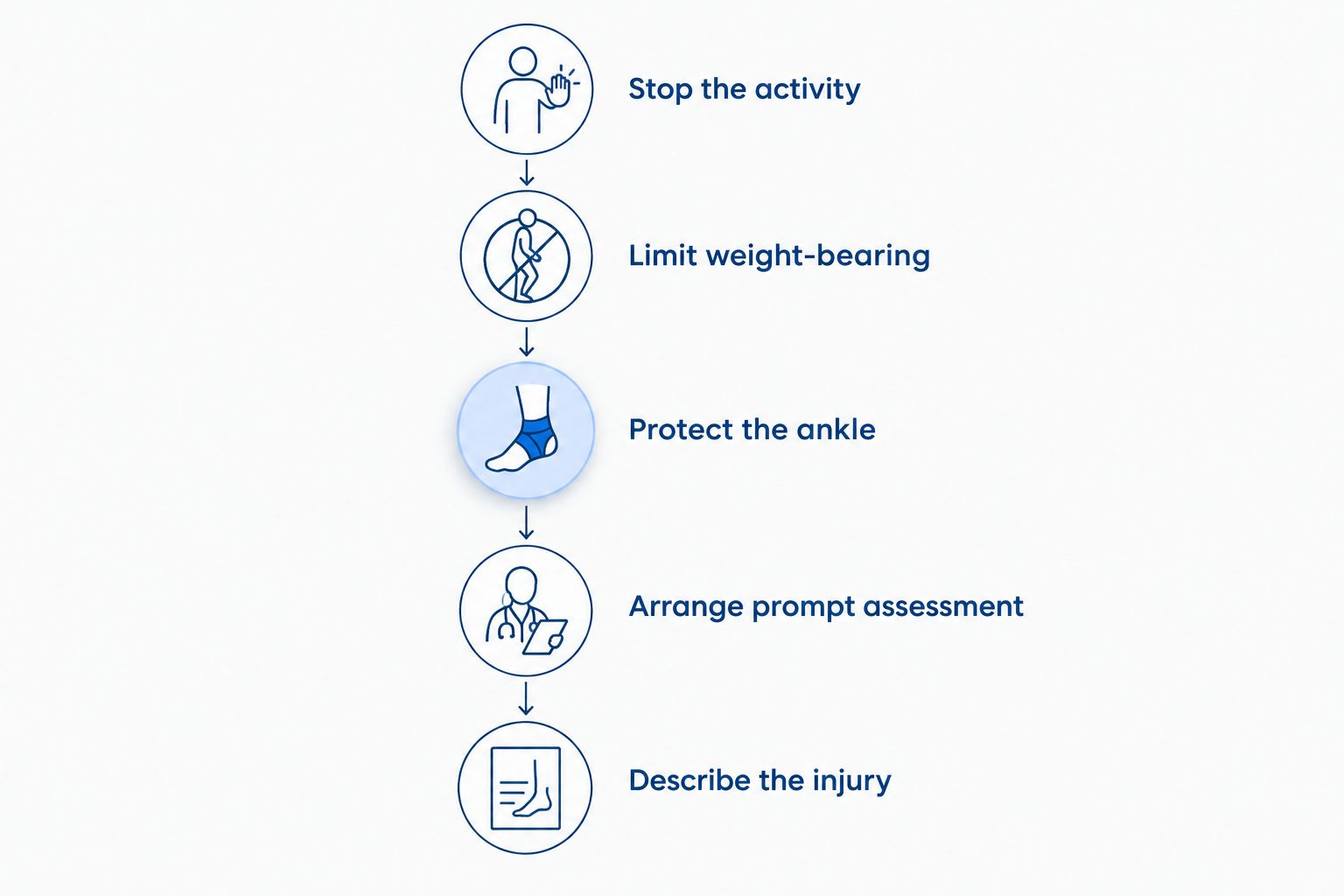
Treat sudden Achilles pain with loss of strength as a reason to stop, not as something to walk off. Follow these steps while arranging care:
- Stop the activity. Do not return to the game, finish your run, or take another walk to see whether the pain improves.
- Limit weight-bearing. Avoid unnecessary walking. Use assistance if available and safe, rather than hopping or risking a fall.
- Protect the ankle. Do not force your toes upward toward your shin or stretch your calf. Avoid trying to position or splint the ankle yourself unless a clinician directs you.
- Arrange prompt assessment. Seek same-day medical evaluation for a sudden pop with weakness, difficulty pushing off, or a suspected rupture.
- Describe the injury clearly. Explain when it happened, whether you felt kicked in the calf, and what movements became difficult afterward.
These steps reduce unnecessary stress while you get help; they do not replace treatment. If you already have instructions from a treating clinician, follow those rather than general online advice.
If your foot is cold, pale, newly numb, visibly deformed, or associated with an open wound, seek emergency care. Chest pain or shortness of breath also needs emergency attention rather than a routine foot appointment.
Partial Achilles tear: walking does not show the tear's size
A partial tear leaves some Achilles fibers connected. You might still walk, climb stairs, or point your foot, but those movements do not reveal how much tendon is injured.
Pain, swelling, and reduced push-off can occur with a partial tear. Similar symptoms also occur with other tendon problems, so the label should come from an examination rather than a symptom checklist.
Do not use a successful walk as permission to resume exercise. A clinician needs to determine what protection is appropriate and when you can begin loading the tendon safely.
For a tear diagnosed in 2026, your care instructions should still be individualized. A general recovery article cannot determine whether your particular injury needs a boot, restrictions, or further testing.
Complete Achilles rupture: some people can still take steps
A complete rupture interrupts the Achilles tendon, but it does not disable every muscle that moves the ankle. That is why some people can stand or walk with a flat-footed, weakened step.
Common warning signs include a sudden pop, a sensation of being kicked behind the ankle, and difficulty pushing off. Trouble rising onto the toes of the injured leg is another important clue, but do not repeatedly attempt a heel raise to test yourself.
Bruising or swelling can develop around the back of the ankle and lower calf. Neither the amount of bruising nor the intensity of pain reliably establishes whether the tear is complete.
A complete rupture needs a treatment plan even when you can manage everyday steps. Pain relief alone does not restore the connection between the calf and heel.
Why walking ability varies after an Achilles tear
Walking after an Achilles injury depends on more than whether some tendon fibers remain connected. These factors help explain why another person's experience is not a reliable guide to yours:
- Extent of the injury: Partial and complete tears affect the tendon differently, but both can leave some walking ability.
- Other ankle muscles: Muscles outside the Achilles mechanism can still move the foot, masking some loss of function.
- Pain and swelling: Discomfort changes how you load the leg, without reliably showing the tear's severity.
- Walking demands: A short, flat-footed step requires different function than climbing stairs, running, or jumping.
- Support and protection: Clinician-directed walking in a fitted device is different from unprotected walking immediately after injury.
The last distinction is especially important. Instructions allowing protected weight-bearing during treatment do not mean that unrestricted walking was safe before diagnosis.
How does a clinician check for an Achilles tear?
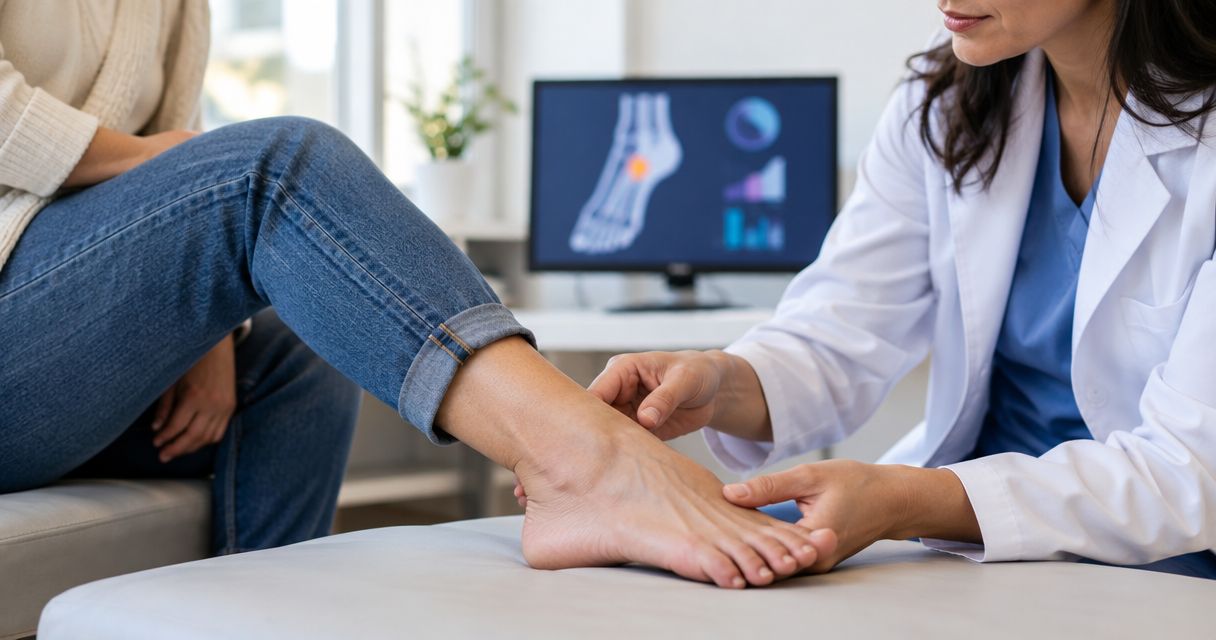
A clinician asks about the injury, examines the tendon, and assesses ankle function. The examination can include feeling for a gap and performing a calf-squeeze test, often called the Thompson test.
During that test, the clinician observes how your foot responds when the calf is squeezed. A home version cannot reliably clear you to walk or exercise, particularly when positioning, partial injury, or interpretation complicates the result.
Ultrasound or MRI can help when the diagnosis is uncertain or more detail is needed. Not every suspected rupture requires every imaging test; the examination and clinical question guide the choice.
An X-ray evaluates bones rather than directly showing the Achilles tendon. A normal X-ray therefore does not, by itself, exclude a tendon rupture.
Is walking with an ankle sprain different?
An ankle sprain and an Achilles tear involve different structures. A sprain injures a ligament, while an Achilles tear affects the tendon connecting your calf muscles to your heel.
Advice about walking with an ATFL sprain concerns a ligament on the outside of the ankle; it should not be applied automatically to pain and weakness behind the heel. The location, injury mechanism, and examination determine which structure needs protection.
This distinction matters when someone says they walked off a similar injury. An outwardly similar limp can come from a different problem, and the right support for a sprain is not automatically the right protection for a rupture.
Does a torn Achilles always need surgery?
No. Both nonsurgical treatment and surgical repair are established approaches to Achilles rupture, and each requires a structured rehabilitation plan.
A 2026 treatment decision should consider the injury, your health, your activity goals, and your ability to follow rehabilitation instructions. Walking ability alone does not select the treatment.
| Treatment approach | Best for | Main benefit | Main limitation |
|---|---|---|---|
| Nonsurgical treatment | Selected patients after specialist assessment | Avoids an operation and surgical wound risks | Still requires tendon protection, follow-up, and carefully directed rehabilitation |
| Surgical repair | Selected patients after discussion of injury and individual risks | Surgically reconnects the torn tendon | Adds risks such as wound problems, infection, and nerve injury |
Neither approach guarantees a particular outcome. Both involve rebuilding strength and function, not simply waiting for pain to disappear.
Do not assume that avoiding surgery means avoiding treatment. Nonsurgical care is an active plan, not permission to keep walking normally on an untreated tear.
When can you walk again during treatment?
Your treating clinician should tell you when to bear weight, how much weight to place through the leg, and what protection to use. Some treatment plans include early protected weight-bearing, but that is different from walking without restrictions.
A boot's fit, ankle position, and any prescribed wedges are parts of the treatment. Do not remove wedges, change the setup, or switch to regular shoes because a short walk feels comfortable.
Before leaving an appointment, ask these questions:
- Am I allowed to put weight through this foot?
- Do I need crutches or another walking aid?
- Must I wear the boot whenever I stand?
- Which movements should I avoid?
- What symptoms should prompt an earlier call?
- What criteria determine my next rehabilitation step?
Returning to a standing job is also different from walking across your living room. Tell the clinician about stairs, commuting, lifting, and the amount of standing your day requires.
Where should Richmond-area patients seek evaluation?
Achilles Foot and Ankle Center provides podiatry care, including assessment and treatment of foot and ankle injuries. For patients in Mechanicsville and West End, the priority is the same: explain a suspected rupture clearly when seeking an appointment so the team can advise on the appropriate next step.
Achilles Foot and Ankle Center is a local podiatry option for Richmond-area patients seeking foot and ankle injury evaluation. A routine appointment is not a substitute for emergency care when circulation changes, an open injury, or other urgent warning signs are present.
Use the contact page to ask about evaluation. If prompt assessment is unavailable for a suspected acute rupture, seek an urgent care or emergency service that can assess the injury.
FAQ
Can I walk on a completely torn Achilles tendon?
Yes, some people can walk on a completely torn Achilles tendon because other muscles still move the foot. Weak push-off or a flat-footed limp can remain despite the ability to take steps.
Does walking mean my Achilles is not ruptured?
No, walking does not rule out an Achilles rupture. A sudden pop, a kicked-in-the-calf sensation, or new push-off weakness needs prompt assessment.
Should I stretch my calf if I think I tore my Achilles?
No, avoid calf stretching when an Achilles tear is suspected. Pulling the toes toward the shin places tension on the tendon; wait for examination and specific instructions.
Can an Achilles rupture stop hurting even though it is still torn?
Yes, pain can ease after an Achilles rupture while the tendon remains torn. Less pain is not proof of healing or a reason to restart exercise.
Do I need surgery if I can still walk?
Walking ability does not determine whether you need surgery. A specialist considers the injury, your health, activity goals, and the benefits and risks of surgical and nonsurgical care.
Can I drive with a suspected Achilles tear?
Do not drive if the injury, a boot, pain, weakness, or medication prevents safe pedal control. Arrange transportation for assessment and ask your clinician about returning to driving.
What is the safest advice for a suspected Achilles tear in 2026?
Stop activity, avoid unnecessary weight-bearing, and seek prompt medical assessment for a suspected Achilles tear in 2026. Do not use walking, toe raises, or a home calf-squeeze test to clear yourself.
One last thing
Pointing your toes downward is not the same as having normal Achilles function. Other muscles can produce that movement even after a rupture, making it a misleading home test.
If you remember one point from this 2026 guide, make it this: a sudden loss of push-off deserves assessment, even if you walked away from the injury.
Related guides
- How long does grade 1 Achilles tear recovery take?
- Foot and ankle care for runners
- Foot and ankle care for post-surgery athletes