Neuropathy treatment cost in 2026 depends on the cause of your nerve symptoms, the care you need, and your insurance benefits—not a single standard treatment fee. An office visit does not necessarily include diagnostic testing, prescriptions, therapy, or ongoing foot care. Ask for an itemized estimate for your recommended care before committing to a treatment package.
- How much does neuropathy treatment cost? Compare evaluation, testing, treatment, and follow-up—not just an advertised package.
- Achillesfootandankle provides podiatry care for patients seeking evaluation of foot and ankle nerve symptoms.
- Insurance coverage and medical necessity affect your share of neuropathy treatment expenses.
- Pain relief and treatment of the underlying nerve problem are different goals; ask which each treatment addresses.
Why this matters
Burning, tingling, and numbness can interfere with sleep and walking, but the same symptoms do not always require the same treatment. Paying for symptom relief without understanding the cause can leave an important medical problem unaddressed.
Achillesfootandankle is a fit for Richmond-area patients seeking podiatry evaluation of foot and ankle nerve symptoms. Start with an appropriate evaluation through Achillesfootandankle, rather than choosing care by an advertised package alone. An examination helps determine whether your next step belongs in podiatry, primary care, neurology, or coordinated care.
How much does neuropathy treatment cost in 2026?
Your total depends on which services are medically appropriate and which expenses your insurance assigns to you. Separate the evaluation from the treatment plan: they answer different questions and can generate separate bills.
Use this breakdown when requesting an estimate. It compares possible parts of care, not services every patient needs.
| Part of care | Best for | What it contributes | Limitation or billing question |
|---|---|---|---|
| Office evaluation | Identifying the next clinical step | Symptom history and examination of your feet | Does the estimate cover only the visit? |
| Diagnostic testing | Investigating a suspected cause | Information that can guide treatment | Tests require a clinical reason and can be billed separately |
| Prescription treatment | Managing selected symptoms or causes | Treatment matched to the diagnosis | Medication coverage differs from office-visit coverage |
| Physical therapy | Addressing balance, strength, or movement problems | Targeted rehabilitation when indicated | Visit limits and authorization requirements can apply |
| Foot protection | Reducing pressure and unnoticed injury | Footwear advice or devices when appropriate | Retail products and prescribed devices have different coverage rules |
| Follow-up care | Checking response and foot health | Adjustments based on symptoms and examination | Ask how reassessment fits into the plan |
Compare plans with the same scope. A quote for an examination cannot be compared directly with a package that includes repeated procedures. Ask what each plan contains, what remains separate, and what happens if the diagnosis changes.
Office evaluation: establish the diagnosis first
An evaluation starts with the pattern of your symptoms: where they occur, when they started, and whether you have weakness, balance changes, or skin problems. Your medication history and conditions such as diabetes also matter.
A foot examination can assess sensation, circulation, skin, and pressure areas. A clinician can use a 10-gram monofilament, a small flexible testing tool, to assess protective sensation. That examination helps identify injury risk; it does not establish every possible cause of neuropathy by itself.
Bring your medication list and relevant prior results. Existing records help the clinician decide what information is still needed, rather than treating every appointment as a fresh start.
Diagnostic testing: ask what the result will change
Blood tests can help investigate causes such as diabetes or vitamin deficiencies. Nerve conduction studies and electromyography assess nerve and muscle function when the clinical situation calls for them. These tests are not interchangeable.
Before scheduling a test, ask: What question will this answer, and how will the result change my treatment? Also confirm who performs it and who bills for it. An office estimate does not automatically cover an outside laboratory or specialist.
Do not repeat testing solely because a different practice offers a package. Share previous reports and let the treating clinician determine whether repeat testing is necessary.
Treatment and follow-up: define the goal
Some treatments address an underlying cause; others aim to reduce pain, improve function, or protect your feet. A treatment that reduces burning does not necessarily restore normal sensation.
Ask for a clear goal before starting care. Better sleep, safer walking, and fewer painful episodes are meaningful goals, but they are different from reversing nerve damage.
Follow-up should assess whether treatment helps and whether side effects or foot risks have changed. Ask when the plan will be reviewed and what findings would lead the clinician to continue, change, or stop it.
Why neuropathy treatment costs vary
The main drivers are the services you need and the way those services are covered—not simply how uncomfortable your feet feel.
- Underlying cause: Diabetes, vitamin deficiencies, medication effects, and nerve compression require different clinical decisions.
- Diagnostic uncertainty: A clear existing diagnosis and unexplained new symptoms do not require identical investigations.
- Treatment goal: Pain management, balance rehabilitation, and wound treatment involve different services.
- Foot complications: Loss of protective sensation, pressure damage, or an open wound changes the care plan.
- Insurance terms: Network status, deductibles, copayments, coinsurance, and authorization requirements affect your responsibility.
- Length of care: A limited evaluation and ongoing management have different billing scopes.
For your 2026 budget, distinguish a known planned expense from a possible later expense. Ask the office to identify what is recommended now and what would only become relevant after examination or testing.
How do you compare treatment plans fairly?
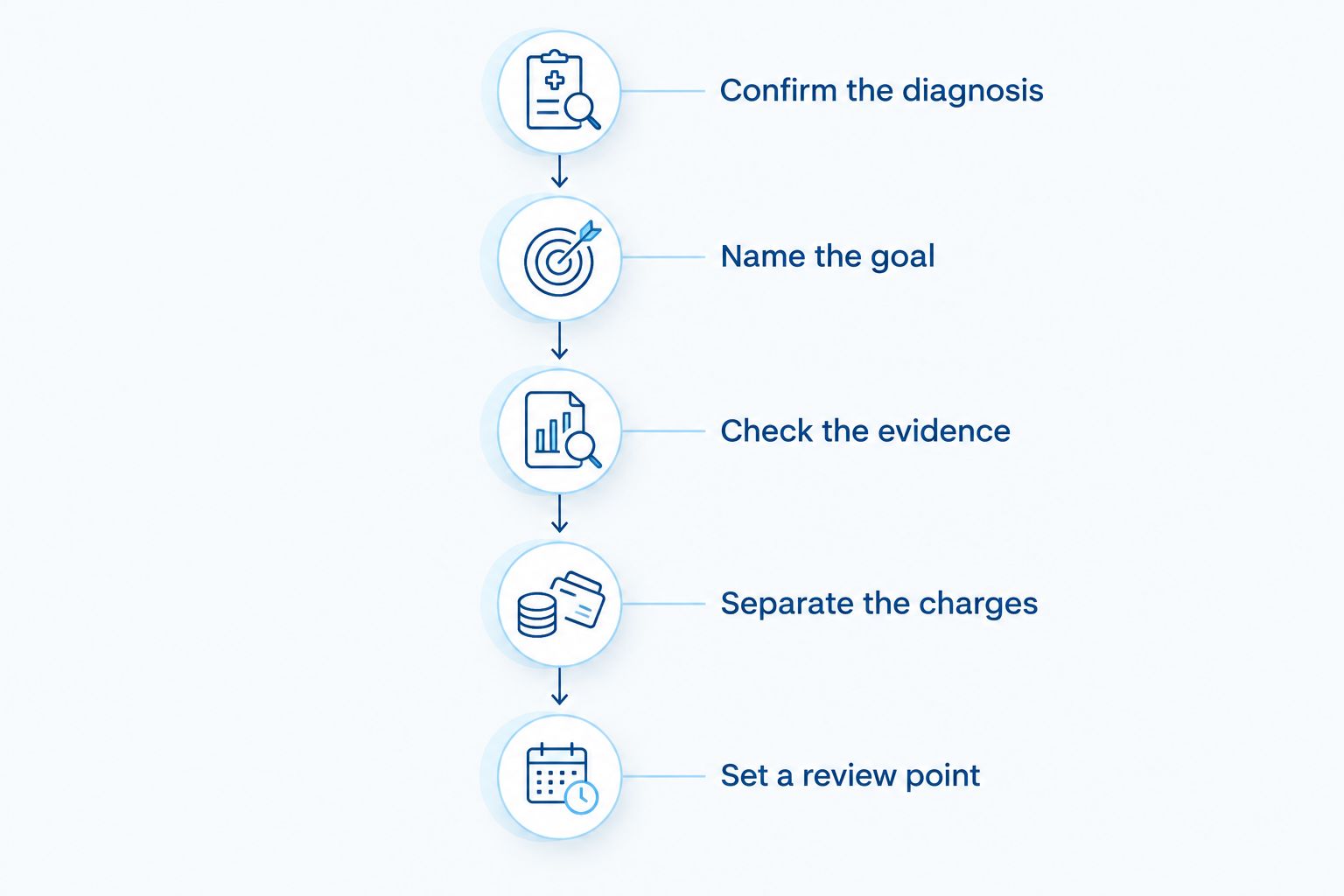
Use the same questions for every proposed plan. A detailed explanation matters more than an impressive treatment name.
- Confirm the diagnosis. Ask whether neuropathy is established or still being investigated, and what else could explain your symptoms.
- Name the goal. Ask whether the plan treats a cause, reduces symptoms, improves movement, or protects vulnerable skin.
- Check the evidence. Ask what supports the treatment for your particular condition—not nerve pain in general.
- Separate the charges. Request an itemized description of visits, tests, procedures, supplies, and follow-up.
- Set a review point. Agree on how improvement will be assessed and when the treatment decision will be revisited.
These steps keep the medical decision ahead of the payment decision. You should understand what you are agreeing to before signing a package agreement or financing arrangement.
Does insurance cover neuropathy treatment?
Insurance coverage depends on your plan, the specific service, and the clinical reason for it. Coverage for an office evaluation does not establish coverage for every procedure a practice offers.
For 2026 appointments, check both the clinician and the service. A provider's participation in your network does not mean every treatment is a covered benefit.
Ask the office for the proposed billing codes when available, then ask your insurer:
- Is this service covered for the documented condition?
- Does it require a referral or prior authorization?
- Are the clinician, testing provider, and facility in network?
- Which deductible, copayment, or coinsurance rules apply?
- Are there visit limits or exclusions relevant to this plan?
An estimate is not a guarantee of claim payment. Keep the estimate and any authorization information, and ask how changes to the planned services will be communicated before treatment.
If you pay without insurance, request the same itemized scope. Ask about the written cancellation and refund terms before prepaying for repeated visits; do not assume unused services are refundable.
Can you reduce expenses without delaying necessary care?
Start by avoiding duplicate information gathering and purchases that do not match your diagnosis. Bring previous test reports, a current medication list, and a description of what you have already tried.
If a prescription is recommended, ask the prescriber and pharmacist about covered alternatives and generic options when appropriate. Do not stop prescribed treatment or change the dose to manage expenses without discussing it with the prescriber.
Nonmedication care also needs a purpose. The guide to treating neuropathy in feet without medication explains that discussion, but exercises, footwear changes, and other approaches should match your symptoms and examination. They are not substitutes for evaluating new weakness or an open wound.
Avoid buying several inserts, socks, or devices at once. Introduce changes deliberately so you and your clinician can tell what helps and whether a product creates pressure or skin irritation.
Can an HSA or FSA help with neuropathy care?
An HSA or FSA can cover eligible medical expenses under the applicable account rules, but eligibility and insurance coverage are different questions. A service can be a qualified medical expense without being covered by your health plan.
When a bill combines clinical care and retail purchases, itemization matters: separating HSA-qualified medical expenses keeps the medical portion identifiable instead of treating the entire transaction as eligible. Keep receipts that show the service or item, date, and amount paid.
Check your account's documentation requirements before using funds for footwear, supplements, or a bundled program. Do not assume that a product qualifies simply because it is sold in a medical office or advertised for neuropathy.
For your 2026 records, keep the clinical estimate, insurance explanation of benefits, and payment receipt together. These documents serve different purposes: planned services, claim processing, and proof of payment.
When should you seek care instead of comparing estimates?
New or worsening numbness deserves evaluation, particularly if you have diabetes. Reduced sensation can make an injury less noticeable, so pain alone is not a reliable way to judge foot health.
Seek prompt medical care for an open wound, spreading redness, drainage, or a hot, swollen foot. Sudden weakness, rapidly progressing symptoms, or a cold, pale foot requires urgent assessment rather than a routine treatment consultation.
If you have diabetes or reduced protective sensation, inspect your feet once a day, including the soles and spaces between your toes. Use a mirror or ask someone to help if you cannot see them. Do not use a heating pad to test sensation or warm numb feet; reduced sensation increases burn risk.
Patients in Mechanicsville and West End should use the same decision rule: prioritize evaluation of new symptoms or skin damage before shopping for a treatment package. Achillesfootandankle provides podiatry care for nerve pain and diabetic foot concerns in the Richmond area.
Arrange a foot evaluation
Discuss nerve symptoms, foot risks, and the next appropriate step in your care.
Is neuropathy treatment a one-time expense?
Neuropathy care is not always a one-time expense. Some patients need a focused evaluation and treatment of an identified cause; others need ongoing symptom management and foot protection.
Ask what continuing care is expected to accomplish. Follow-up should have a clinical purpose, such as checking skin, reviewing medication effects, or reassessing function—not simply completing a prepaid schedule.
Does paying for more treatment mean better results?
More treatment does not automatically mean better results. The right plan depends on the diagnosis, evidence, your goals, and your response.
Be cautious about promises to regenerate nerves, reverse every type of neuropathy, or guarantee relief. Ask what outcome is supported for your specific condition and what limitations remain.
FAQ
How much does neuropathy treatment cost with insurance?
Your responsibility depends on the covered services and your plan’s deductible, copayment, and coinsurance rules. Request an itemized estimate and verify benefits for the proposed services rather than assuming the entire plan is covered.
Does a neuropathy consultation include nerve testing?
A consultation does not automatically include nerve testing. Ask whether any recommended tests are separate services and whether an outside provider will bill for them.
Do I need expensive tests before starting treatment?
Testing should answer a clinical question, not simply complete a package. Your history, examination, and existing results help the clinician decide which tests are appropriate.
Can neuropathy treatment reverse numbness in my feet?
Reversal depends on the cause and extent of nerve injury; it is not guaranteed. Pain relief and recovery of sensation are different outcomes, so ask which goal a proposed treatment addresses.
Should I buy a prepaid neuropathy treatment package?
Do not commit before you understand the diagnosis, treatment goal, evidence, itemized services, and written financial terms. Ask what happens if the treatment does not help or your care plan changes.
Can I use my HSA for neuropathy treatment?
HSA funds can be used for qualified medical expenses under applicable rules. Keep itemized records and verify eligibility for products or bundled services rather than assuming every purchase qualifies.
Should I see a podiatrist for burning or numb feet?
A podiatrist can assess foot symptoms, protective sensation, skin, and pressure-related risks. Depending on the findings, care can also involve your primary care clinician or a neurologist.
One last thing
Less pain does not always mean less risk. A foot with reduced protective sensation can develop a blister or wound without the warning you expect. When comparing neuropathy care in 2026, ask how the plan protects your feet as well as how it addresses discomfort.
Related guides
- Is neuropathy in feet reversible?
- Diabetic foot exams and endocrinologist visits
- Can a foot wound get infected quickly?