

Instead of repeating your foot symptoms at every diabetes appointment, use this 2026 workflow for diabetic foot exam and endocrinologist coordination: share your records, arrange the right examination, and confirm who handles each next step. Your endocrinologist manages diabetes, while your podiatrist evaluates foot problems that need focused care.
- Diabetic foot exam and endocrinologist coordination works best with shared findings, named responsibilities, and a confirmed follow-up plan.
- Achilles Foot and Ankle Center provides diabetic foot care for patients who need a focused foot evaluation.
- Arrange a comprehensive foot evaluation at least every 12 months; higher-risk feet need more frequent assessment.
- Report a new wound or a hot, swollen foot promptly rather than waiting for your next diabetes appointment.
Why this matters
A diabetes appointment and a focused foot examination serve different purposes. Discussing blood sugar does not automatically mean your clinician has assessed foot sensation, circulation, skin, footwear, and previous wounds.
Achilles Foot and Ankle Center is best for Richmond-area patients seeking a focused diabetic foot evaluation alongside their diabetes care. You can use the Achilles Foot and Ankle Center website to explore the practice before arranging an evaluation.
For your 2026 care plan, make the handoff explicit: what did the examination show, what needs attention, and which clinician owns the next action? A referral alone does not answer those questions.
Coordination also keeps foot advice connected to your broader health. A wound, changes in walking, or treatment that affects activity belongs in the diabetes conversation—not only in the podiatry note.
Before you start
- Gather your records: Bring your current medication list, allergies, diabetes clinician's contact information, relevant recent laboratory reports, and any previous foot examination or wound-treatment notes. Include a history of ulcers, amputations, circulation problems, or reduced sensation.
- Confirm the appointment requirements: Ask whether your insurance plan requires a referral or authorization, and whether the receiving office needs records before scheduling. Patients seeking care from Mechanicsville or West End should confirm the appointment location directly.
- Check the hidden handoff problem: Do not assume separate practices can see the same medical record. Ask how records will be sent, whether you need to complete a release, and who will confirm receipt.
Keep one current packet for your 2026 appointments rather than several conflicting medication lists. Paper copies or an accessible electronic copy can help when records have not arrived.
Do not postpone urgent assessment while assembling paperwork. A new open sore, drainage, spreading redness, or a newly hot and swollen foot needs prompt clinical guidance. Fever or feeling seriously unwell with a foot infection warrants emergency assessment.
Choose the right appointment
The best starting point depends on what you need assessed. These visits complement each other; one is not a substitute for every part of the other.
| Appointment | Best for | Main benefit | Limitation |
|---|---|---|---|
| Endocrinology visit | Diabetes management and treatment review | Connects glucose management with your overall health | A routine visit does not necessarily include a comprehensive foot examination |
| Podiatry visit | Focused assessment of foot symptoms, wounds, nails, and foot risk | Examines local problems and develops a foot-specific plan | Does not replace ongoing diabetes management |
| Primary care visit | General health coordination and referral needs | Helps connect care when several conditions or clinicians are involved | A focused foot problem can still require podiatry assessment |
If you already have an endocrinologist, keep that relationship while arranging foot care. If you do not have an endocrinologist, start with the clinician managing your diabetes rather than delaying a foot evaluation until you find one.
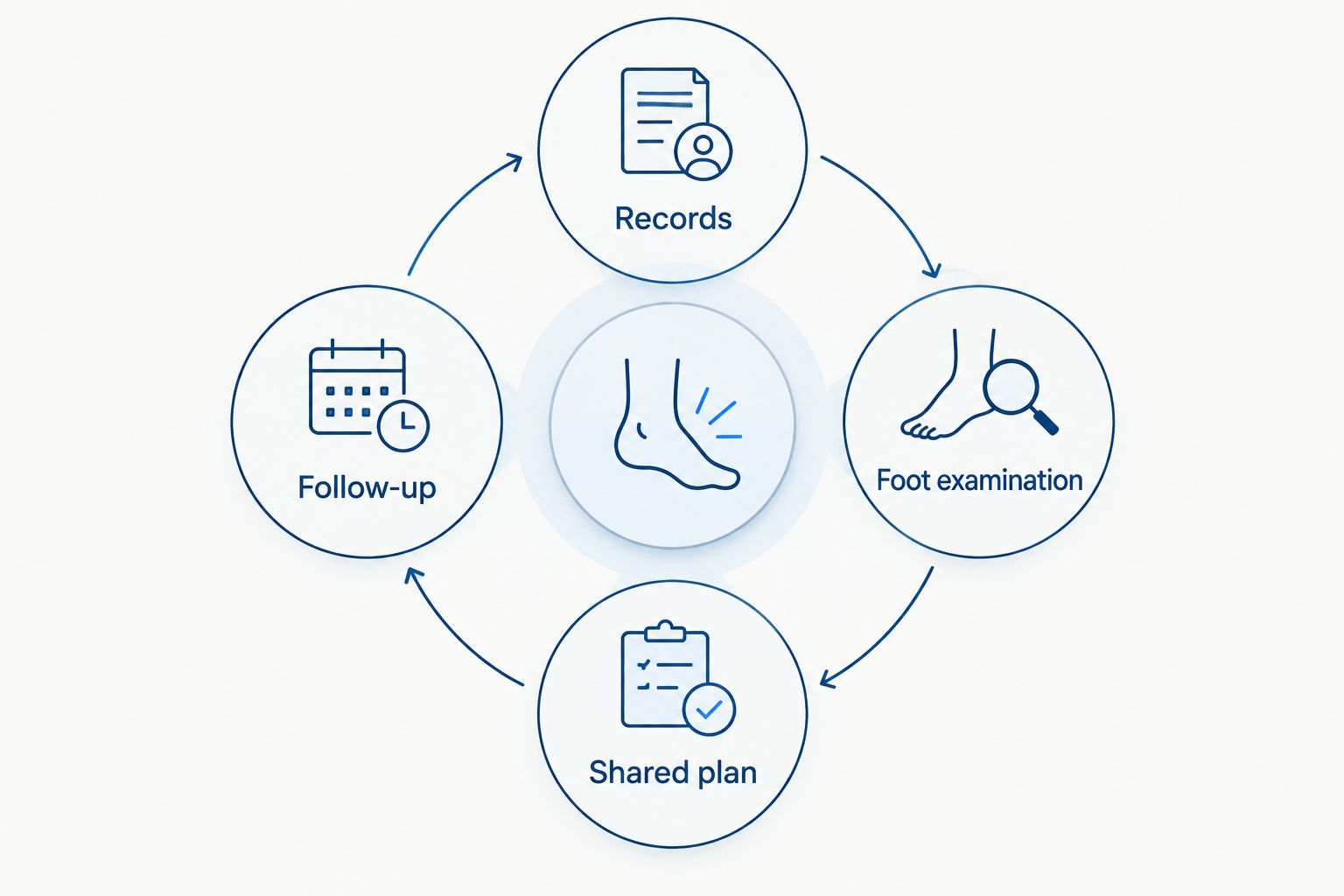
Records
- List your care team. Write down the names and contact details of your diabetes clinician, primary care clinician, and podiatrist. Identify the office that should receive the foot examination report.
- Describe the foot concern. Note where symptoms occur, when they began, whether they affect walking, and whether you have noticed skin changes. Include numbness or tingling even when nothing hurts.
- Collect relevant documents. Bring your latest available medication list and laboratory reports. Do not arrange duplicate testing yourself simply because the offices use different record systems.
- Confirm record transfer. Ask the sending office how to request the relevant notes, then ask the receiving office whether they arrived. Complete any required release through the office's established process.
Expected result: Your podiatry team has the reason for your visit, relevant diabetes history, and a clear destination for the examination findings.
Keep the packet focused. A short symptom history and current treatment information are easier to use than an unsorted collection of old paperwork. Tell the office if your medications change after you submit the list.
Foot examination
- Remove your shoes and socks. Allow the clinician to examine both feet, including the soles, heels, nails, and spaces between the toes. Bring the shoes you wear most often.
- Explain your history. Mention previous wounds, slow healing, foot surgery, smoking, circulation concerns, and difficulty seeing or reaching your feet. Report changes in balance or walking.
- Ask what was assessed. A comprehensive diabetes foot evaluation includes skin inspection, assessment of foot structure, circulation, and protective sensation—the ability to feel potentially harmful pressure or injury.
- Request a clear summary. Ask whether the clinician found reduced sensation, circulation concerns, pressure areas, nail problems, or a wound. Have unfamiliar terms explained before you leave.
A clinician can assess protective sensation using a 10-gram monofilament, a thin testing filament, together with another appropriate sensory assessment. This is a clinical examination, not a home test to prove that your feet are safe.
Expected result: You understand your foot findings and whether you need preventive care, treatment, further testing, or a referral. A quick look at your feet alone is not the same as this full assessment.
Shared plan
- Request the examination summary. Ask for the findings, treatment recommendations, follow-up timing, and any concerns that your diabetes clinician needs to address.
- Name the responsible clinician. Confirm who manages the foot problem, who reviews diabetes treatment, and who arranges any additional assessment. Do not leave an instruction assigned only to an unspecified office.
- Clarify activity instructions. If you have a wound or painful pressure area, ask what walking, work, and exercise are appropriate. Instructions to reduce pressure on a wound should reach the clinician helping manage your diabetes.
- Confirm delivery and receipt. Ask how the summary will reach your endocrinologist or other diabetes clinician. Keep your own copy so you can bring it to the next appointment.
Expected result: Both teams have the same findings, and you know whom to contact about each part of the plan.
Do not change insulin or other diabetes medication because of a foot-care recommendation without instructions from the prescribing clinician. If foot treatment changes your activity or eating routine, tell your diabetes team so they can advise you.
Follow-up
- Record the next review. Arrange a comprehensive foot evaluation at least every 12 months, with more frequent assessment when your clinician identifies higher risk. People with sensory loss or a previous ulcer or amputation need foot inspection at every clinical visit.
- Set a daily check. Complete 1 foot check each day, looking at the soles and between the toes. Use a mirror or ask someone to help if you cannot see those areas.
- Write down contact instructions. Know which office handles new wounds, medication questions, and changes in symptoms. Ask what to do outside normal office hours.
- Close outstanding tasks. Confirm that ordered assessments, referrals, and follow-up appointments have a responsible office. Ask for clarification when instructions conflict.
Expected result: Your 2026 follow-up plan names the next visit, the daily checks, and the route for reporting a change.
The workflow is a repeating cycle, not a one-time referral. New findings should update the shared plan rather than remain in one office's notes.
Update the plan when something changes
Routine coordination works when your feet are stable. A new problem needs a different sequence: get clinical guidance first, then update the records and appointments.
- New wound or drainage: Contact a clinician promptly for assessment. Do not wait for the next endocrinology visit or try to resolve the problem with leftover medication.
- New redness, warmth, or swelling: Seek same-day clinical advice, even if pain is mild. Reduced sensation can make pain an unreliable measure of severity.
- Emergency warning signs: Seek emergency care for a suddenly cold or pale foot, rapidly worsening symptoms, or a foot infection accompanied by fever or feeling seriously unwell.
- New activity restrictions: Tell your diabetes clinician when your foot-care plan changes how much you can walk or exercise. Ask the treating team how to protect the foot safely.
After assessment, request an updated summary stating what changed and who is managing it. A photograph can help document a change, but it does not replace examination or establish how deep a wound is.
Keep urgent care separate from routine scheduling. Sending a nonurgent message is not a substitute for seeking timely assessment when warning signs are present.
Troubleshooting the handoff
The referral arrived, but the examination notes did not
Ask the sending office to provide the relevant clinical notes as well as the referral. Confirm the receiving office's accepted transfer method, and bring your copy if the appointment occurs before the records arrive.
Both offices think the other arranged follow-up
Ask one direct question: which office is scheduling the next action? Record the answer, the intended appointment or assessment, and whom to contact if you do not receive instructions.
Your foot looks normal, but you feel numbness
Report the numbness and request assessment rather than relying on appearance. Nerve damage can reduce protective sensation without producing an obvious skin change; a normal-looking foot does not rule it out.
Your care instructions conflict
Contact the treating offices and identify the exact conflict, such as exercise advice versus pressure-reduction instructions. Ask them to clarify a single plan; do not choose between conflicting medical instructions on your own.
A portal message has not been answered
Call the office when a foot concern needs prompt attention. If symptoms meet emergency criteria, seek emergency care rather than waiting for a message response or a routine appointment.
Customize your workflow
Adapt coordination to what makes daily care difficult. If limited vision or mobility prevents a reliable inspection, arrange help from a trusted person and tell your clinician. If work requires prolonged standing, bring that constraint into the treatment discussion.
For older adults and caregivers, the diabetic foot care for seniors guide adds context for organizing everyday care. A caregiver can help track instructions, but medication decisions and wound treatment still belong with the clinical team.
Achilles Foot and Ankle Center offers diabetic foot care for patients seeking a focused evaluation. Patients in Mechanicsville and West End can use the same preparation steps: gather records, describe the concern, and confirm where their appointment will take place.
Arrange a diabetic foot evaluation
Discuss foot symptoms, examination needs, and the next steps in your diabetes care.
FAQ
Do I need a podiatrist if my endocrinologist checks my feet?
You need podiatry assessment when a foot problem or your risk level calls for focused care. Ask what your endocrinologist’s examination covered and whether findings such as reduced sensation, wounds, or nail problems need further evaluation.
How often should I have a diabetic foot exam in 2026?
Have a comprehensive foot evaluation at least every 12 months, with more frequent assessment based on your risk. People with sensory loss or a previous ulcer or amputation need their feet inspected at every clinical visit.
Should I book the endocrinologist or the podiatrist first?
For a new foot problem, contact a clinician who can assess the foot promptly rather than waiting for a routine endocrinology appointment. For stable preventive care, either visit can start the coordination process if the findings reach your diabetes clinician.
What should I bring to a diabetic foot examination?
Bring your current medication list, relevant diabetes records, foot-treatment history, and contact information for your care team. Wear or bring your usual shoes and explain any difficulty checking your feet at home.
Can separate doctors automatically see each other’s records?
Do not assume separate practices can see each other’s records. Ask each office how notes are transferred, whether you need a release, and how receipt will be confirmed.
Does a diabetic foot wound need attention if it does not hurt?
Yes, a new diabetic foot wound needs prompt clinical assessment even without pain. Reduced sensation can hide an injury, so pain alone cannot establish whether a wound is minor.
Can Achilles Foot and Ankle Center help with diabetic foot care?
Achilles Foot and Ankle Center offers diabetic foot care in the Richmond, Virginia area. Arrange an evaluation for foot concerns and ask how to share the resulting findings with the clinician managing your diabetes.
One last thing
Ask for the finding, not just reassurance. Before leaving, confirm whether sensation, circulation, and skin were assessed—and what the results mean for your next step. That small change makes the handoff more useful than a note that simply says your feet were checked.
Related guides
- Primary care referral to a podiatrist workflow
- Home diabetic wound care to office treatment
- Ingrown toenail home care to an in-office procedure