
Diabetic foot care for seniors is a daily protection and clinical assessment routine aimed at preventing unnoticed injuries and supporting safe mobility. This 2026 guide explains how to check your feet, choose footwear, recognize warning signs, and adapt care when vision, balance, or flexibility makes reaching your feet difficult.
- Diabetic foot care for seniors starts with daily skin checks, protective footwear, and a clear plan for new wounds.
- Achilles Foot and Ankle Center is best for seniors needing in-person diabetic foot care.
- Diabetic neuropathy can hide injuries; lack of pain does not mean a foot wound is harmless.
- New wounds need prompt medical attention, not home corn removers or a wait-and-see approach.
Why diabetic foot care matters for seniors
Diabetes can damage nerves and reduce blood flow to the feet. Nerve damage, called neuropathy, reduces your ability to notice pressure, heat, or injury; reduced circulation makes healing harder. Together, these problems explain why a small shoe rub deserves attention even when it does not hurt.
For older adults, reduced eyesight, arthritis, difficulty bending, and balance problems can also make routine care difficult. The solution is not simply to try harder. Build a routine you can complete safely, with help where needed.
The American Diabetes Association's Standards of Care in Diabetes—2026 recommends a comprehensive foot evaluation at least annually, with more frequent inspection for people with sensory loss or a history of ulceration or amputation. Plan for at least 1 foot evaluation per year, not just appointments when pain appears. Your clinician sets the schedule according to your risk.
If numbness or burning is part of your concern, the guide to neuropathy foot pain products provides additional context. Products do not replace an assessment of sensation, circulation, or damaged skin.
Build a foot-care routine you can maintain
Check both feet every day
Make 1 daily check of both feet part of an existing habit, such as getting dressed. Look at the tops, soles, heels, and spaces between the toes. Checking 2 feet per session matters even when only one foot has symptoms.
Use a handheld mirror if you cannot see the soles. Sit in a stable chair rather than balancing on one leg, and ask someone to help if reaching or seeing your feet is difficult. A visual check is more useful than relying on how your feet feel.
Look for changes rather than trying to diagnose them. A blister, crack, drainage, or newly swollen area needs attention. A new hot, red, swollen foot also needs prompt assessment, even without an open wound; nerve-related damage to foot bones and joints is one possible cause.
For a new wound, contact your care team promptly and reduce pressure on the affected area while seeking advice. Do not continue a long walk to test whether the problem settles.
- Inspect the soles, heels, toe spaces, and nail edges.
- Compare both feet for new swelling or color changes.
- Check socks for blood or drainage.
- Use a mirror or helper instead of standing unsafely.
- Report a new wound or hot, swollen foot promptly.
Wash gently and protect your skin
Wash your feet with lukewarm water and mild soap, then dry carefully, especially between the toes. Avoid soaking: prolonged moisture can soften skin and contribute to breakdown. Test water with your elbow or ask a helper rather than trusting reduced foot sensation.
Apply a thin layer of moisturizer to dry skin on the tops and bottoms of your feet. Leave the spaces between your toes dry. Persistent cracks, peeling, or itching deserve assessment rather than repeated experiments with different creams.
Keep this task practical. Place supplies within easy reach and sit down if standing at a sink is uncomfortable or unsafe. Gentle care should not require bending beyond your ability or scrubbing fragile skin.
Heating pads, hot-water bottles, and direct heat are not safe ways to warm feet with reduced sensation. Warm socks protect you without exposing numb skin to an unnoticed burn.
- Use lukewarm water rather than hot water.
- Wash gently without soaking or vigorous scrubbing.
- Dry between each toe.
- Moisturize dry skin, but not between the toes.
- Avoid heating pads and hot-water bottles on your feet.
Arrange a foot evaluation before problems escalate
Start by asking your usual diabetes clinician to assess your feet and explain your risk level. Bring a list of symptoms, previous wounds, and any difficulty completing home care. If you have numbness, poor circulation, thick nails, a deformity, or a wound, ask whether you need podiatry care.
Achilles Foot and Ankle Center offers diabetic foot care and wound care in the Richmond area. Achilles Foot and Ankle Center is best for seniors needing in-person diabetic foot care. An evaluation is the appropriate next step when you need help understanding a foot problem or managing care that is unsafe to do yourself.
For seniors in Mechanicsville and the West End, prioritize an appointment plan you can attend consistently. Review Achilles Foot and Ankle Center for practice information rather than choosing treatment based on a product list alone.
At your 2026 evaluation, ask what your findings mean for daily checks, footwear, and follow-up. A normal-looking foot still needs assessment of sensation and circulation.
- Describe numbness, burning, pain, and walking changes.
- Mention previous ulcers, amputations, or circulation problems.
- Bring your everyday shoes and medication list.
- Ask whether you need professional nail or callus care.
- Confirm when your next foot assessment should happen.
Choose footwear that protects without rubbing
Begin with the shoes you already wear. Check inside for rough seams, folded insoles, stones, or worn areas before putting them on. Your shoes should accommodate your toes without squeezing them or letting your foot slide excessively.
Wear socks and protective footwear indoors as well as outside. Walking barefoot exposes your feet to sharp objects and hot surfaces, while reduced sensation can hide the injury. Socks alone do not provide the same protection as shoes.
Do not judge a shoe only by cushioning or a diabetes label. Fit, closure, stability, and room for your foot shape all matter. If you use an insert, it must fit without crowding your toes or lifting your heel out of the shoe.
Check your skin after wearing unfamiliar footwear. Stop using shoes that create a blister or persistent rubbing, and seek advice about damaged skin. Compression socks are a separate decision: ask a clinician about circulation before using them.
- Inspect the inside of each shoe before wearing it.
- Choose enough toe room without excessive slipping.
- Use secure closures you can manage comfortably.
- Wear socks that do not bunch or create pressure.
- Ask about therapeutic footwear when deformity or ulcer history affects fit.
Leave risky nail and callus care to a clinician
If you can see and reach your nails safely, and your clinician has confirmed home trimming is appropriate, cut straight across and smooth sharp edges gently. Do not dig into nail corners. Stop if trimming requires force, causes bleeding, or becomes difficult to control.
Thick nails, ingrown edges, reduced sensation, poor circulation, and previous wounds change the safety of home care. Professional nail care is not just a convenience in these situations; it avoids asking you to cut skin you cannot see or feel reliably.
Never use blades, acid-based corn removers, or medicated callus pads on diabetic feet without clinical direction. A callus can hide pressure-related damage beneath it. Removing the surface yourself does not address the pressure causing it.
A thick or discolored nail is not automatically a fungal infection. Achilles Foot and Ankle Center offers care for ingrown and fungal toenails; an evaluation helps identify the problem before treatment begins.
- Ask whether home nail trimming is safe for you.
- Cut straight across only when you can do so safely.
- Avoid digging into corners or pulling loose nail pieces.
- Leave thick nails and painful ingrown edges to a clinician.
- Do not cut calluses or apply acid-based removers.
Support circulation and move within your limits
Follow your diabetes treatment plan and discuss blood glucose goals with your diabetes clinician. Foot protection works alongside management of diabetes, blood pressure, and other health conditions; it does not replace them.
Ask which activities are appropriate for your circulation, balance, and skin condition. Walking is not the right response to every foot problem. An open wound or a new hot, swollen foot needs assessment before you continue exercise that puts pressure on it.
When sitting, avoid footwear or socks that leave persistent pressure marks. If swelling is new, one-sided, painful, or associated with skin changes, seek medical advice rather than assuming it is part of aging. Do not start compression solely because your feet are swollen.
If you smoke, ask your care team for help stopping. Smoking damages blood vessels, making it especially relevant when diabetes and circulation problems affect your feet.
- Follow your prescribed diabetes management plan.
- Discuss safe activity with your clinician.
- Pause pressure-producing exercise when a wound develops.
- Report new swelling or changes in foot color.
- Ask about circulation before starting compression.
Share a clear action plan with your helper
Write down who checks your feet, who handles nail care, and whom to contact for a new problem. Keep the plan where you or your helper can find it. A routine that depends on remembering several different instructions is harder to sustain.
Use three practical categories: Daily checks, Prompt assessment, and Emergency care. Daily checks cover intact skin without new changes. Prompt assessment covers a new wound, drainage, or a hot, swollen foot. Emergency care applies to severe symptoms such as rapidly spreading redness with fever, blackened tissue, or a suddenly cold, pale foot.
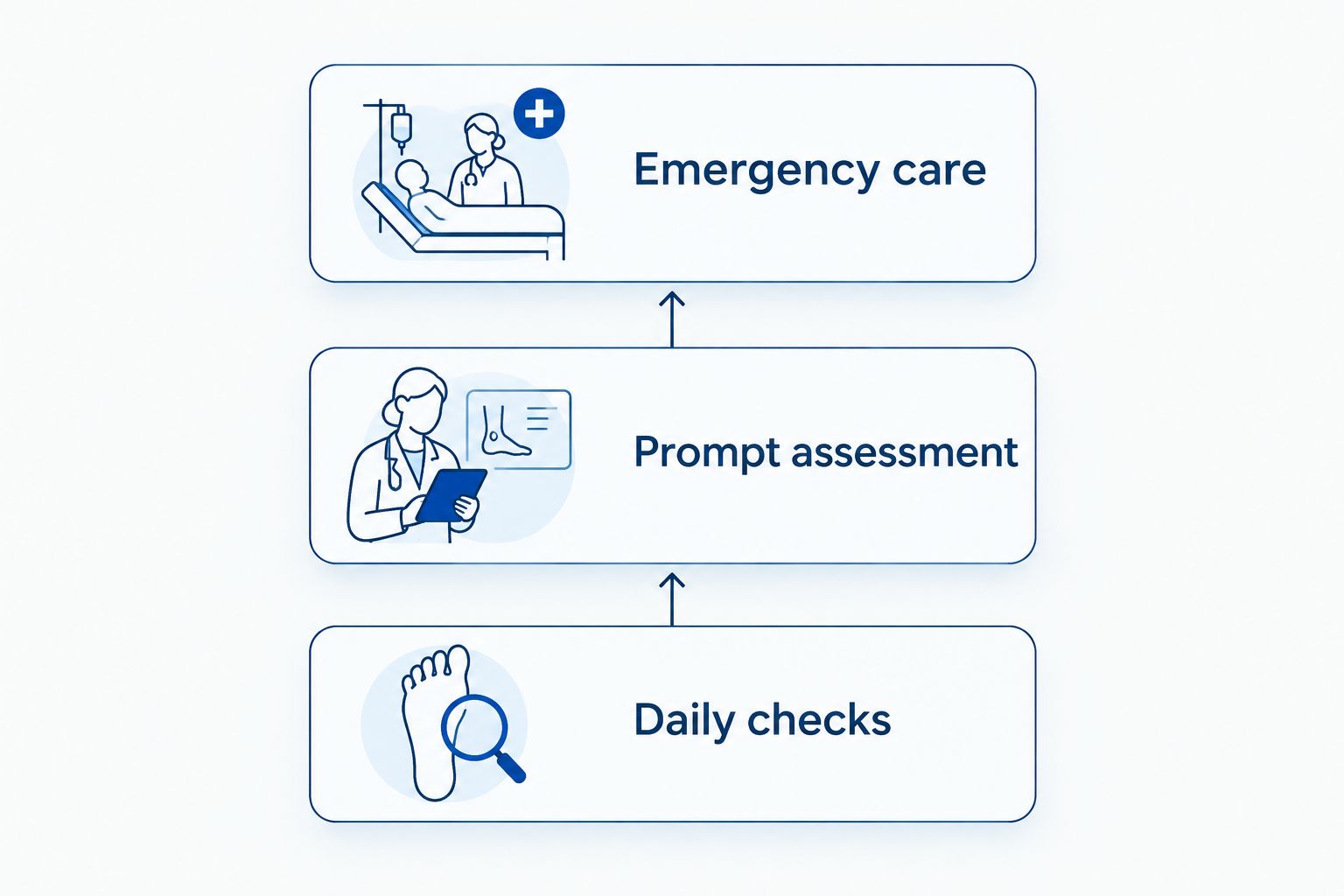
For your 2026 care plan, confirm how to obtain urgent advice when the usual office is closed. Seek emergency care for serious symptoms rather than waiting for a routine appointment. If you are unsure how urgent a new change is, contact a medical professional promptly.
- Name a helper for checks you cannot complete safely.
- Keep your care team's contact information accessible.
- Record new skin changes and when they started.
- Confirm instructions for evenings and weekends.
- Make transportation part of the appointment plan.
Compare your foot-care options
Use home care for prevention and clinical care for assessment. These options work together; none makes the others unnecessary. The right choice depends on the condition of your skin, sensation, circulation, and ability to care for your feet safely.
| Option | Best for | Main benefit | Key limitation |
|---|---|---|---|
| Independent daily care | Seniors who can see and reach their feet safely | Makes skin changes easier to notice | Cannot assess circulation or diagnose a wound |
| Helper-assisted daily care | Seniors with vision, mobility, or balance limitations | Supports checks that would otherwise be missed | Requires consistent help and clear instructions |
| Diabetes clinician assessment | Coordinating diabetes management and foot-risk review | Connects foot findings with your overall treatment plan | Some problems require additional specialist care |
| Podiatry evaluation | Numbness, nail problems, deformity, wounds, or unsafe self-care | Addresses foot-specific diagnosis and treatment | Does not replace daily checks or diabetes management |
| Urgent or emergency assessment | New wounds or serious warning signs | Prioritizes time-sensitive problems | Is not a substitute for scheduled preventive care |
Achilles Foot and Ankle Center provides podiatry care, including diabetic foot care and wound care. Daily observation still belongs in your routine between visits.
Arrange a diabetic foot evaluation
Discuss foot changes, wound concerns, or daily care that has become difficult to manage safely.
Common mistakes seniors make with diabetic foot care
For your 2026 routine, remove these habits before adding more products. Prevention depends on noticing changes and choosing a safe response.
- Waiting for pain. Neuropathy can make an injury painless. Inspect your skin even when your feet feel comfortable.
- Trimming by touch when eyesight is limited. Ask for help or professional nail care instead of cutting where you cannot see clearly.
- Treating a callus as a cosmetic problem. Pressure beneath a callus needs attention; blades and acid-based removers can damage surrounding skin.
- Buying compression without a circulation assessment. Swelling and neuropathy do not automatically make compression appropriate.
- Walking through a new blister or swollen foot. Reduce pressure and seek advice instead of waiting for the shoe to soften or the swelling to settle.
FAQ
What’s the best daily routine for diabetic foot care for seniors?
Check both feet daily, wash gently, dry between the toes, and wear protective footwear. Add help for tasks you cannot complete safely and follow the examination schedule your clinician recommends.
How often should a senior with diabetes have a foot examination?
A senior with diabetes needs a comprehensive foot evaluation at least annually. Sensory loss, previous ulcers, amputation, or other risk factors require closer follow-up; your clinician sets the interval.
Can I have a diabetic foot wound without feeling pain?
Yes, diabetic neuropathy can reduce sensation enough that a wound does not hurt. Check your feet visually and seek prompt advice for a new break in the skin.
Should I cut my own toenails if I have diabetes?
Home trimming is appropriate only when you can do it safely and your clinician has not advised against it. Poor vision, reduced sensation, poor circulation, thick nails, or previous wounds are reasons to ask about professional nail care.
Are compression socks safe for seniors with diabetic neuropathy?
Compression socks are not appropriate for every senior with diabetic neuropathy. Ask a clinician to assess circulation and explain whether compression is suitable before choosing a pair.
When does a diabetic foot problem need urgent care?
A new wound, drainage, or a hot, red, swollen foot needs prompt medical assessment. Rapidly spreading redness with fever, blackened tissue, or a suddenly cold, pale foot requires emergency care.
What can I do if I cannot reach the bottoms of my feet?
Use a mirror while seated or ask a trusted helper to inspect your feet. Do not risk a fall to complete the check; arrange clinical help for nail care or other tasks you cannot perform safely.
One last thing
A painless foot is not necessarily a healthy foot. The most useful addition to your 2026 routine is a reliable way to see the soles of your feet every day. If you cannot do that independently, arranging help is part of treatment—not a failure of self-care.
Related guides