Best overall: seamless, nonbinding socks that manage moisture. Best for sensitive soles: lightly cushioned socks. Best for a roomy fit: extra-wide socks. This 2026 guide compares the best diabetic socks for neuropathy by construction and fit, rather than assuming a “diabetic” label makes a sock suitable for your feet.
- The best diabetic socks for neuropathy have smooth interiors, nonbinding cuffs, and a fit that stays put.
- Choose light cushioning for sensitive soles only when your shoes have enough room.
- Extra-wide socks suit fuller feet; compression socks require a separate clinical decision.
- Achilles Foot and Ankle Center provides diabetic foot care; socks do not replace an evaluation for numbness or wounds.
Why this matters
Diabetic neuropathy means nerve damage associated with diabetes. When it reduces sensation in your feet, you can miss rubbing, a blister, or pressure from a tight sock. Comfort alone does not prove that a sock fits safely.
The CDC’s diabetes foot-care guidance emphasizes daily inspection, properly fitting footwear, and prompt attention to foot problems. Socks support that routine; they do not restore sensation, heal an ulcer, or treat the cause of neuropathy.
Achilles Foot and Ankle Center provides diabetic foot care for patients who need an evaluation of numbness, skin changes, or wounds. Patients in Mechanicsville and the West End can explore Achilles Foot and Ankle Center before choosing their next step.
What makes the best diabetic socks for neuropathy?
For your 2026 shortlist, judge the actual construction—not the wording on the package:
- Smooth interior: Check the toe area and inside surface for raised seams, rough stitching, or loose threads.
- Nonbinding cuff: The top should stay up without leaving a tight band around your leg.
- Moisture management: Choose fabric that helps move moisture away from your skin, and replace damp socks.
- Stable fit: The heel should sit correctly, with no folds under your toes or arch.
- Shoe compatibility: Padding must fit inside your shoes without squeezing your toes.
- Inspectability: Light-colored fabric makes drainage or blood easier to notice, although you still need to inspect your skin.
“Seamless” does not always mean that every interior surface is smooth. Turn the sock inside out and feel the toe area with your fingers. A soft-looking sock can still have a prominent seam.
Best diabetic socks for neuropathy at a glance
These are ranked sock designs, not tested product brands. Features can overlap: an extra-wide sock can also have a smooth toe and a light-colored interior. Start with the design that addresses your main fit problem, then apply the criteria above.
| Rank and sock design | Best for | Standout feature to check | Key limitation |
|---|---|---|---|
| 1. Seamless, nonbinding socks | Everyday wear | Smooth toe area and a cuff that does not constrict | The label does not establish the fit |
| 2. Lightly cushioned socks | Sensitive soles | Modest padding without bulky folds | Padding takes up shoe space |
| 3. Extra-wide socks | Fuller feet or calves | More room without stretching the cuff tightly | Excess fabric can bunch |
| 4. Thin moisture-managing socks | Sweaty feet in well-fitting shoes | Low bulk and fabric that moves moisture | Minimal cushioning |
| 5. Light-colored socks | Easier spotting of drainage | A pale interior that shows stains | Color does not prevent injuries |
| 6. Clinician-recommended compression socks | Swelling with a prescribed plan | A specified compression level and measured fit | Not an automatic choice for neuropathy |
1. Seamless, nonbinding socks: best for everyday neuropathy care
A smooth interior and a cuff that does not squeeze are the most useful starting features. These socks suit everyday wear when your shoes already fit well and you do not need additional padding or extra width.
Check the entire sock, not just its toe. Fabric can fold beneath your foot even when the toe construction is smooth.
Seamless, nonbinding socks pros:
- Reduce exposure to prominent toe seams.
- Avoid a deliberately tight cuff when correctly fitted.
- Work as a starting point for different footwear needs.
Seamless, nonbinding socks cons:
- “Diabetic” and “nonbinding” labels do not guarantee suitability.
- An overly loose sock can slip or bunch.
Best for: Your default daily pair when there is no separate swelling or shoe-fit concern.
Verdict: Buy a pair that passes an interior check and fits smoothly inside your shoes. Do not choose by softness alone.
2. Lightly cushioned socks: best for sensitive soles
Light cushioning adds a soft layer beneath the foot. It is an option when thin socks feel uncomfortable, provided the added material does not crowd your shoes.
More padding is not automatically better. If your toes lose room or the shoe upper presses against your foot, the sock-and-shoe combination needs changing.
Lightly cushioned socks pros:
- Add softness beneath the sole.
- Offer an alternative to very thin everyday socks.
- Combine with smooth-toe construction when both features are present.
Lightly cushioned socks cons:
- Take up space inside your shoes.
- Do not remove the need to evaluate a painful pressure point.
Best for: Sensitive soles in shoes with enough internal room for modest padding.
Verdict: Buy only after checking the sock inside your usual footwear. Skip thick padding if it makes the shoe tighter.
3. Extra-wide socks: best for fuller feet or calves
Extra-wide socks provide more room through the foot, calf, or both, depending on their construction. They are a better starting point than stretching a standard sock until it feels tight.
Width and length are different. A longer sock size can leave excess fabric at the toes without solving a tight calf opening. Look for dimensions that address where your current socks actually bind.
Extra-wide socks pros:
- Provide room without relying on a tightly stretched cuff.
- Address width separately from foot length.
- Allow a smoother fit for fuller feet when correctly sized.
Extra-wide socks cons:
- Excess width can create folds inside shoes.
- New or increasing swelling needs assessment, not just a larger sock.
Best for: Fuller feet or calves when standard socks leave constricting marks.
Verdict: Buy for an identified fit need. Hold if swelling is new, unexplained, or increasing, and arrange an evaluation.
4. Thin moisture-managing socks: best for sweaty feet
Thin socks made to move moisture away from the skin are useful when bulky socks crowd otherwise well-fitting shoes. Read the fabric and construction information rather than assuming one fiber suits everyone.
A moisture-managing sock still needs changing when damp. Keeping the same wet pair on defeats the purpose of choosing it.
Thin moisture-managing socks pros:
- Add less bulk inside your shoes.
- Prioritize moisture movement during daily wear.
- Make it easier to preserve an existing shoe fit.
Thin moisture-managing socks cons:
- Offer little padding beneath sensitive areas.
- Moisture-management claims do not eliminate the need for sock changes.
Best for: Sweaty feet when your shoes fit correctly and extra cushioning is unnecessary.
Verdict: Buy if the interior is smooth and the cuff does not bind. Skip a pair that stays damp against your skin.
5. Light-colored socks: best for spotting drainage
White or other light-colored socks make blood or drainage easier to notice than dark fabric. That is useful when reduced sensation prevents an injury from announcing itself through pain.
Treat color as an inspection aid, not a protective feature. A pale sock with rough seams or a tight cuff is still a poor choice.
Light-colored socks pros:
- Make visible staining easier to spot.
- Add an inspection cue when you remove your shoes.
- Combine with nonbinding, smooth-interior designs.
Light-colored socks cons:
- Cannot reveal every injury or pressure area.
- Do not replace inspection of the skin itself.
Best for: A daily routine that includes checking both feet and the socks you remove.
Verdict: Buy when the fit and construction also meet your needs. Treat unexplained drainage as a reason for prompt medical attention.
6. Clinician-recommended compression socks: best for prescribed swelling care
Compression socks apply pressure to the leg and are a separate category from ordinary nonbinding diabetic socks. They are not the default answer to numbness, burning, or tingling.
A clinician needs to consider the reason for swelling, circulation, skin condition, and appropriate fit before recommending compression. Reduced sensation makes it especially important not to judge compression safety by whether it feels comfortable.
Clinician-recommended compression socks pros:
- Fit a defined swelling-management plan when prescribed.
- Provide a specified pressure rather than an ordinary loose cuff.
- Allow fit and skin checks to form part of supervised care.
Clinician-recommended compression socks cons:
- Are unsuitable for some circulation problems.
- Require a clinical decision about pressure and sizing.
Best for: People whose clinician has recommended compression after evaluating their feet and legs.
Verdict: Hold until you have that recommendation. Skip self-selected compression as a treatment for neuropathy.
How we ranked these sock designs
The 2026 ranking prioritizes smooth contact with the skin, a nonbinding fit, moisture management, and compatibility with shoes. Everyday nonbinding socks come first because they address the basic fit checks without adding a separate treatment decision.
The remaining designs solve narrower problems: sensitive soles, fuller feet, moisture, or visibility of drainage. Compression comes last because it requires an individualized clinical recommendation. This is a feature-based buying guide, not a claim of product testing or medical superiority.
Check the fit before making a sock your daily pair
Use this 2026 fit check with the shoes you actually wear. Inspect with your eyes and hands rather than relying only on sensation.
- Check inside: Turn the sock inside out and feel for seams, rough areas, and loose threads.
- Smooth fabric: Position the heel correctly and remove folds beneath the toes and arch.
- Check shoes: Put on your usual footwear and confirm that the sock does not crowd your toes.
- Inspect skin: After removing the sock, look for redness, rubbing, or a constricting cuff mark.
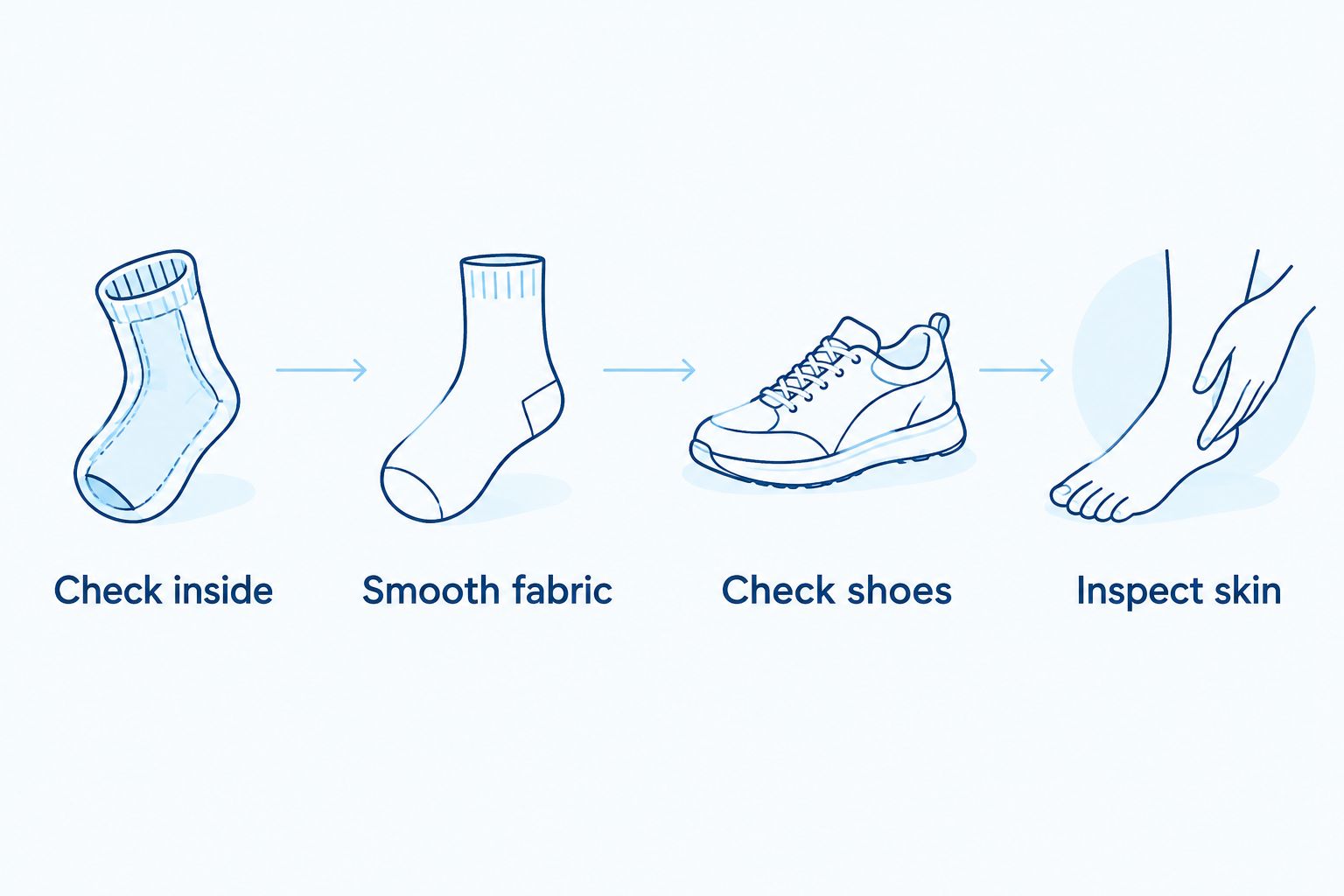
Do not keep wearing a pair that leaves persistent redness or rubs your skin. If you cannot clearly see the bottoms of your feet, use a mirror or ask someone to help. Reduced sensation can hide a problem that is visible during inspection.
Build a daily routine around the socks
Start with 1 clean pair each day, and change again whenever the socks become damp or soiled. Complete 1 foot inspection each day, checking both feet, including the soles and between the toes. These are routine actions, not a guarantee against complications.
Follow these habits alongside your sock choice:
- Wear well-fitting shoes rather than walking barefoot, including indoors.
- Check inside shoes for grit, foreign objects, or rough areas before putting them on.
- Wash your feet and dry carefully between the toes.
- Keep socks smooth instead of rolling the cuffs into tight bands.
- Avoid heating pads and hot-water bottles against feet with reduced sensation.
When socks are not the next step
Arrange an evaluation for persistent numbness, burning, tingling, repeated rubbing, or a change in foot shape. A sock purchase should not delay assessment of symptoms you have not discussed with a clinician.
Seek prompt medical attention for an open sore, drainage, spreading redness, or a newly warm, swollen foot—even without pain. Fever, rapidly worsening redness, or a foot that suddenly becomes cold or discolored requires urgent care.
Achilles Foot and Ankle Center offers diabetic foot care, wound care, and nerve-pain evaluation. For patients in Mechanicsville and the West End, the next useful step is an appropriate examination, not repeated purchases aimed at covering up symptoms.
Which diabetic socks should you choose?
Choose seamless, nonbinding socks as your 2026 default, then adjust for the fit problem you actually have. Add light cushioning only when your shoes have room. Choose extra width for a fuller foot or calf, and prioritize moisture management when socks become damp.
A light-colored interior is a useful addition to any suitable design. Compression belongs in a clinician-directed plan, not in a trial-and-error search for neuropathy relief.
FAQ
What are the best diabetic socks for neuropathy in 2026?
The best starting choice is a smooth-interior, nonbinding sock that fits without folds and helps manage moisture. Choose padding or extra width only when those features address your foot and shoe fit.
Can diabetic socks cure neuropathy?
Diabetic socks do not cure neuropathy or restore lost sensation. Their role is to support a suitable fit and daily foot-care routine while the underlying condition receives appropriate medical care.
Are compression socks better than diabetic socks?
Compression socks are not automatically better for diabetic neuropathy. They apply pressure and require a separate decision about circulation, swelling, skin condition, and sizing.
Should diabetic socks be tight or loose?
Diabetic socks should stay in place without constricting your foot or leg. Avoid both tight cuffs and loose fabric that bunches inside your shoes.
Is cotton the best fabric for diabetic socks?
Cotton is not automatically the best choice for every foot. Evaluate the finished sock for moisture management, interior smoothness, fit, and how it works inside your shoes.
Should I wear thick socks if my feet feel numb?
Thick socks are not automatically appropriate for numb feet. Added bulk can crowd your shoes, and numbness means you cannot rely on discomfort to warn you about pressure.
Can I wear ordinary socks if I have diabetes?
An ordinary sock can meet your needs if its interior is smooth, its cuff does not bind, and it fits correctly. The diabetic label alone is not proof that a sock is suitable.
When should I see a podiatrist instead of buying new socks?
Seek an evaluation for persistent numbness, repeated rubbing, skin changes, or swelling. An open sore, drainage, spreading redness, or a newly warm and swollen foot needs prompt medical attention.
One last thing
Inspect the pair you take off, not just the pair you put on. A stain, worn patch, or repeated fold can tell you where to look more closely at your skin and footwear. Bring the socks and shoes that cause problems to your evaluation at Achilles Foot and Ankle Center so you can discuss the actual fit.
Related guides