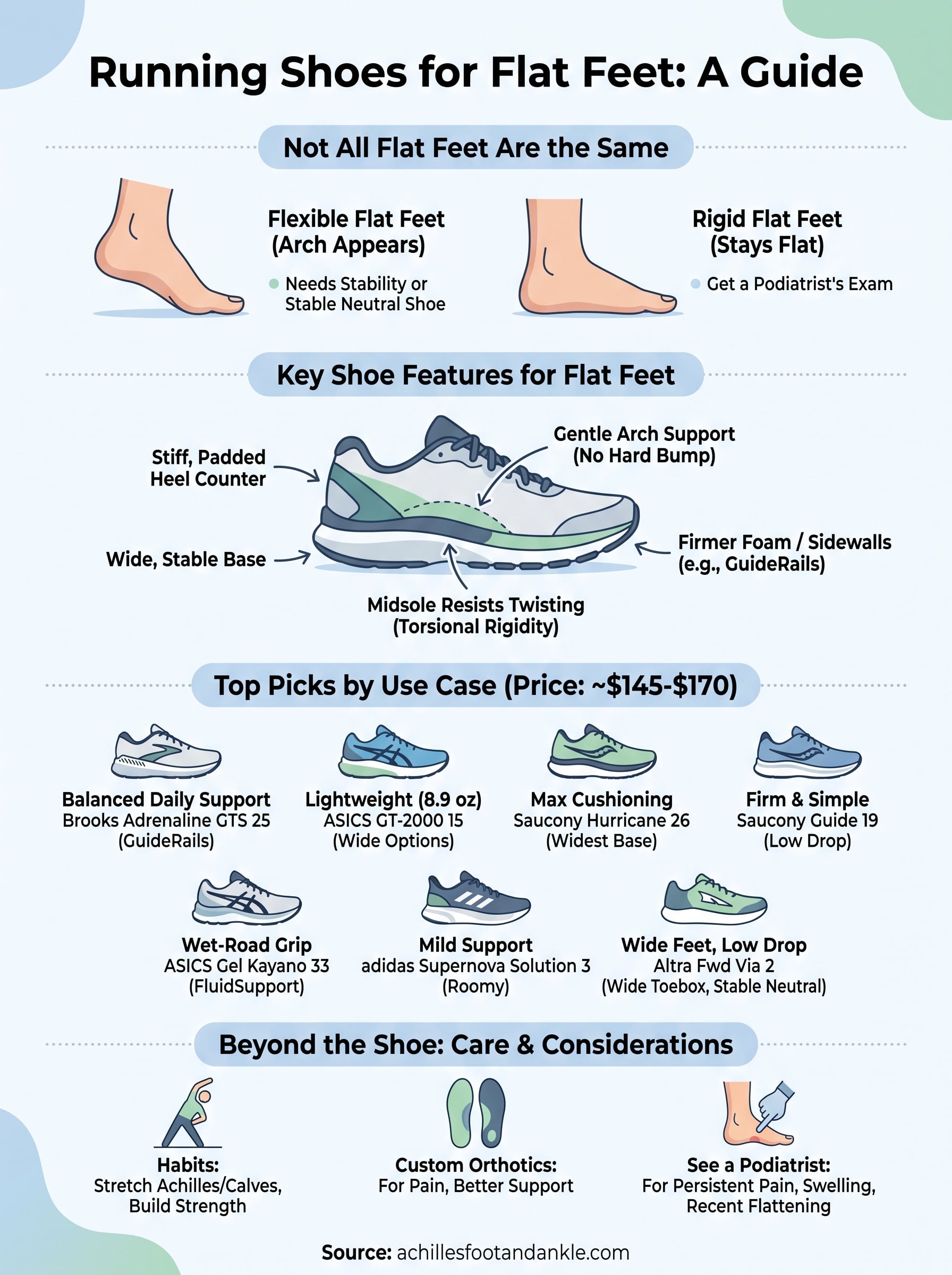
The best running shoes for flat feet have a wide, stable platform, a firm heel counter, and a midsole that resists twisting, without a hard bump under the arch. For most runners that means a stability trainer. The Brooks Adrenaline GTS 25 is the safest all-round pick. The ASICS GT-2000 15 suits runners who want a light shoe, and the Saucony Hurricane 26 suits those who want max cushioning. The Altra Fwd Via 2 suits wide feet that need room more than correction.
The trouble is that "flat feet" covers very different feet. Some runners overpronate and need guidance. Others have flexible arches that never roll in much and do fine in a stable neutral shoe. This guide ranks seven shoes with real specs and list prices, then shows how to choose features for your pronation, width, and gender.
Our podiatry team at Achilles Foot & Ankle treats flatfoot and heel and arch pain, so you also get a plain guide to when a better shoe is not enough.
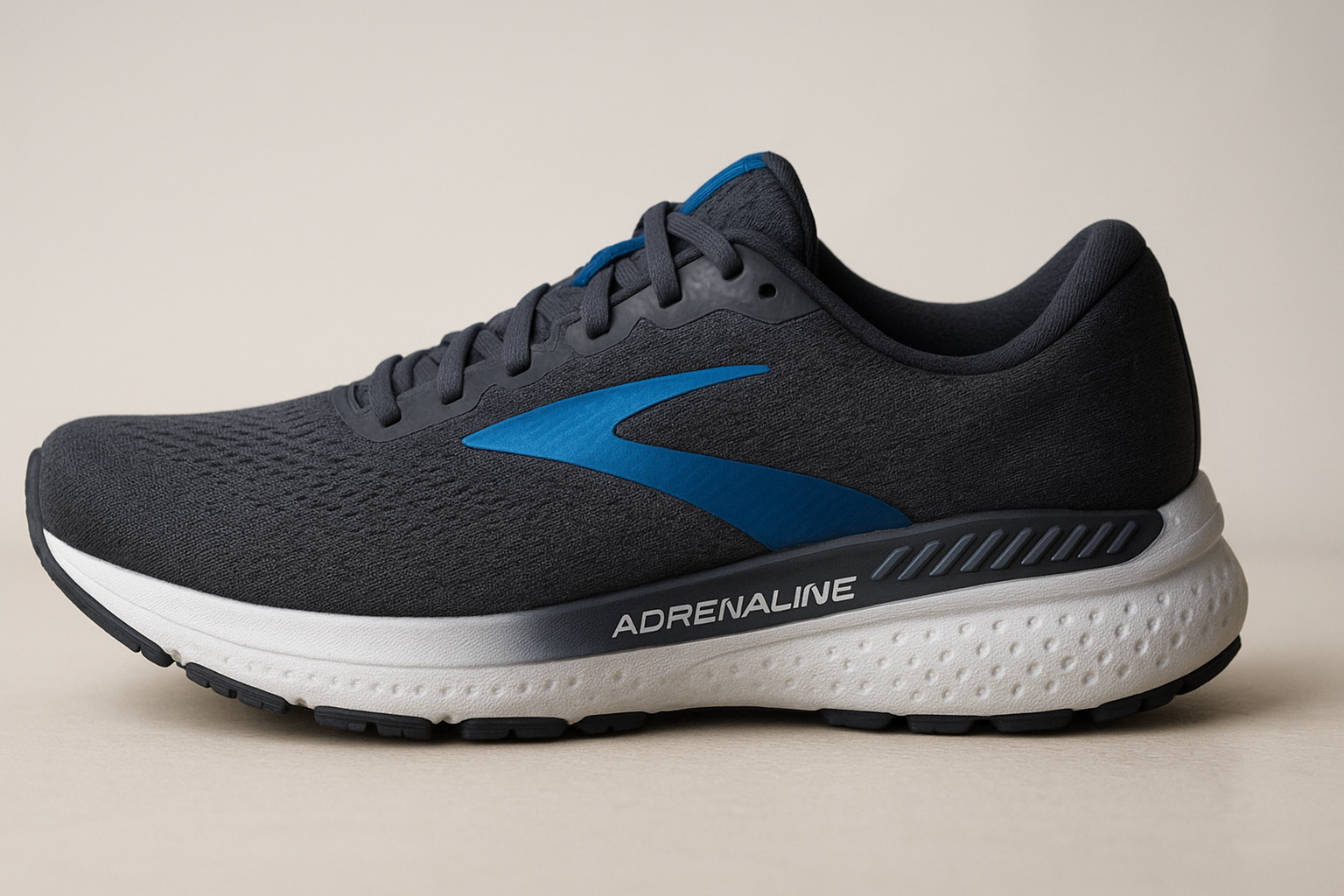
1. Brooks Adrenaline GTS 25: best daily stability trainer
The Brooks Adrenaline GTS 25 is the best first shoe to try if you have flat feet and overpronate. It gives steady, unobtrusive support at a fair price.
How it supports flat feet
The shoe uses Brooks’ GuideRails, strips of dense foam along the inner and outer sides that act like bumpers. They keep your knee and ankle lined up when your arch collapses inward, and they do it without a hard post under the arch. The base is wide, about 100.7 mm at the heel, so your foot lands on a real platform.
Cushioning comes from DNA Loft v3 foam, which feels plush rather than harsh. Testers who overpronate with flat arches reported steady support late into a 14-mile run and no blisters from foot slide.
If you want one safe starting point, try the Adrenaline GTS 25 first.
Specs and price
Here are the numbers that matter before you buy.
- Weight: about 10.4 to 10.6 oz (295 to 300 g) in men’s, 9.8 oz in women’s size 8
- Drop: 10 mm
- Stability system: GuideRails
- List price: roughly $145 to $155, often discounted
Who it suits
This shoe suits daily trainers, heel strikers, and overpronators who run mixed mileage, from a 5K to a long Sunday run.
Skip it if you want a light shoe for speed work, because it is on the heavy side. A few testers also wanted longer laces.
2. ASICS GT-2000 15: best lightweight stability shoe
The ASICS GT-2000 15 is the pick when you want real stability without a bulky shoe. It is one of the lightest stability trainers you can buy.
How it supports flat feet
ASICS builds support around its 3D Guidance System, and a stiff heel counter holds your heel in place. The base is slightly wide, about 117.2 mm in the forefoot and 95.7 mm at the heel. Despite the support, the stack is tall, around 38.2 mm at the heel, and the shock absorption is among the best of any stability shoe.
The medial side is firm and feels like a well-integrated post. That helps flat feet that collapse at the midfoot, and it makes the shoe easy to turn over at faster paces.
A flat-feet shoe does not have to weigh 10 ounces to hold you up.
Specs and price
This is the lightest of the seven.
- Weight: 8.9 oz (252 g), below the roughly 9.2 oz average for neutral and stability shoes
- Heel counter stiffness: 4 out of 5
- Widths: D, 2E, and 4E
- List price: $150
Who it suits
It suits runners who want a stability shoe for tempo days and workouts up to about 10K, as well as everyday mileage. The firm ride is a real plus if you dislike mushy foam.
The toebox is snug, so broad forefeet should try the 2E or 4E widths. Runners who love soft, max-cushioned shoes may find it too firm.
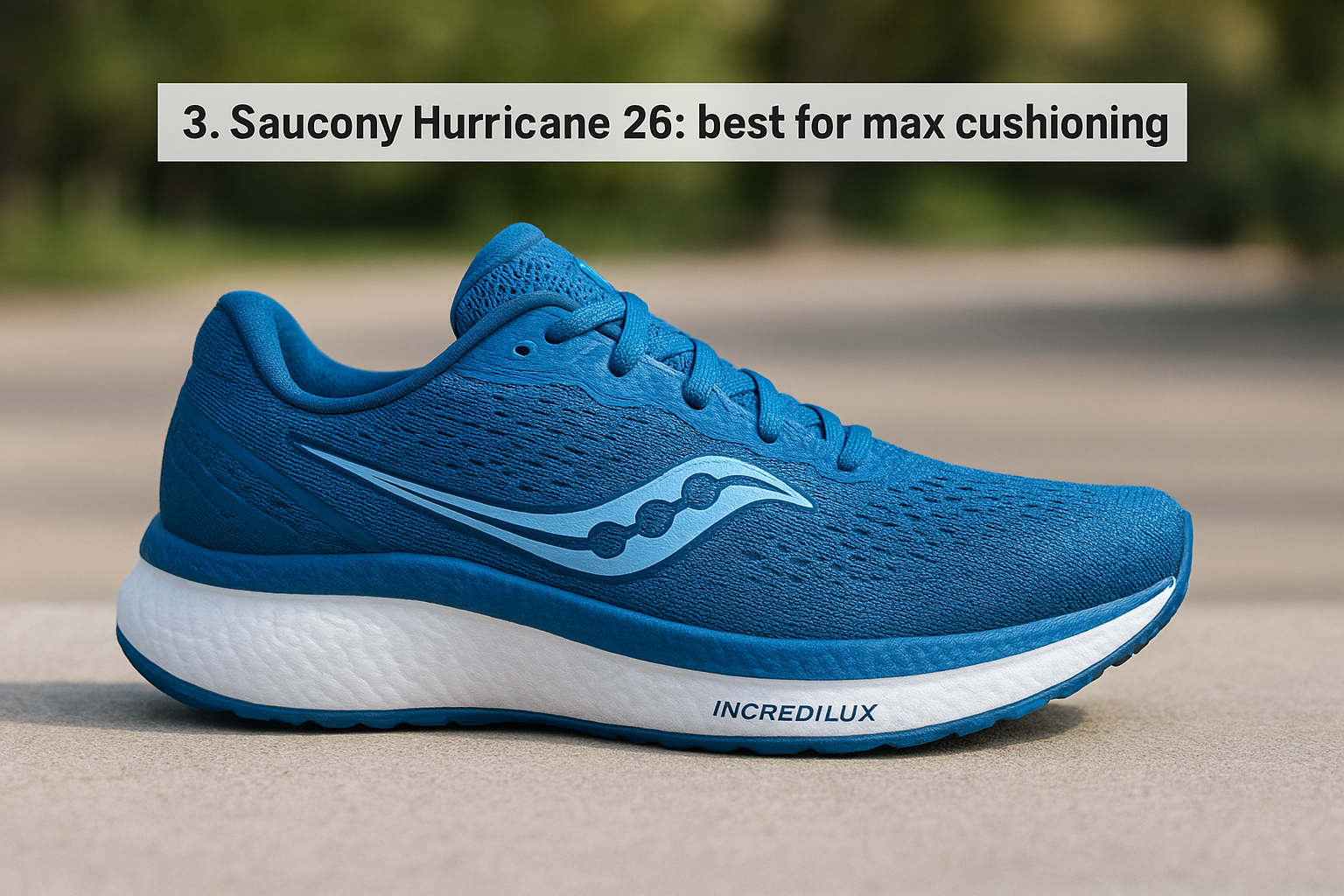
3. Saucony Hurricane 26: best for max cushioning
The Saucony Hurricane 26 is the best choice for flat-footed runners who want a plush, protective ride for long runs. It is a cushioned stability shoe with a very wide base.
How it supports flat feet
Saucony’s CenterPath technology pairs higher sidewalls with a broad platform to keep your foot centered. A dual-density PWRRUN frame adds firmer foam where you need it. The base is huge: about 129.8 mm across the forefoot and 112.3 mm at the heel, the widest in this list.
The new incrediLUX top layer makes the shoe bouncy as well as soft. The firmer density on the inner side gives noticeable support without the irritating push that a rigid post can have on a low arch.
When you want maximum cushioning and a stable base, the Hurricane 26 is the shoe.
Specs and price
The numbers show why it feels so protective.
- Weight: 9.6 oz (272 g)
- Stack height: about 38.3 mm heel, 32.4 mm forefoot
- Stability system: CenterPath with a dual-density frame
- List price: $170
Who it suits
It suits marathon training, long runs, and heavier runners who want impact protection under flat feet. It handles a lot of miles without leaving your legs beaten up.
The oversized platform feels bulky if you like an agile, close-to-the-ground ride. The price is also the highest here, so check for sales.
4. Saucony Guide 19: best firm, simple stability
The Saucony Guide 19 is a no-frills stability trainer that handles daily miles reliably. It costs less than most shoes in this list, and the support is mild.
How it supports flat feet
The Guide 19 uses the same CenterPath idea as the Hurricane, with higher sidewalls and a broader base that calm erratic foot motion. The foam is PWRRUN, a proprietary EVA blend, and it sits on the firmer side. That firmness is the point for many flat feet, because a stiffer platform asks your arch to do less work.
A slight rocker helps your stride roll forward smoothly. The fit is locked in and comfortable, with several width options.
The Guide 19 proves that good support for flat feet does not need to be flashy.
Specs and price
This shoe sits in the middle on weight and has the lowest drop of the group.
- Weight: 9.7 oz in men’s, 8.9 oz in women’s
- Drop: 6 mm
- Widths: multiple
- List price: $150
Who it suits
It suits mild to moderate overpronators and runners who want an honest daily trainer without bouncy gimmicks. The firm feel works well for steady mileage.
It is not the shoe for a pillowy ride, and some testers found the toe area slightly long. If you want more cushion, move up to the Hurricane 26.
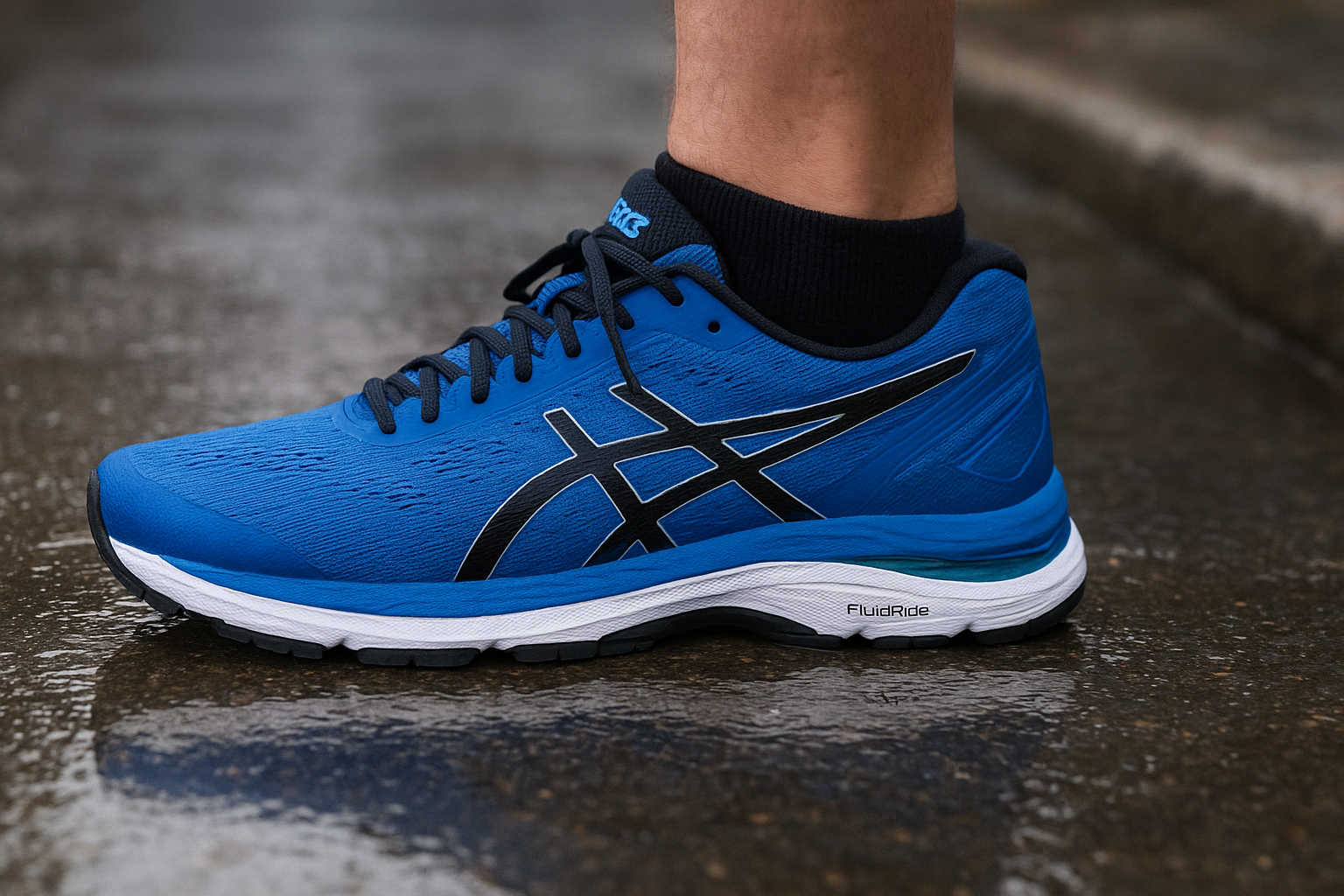
5. ASICS Gel Kayano 33: best for wet-road traction
The ASICS Gel Kayano 33 is the pick for flat-footed runners who run in all weather. It combines stable support with some of the best grip in this group.
How it supports flat feet
The FluidSupport system puts firmer foam under the arch to reinforce it as you pronate, and tall sidewalls resist twisting. The platform is broad, about 120.7 mm at the forefoot and 97.1 mm at the heel. This is also the softest Kayano yet, so the support feels natural rather than corrective.
The Hybrid ASICSGRIP outsole recorded a wet friction coefficient of 0.93, which is about 80% grippier than average in lab testing. That matters on slick sidewalks and painted crosswalks.
If you run in rain and need support, the Kayano 33 gives you both.
Specs and price
The Kayano trades some weight for support.
- Weight: 10.5 oz (298 g)
- Stack height: about 36.8 mm heel, 28.3 mm forefoot
- Stability system: FluidSupport
- List price: $170
Who it suits
It suits easy miles, recovery runs, and wet-weather running for mild to moderate pronation. The ride is smooth and comfortable.
The energy return is low and the shoe feels heavy, so it is not for speed. Extreme overpronators may find it less stable than a motion control shoe, and that is worth a conversation with a podiatrist.
6. adidas Supernova Solution 3: best for mild support
The adidas Supernova Solution 3 is the best pick when your flat feet need only a light touch. It sits between a stability shoe and a neutral trainer.
How it supports flat feet
adidas calls its approach the Guide Your Ride system, and it creates a centered ride without a rigid feel. Torsional rigidity is 4 out of 5, so the shoe resists twisting, yet it bends easily at the forefoot. The bend test showed a near-average 15.2 N.
Grip is the standout. The LIGHTTRAXION outsole scored 0.77 in traction testing, about 48% grippier than average. The fit is roomy, and the shoe feels fine for neutral runners too.
Light support is enough for plenty of flat feet, and this shoe delivers exactly that.
Specs and price
Here is what the lab and listings show.
- Midsole width: about 114.7 mm forefoot, 91.1 mm heel
- Torsional rigidity: 4 out of 5
- Stability system: Guide Your Ride
- List price: $150, with frequent discounts
Who it suits
It suits flexible flat feet with mild pronation and runners who find classic stability shoes too stiff. It is a good everyday option.
Energy return is low, so it will not excite you on tempo runs. Ventilation is poor, and the shoe is a bit heavy, which matters in hot weather.
7. Altra Fwd Via 2: best for wide feet and low drop
The Altra Fwd Via 2 is the pick when your flat feet are wide and you need room more than correction. It is the least corrective shoe here, and that is intentional.
How it supports flat feet
Altra’s wide toebox lets your toes splay, which helps your foot stay stable on landing. The midsole is thick, with Ego P35 foam reaching 37 mm at the heel, so your arch does not feel unsupported even at a low drop. A slight rocker shape promotes a smooth roll.
The 4 mm drop is low but not zero, so you can ease into this type of shoe without a big jump from a typical trainer.
Flat feet that overpronate little may do best with a wide, stable shoe rather than a corrective one.
Specs and price
The numbers show a roomy, cushioned shoe.
- Weight: 10.6 oz in men’s, 8.7 oz in women’s
- Drop: 4 mm
- Midsole: Ego P35 foam, 37 mm at the heel
- List price: $165
Who it suits
It suits wide or high-volume feet, runners with minimal overpronation, and anyone curious about a lower drop. Many runners in this group are comfortable in neutral shoes.
It is too wide for narrow feet. If you overpronate noticeably, choose one of the stability shoes above instead.
Running shoes for flat feet compared side by side
All seven shoes list between $145 and $170, so price rarely decides the pick. Support type and fit do. The table puts the key differences in one place.
The seven picks compared
Check the current price before you buy, because retailers discount often and models update every year.
| Shoe | Support system | Standout trait | List price |
|---|---|---|---|
| Brooks Adrenaline GTS 25 | GuideRails | Balanced daily support | $145 to $155 |
| ASICS GT-2000 15 | 3D Guidance System | 8.9 oz, widths up to 4E | $150 |
| Saucony Hurricane 26 | CenterPath, dual-density frame | Widest base, max cushion | $170 |
| Saucony Guide 19 | CenterPath | Firm and simple | $150 |
| ASICS Gel Kayano 33 | FluidSupport | Wet-road grip | $170 |
| adidas Supernova Solution 3 | Guide Your Ride | Light support, roomy fit | $150 |
| Altra Fwd Via 2 | Stable neutral, wide toebox | Wide fit, 4 mm drop | $165 |
Matching a shoe to your situation
Use this list to narrow the seven picks quickly.
- Moderate overpronation, daily miles: Adrenaline GTS 25
- Speed days and light weight: GT-2000 15
- Long runs and heavy cushioning: Hurricane 26
- Firm feel and a simple design: Guide 19
- Rain and slick roads: Gel Kayano 33
- Mild pronation, flexible feet: Supernova Solution 3
- Wide feet, little overpronation: Fwd Via 2
How to choose running shoes for flat feet
Choose by your foot type first, then by stability level, then by a short feature checklist. Fit decides the final call, and no spec can replace trying a pair on.
Know which flat foot you have
Flexible and rigid flat feet need different shoes. Stand on your tiptoes. If an arch appears, your feet are flexible. If the foot stays flat, it may be rigid, and that deserves an exam.
| Flexible flat feet | Rigid flat feet | |
|---|---|---|
| Arch when sitting or on tiptoes | Appears | Stays flat |
| Usual symptoms | Often painless | Often painful in daily life |
| Shoe approach | Stability or stable neutral | See a podiatrist first |
For a quick home check, wet your foot and stand on cardboard. A full footprint means a flat arch.
Arch support is not always the answer. A collapsed arch from muscle weakness can benefit from added support while you build strength. An anatomically flat foot can pass stress up to the knee if the arch support is too aggressive.
Stability shoe or stable neutral?
Stability shoes carry trademarked systems like GuideRails and suit moderate overpronation. Stable neutral shoes have a wide, stiffer base but no corrective technology, and they suit mild or no overpronation.
Not every flat-footed runner overpronates, so match the shoe to how your foot moves. Severe overpronation sometimes calls for a motion control shoe, such as the Brooks Beast, but get a professional opinion before going that far. Avoid soft, narrow, flexible shoes, because flex in the midfoot adds stress to the arch.
Features to check before you buy
Run through this list in the store or on the product page.
- Wide platform: more ground contact means more stability
- Stiff, padded heel counter: pinch the sides, and it should not collapse
- Torsional rigidity: twist the shoe, and it should resist
- Sidewalls or dual-density foam: firmer material on the inner side
- Midfoot stiffness: the shoe should bend at the ball of the foot, not the middle
- A gentle arch: support you barely notice, never a bump that pushes
Weight matters less than you might expect. Stability shoes average about 10 oz (285 g) against 9.3 oz (263 g) for neutral shoes, and the GT-2000 15 shows how light a supportive shoe can get.
Fit, width, and men’s versus women’s models
Fit is the final filter. Try shoes in the afternoon, when your feet are largest, and leave about a thumb’s width of space past your longest toe. If you have broad feet, look for multiple width options, such as the D, 2E, and 4E offered in the GT-2000 15.
Women’s versions are not just smaller. The Adrenaline GTS 25 weighs 9.8 oz in women’s size 8 against 10.6 oz in men’s size 9. Flat feet are also more common in women over 40, so women often benefit from trying a few widths. Other brands make stability trainers too, including the Nike Structure Plus, which is worth trying if Nike fits you best. Plan to replace any pair after roughly 300 to 500 miles.
Beyond the shoe: habits, orthotics, and when to get care
A good shoe helps, but it cannot fix every flat foot. Habits, orthotics, and a professional exam fill the gaps.
Habits that help flat-footed runners
Stretch your Achilles, calves, and hamstrings to reduce strain on your arches. Add simple foot-strengthening work, build mileage gradually, and rotate two pairs if you run often.
Strong feet and flexible calves reduce the load that flat arches carry.
Orthotics and what a podiatrist can add
If a stability shoe still leaves you sore, custom orthotics are the next step. Ours are prescription orthotic devices designed around your foot structure, and they use a 3D imaging system to improve support, comfort, balance, and pressure distribution. Most need a shoe with a removable insole and enough volume.
A podiatrist can also tell whether you have anatomically flat feet or a collapsing arch. Our practice performs x-rays, ultrasound, and fluoroscopy at the office, so the exam can happen in one visit.
Signs you should book an exam
Book an exam if you notice any of these.
- Pain on the inside of the foot or ankle, or on the outside of the ankle
- An arch that has flattened recently, or only on one foot
- A flat foot that stays flat when you stand on your tiptoes
- Heel pain or arch pain that lasts more than a couple of weeks
- Swelling along the inner ankle after runs
Those symptoms can point to adult flatfoot, which develops when the arch collapses in adulthood. A new pair of shoes will not fix it.
Pick one, then test it on a real run
Running shoes for flat feet come down to three choices: how much support your foot needs, how wide it is, and how the shoe feels after a mile. Start with the Brooks Adrenaline GTS 25 if you overpronate, the GT-2000 15 if you want light, and the Fwd Via 2 if width is your problem. Then run in them and trust your feet.
If you have pain, a flattening arch, or a shoe that still hurts after a fair trial, get checked. Our board-certified specialists can examine your feet and recommend the right shoe or orthotic. You can book a same-day podiatry exam online or by phone.