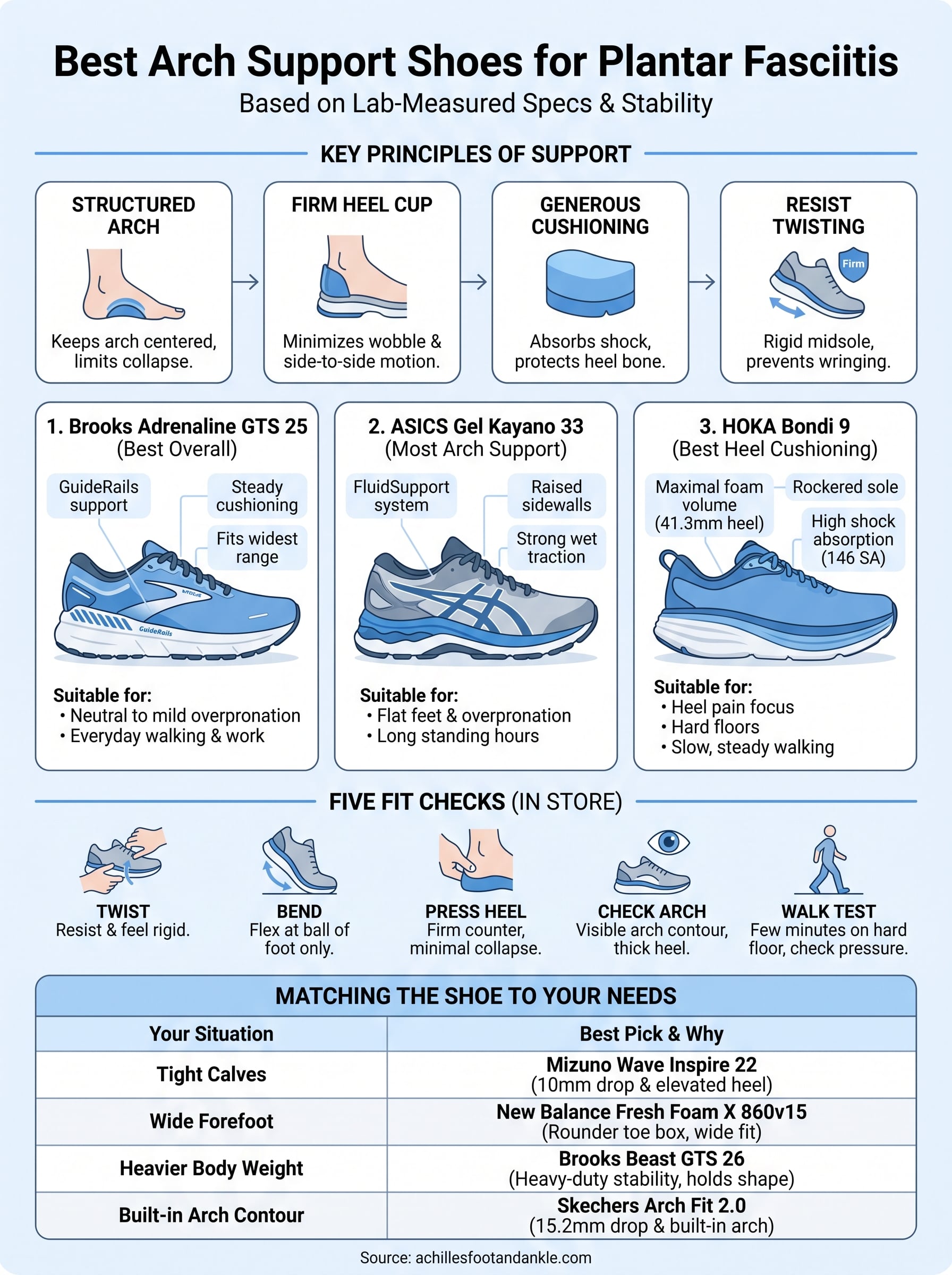
The best arch support shoes for plantar fasciitis combine a structured arch, a firm heel cup, generous heel cushioning, and a midsole that resists twisting. For most people, the Brooks Adrenaline GTS 25 is the safest first pick. The ASICS Gel Kayano 33 suits flat feet and overpronation. The HOKA Bondi 9 suits anyone who wants maximum heel cushioning. The Mizuno Wave Inspire 22 suits people who like a higher heel.
If you wake up with sharp heel pain, every shoe list online starts to look the same. Most are written to sell, and few explain why a shoe helps or who should skip it. Shoes will not cure plantar fasciitis on their own. But the wrong pair keeps irritating the tissue, and the right pair gives it room to settle.
This guide ranks seven shoes by arch and heel support, lab-measured shock absorption, and stability. For each one you get who it suits, where it falls short, and how to check the fit. At Achilles Foot and Ankle Center, our podiatrists treat heel and arch pain in the Richmond area, so the last section covers when to stop shopping and get your foot examined.
1. Brooks Adrenaline GTS 25: best overall
Key specs
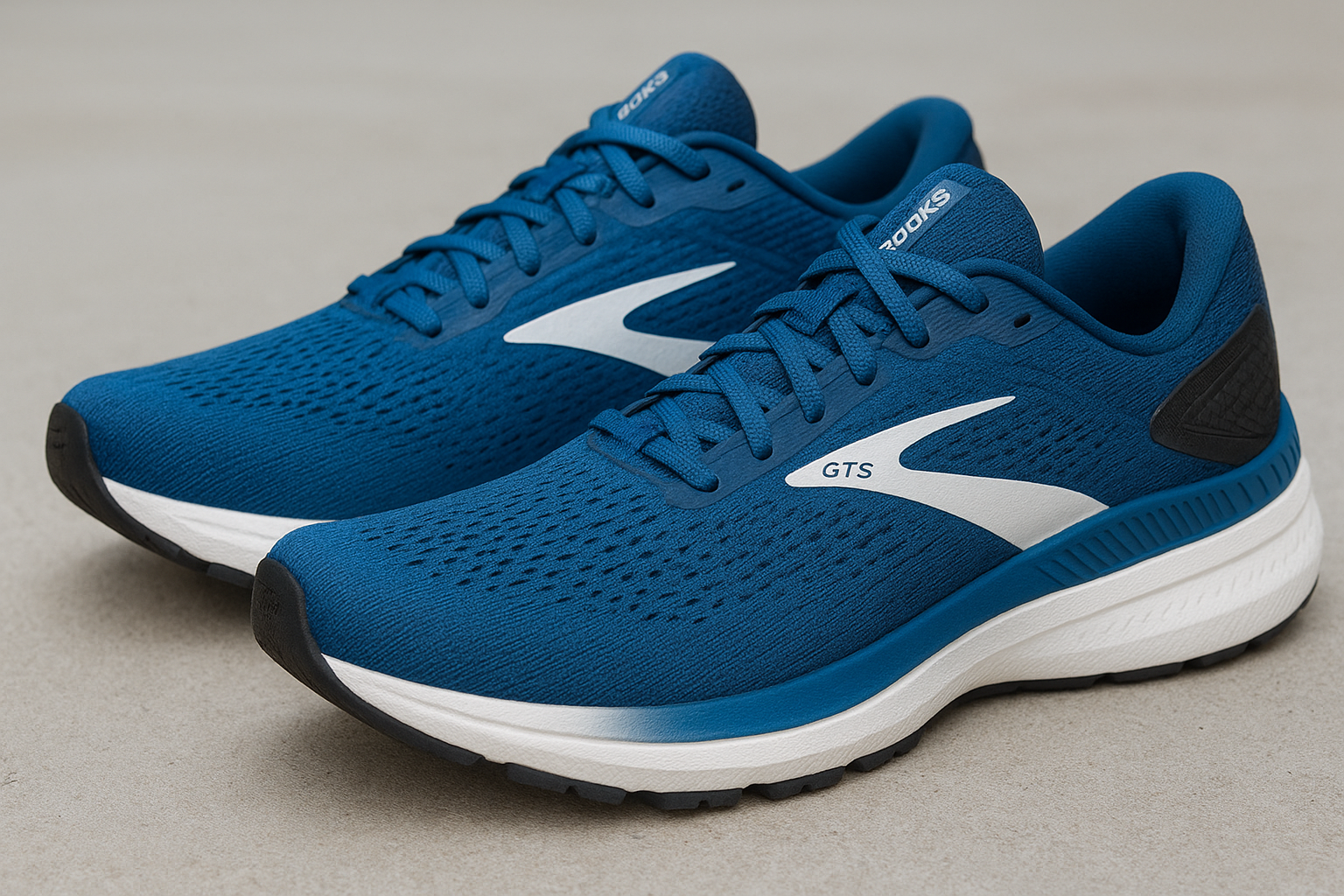
The Adrenaline GTS 25 is a stability shoe that builds its arch support into a frame around your whole foot. These are the numbers that matter for heel pain:
- Support system: GuideRails along both sides of the shoe
- Base width: 117.7 mm at the forefoot and 100.7 mm at the heel
- Flexibility: about 7% more flexible than the average walking shoe
- Wet traction: a 0.59 friction score, slightly above average
- List price: $145, though retailers often sell it for less
How the arch support works
The GuideRails keep your foot centered and limit the side-to-side motion that lets the arch collapse and tug on the plantar fascia. There is no hard bump under the arch. The support is subtle, which suits people who find aggressive arch contours uncomfortable.
The Adrenaline GTS 25 steadies your arch without forcing it, which is why it works for the widest range of feet.
A wide base and a softer midsole foam do the rest. You get steady heel cushioning without the wobble of a plush shoe, and the shoe still bends where your foot bends.
Who it suits and the trade-offs
Choose it if you have neutral feet or mild overpronation and want one everyday shoe for walking, errands, and work. Heel strikers do well in it, and it holds up to daily wear.
The downsides are small. The tongue is not gusseted, so lace it snugly to stop it sliding, and the shoe is heavier than you might like. It is not the plushest option here, so if heel cushioning is your top priority, jump to pick 3.
2. ASICS Gel Kayano 33: most arch support
Key specs
The Kayano 33 is the pick when you want the most noticeable arch control. Its core specs:
- Support system: FluidSupport, working with raised midsole sidewalls
- Base width: 120.7 mm at the forefoot and 97.1 mm at the heel
- Stack height: 36.8 mm at the heel and 28.3 mm at the forefoot
- Heel shock absorption: 132 SA
- Wet traction: a strong 1.13 friction score
- List price: $170
How the arch support works
FluidSupport gives the Kayano firm arch support underneath, while the sidewalls hold your foot in the middle of the shoe. That combination limits inward roll, one of the common risk factors for plantar fasciitis. The foam is described as the softest Kayano yet, and it does not sink under heavy loads.
If your arch flattens when you stand, the Kayano 33 is the shoe on this list that pushes back hardest.
The base is wide, so your foot has little room to spill over the edge. The heel cushioning of 132 SA is solid for long days on hard floors, though it is below the Bondi.
Who it suits and the trade-offs
It suits people with flat feet or overpronation who want a premium stability shoe that works for any foot strike. It also fits those who stand or walk for hours.
Expect a heavy shoe. The outsole is thicker than it needs to be at 4.0 mm, which adds a bottom-heavy feel. Lab testers found it less stable for extreme overpronators, so if your ankles roll in severely, ask a podiatrist whether you need orthotics on top of the shoe.
3. HOKA Bondi 9: best heel cushioning
Key specs
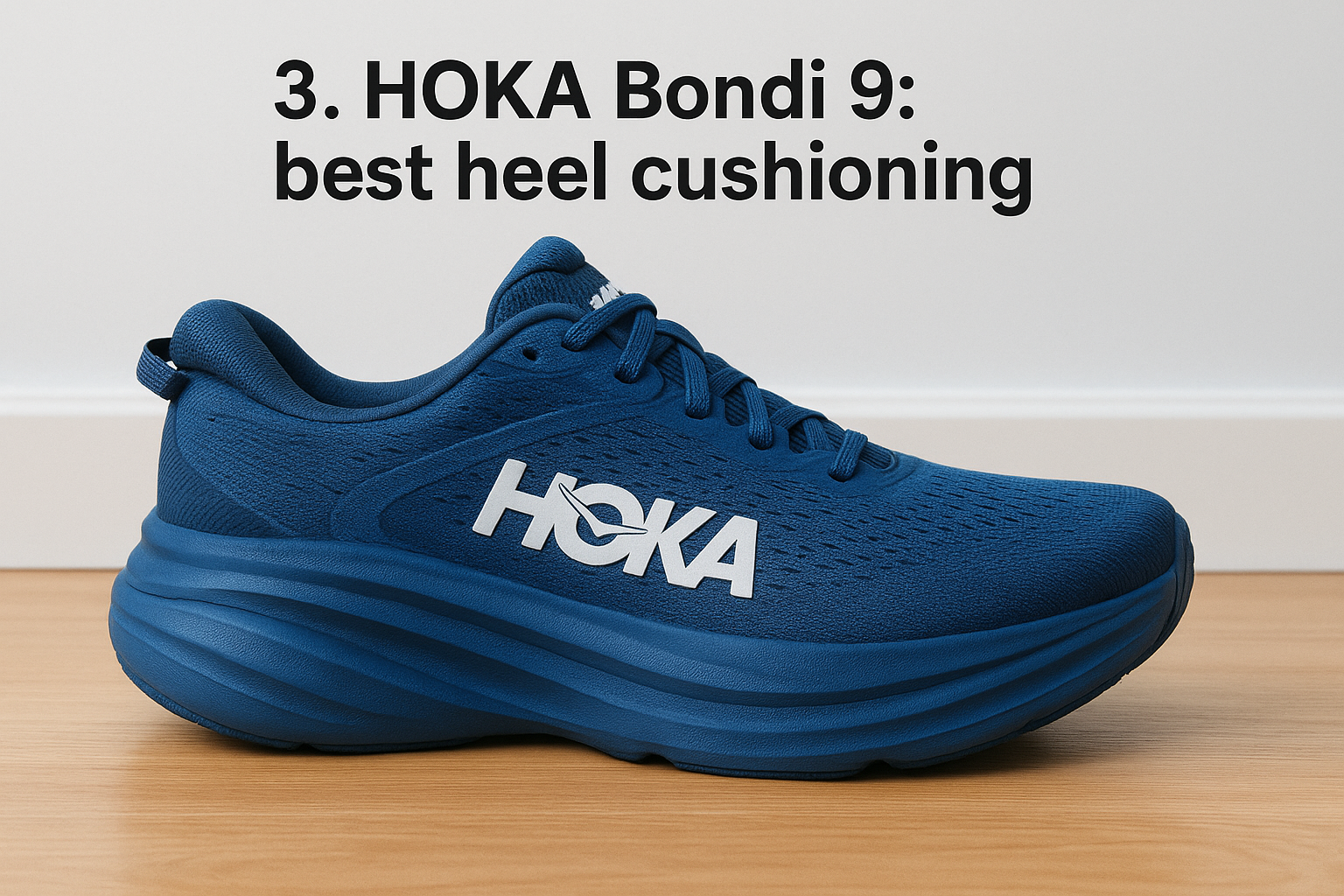
The Bondi 9 protects your heel with sheer volume of foam. Its lab figures:
- Heel stack: 41.3 mm, about 7 mm above average
- Heel shock absorption: 146 SA, against an average of 127 SA
- Heel width: 104.2 mm, about 13.5 mm wider than average
- Twist resistance: 4 out of 5
- Weight: 10.7 oz (303 g)
- List price: $170
How the arch support works
The Bondi pairs reliable arch support with raised sidewalls and a rockered sole. The rocker makes the roll from heel to toe smoother, so your fascia is stretched less at push-off. Podiatrists often recommend stiff rocker profiles for plantar fasciitis for exactly this reason.
When heel impact is what hurts most, the Bondi 9 absorbs more of it than any other shoe in this list.
The wide heel makes each landing feel secure, and the high shock absorption softens hard surfaces like tile, concrete, and hospital floors.
Who it suits and the trade-offs
Pick it if your pain is mostly under the heel and you spend long hours on hard floors. It also works as a walking shoe at slow, steady paces.
It is heavy and a little clunky, and the fit is not good for wide feet. A rockered shoe can feel odd for the first few days, especially when you stand still, so wear it indoors before you commit to a full day.
4. Mizuno Wave Inspire 22: best for a higher heel
Key specs
The Wave Inspire 22 is a support shoe with an elevated heel, which sets it apart from most of this list. Its specs:
- Category: support shoe for overpronators
- Stack height: 38 mm at the heel and 28 mm at the forefoot
- Heel-to-toe drop: 10 mm, down from 12 mm in earlier versions
- Weight: 294 g (10.4 oz) for men and 250 g (8.8 oz) for women
- Price: check the brand’s page for the current figure
How the arch support works
A 10 mm drop lifts your heel and takes some strain off the calf and Achilles. A tight Achilles is a recognized risk factor for plantar fasciitis, because it adds tension to the fascia. An internal structure under the arch and a responsive midsole supply the rest of the support.
If your calves are tight, a shoe with a real heel lift can calm heel pain faster than extra foam alone.
Specialty running stores report that people who are on their feet all day often feel relief within minutes of trying this shoe. That is anecdotal, not a trial result, but it matches the design logic.
Who it suits and the trade-offs
It suits people with tight calves, mild to moderate overpronation, and an active routine. The fit is generous and fits most foot shapes.
The cushioning is mid-high and responsive, so it feels firmer than the Bondi. If you want a pillowy ride, this is not it. The forefoot is also lower than the heel by design, so give your calves a few days to adjust if you are used to flat shoes.
5. New Balance Fresh Foam X 860v15: best for wide feet
Key specs
The 860v15 is a control shoe with a rounder front end. Here is what it offers:
- Category: stability shoe for overpronators
- Stack height: 40 mm at the heel and 34 mm at the forefoot
- Heel-to-toe drop: 6 mm
- Weight: 330 g (11.6 oz) for men and 263 g (9.2 oz) for women
- Widths: a wide fit is available
- Price: check the brand’s page for the current figure
How the arch support works
A firmer foam section sits on the inner side of the rearfoot, with a softer layer of Fresh Foam X above it. The firm layer resists the inward roll of your arch, and the soft layer takes the edge off impact. The cushioning never feels mushy, which matters because overly soft shoes can leave the fascia unsupported.
A firm base under a soft top layer gives you arch control without the harshness of a rigid shoe.
The rounder toe box lets your toes spread naturally. That reduces pressure on the forefoot, which is a common complaint when plantar fasciitis changes the way you walk.
Who it suits and the trade-offs
It suits people with a broad forefoot or a high instep who struggle to find stability shoes that do not pinch. It is also a good durable choice for daily walking.
The 6 mm drop is lower than the 8 mm rule of thumb that some shoe testers use for plantar fasciitis. If your calves are tight, try the Mizuno first. It is also a heavier shoe, so it is not the one for fast walks.
6. Brooks Beast GTS 26: best for heavier walkers
Key specs
The Beast GTS 26 is built for people who need more control than a standard stability shoe gives. Its specs:
- Category: high-level stability shoe for overpronators
- Stack height: 38 mm at the heel and 26 mm at the forefoot
- Heel-to-toe drop: 12 mm
- Weight: 354 g (12.5 oz) for men and 317 g (11.2 oz) for women
- Price: check the brand’s page for the current figure
How the arch support works
Brooks uses the same GuideRail system here as in the Adrenaline, but tuned for firmer control and a sturdier build. Extra body weight is a recognized risk factor for plantar fasciitis, because the fascia absorbs more load with every step. A shoe that resists compressing and twisting keeps the arch from flattening under that load.
Heavier walkers need a shoe that holds its shape, and the Beast GTS 26 is made for that job.
The 12 mm drop also lifts the heel, which eases strain on the Achilles and calf. Together with the deep cushioning, it makes standing for hours less punishing.
Who it suits and the trade-offs
Choose it if you are heavier, need maximum stability, or have worn out softer shoes within months. It is a heavy-duty shoe that lasts.
It is the heaviest shoe on this list, so it will not feel nimble. A 12 mm drop is also the steepest of the Brooks picks, so wear it for short stretches first if you usually wear flatter shoes.
7. Skechers Arch Fit 2.0: best built-in arch contour
Key specs
The Arch Fit 2.0 is the only pick here whose name promises arch support, and the lab numbers back up most of it:
- Arch support type: stability
- Heel shock absorption: 134 SA
- Heel-to-toe drop: 15.2 mm
- Twist resistance and heel counter: 3 out of 5 for each
- Toe box width at the big toe: 68.3 mm
- Price: check the brand’s page for the current figure
How the arch support works
The shoe gives you a pronounced arch contour and strong heel cushioning, both of which reduce load on the fascia. The 15.2 mm drop is the highest on this list, so the heel sits well above the forefoot.
The Arch Fit 2.0 suits people who want the arch lifted by the shoe itself, not by an add-on insole.
It scores 3 out of 5 for twist resistance and heel counter stiffness. That is the minimum acceptable level, not a standout. Press on the back of the heel and twist the shoe in the store before you buy.
Who it suits and the trade-offs
It suits people who like a built-in arch and want a softer, more casual feel than a stability trainer gives. It also works if your calves are tight and you respond well to a big heel lift.
The toe box is narrow compared with the roomiest walking shoes in the same lab comparison, so skip it if your forefoot is wide. The heel is also narrower than the Bondi or Kayano, so it gives less side-to-side stability.
How to choose arch support shoes for plantar fasciitis
What arch support should actually do
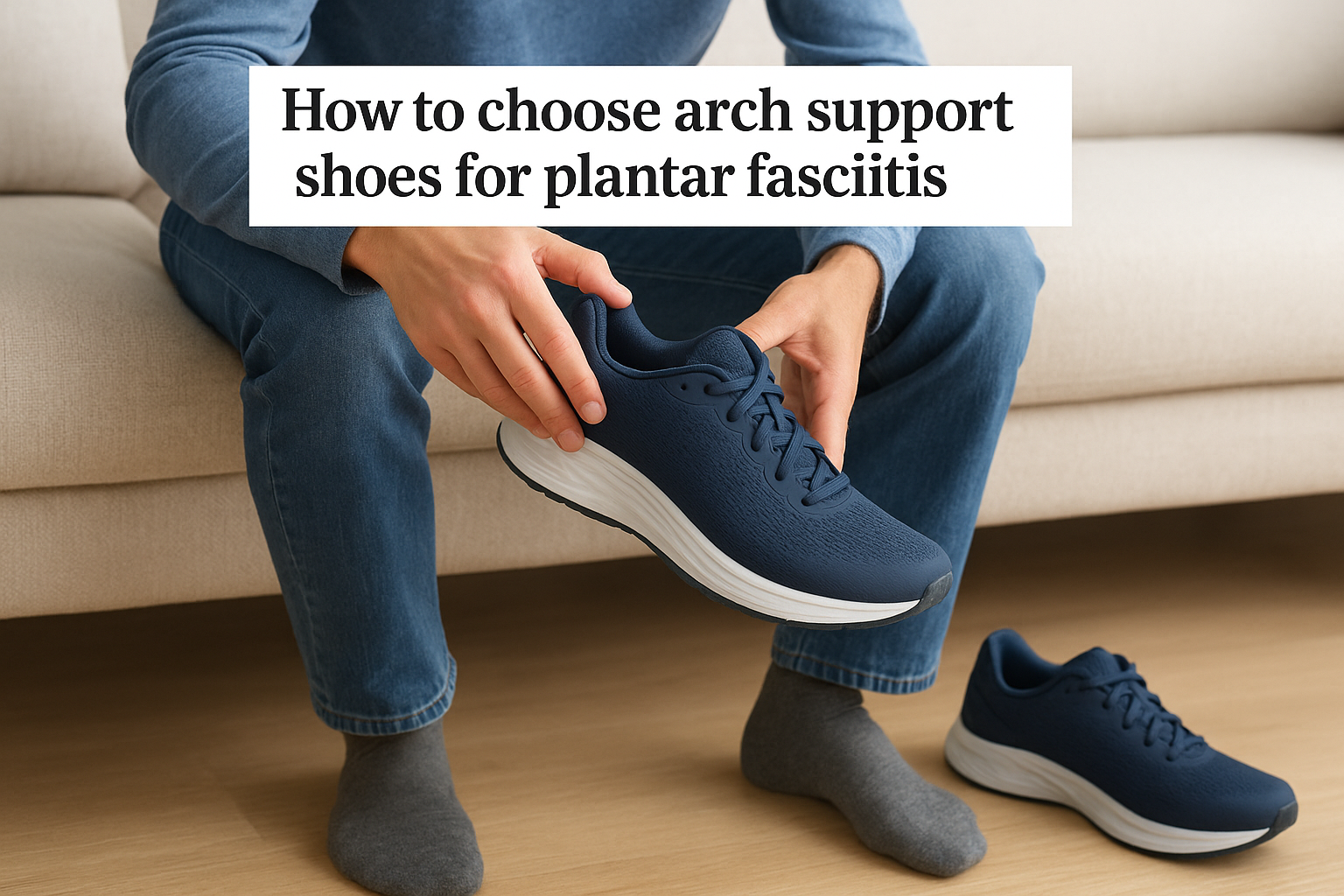
Good arch support controls how your arch moves under load, instead of simply lifting it. Shoes that do this well share a handful of measurable traits:
- Twist resistance of at least 3 out of 5, so the shoe does not wring like a towel
- Heel counter stiffness of at least 3 out of 5, so the heel does not wobble
- Heel shock absorption of at least about 100 SA, with 120 or more being better
- Heel-to-toe drop around 8 mm or more, as a rule of thumb, unless your calves are flexible
- A roomy toe box, so your toes spread
Five fit checks to do in the store
Run through these quick tests before you pay, ideally late in the day when your feet are at their largest:
- Twist the shoe. It should resist and feel rigid through the middle.
- Bend it. It should flex at the ball of the foot, not in the arch.
- Press the back of the heel. A firm counter should barely collapse.
- Check the arch and heel. You want a visible arch contour and thick heel cushioning.
- Walk on a hard floor for a few minutes and notice any rubbing or pressure.
Shoes to avoid and what to wear at home
The worst shoes for plantar fasciitis are flat flip-flops, thin plimsolls, minimalist or barefoot-style shoes, high heels, and old pairs whose midsoles have flattened. Soft memory-foam slippers also fail, because they squash flat within weeks.
Barefoot walking at home is the hidden culprit for many people. Keep a supportive slide or clog by the bed so your first steps of the day land on a contoured footbed. Cork-footbed and orthotic-style slippers from comfort brands are a sensible choice.
Which pick fits which foot
| Your situation | Best pick | Why |
|---|---|---|
| Neutral feet or mild overpronation | Brooks Adrenaline GTS 25 | Subtle GuideRails support |
| Flat feet, strong overpronation | ASICS Gel Kayano 33 | FluidSupport arch and wide base |
| Maximum heel cushioning | HOKA Bondi 9 | 41.3 mm heel stack and rocker |
| Tight calves | Mizuno Wave Inspire 22 | 10 mm drop and elevated heel |
| Wide or broad forefoot | New Balance Fresh Foam X 860v15 | Rounder toe box, wide fit |
| Heavier body weight | Brooks Beast GTS 26 | Heavy-duty stability |
| Built-in arch contour | Skechers Arch Fit 2.0 | 134 SA and 15.2 mm drop |
Match the shoe to your foot and your pain, not to the longest list of features.
When shoes are not enough: orthotics and a podiatrist
Custom orthotics and removable insoles
If a good shoe still leaves you sore, the next step is usually custom orthotics. These are prescription orthotic devices built around your foot structure to improve support, comfort, balance, and pressure distribution. At our clinic, they are designed from a 3D imaging scan.
Pick shoes with a removable insole if you think you might need them. A shoe with a fixed insole leaves no room for an orthotic, and stacking both makes the fit too tight.
A great shoe supports an average foot. An orthotic supports yours.
Signs it is time to see a podiatrist
Book an exam if you have switched to supportive shoes and still wake up with sharp heel pain. The same goes if pain limits your walking or work, or you notice swelling, numbness, or tingling. Many other conditions cause heel pain, so a diagnosis beats guessing.
Conservative treatment is often successful, and surgery is rarely required. Treatment usually starts with stretching, supportive footwear, and orthotics. Our Richmond area offices have ultrasound, fluoroscopy, and x-rays on site, and you can book a same-day appointment online or by phone.
Diabetes changes the shopping rules
If you have diabetes, do not choose from this list alone. Our Diabetic Shoe Program offers therapeutic footwear for eligible patients who need added protection and support. Coverage is 80 percent of the cost of one pair of shoes and three pairs of inserts per year. Secondary insurance may cover the remaining costs totally.
Choose support, then give it time
The shoes on this list share the same logic: control the arch, cushion the heel, and keep the foot stable. Start with the Adrenaline GTS 25 if you are unsure. Move to the Kayano for flat feet, the Bondi for heel impact, the Mizuno for tight calves, the 860v15 for wide feet, the Beast for heavier walkers, or the Arch Fit 2.0 for a built-in arch.
Wear your new pair daily, keep a supportive pair by the bed, and give your fascia several weeks to respond. If your heel still hurts, the problem needs a diagnosis, not a different shoe. You can book a same-day visit with our foot and ankle team and get a plan that fits your feet.