The best arch support insoles for overpronation have a firm, contoured arch, a deep heel cup and a stiff inner edge that stops your foot from rolling inward. Custom orthotics suit you best if you have steady pain or very flat feet. Powerstep Pinnacle Maxx and Cadence Original suit most adults who want an off-the-shelf pair. Aetrex Speed suits runners, Tread Labs Pace 2 suits heel pain, and Spenco is the budget route.
Shopping for these is confusing because almost every insole box promises stability. Many shelf insoles are soft cushions that feel nice in the store and do nothing about the inward roll. This article compares seven options by how they control motion, who they fit and what they cost, so you can choose a pair without opening ten more tabs.
We are a podiatry practice in Central Virginia, and we treat overpronation, flatfoot and arch pain as part of our regular work. That is why the first pick is a device we prescribe, and why the later sections tell you plainly when an insole is enough and when it is not.
What arch support insoles do for overpronation
A firm arch support insole holds your arch up while you load it, which limits how far your foot rolls inward with each step. That is the whole job. Structure does the work, and soft cushioning alone will not stop the roll.
Firm structure stops the roll, soft cushion only makes the roll feel nicer.
How to tell if you overpronate
Overpronation means your foot rolls inward past the point where it absorbs shock, and your arch flattens too much. It is not the same as having flat feet. Flat feet describe the shape of your arch, while overpronation describes how your foot moves, and the two often show up together. Three quick checks will point you in the right direction:
- Wear test: Look at an old pair of shoes. Heavy wear along the inner edge, from the heel through the ball toward the big toe, suggests an inward roll.
- Wet test: Wet your foot and step on cardboard. A wide print with almost no curve at the middle suggests a collapsing arch.
- Symptom pattern: Aching arches, heel pain, shin splints or knee pain after walking or running often go with overpronation.
These checks point, they do not diagnose. A podiatrist can confirm the cause with an exam.
Features that matter most
Judge any insole on four features before you look at the brand. A pair that gets these right will outperform a famous name that gets them wrong.
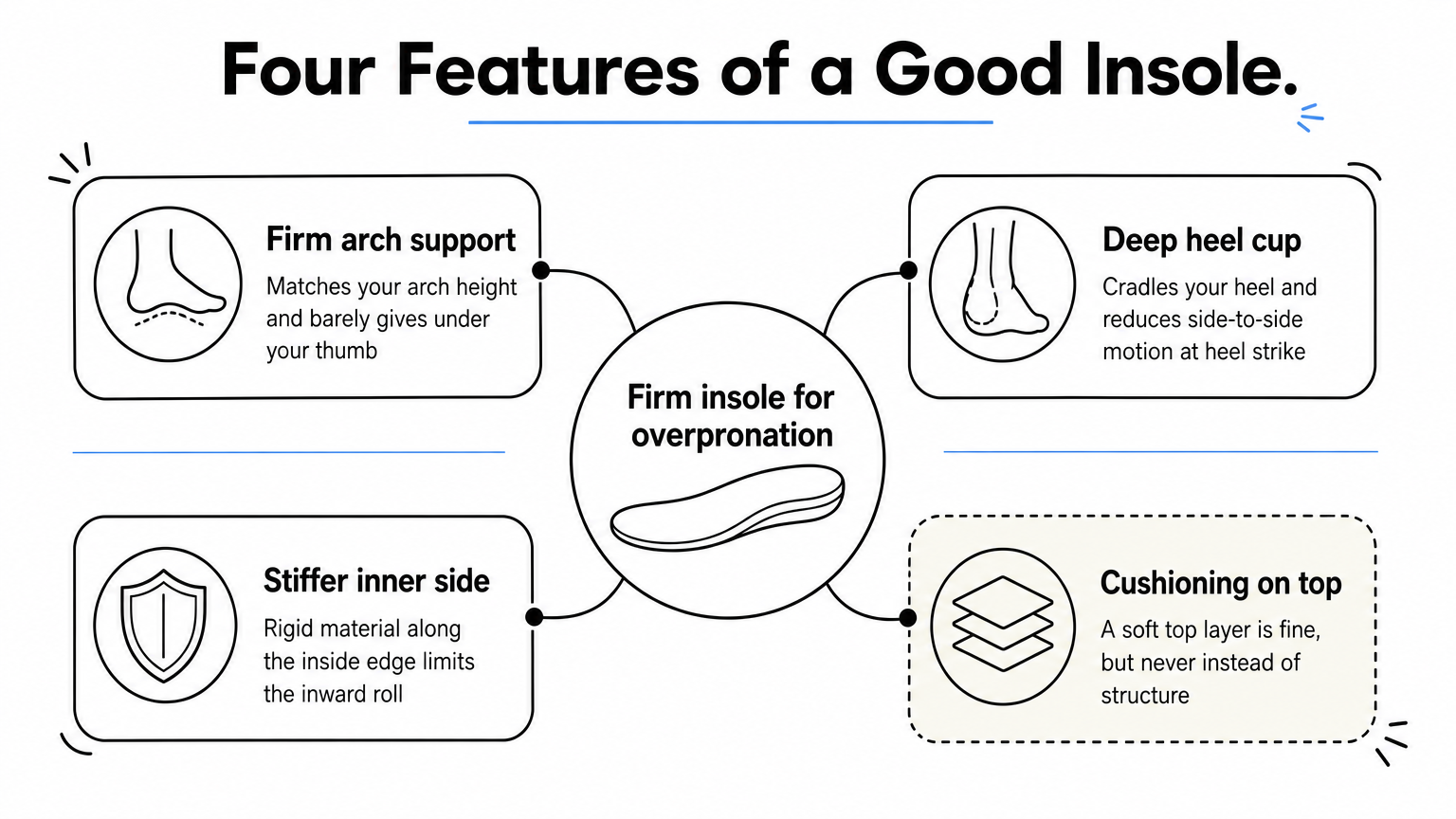
- Firm arch support that matches your arch height. Press the arch with your thumb. It should barely give and should feel springy, not squishy.
- A deep heel cup that cradles your heel and reduces side-to-side motion from the moment of heel strike.
- A stiffer inner side. Rigid material along the inside edge is what limits the inward roll.
- Cushioning on top, not instead of structure. A soft foam core flattens quickly and takes the support with it.
Do insoles work, and what they cannot fix
Insoles work by changing your foot position the moment you put them on, so relief can start as soon as your feet adjust. For most people with flexible or low arches, firm support is the first thing to try. Wearing a stable shoe matters too. If you can bend a shoe in half, it is too flimsy to pair with any insole.
An insole does not build strength. Weak muscles in the feet and ankles, and tight calves, can both push the foot inward. Heel raises, short foot exercises (gently drawing the ball of the foot toward the heel to lift the arch) and calf stretches work alongside insoles, not instead of them.
1. Custom orthotics from Achilles Foot and Ankle Center
Custom orthotics are the most precise fix on this list, because they are made from your foot instead of an average one. Our podiatrists and nurse practitioners at Achilles Foot and Ankle Center in Richmond, Virginia, prescribe them when overpronation or arch pain has not eased with supportive shoes and shelf insoles.
A custom orthotic is the right next step when a good shelf insole has not stopped the pain.
How it works
We start with your symptoms, goals and medical history, then examine the foot and ankle. The orthotic is designed from a state-of-the-art 3D imaging system scan of your foot, so the arch contour and heel position match you, not a size chart. That is the difference from every other item here.
What a custom device can do that a shelf pair cannot:
- Match your exact arch height and shape
- Support each foot differently when your feet are not the same
- Follow your diagnosis, such as adult flatfoot or plantar fasciitis
Who it suits
Custom orthotics suit you if you have tried a firm over-the-counter pair for several weeks and still have pain. They also suit adult flatfoot, where the arch has collapsed and hurts in the foot and ankle, and people whose symptoms continue even in supportive running shoes.
Heel and arch pain are another common reason, including plantar fasciitis and Achilles tendinitis, once an exam confirms the cause. Orthotics are part of conservative care, and we try appropriate non-surgical options before anything surgical.
Price and trade-offs
Expect to pay more than for a shelf pair, and know that orthotic coverage depends on your plan, so call your insurer to confirm it. We explain findings, options and pricing upfront, and we accept a wide range of insurance, including all major insurance companies such as Aetna and Anthem.
- Higher cost than any shelf insole here
- Requires a visit at one of our Mechanicsville, Glen Allen or West End offices
- Same-day appointments are often available, though not guaranteed
2. Powerstep Pinnacle Maxx
Powerstep Pinnacle Maxx is the pick for adults who want maximum stability from an off-the-shelf orthotic. Powerstep sells it as a corrective insole for overpronation, and retail insole specialists list it among their recommended pairs for the problem.
If you want the firmest shelf support before paying for custom, start with a structured corrective orthotic like this one.
How it works
Powerstep says its insoles stabilize the ankle and balance the foot to ease flat feet pain, and it markets them as clinically proven for overpronation and low arches. Treat that as the maker’s claim, not a guarantee. What you can check yourself is the structure of the pair in your hands.
On first try, check three things:
- The arch feels firm when you press it
- Your heel sits in the cup without sliding
- Your shoe still closes without crushing your toes
Who it suits
This pair suits adults with flat or low arches and moderate overpronation who spend most of the day on their feet. It is a sensible first stop if your symptoms are real but you are not ready for a clinic visit.
It is a poor match for slim or tight shoes, because a structured orthotic needs room. Remove the factory liner first. If you have never worn firm support, expect it to feel strange for a few days.
Price and trade-offs
Powerstep prices differ by retailer, so compare current listings before you buy. Expect a mid-priced to premium shelf pair rather than a bargain one.
- Firm feel needs a break-in period
- One shape for everyone, so no tailoring if your feet differ
- Buy from a seller with a return window
3. Cadence Original and Form Maximum Support
Cadence Original and Form Maximum Support are the dependable middle of the market. One insole specialist lists them at $49.95 and $44.95, and also recommends both for overpronation.
At about $45 to $50, you are paying for structure, so check the firmness before you commit to wearing them.
How it works
Both sit in the motion control category, meaning they aim to limit the inward roll with a firm arch, a heel cup and a stiffer inner side. Do the thumb test when they arrive. If the arch collapses under moderate pressure, it will collapse under your body weight too, and you should send the pair back.
The same retailer lists two other motion control options in this price band:
- 10 Seconds Motion Control, listed at $49.99
- Prothotics Motion Control Sport, listed at $44.95
Who it suits
These suit everyday wearers, people on their feet through a work shift and first-time buyers who want a mid-priced pair with a track record. They fit well in sturdy walking shoes and cross trainers.
Review counts at that retailer, 140 for Cadence and 61 for Form, give you a way to read feedback on fit before you buy. Look for comments from people with feet like yours.
Price and trade-offs
At $44.95 to $49.95, they cost far less than custom orthotics and a little more than budget gel pairs. The trade-off is that they are not tailored, so one foot that needs more support than the other will not get it.
- You may need to try two pairs to find your fit
- Return policy matters more than the small price gap between them
- A reasonable pair to test for a few weeks before deciding on custom
4. Aetrex Speed Orthotics
Aetrex Speed Orthotics suit runners who overpronate. Aetrex built them with a posted heel and medial support, and its own running guide names them its top choice for overpronating runners.
A runner needs control and shock absorption together, and a posted heel plus a resilient core is how this insole tries to deliver both.
How it works
A posted heel is a firmer wedge under the inner heel that limits rollover. Aetrex pairs it with an AeroCell polyurethane core for shock absorption and shape retention, plus a CopperGuard top cover meant to keep feet fresh. These are the maker’s descriptions, so judge the feel yourself.
- Posted heel to control inward roll
- Medial support for stability
- Polyurethane core that resists flattening under repeated impact
Who it suits
They suit runners with mild to moderate overpronation. Stability running shoes have a firmer inner midsole post and suit mild to moderate overpronators, while motion control shoes suit more severe cases. An insole adds tailored arch support on top of either.
They are a weaker match for slim casual shoes. Running orthotics tend to be thicker, and many people keep a slimmer pair for everyday footwear.
Price and trade-offs
Aetrex does not publish a single price for this model in its guide, so check the current listing. The brand runs sales through the year, and its newsletter is one way to hear about them.
Break them in slowly. Wear them for a few hours of walking over a couple of days before you run. A common guideline for running insoles is to replace them every 400 to 500 miles. At 20 miles a week, that arrives in 20 to 25 weeks.
5. Tread Labs Ramble Insoles
Tread Labs Ramble Insoles are for everyday comfort if you overpronate. Tread Labs recommends them for people who overpronate and mainly want more comfortable footwear, and they list at $65.
Support placed under the inner heel, then spread forward into the arch, controls pronation without feeling harsh.
How it works
Tread Labs builds its logic around the calcaneal shelf, a ledge on the inside of the heel bone toward the rear of the arch. Support beneath it is, in their view, the best way to limit pronation. Spreading that support forward into the arch makes it more comfortable. The result should be firm with a spring-like feel, not soft.
- Firm support that follows the contour of your arch
- A choice of several arch heights
- Designed to fit a wide range of everyday shoes
Who it suits
Ramble suits walkers and people who stand for long hours and want to feel better at the end of the day without paying for custom. The multiple arch heights are the main reason to choose it over one-size insoles.
Pick the height that matches your arch, and use the wet test above to help. A height that is too high feels like a lump, and one that is too low lets the arch drop.
Price and trade-offs
At $65, Ramble costs about $15 to $20 more than the mid-priced pairs above. You are paying for arch height options and firmer support.
Tread Labs steers people with plantar fasciitis to a different model and athletes to others, so Ramble is the comfort-first choice, not the pain-first choice. Expect a break-in period with any firm insole.
6. Tread Labs Pace 2 Insoles
Tread Labs Pace 2 Insoles are the heel pain pick for people who overpronate. Tread Labs recommends them for plantar fasciitis and other foot pain, and they list at $80.
When your arch collapses on every step, it keeps pulling on the plantar fascia, so controlling the collapse is part of treating the heel.
How it works
Overpronation flattens the arch, which stretches the plantar fascia, the band of tissue from your heel to the ball of your foot. Tread Labs says plantar fasciitis affects about 1 in 10 people at some point. A firm arch support reduces that repeated stretch, which is why overpronators with heel pain often benefit from structure rather than cushion.
A typical sign is sharp heel pain with your first steps after rest. Pain that eases as you warm up and then returns later in the day is common too.
Who it suits
Pace 2 suits people with heel pain and a flat or flexible arch who have not yet found relief with cushioned insoles. It makes sense as a serious trial before moving to a clinic.
If you have used firm support consistently and the heel still hurts, get an exam. Heel and arch pain has several causes, including Achilles tendinitis and sesamoiditis, and an insole alone does not fix all of them. We treat these conservatively, from rest to quick corticosteroid injections.
Price and trade-offs
At $80, Pace 2 is the second most expensive pair in this list. It costs more than the $44.95 to $49.95 pairs, but still well below custom. The cost is worth it only if the firmness matches your pain pattern.
7. Budget picks: Spenco and Dr. Scholl’s
Spenco Total Support Gel and Dr. Scholl’s Stabilizing Support are the budget route, and Spenco is listed at $29.99. They make sense for mild symptoms or as a low-cost trial of whether support helps you.
A cheap insole is worth buying only if it is firm enough to resist your arch, so test the firmness before the price.
How it works
Spenco describes its gel insole as absorbing shock and providing arch support. Dr. Scholl’s says its stabilizing insoles boost stability and balance, improve ankle alignment and provide arch support to reduce overpronation. Both claims come from the makers.
Be skeptical of the category. Many over-the-counter pairs lack the firm support needed to limit pronation, and one-size designs ignore that every arch is different. Gel adds shock absorption, but absorption is not control.
- Press the arch. It should resist your thumb
- Check for a defined heel cup
- Make sure the pair can go back if it feels like a cushion
Who it suits
These suit mild, occasional symptoms, a spare pair for a second pair of shoes, or a cheap test of whether arch support changes how your feet feel. If a budget pair helps, you have learned something useful before spending more.
They are a poor fit for severe overpronation, very flat feet or ongoing pain. In those cases a firm pair or custom orthotics will do more.
Price and trade-offs
Price per year matters more than the sticker. Suppose a $65 pair lasts 12 months, which is about $5.42 a month. If a $29.99 pair flattens after 6 months, you buy two a year and spend $59.98. The cheaper pair then costs about the same and supports you less. That is a hypothetical, but check how long a budget pair keeps its shape.
How to choose between these arch support insoles
Choose by your main problem, not by the brand name. Persistent pain or very flat feet point to custom orthotics, running points to Aetrex Speed, heel pain points to Pace 2, and a tight budget points to the Spenco or Dr. Scholl’s route.
Pick by your main problem, not by the brand name.
Side-by-side comparison
Prices below are those listed by the retailers named above and change often, so confirm before you buy.
| Pick | Type | Best for | Listed price |
|---|---|---|---|
| 1. Custom orthotics, Achilles | Custom, from 3D imaging | Persistent pain, flatfoot, failed shelf insoles | Explained upfront; check insurance |
| 2. Powerstep Pinnacle Maxx | Corrective shelf orthotic | Maximum stability | Varies by retailer |
| 3. Cadence Original / Form Maximum | Motion control shelf pair | Everyday wear | $49.95 / $44.95 |
| 4. Aetrex Speed | Running orthotic | Runners | Varies; brand runs sales |
| 5. Tread Labs Ramble | Firm everyday insole | Comfort-first overpronators | $65 |
| 6. Tread Labs Pace 2 | Firm, pain-focused insole | Plantar fasciitis | $80 |
| 7. Spenco / Dr. Scholl’s | Budget shelf pair | Mild symptoms, trial | $29.99 (Spenco) |
Match the pick to your situation
Start with how long the pain has lasted and what you have already tried. Then choose the row that fits.
- Pain for months, or nothing has helped: custom orthotics.
- Heel pain with a flat arch: Pace 2, then an exam if it persists.
- You run: Aetrex Speed, with a stability shoe.
- You walk or stand all day: Cadence Original, Form Maximum, Ramble or Powerstep.
- Mild symptoms, tight budget: Spenco or Dr. Scholl’s, firmness tested.
Breaking in, replacing and when to get help
Remove the factory liner so the new insole lies flat and fits snugly against the sides of the shoe, without bunching. Wear a new pair for a few hours a day at first, and build up over a week. Feet need time to adapt to firm support.
Replace insoles when they flatten or show wear. See a podiatrist if your pain is constant, severe or limits daily activity, or if a firm pair has not helped after consistent use.
Pick the support that matches your pain
The right insole for overpronation is firm, shaped to your arch and paired with a stable shoe. Shelf pairs from Powerstep, Cadence, Form, Aetrex and Tread Labs cover most needs, and a budget pair can tell you cheaply whether support helps. When pain continues, custom orthotics made from a scan of your own foot are the better answer.
If you have tried a firm pair and still hurt, or you are not sure whether you overpronate at all, get your feet examined. You can book a same-day appointment at Achilles Foot and Ankle Center, and we will explain your options and pricing upfront.