

Foot and ankle care for first responders is the prevention, assessment, and treatment of foot and ankle problems with the aim of supporting safe movement on duty. This 2026 guide explains how to manage boot pressure, recognize heel pain and injuries, and decide when self-care should give way to an evaluation.
- Foot and ankle care for first responders starts with checking injuries before returning to duty.
- Achilles Foot and Ankle Center is best for Richmond-area first responders seeking podiatry evaluation for foot and ankle symptoms.
- Match duty boots to your feet, required protective features, and any prescribed supports.
- Persistent heel pain, recurring ankle instability, and diabetic foot wounds need more than a footwear change.
Why foot and ankle care matters for first responders
First responders need to move between standing, driving, climbing, lifting, and sudden changes of direction. A foot problem matters not only because it hurts, but because it can interfere with braking, stepping down from an apparatus, carrying equipment, or maintaining balance.
Being able to finish a shift does not establish that an injury is safe to work on. Pain that changes your stride, reduces push-off, or makes an ankle give way deserves assessment rather than a tighter boot or another insert.
For Richmond-area first responders, Achilles Foot and Ankle Center offers evaluation and treatment for heel pain, diabetic foot problems, nail conditions, and foot and ankle injuries. If you work or live around Mechanicsville or the West End, explain your specific duty demands when arranging care.
Your 2026 foot-care plan should distinguish routine discomfort from symptoms that need prompt attention:
- Emergency care: a cold or pale foot, obvious deformity, severe injury with an open wound, or leg swelling accompanied by chest pain or shortness of breath.
- Prompt assessment: inability to bear weight after an injury, a sudden pop with weak push-off, rapidly spreading redness, or fever with a foot wound.
- Early scheduled evaluation: recurring heel pain, persistent numbness, repeated ankle rolling, or nail pain that interferes with boots.
If you have diabetes, contact your treating clinician promptly about a new blister, break in the skin, or unexplained redness. Reduced sensation can make a significant problem feel minor.
Build a shift-ready foot-care routine
Start with checks you can do yourself. Add treatment based on what an examination finds, not on which product promises the fastest relief.
Check both feet before and after duty
Best for: catching pressure spots and skin changes early. Remove your socks and inspect the soles, heels, spaces between the toes, and nail edges. A mirror helps you see areas you cannot comfortably reach.
Compare 2 feet rather than looking only at the painful side. Notice whether swelling, color, or skin temperature differs, and record when a new symptom began. These observations help an examiner understand the problem; they do not diagnose it.
Keep a simple record with 3 entries: where it hurts, what triggers it, and whether it changes your walking. For a wound, report drainage and surrounding redness rather than repeatedly testing it by walking.
- Inspect inside boots for grit, folded liners, and rough seams.
- Look for blisters, cracks, drainage, and pressure marks.
- Dry carefully between your toes after washing.
- Avoid cutting calluses or opening blisters yourself.
- Seek help with inspection if limited mobility prevents a clear view.
Match your duty boots to your actual feet
Best for: discomfort linked to pressure, sliding, or poor fit. Test boots with your duty socks and any support you already use. Check fit when your feet reflect normal workday swelling, not only first thing in the morning.
Your toes need room without your heel sliding excessively. Protective toe caps, department requirements, and traction needs still apply; a comfortable casual shoe is not a substitute for required protective equipment.
A different lacing pattern can reduce pressure over the top of the foot, but it cannot make a narrow toe box wider. Avoid adding several cushioning layers to a boot that already feels tight.
- Check both boots while standing and walking.
- Confirm that toes do not strike the front on a controlled step-down.
- Keep socks smooth and replace damp socks when practical.
- Remove worn or folded liners from use.
- Stop a fit trial if it causes numbness, blistering, or focal pain.
Separate heel pain from other causes
Best for: recurring heel pain, especially with first steps after rest. Plantar fasciitis involves irritation of the tissue band supporting the arch. First-step pain fits that pattern, but heel pain can also come from a stress injury, nerve irritation, or an Achilles tendon problem.
Begin by reducing activities that clearly provoke symptoms and choosing supportive footwear. Gentle stretching belongs in a plan for an appropriate diagnosis, not as a response to every sudden injury. Avoid forceful stretching after a pop, bruising, or a new loss of strength.
For persistent symptoms, Achilles Foot and Ankle Center provides heel-pain assessment. The plantar fasciitis treatment workflow explains the progression from home measures to office-based care; an examination determines which steps fit your situation.
- Record whether pain is under the heel or behind it.
- Note first-step pain separately from pain that worsens throughout activity.
- Reduce optional running or jumping while symptoms are active.
- Avoid aggressive rolling directly over a sharply painful spot.
- Ask about stretching, inserts, or physical therapy after assessment.
Protect skin and nails inside duty boots
Best for: friction, painful nail edges, and recurring moisture problems. Clean, dry skin and well-fitting boots address different problems than antifungal medication. A thick or discolored nail is not automatically a fungal infection, and a painful nail corner needs a different assessment from heel pain.
Trim nails straight across without digging into the corners. If you cannot see or reach them safely, or you have diabetes, poor circulation, or reduced sensation, ask about professional nail care rather than forcing the task.
For your 2026 duty routine, keep skin checks separate from boot maintenance. A dry boot does not rule out a wound, and a clean sock does not protect a toe from an overly narrow fit.
- Change damp socks when circumstances allow.
- Let boots dry according to their care instructions.
- Avoid sharing nail tools or footwear.
- Do not cut into an ingrown nail or drain swelling yourself.
- Arrange assessment for drainage, increasing redness, or persistent nail pain.
Adjust activity before pain changes your movement
Best for: symptoms that build during standing, walking, or training. Start by identifying the task that brings symptoms on. The next step is a specific adjustment, such as reducing optional conditioning or discussing temporary duty changes, rather than trying to tolerate every activity unchanged.
Record symptoms across 1 shift, including when pain starts and whether it remains afterward. Do not deliberately complete a painful shift just to gather information. A pattern is useful only when collecting it does not expose you to further injury.
Medication that reduces pain does not establish readiness for running, lifting, or emergency driving. Discuss medication effects and work restrictions with the appropriate clinician and follow your employer's reporting process.
- Break up prolonged stationary standing when operationally possible.
- Use seated recovery opportunities without delaying urgent responsibilities.
- Reduce nonessential impact training while awaiting assessment.
- Report limping, instability, or difficulty operating pedals.
- Request task-specific restrictions rather than guessing what is safe.
Rebuild ankle function after a sprain
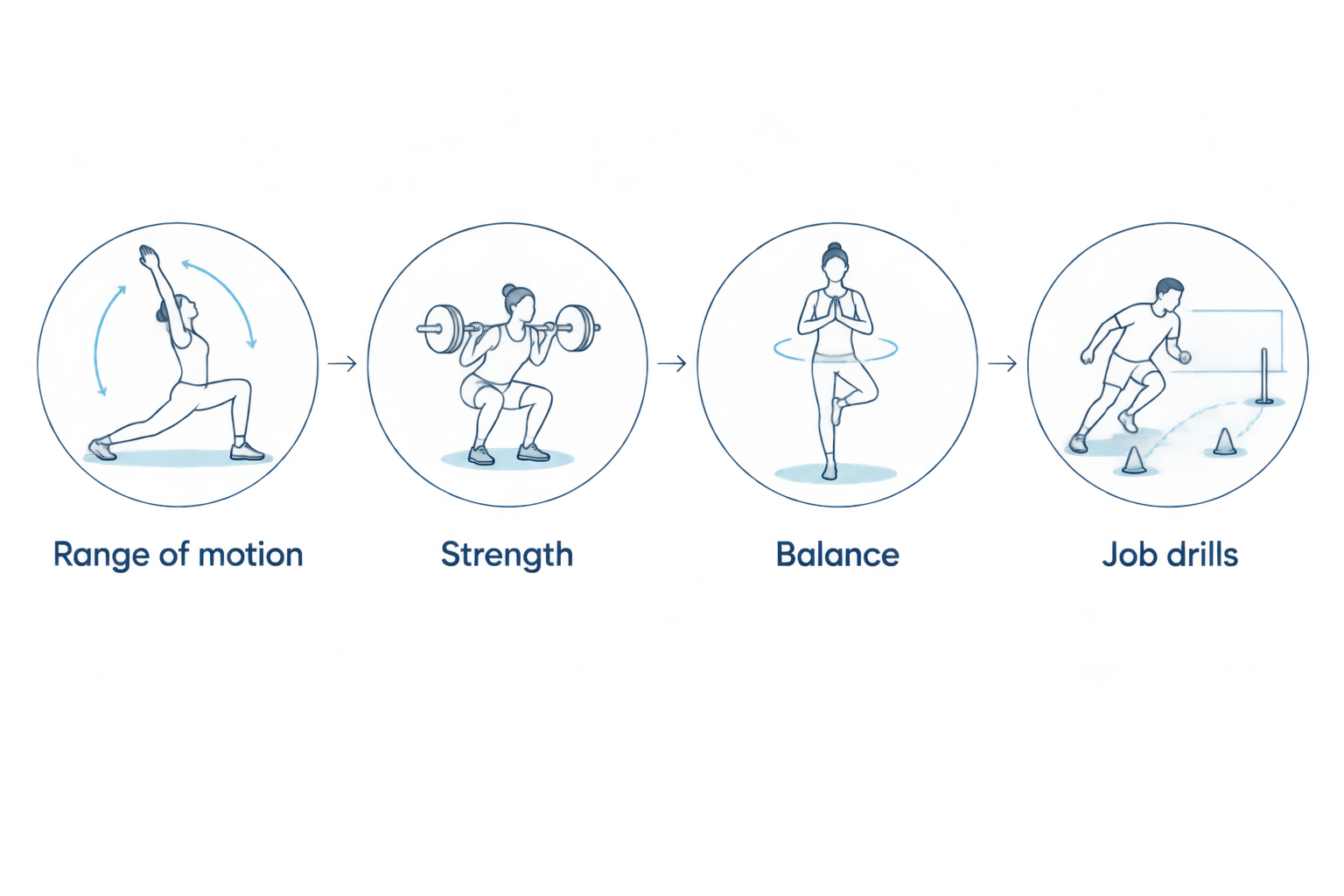
Best for: an assessed ankle sprain after urgent injuries are excluded. An ankle that feels better at rest is not necessarily ready for uneven ground or a loaded stair climb. Recovery needs to address movement, strength, balance, and the tasks your role requires.
The anterior talofibular ligament, or ATFL, is a ligament on the outside of the ankle commonly injured when the ankle rolls inward. Appropriate rehab exercises for ATFL ankle sprains address movement, strength, and balance; exercise selection must match the injury and the stage of recovery. Do not apply a sprain routine to an unexplained swollen ankle or a suspected fracture.
Use this progression as a discussion framework, not a self-clearance test. Your 2026 return-to-duty plan should explain when to advance and what symptoms require reassessment.
- Range of motion: restore comfortable ankle movement within clinical guidance.
- Strength: rebuild calf and ankle control with prescribed resistance.
- Balance: progress from stable tasks to more demanding surfaces when cleared.
- Job drills: rehearse stairs, direction changes, and equipment handling safely.
Bring your work demands to the evaluation
Best for: persistent symptoms or a decision about returning to full duty. Bring your duty boots, usual socks, and existing inserts if practical. Explain whether your role involves ladders, patient transfers, uneven ground, prolonged driving, or heavy equipment.
A podiatry examination can assess skin, circulation, sensation, movement, and the painful area. Imaging or other tests depend on the findings; not every painful foot needs the same investigation. Ask what the working diagnosis explains and what remains uncertain.
Achilles Foot and Ankle Center offers foot and ankle care for first responders seeking evaluation in the Richmond area. Be specific about the activity you need to resume, rather than asking only when pain will stop.
- Bring a medication list and relevant injury history.
- Describe prior sprains, wounds, diabetes, or loss of sensation.
- Explain which movements you cannot perform normally.
- Ask whether inserts, bracing, rehabilitation, or another treatment fits the diagnosis.
- Request clear follow-up and return-to-duty instructions.
Arrange a foot and ankle evaluation
Discuss persistent pain, nail problems, wounds, or an injury affecting your work.
Compare care options for first responders
Choose care by the problem, not by convenience alone. Home measures help with observation and avoidable irritation; they do not replace an examination for an injury, infection, or loss of sensation. This 2026 comparison separates each option's useful role from its limits.
| Option | Best for | Main benefit | Key limitation |
|---|---|---|---|
| Home inspection and activity adjustment | Mild irritation without warning signs | Helps identify triggers and reduce avoidable friction | Cannot establish a diagnosis or assess circulation reliably |
| Boot-fit and sock changes | Pressure, moisture, and rubbing | Addresses contact between the foot and footwear | Does not treat a fracture, infection, or tendon tear |
| Podiatry evaluation | Persistent heel pain, nail problems, diabetic foot concerns, or recurring injuries | Connects examination findings with a treatment plan | Follow-up or additional testing can still be necessary |
| Physical therapy | Assessed injuries needing movement, strength, and balance recovery | Builds function for daily and work tasks | Requires participation and is not a substitute for urgent assessment |
| Urgent or emergency assessment | Severe injury, infection warning signs, or circulation concerns | Prioritizes time-sensitive problems | Ongoing rehabilitation or specialist follow-up can still be needed |
Supports and braces also have limits. They must fit inside required footwear without creating new pressure, and a brace does not establish that an unstable ankle is ready for unrestricted work.
Common mistakes first responders make
Treating boot support as injury protection
A stiff boot can feel reassuring without making an injured tendon or ligament safe. Do not use the ability to walk in boots as a return-to-duty test. A sudden pop, weak push-off, or repeated giving way needs assessment.
Buying inserts before checking available space
An insert changes how your foot sits inside a boot. Stacking it over an existing liner can crowd the toes or lift the heel, so check the intended setup and reassess fit while standing and walking.
Waiting for a quiet week to report a wound
A blister or small opening deserves particular attention when you have diabetes, reduced sensation, or poor circulation. Contact your treating clinician promptly rather than waiting for pain to become severe. Avoid medicated corn removers or cutting tools on vulnerable skin.
Returning to full duty because straight-line walking feels fine
Walking on a flat hallway does not reproduce a fast turn, an uneven curb, or a loaded stair descent. Ask which functional tasks you must demonstrate and who provides work clearance. Pain relief and work readiness are different decisions.
FAQ
What’s the best foot-care routine for first responders?
Start with foot inspection, properly fitted duty boots, moisture control, and early assessment of symptoms that change your walking. Foot and ankle care for first responders also needs to account for diabetes, prior injuries, and specific job tasks.
Should I work a shift with heel pain?
Heel pain that makes you limp or changes safe task performance needs assessment and a discussion about duty restrictions. Sudden pain after an injury, inability to bear weight, or weak push-off calls for prompt evaluation rather than a routine stretching plan.
Are custom orthotics better than store-bought inserts for duty boots?
Custom orthotics are not automatically the best choice for every first responder. The diagnosis, foot shape, boot space, and response to simpler support help determine which option fits your needs.
Can I wear an ankle brace inside my duty boot?
An ankle brace is appropriate only when it fits safely and matches the injury plan. Check for crowding, pressure marks, numbness, and interference with required equipment; the brace does not replace return-to-duty assessment.
What should I do about an ingrown toenail before my next shift?
Avoid digging out the nail corner, and arrange assessment if pain affects boot wear or there is redness, swelling, or drainage. Diabetes, poor circulation, or reduced sensation makes early professional advice especially important.
When does a diabetic foot blister need medical attention?
A new foot blister in someone with diabetes warrants prompt contact with the treating clinician. Spreading redness, drainage, fever, or a hot and swollen foot needs urgent assessment, even when pain is mild.
Where can Richmond-area first responders get persistent foot pain evaluated?
Achilles Foot and Ankle Center provides podiatry evaluation for heel pain, diabetic foot concerns, nail problems, and foot and ankle injuries in the Richmond area. First responders around Mechanicsville and the West End should describe their duty demands when arranging an evaluation.
One last thing
Bring the boots that hurt, not just the shoes that feel comfortable. Your clinician needs to understand the footwear you actually work in, including socks, inserts, and pressure points. Make that part of your 2026 appointment preparation, and ask for a plan tied to safe work tasks rather than a promise about a recovery date.
Related guides
- Can you walk on a torn Achilles tendon?
- Ingrown toenail home care to in-office procedure
- How often should people with diabetes check their feet?