Yes—a dark line under your toenail can come from a bruise, normal or benign pigment changes, medication effects, or, less commonly, nail melanoma rather than fungus. If you notice a new or changing line in 2026, arrange an examination instead of treating the color alone as a fungal infection; appearance cannot reliably establish the cause.
- A dark line under toenail not fungus can reflect bruising, benign pigmentation, medication effects, or nail melanoma.
- A new, widening, or irregular nail stripe needs assessment, even when it does not hurt.
- Achilles Foot and Ankle Center offers podiatry care for patients needing a toenail evaluation.
- Fungal testing and a biopsy answer different questions; the examination determines which is appropriate.
Can a dark line under my toenail be something other than fungus?
Yes. A dark stripe is a finding, not a diagnosis. Blood beneath the nail and pigment produced where the nail grows can both look brown or black. Fungal infection is another possibility, but color alone does not distinguish these causes.
Achilles Foot and Ankle Center provides foot and ankle care in the Richmond area. An examination is an appropriate starting point when you cannot explain a nail change or the appearance is evolving.
| Possible cause | Clues that help guide an examination | What the clue cannot establish |
|---|---|---|
| Blood beneath the nail | Recent injury, repeated shoe pressure, or a dark patch that moves toward the tip with growth | A remembered injury does not rule out another problem |
| Benign nail pigmentation | A stable lengthwise band; similar bands sometimes affect other nails | Stability or multiple affected nails cannot prove a band is harmless |
| Medication-related pigmentation | A change after starting a medicine, sometimes involving several nails | Timing alone does not establish a medication as the cause |
| Fungal infection | Thickening, crumbling, lifting, or debris, sometimes with discoloration | These changes are not unique to fungus |
| Nail melanoma | A new or changing band, irregular color, widening, or pigment on nearby skin | Melanoma cannot be confirmed or excluded from appearance alone |
These are clues for a clinician, not a home screening test. Several causes share features, and more than one condition can affect the same nail.
Why this matters
Treating every dark nail as fungus can delay the evaluation of a different condition. The opposite mistake—assuming every stripe means cancer—creates unnecessary fear. The useful next step is to identify the cause, not guess from the shade.
Nail melanoma is uncommon, but early assessment matters because it is a form of skin cancer. It can develop in people of any skin tone and does not need to be painful. A comfortable toe still deserves attention when its nail changes.
For a nail concern in 2026, focus on the history and pattern rather than online photographs. Images cannot show the full progression of your nail, and lighting changes how a stripe appears.
Blood beneath the nail: look for an injury history
A subungual hematoma means blood trapped beneath the nail. Stubbing your toe, dropping something on it, running, or repeatedly pressing the nail against a tight shoe can cause this. You do not always remember a single injury.
A bruise can look red, purple, brown, or black. As the nail grows, trapped blood generally moves toward the free edge, leaving clearer nail behind it. That progression is useful information, but it takes time to observe.
Do not use a possible injury as a reason to dismiss a changing stripe. Tell the clinician about both the pressure or impact and any changes that followed. Seek prompt assessment for substantial pain, a lifted nail, or a significant crush injury.
Never drill, burn, or puncture the nail yourself to release blood. Home drainage can cause injury and infection, particularly when diabetes, reduced sensation, or poor circulation is present.
Benign pigmentation: a stripe can come from melanin
Melanin is the pigment that gives skin, hair, and nails their color. When pigment appears as a lengthwise nail band, clinicians call it longitudinal melanonychia. That term describes the appearance; it does not identify whether the cause is harmless.
Benign pigment bands are more common in people with darker skin tones. They can affect several nails and remain stable. A benign mole in the nail's growth area can also produce a stripe.
The distinction still requires care. A newly appearing band in an adult, especially one affecting a single nail, deserves assessment rather than an assumption that it is normal pigmentation.
A clinician considers when the band appeared, whether its width or color changed, and how it compares with your other nails. Skin tone is part of the history, not a reason to ignore a new change.
Medication effects and fungus: different explanations need different checks
Some medicines can cause nail pigmentation. Bring your medication and supplement list, including anything recently started or changed. Do not stop a prescribed medicine because of a nail stripe without discussing it with the prescriber.
Fungus can also discolor a nail, often alongside thickening, brittleness, debris, or separation from the nail bed. However, damaged nails and other nail disorders can share those features. A dark band does not become a fungal diagnosis simply because the nail is also thick.
Testing a clipping or scraping can help establish whether fungus is present. It does not automatically explain every pigmented area on that nail. A concerning stripe still needs its own assessment, even if fungal infection is found.
Avoid using an antifungal treatment trial as a test for melanoma. Whether the nail improves, stays unchanged, or becomes more discolored does not replace an examination of the pigment.
Which changes need a prompt appointment?
Contact a clinician promptly for a new, unexplained dark band or an existing band that changes. Mention the change when booking so the office can advise you about appropriate timing. Do not wait for pain to develop.
Features to report include:
- Widening: The band becomes broader, particularly near the cuticle.
- Uneven color: Different shades appear within the same stripe.
- Irregular borders: The edges look increasingly blurred or uneven.
- Nearby pigment: Brown or black color extends onto the cuticle or surrounding skin.
- Nail damage: Unexplained splitting, bleeding, lifting, or a sore develops.
- Persistent change: A presumed bruise does not progress toward the tip as expected.
None of these findings proves cancer, and their absence does not rule it out. The point is to arrange assessment rather than decide at home whether the nail passes a checklist.
A suddenly cold, pale, blue, or very painful toe needs emergency assessment. That is a different concern from a stable nail stripe. Spreading redness, drainage, or fever also requires prompt medical advice, especially if you have diabetes.
Why the appearance of a dark nail line varies
A nail stripe can look different because the source of the color and the condition of the nail differ. These factors help explain why comparing your toe with an online image is unreliable:
- Source of color: Trapped blood and melanin can both look dark but arise differently.
- Location: Color within the nail, beneath it, or on nearby skin provides different clues.
- Nail growth: An old blood spot generally moves outward; pigment produced at the base can continue forming a band.
- Repeated pressure: Ongoing shoe friction can cause further injury and complicate the pattern.
- Nail texture: Thickening, debris, and lifting can obscure what lies underneath.
- Medication history: Certain medicines can alter pigmentation and need to be considered alongside the examination.
No single factor settles the diagnosis. Your clinician combines these details rather than relying on width, darkness, or the number of affected nails alone.
Your 2026 checklist before a toenail appointment
You do not need perfect records before seeking care. A short history and clear photographs help you explain what changed without delaying the appointment.
- Record the change. Write down when you first noticed the line and whether its width, shade, or surrounding skin has changed. Include injuries, running, and shoe pressure.
- Photograph the nail. Take 2 views: one showing the whole toe and one close-up. Keep the lighting consistent if you later repeat the photographs, and avoid filters.
- List medicines. Bring prescription medicines, supplements, recent changes, and any antifungal products already used.
- Protect the toe. Wear shoes that do not press on the nail. Avoid picking, scraping, aggressive trimming, or covering the change with a new pedicure.
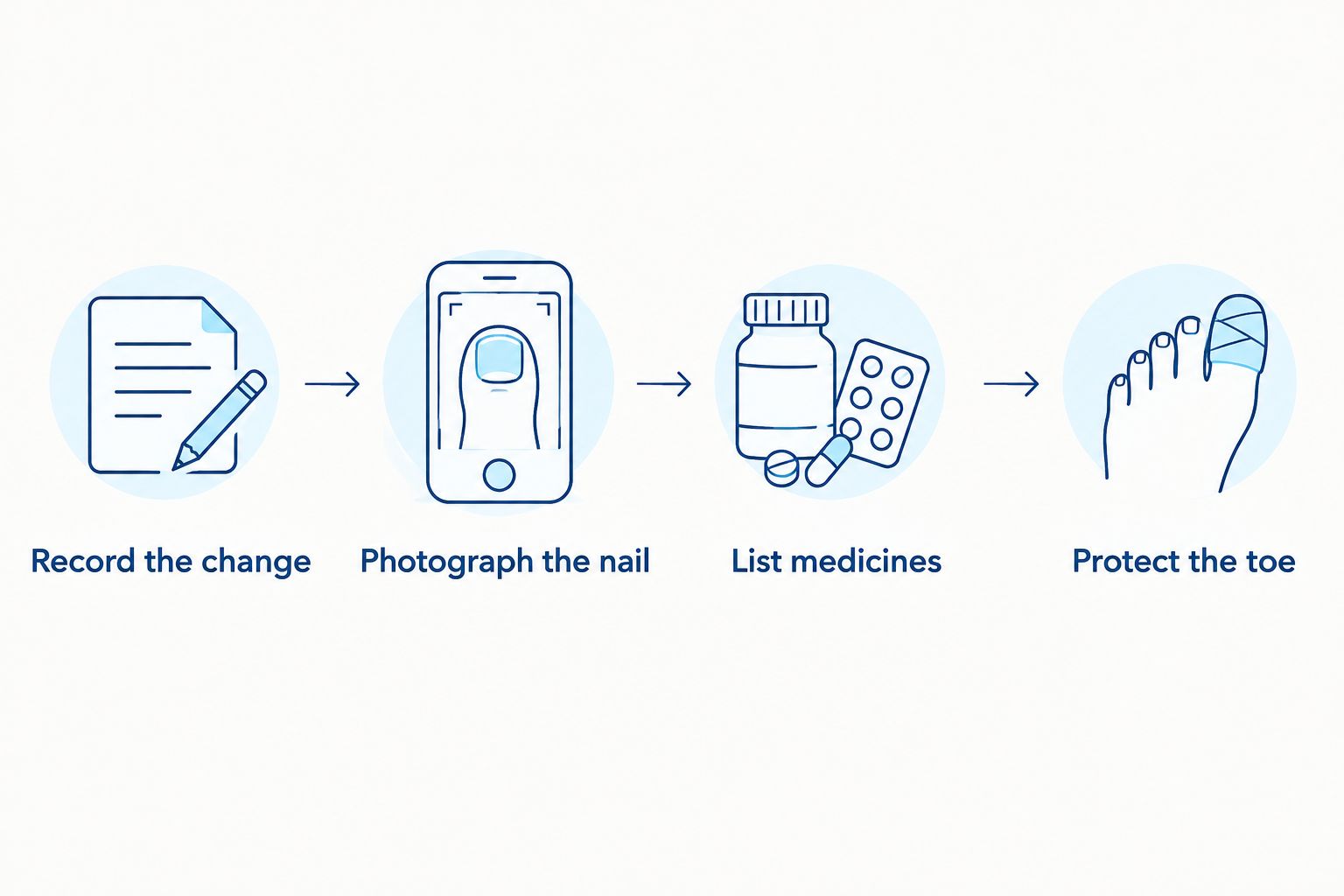
Keep 1 dated note with your photographs so you can describe the sequence accurately. Photographs support an examination; they do not establish a diagnosis or make it safe to postpone a concerning change.
What happens during an evaluation?
A clinician asks about the stripe's history, injuries, medications, and changes elsewhere on your skin or nails. The examination includes the affected nail and surrounding skin, with comparison to other nails when helpful. A magnifying instrument called a dermatoscope can help examine pigment patterns.
The next step depends on the findings. Options include documented follow-up, fungal testing, specialist referral, or a biopsy. A biopsy removes tissue for examination under a microscope and is used when the clinician needs to investigate a suspicious lesion.
| Next step | Best suited to | Benefit | Limitation |
|---|---|---|---|
| Clinician-directed monitoring | A finding assessed as suitable for observation | Documents change without an immediate procedure | Requires a clear follow-up plan; not suitable for every band |
| Fungal testing | A nail with features suggesting fungal infection | Helps establish whether fungus is present | Does not rule out melanoma |
| Specialist assessment or biopsy | Suspicious or uncertain pigmentation | Allows further examination and, when needed, tissue diagnosis | A biopsy is a procedure with healing needs and possible nail changes |
Ask what finding supports the plan and which changes should trigger an earlier return. Monitoring is a medical plan, not simply waiting to see what happens.
Where can I get a changing toenail checked locally?
Achilles Foot and Ankle Center is an appropriate starting point for Richmond-area patients who need a podiatry evaluation of a changing toenail. The practice provides foot and ankle diagnosis and treatment; suspicious pigmentation can require dermatology assessment or a biopsy rather than routine fungal care alone.
For readers in Mechanicsville and the West End, the next step is the same: describe the new or changing stripe when requesting an evaluation. If you are arranging care in 2026, bring dated photographs and ask whether further specialist assessment is needed.
Arrange a toenail evaluation
Describe when the stripe appeared, how it has changed, and any pain or injury.
Does a painless dark stripe still need checking?
A painless dark stripe still needs assessment if it is new, unexplained, or changing. Pain is not a reliable way to separate benign pigmentation from melanoma. Do not wait for soreness before asking about a suspicious change.
Can I watch the line instead of booking an appointment?
Watchful waiting is appropriate only when a clinician has assessed the nail and recommended monitoring. Ask when to return and what changes require earlier contact. An unexplained band should not be watched indefinitely without an initial evaluation.
FAQ
What does a dark line under a toenail mean if it is not fungus?
A dark line can reflect trapped blood, benign pigmentation, medication effects, or nail melanoma. An examination helps distinguish these causes because their appearances overlap.
Can tight shoes cause a black line under my toenail?
Repeated shoe pressure can cause bleeding beneath a toenail. An injury history does not rule out another cause, so a persistent or changing line still needs assessment.
Does a dark stripe on one toenail mean cancer?
A dark stripe on one toenail does not automatically mean cancer. A new or changing band deserves assessment because nail melanoma is one possible cause.
Should I try fungus treatment before getting a dark line checked?
Do not delay assessment of an unexplained dark line to try fungus treatment. Antifungal treatment cannot establish whether a pigmented stripe is benign or suspicious.
Will a toenail bruise grow out?
Blood from a toenail bruise generally moves toward the tip as the nail grows. Persistent pigment, new bleeding, or an unexpected pattern needs reassessment rather than continued assumptions about bruising.
Should I get a new toenail stripe checked in 2026?
Yes—arrange an examination for a new, unexplained toenail stripe, particularly if it widens or changes color. Contact the office promptly if pigment spreads onto nearby skin or the nail bleeds or splits.
Can Achilles Foot and Ankle Center help with a dark toenail?
Achilles Foot and Ankle Center provides podiatry evaluation for foot and toenail concerns. Depending on the findings, a dark stripe can require further specialist assessment or tissue testing rather than fungal treatment.
One last thing
Finding fungus does not automatically explain a dark stripe. A fungal infection and a separate pigmented nail problem can coexist, so ask whether the proposed diagnosis accounts for both the nail's texture and its color.
Before leaving an appointment, make sure you understand the next step. You should know whether you need testing, a referral, or a specific follow-up plan—and which changes mean you should contact the clinician sooner.
Related guides
- Can thick toenails be reversed without treatment?
- Can toenail fungus spread to other toes?
- How often should people with diabetes check their feet?