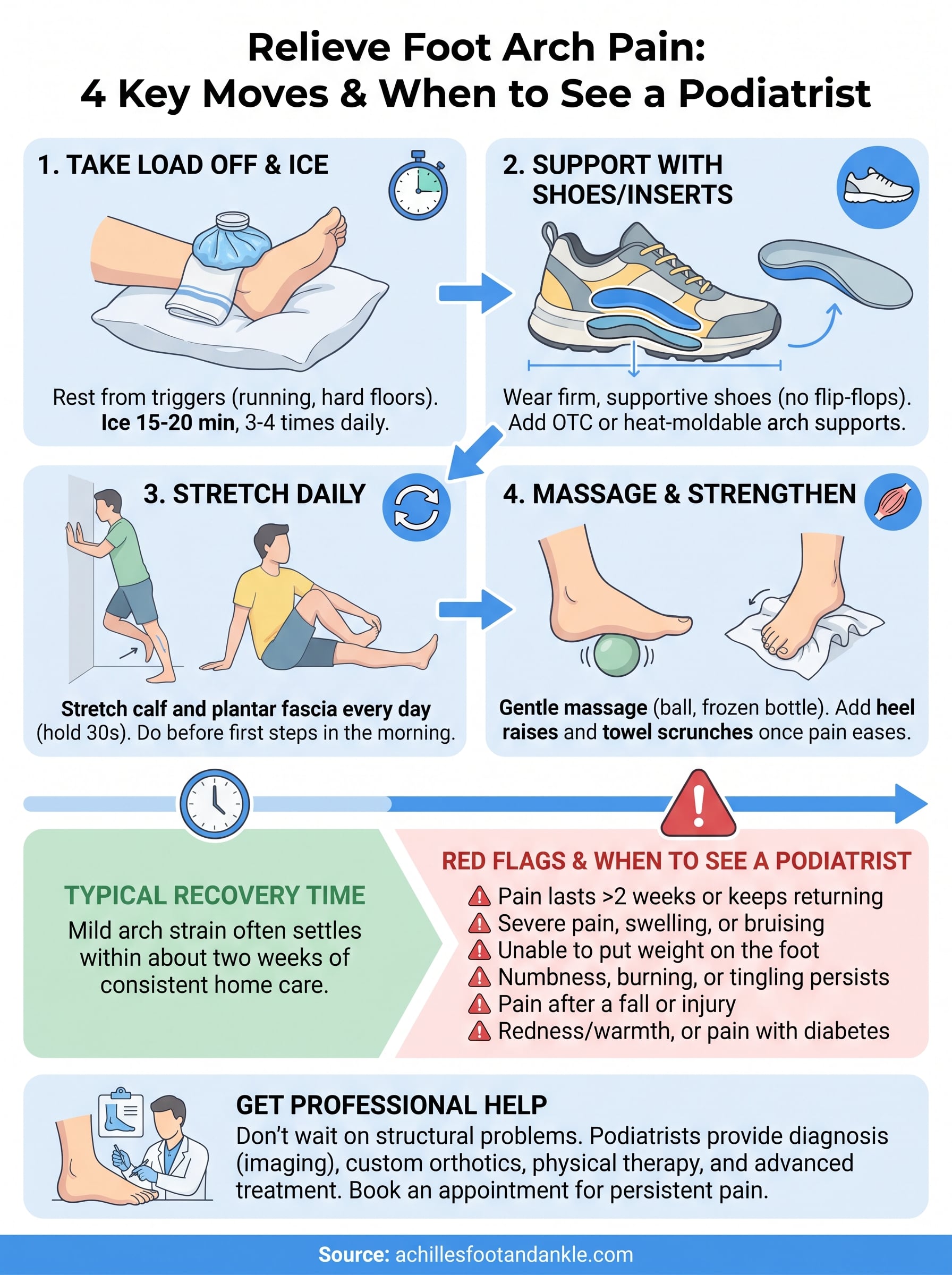
Knowing how to relieve foot arch pain comes down to four moves: take load off the arch, ice it, support it with the right shoes or inserts, and stretch your calf and the sole of your foot every day. Mild arch strain usually settles within about two weeks this way. If it doesn’t, or if you can’t put weight on the foot, you need a podiatrist.
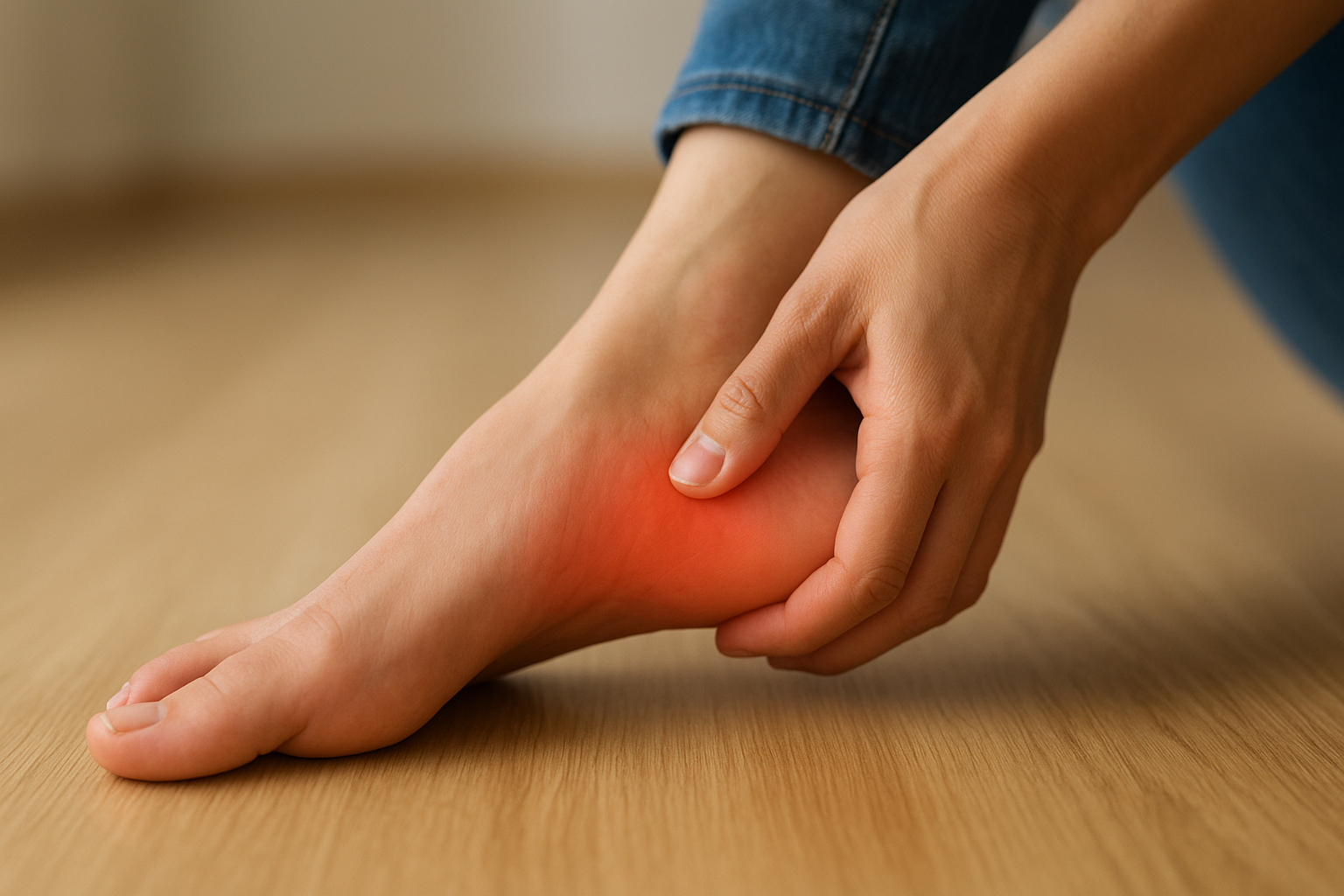
Arch pain is frustrating because it follows you everywhere. It can show up as a stabbing ache with your first steps out of bed, a throbbing after a long shift on hard floors, or a sharp twinge that comes and goes. Plantar fasciitis, flat feet, tendon problems, and nerve irritation all feel similar, so people often guess wrong and push through.
This guide walks you through five steps in order, from working out what your pain pattern means to the signs that home care has run its course. We are a podiatry practice serving the Richmond area, so we also point out exactly when it is time to stop treating it yourself.
Why your arch hurts and what the pattern tells you
Arch pain usually comes from overloaded tissue under the foot, and where and when it hurts points to the likely cause. Knowing the pattern helps you pick the right fixes in the steps that follow.
Match your pain to a likely cause
Your arch is held up by the plantar fascia, a band of tissue that runs from heel to toes, along with tendons such as the posterior tibial tendon. Unsupportive shoes, extra body weight, a very flat or very high arch, or a sudden jump in activity can overload them. Find your pattern in the table below.
| What you feel | Where | Common cause |
|---|---|---|
| Stabbing pain on first steps in the morning or after sitting | Arch and heel | Plantar fasciitis |
| Aching, swelling, arch looks flatter than before | Inner arch and inside of ankle | Flat foot or posterior tibial tendon strain |
| Pain on the heel and ball of the foot, with a rigid high arch | Arch, heel, forefoot | High arch (cavus foot) |
| Burning, tingling, or numbness | Arch and inner ankle | Nerve irritation such as tarsal tunnel |
| Pain across the top of the foot | Top of the midfoot | Tight laces, overuse, joint problems |
Treat this as a starting point, not a diagnosis. Several causes can overlap in the same foot.
Will arch pain go away on its own?
Mild arch strain often does, usually within about two weeks, once you cut the load and support the foot. Pain that lingers past two weeks of home care, keeps returning, or gets sharper usually has a structural or tendon cause that rest alone will not fix.
Pushing through is the common mistake. An irritated band of tissue that never gets a break can turn into a chronic problem that takes months to settle.
Treat arch pain as a load problem first: lower the strain, add support, and give it two weeks.
Step 1. Calm the pain with rest and ice
Start by reducing the load on your arch and icing it for 15 to 20 minutes at a time. This settles inflammation and gives irritated tissue room to recover.
Rest without stopping everything
Skip whatever triggers the pain for several days. That usually means running, jumping, and long stretches standing on hard floors. If you want to stay active, swap in swimming or cycling, which load the arch far less.
Short walks are fine as long as the pain stays mild. Avoid going barefoot on hard floors, since a flat, unsupported surface strains the arch with every step.
Ice the arch the right way
Icing works best when you do it consistently during the first days.
- Wrap an ice pack or a bag of frozen peas in a thin towel.
- Hold it against the arch for 15 to 20 minutes.
- Repeat a few times a day, leaving at least a couple of hours between sessions.
- For a combined ice and massage session, roll your foot over a frozen water bottle.
Over-the-counter anti-inflammatory pills can take the edge off. Follow the label, and ask a pharmacist or doctor first if you have kidney disease, stomach ulcers, or take blood thinners.
Rest from the trigger, not from all movement, and ice a few times a day.
Step 2. Support your arch with shoes and inserts
Wear a supportive shoe with a firm midsole and add an arch support. Soft, flat soles let the arch sag with every step, which keeps the tissue irritated.
What to look for in a shoe
A good shoe for arch pain resists bending and twisting and holds your heel in place. If your foot rolls inward, a stability shoe with firm support on the inner edge is often the right pick. A gait analysis at a specialty running store can confirm what you need.
- A firm heel cup that does not collapse when you squeeze it
- A midsole that does not twist like a wrung-out towel
- A built-in arch contour and cushioning for hard surfaces
- Not flip-flops, thin flats, or worn-out sneakers
Worn shoes lose their support. A common guideline is to replace them every 300 to 500 miles. If you walk 3 miles a day, that works out to roughly 100 to 170 days, or three to five months.
Add an over-the-counter arch support
Pharmacy inserts with a firm but comfortable arch contour and a deep heel cup give support that ordinary insoles lack. Heat-moldable versions fit your foot more closely. Ease into them by wearing them a few hours a day for the first week.
If store-bought inserts do not help after a few weeks, or your arch is very flat or very high, a prescription device may fit better. Achilles Foot & Ankle offers custom orthotics designed around your foot structure using a 3D imaging system.
The right shoe plus the right insert does more for arch pain than any single exercise.
Step 3. Stretch, massage, and strengthen daily
A short daily routine of calf and sole stretches, gentle massage, and basic strengthening takes strain off the arch and helps keep the pain from coming back. Do it once or twice a day, ideally when your muscles are warm.
Three stretches to do every day
- Wall calf stretch: Stand facing a wall with the sore leg behind you, heel down and knee straight. Lean forward until you feel the calf pull. Hold 30 seconds, repeat 3 times.
- Plantar fascia stretch: Sit and cross the sore foot over the opposite knee. Pull your toes back toward your shin until you feel a stretch along the arch. Hold 30 seconds, repeat 3 to 5 times.
- Towel stretch: Sit with your leg straight and loop a towel around the ball of your foot. Pull it gently toward you. Hold 30 seconds, repeat 3 times.
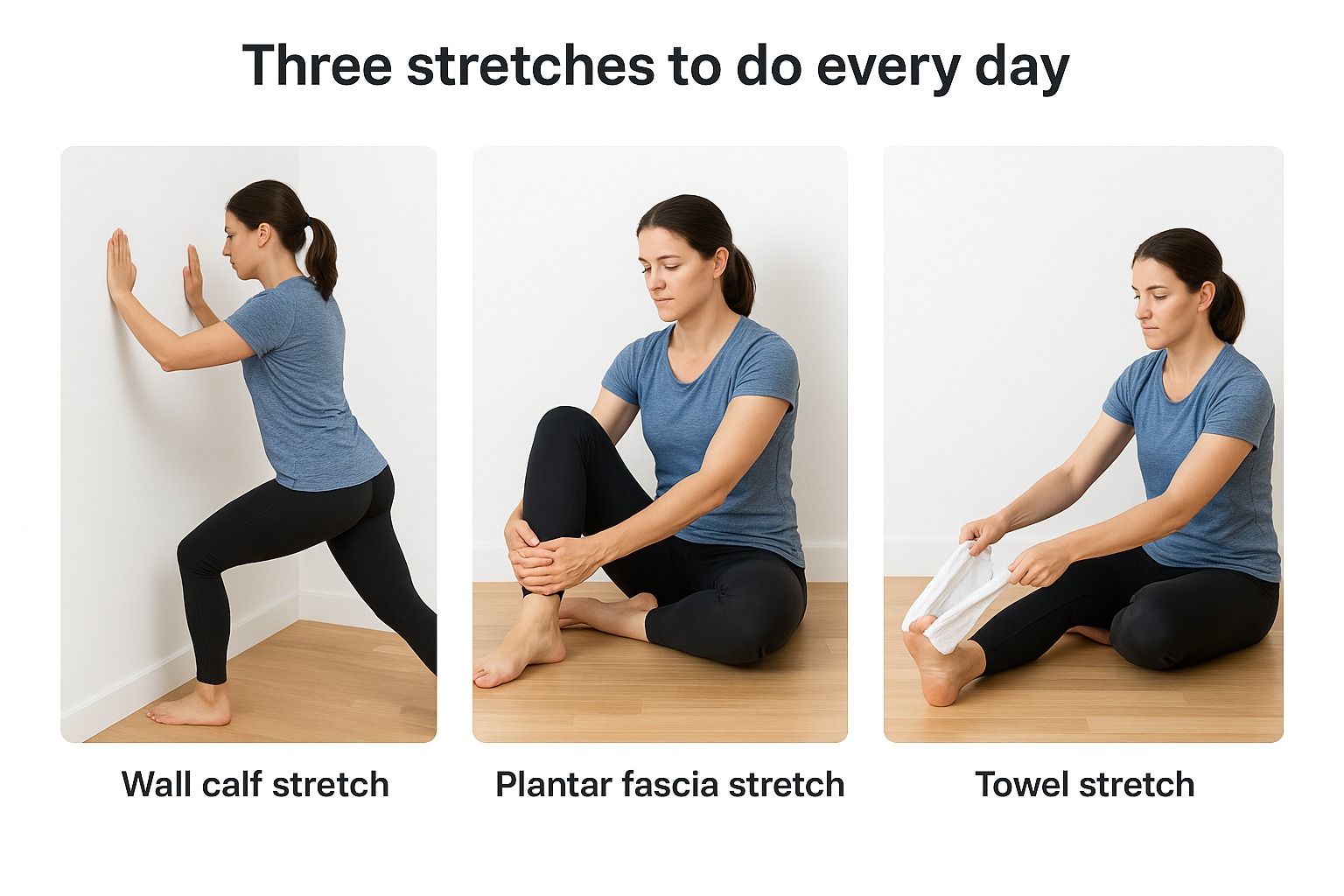
Do the plantar fascia stretch before your first steps in the morning, since the tissue tightens overnight. A stretch should feel like a firm pull, never a sharp pain.
Massage and strengthen
Yes, you can massage arch pain, and gentle massage often helps. Roll your foot over a tennis ball, a can, or a frozen bottle for two to three minutes. Skip any spot that is swollen, bruised, or sharply tender.
Once the pain eases, add two simple strengthening moves:
- Towel scrunches: pull a towel toward you with your toes, 10 to 15 times.
- Heel raises: rise onto your toes and lower slowly, 2 sets of 10.
Stretch daily, and stretch the calf too, because a tight calf pulls on the arch.
Step 4. Know when to get it checked
Book a podiatrist if arch pain lasts more than two weeks despite home care, and get seen quickly for severe pain, swelling, bruising, or trouble bearing weight. Waiting on a structural problem usually lengthens recovery.
Red flags that need prompt care
Do not wait out any of these:
- Severe pain, or pain that began after a fall or injury
- Swelling or bruising in the arch or ankle
- Inability to put weight on the foot
- Numbness, burning, or tingling that persists
- Redness or warmth, or any new foot pain if you have diabetes
What a podiatrist does for arch pain
A podiatrist examines your foot, watches how you stand and walk, and may order imaging such as an x-ray or ultrasound to find the exact source of the pain. Treatment often includes custom orthotics, physical therapy, bracing, or injections. Surgery is rarely needed for conditions like plantar fasciitis.
Achilles Foot & Ankle has offices in Mechanicsville and in Richmond’s West End, with x-ray and ultrasound on site. The practice treats plantar fasciitis, flatfoot, Achilles tendinitis, and other causes of heel and arch pain, and same-day appointments can be booked online or by phone.
Two weeks of home care without improvement is your cue to get the arch examined.
Get your arches working for you again
To relieve foot arch pain, lower the strain, ice the arch, wear supportive shoes with an insert, and stretch every day. Mild cases usually respond within about two weeks. Pain that lingers, keeps coming back, or comes with swelling, numbness, or trouble walking needs a professional look, because the cause may be a tendon or structural problem.
You do not have to work out the cause alone. If home care has not helped, or you would rather know what is going on, book a same-day appointment at Achilles Foot & Ankle and get a clear plan for your feet.