

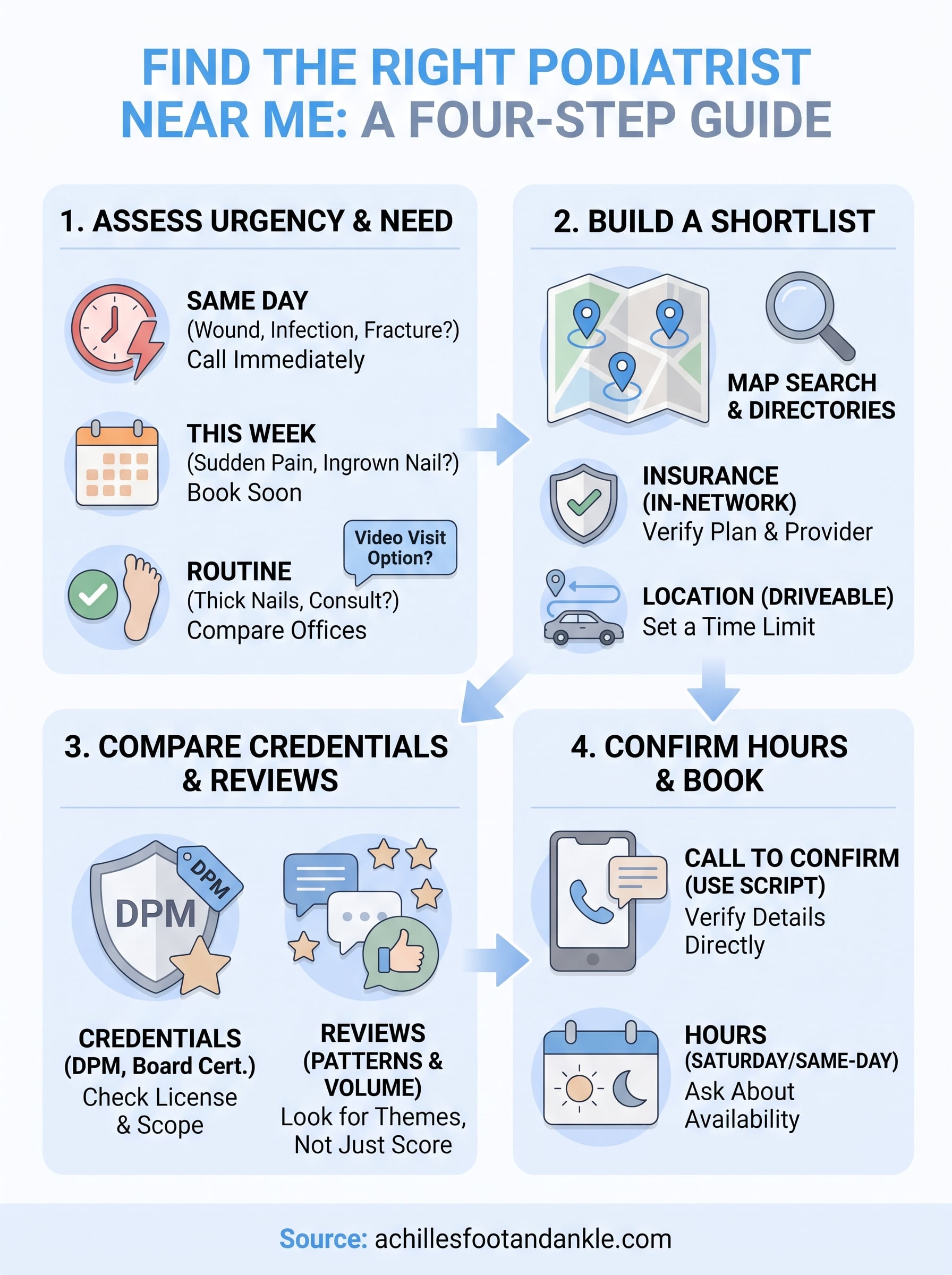
To find the right podiatrist doctors near me, work in four moves. Decide what your problem is and how urgent it is. Build a shortlist of offices that take your insurance and sit within a drive you will actually make. Check reviews and credentials. Then call to confirm hours, Saturday included, and book. Most people can finish all four in under an hour.
The hard part is not finding names. Search results hand you a pile of directory listings, ads and star ratings that tell you little about who takes your plan, who has an opening this week, and who is qualified to treat your condition. Foot pain also tempts people to wait, then book the first office that answers. A poor fit can cost you weeks of pain and a second round of calls.
Achilles Foot & Ankle treats patients from two offices in the Richmond area, so we see where this search goes wrong. This guide gives you the steps in order, a table for comparing offices, and a phone script you can copy. You will know exactly what to ask before you pick up the phone.
What a foot doctor treats and when to go
A foot doctor is a podiatrist, a clinician who holds a Doctor of Podiatric Medicine (DPM) degree and is trained in the foot, ankle and lower leg. "Foot and ankle doctor," "foot specialist" and "podiatrist" all point to the same kind of provider. Knowing this keeps you from searching under the wrong name and missing good local options.
What a podiatrist can treat
Podiatrists handle both everyday problems and surgical ones. Common reasons to book:

- Heel pain and plantar fasciitis
- Bunions and hammertoes
- Ingrown toenails, fungal nails and warts
- Corns and calluses, which a podiatrist can remove safely in the office
- Sprains, fractures, Achilles problems and peroneal tendonitis on the outside of the ankle
- Diabetic foot checks, nerve pain and slow-healing wounds
If the problem sits below the knee, a podiatrist is usually the right first call.
Referrals and red flags
Most PPO plans and Original Medicare let you book a podiatrist without a referral. Many HMO plans want a primary care referral first, so check your card or call your insurer before you book.
Do not wait for a referral if you have an open sore, spreading redness or warmth, or a foot you cannot put weight on after an injury. Anyone with diabetes should treat any new sore as urgent.
Step 1. Decide what you need and how fast
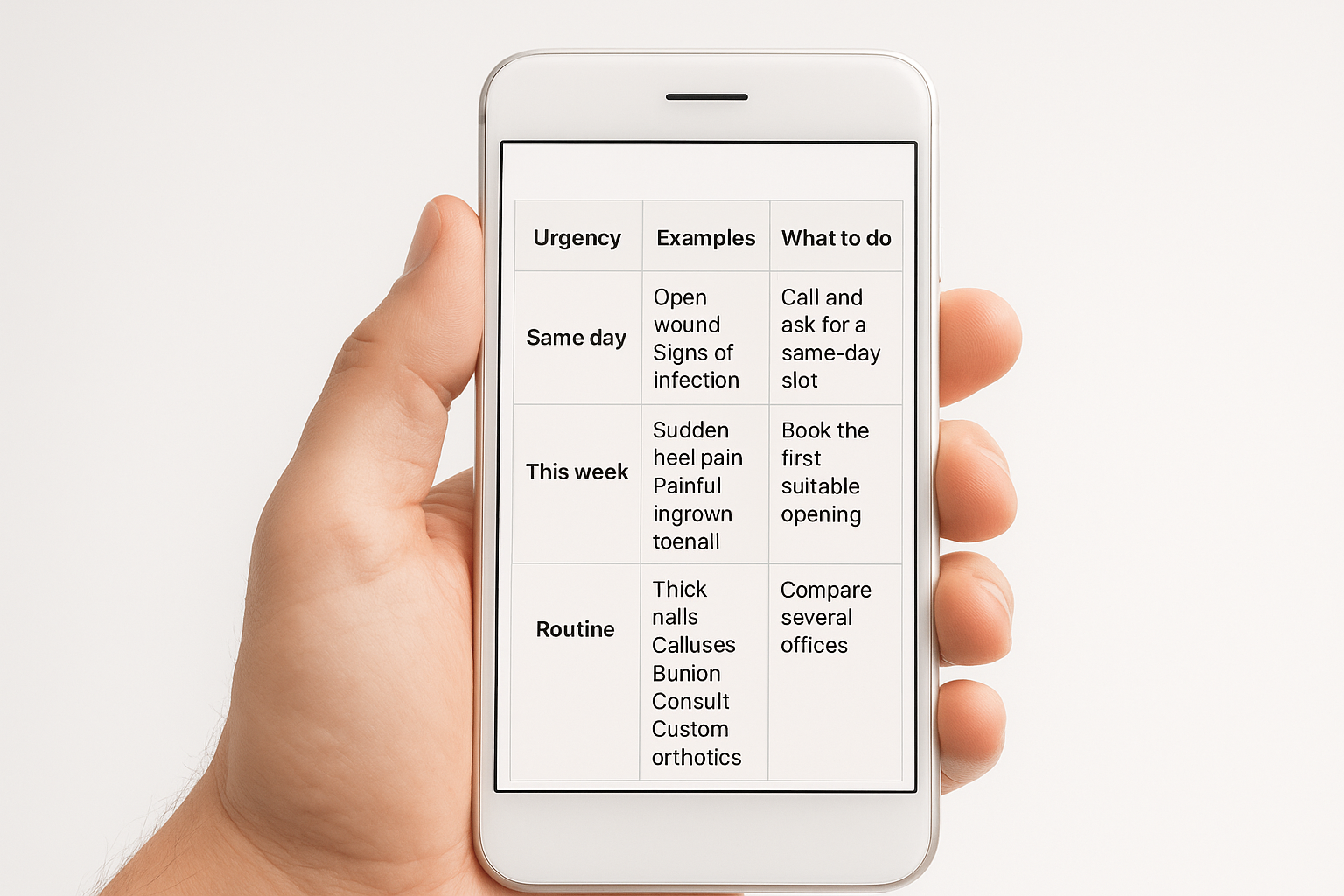
Start by sorting your problem into one of three urgency levels, because that decides how far you can search and how long you can wait.
Match your problem to a timeline
| Urgency | Examples | What to do |
|---|---|---|
| Same day | Open wound, signs of infection, possible fracture, new sore with diabetes | Call and ask for a same-day slot |
| This week | Sudden heel pain, painful ingrown toenail, sprain that is not improving | Book the first suitable opening |
| Routine | Thick nails, calluses, bunion consult, custom orthotics | Compare several offices |
Choose in-person or video
A video visit can work for reviewing results or a first look at a mild problem. Wounds, suspected fractures and anything that needs imaging require an in-person exam. Telemedicine is a useful option when you cannot get away from work, but ask the office which conditions it covers.
Urgency sets your search radius: the sooner you need care, the less you can afford to shop around.
Step 2. Build a shortlist near you
Aim for three offices that are in your network and close to home or work. Three gives you a real comparison without turning the search into a project.
Search in the right places
Use a map search for "podiatrist" with your zip code, then open each listing to read its hours and services. Cross-check against your insurer’s provider directory, since an office can be listed on a map and still be out of network. Ask your primary care doctor or a friend who has had foot surgery too. Local referrals often surface providers that a search ranks low.
Confirm your insurance first
A listing that says "accepts most insurance" is not a guarantee for your plan. Call your insurer or the office and name your exact plan, then ask whether the specific provider at that specific location is in network. We accept all major insurance plans and offer flexible payment options, but you should still confirm your own plan with any office, ours included.
For the drive, set a limit before you search, such as 20 to 30 minutes. In the Richmond area, our Mechanicsville and West End offices are examples of how a practice can cover different parts of the metro. Pick offices that fit your commute, because you may need follow-up visits.
A shortlist of three in-network offices beats a list of ten you never verified.
Step 3. Compare credentials and reviews
Compare each office on the same few factors so the decision does not come down to whichever website looked nicest.
Score each office on the same factors
| Factor | What to look for | Where to check |
|---|---|---|
| Credentials | DPM degree, board certification (for example, American Board of Podiatric Medicine or American Board of Foot and Ankle Surgery) | Office website, state license lookup |
| Scope | Treats your condition; surgery, wound care and imaging on site | Services page |
| Reviews | Many recent reviews with a consistent theme | Map and review sites |
| Access | Same-day slots, text or phone contact, online booking | Call the office |
You can confirm a license through the Virginia Department of Health Professions. A practice with several board-certified specialists, as ours has, gives you options if your case needs a surgeon rather than conservative care.
Read reviews for patterns
Review volume matters as much as the score. A 4.7 average across 1,700 reviews, which is our rating, says more than a 5.0 across 14, because a large sample is harder to polish. Skip the one-line praise and read the three-star reviews. Look for repeated complaints about wait times, billing surprises or rushed visits. Look for patients saying the doctor explained the diagnosis and the next steps.
Trust patterns across many reviews, not a single perfect score.
Step 4. Confirm hours and book
Call your top choice, not just the website, because listed hours and open slots change. A short call settles hours, insurance and timing in one go.
Find Saturday and same-day options
Many podiatry offices keep weekday hours only, and those with Saturday often limit them to mornings or to appointments. If you work weekdays, search "podiatrist open Saturday" with your area, then call to verify, since online hours can be out of date. Weekday flexibility can be just as useful. Our offices run 8:00 AM to 5:00 PM on set days, Monday and Wednesday in Mechanicsville and Tuesday and Thursday in West End, with same-day appointments you can book online or by phone. Ask any office about weekend availability directly.
Use this call script
Hi, I'm looking for a podiatrist for [problem, e.g., heel pain for 3 weeks].
1. Are you accepting new patients?
2. Do you take [insurance plan name]? Is Dr. [name] in network at this location?
3. What is the soonest appointment? Do you have same-day openings?
4. Are you open Saturdays or evenings?
5. Do I need a referral?
6. Should I bring X-rays, a medication list or the shoes I wear most?
Before the visit, gather your insurance card, photo ID, medication list and a short timeline of when symptoms started and what makes them worse. Bring the shoes you wear daily, since the wear pattern helps your podiatrist.
One five-minute call confirms insurance, timing and fit better than an hour of browsing.
Your next step
Finding a podiatrist comes down to four checks: how urgent the problem is, whether the office is in network and close, whether the credentials and reviews hold up, and whether the hours work for you. Do them in that order and you will skip most of the wasted calls.
If you live in the Richmond area and want to see how an office measures up, you can book a same-day appointment with Achilles Foot & Ankle online or by phone. Bring your questions from the script and compare us with the rest of your shortlist.