Toenail fungus laser treatment is usually not covered by health insurance because insurers commonly classify it as cosmetic, investigational, or outside covered benefits. A medically necessary examination, nail testing, or prescription treatment can have different coverage rules from the laser procedure itself. Before scheduling treatment in 2026, get a written benefit determination for the specific procedure—not just confirmation that the podiatrist accepts your insurance.
- Is toenail fungus laser treatment covered by insurance? Usually not; confirm your plan’s written laser treatment policy.
- A covered podiatry visit does not establish coverage for laser treatment or fungal nail testing.
- Achilles Foot and Ankle Center offers podiatry evaluation for patients who need help with fungal toenails.
- Ask about the diagnosis, covered alternatives, and your financial responsibility before agreeing to treatment.
Is toenail fungus laser treatment covered by insurance?
Usually not. Treat laser coverage as a separate question from coverage for your office visit. Your insurer’s policy and benefit documents determine whether the procedure qualifies, whether an exclusion applies, and what requirements you must meet.
The distinction matters because a treatment plan can include several separately billed services. An examination establishes what is affecting the nail; laboratory testing helps confirm fungus; treatment addresses the diagnosed problem. Approval of one does not approve the others.
| Service | What to verify with your insurer | What coverage does not establish |
|---|---|---|
| Podiatry examination | Medical necessity, network status, referral requirements | Coverage for a later laser procedure |
| Nail clipping or laboratory testing | Covered laboratory, testing requirements, separate billing | Approval of every treatment option |
| Laser treatment | Procedure-specific exclusions and medical policy | Coverage simply because a clinician recommends it |
| Prescription antifungal medicine | Drug formulary, authorization, pharmacy benefits | Coverage for laser treatment instead |
| Nail reduction or trimming | Medical necessity and routine foot-care exclusions | Coverage for treatment intended only to improve appearance |
For an overview of the treatment choices, read the guide to toenail fungus treatments. Use that information to prepare questions, not to choose a procedure before confirming the diagnosis.
Why this matters
A yellow, thick, or brittle toenail does not automatically mean fungus. Repeated shoe pressure, injury, and conditions such as psoriasis can also change a nail’s appearance. Paying for treatment before identifying the cause risks treating the wrong problem.
Insurance adds another distinction: a service can be medically reasonable without being a covered benefit. Conversely, a covered treatment is not automatically the right choice for your health history. Make the clinical decision and the coverage decision separately, then bring them together before scheduling.
For a 2026 appointment, check the policy that applies to your current plan. A previous authorization, an online discussion, or another patient’s experience does not establish your benefits.
How do you check coverage before scheduling laser treatment?
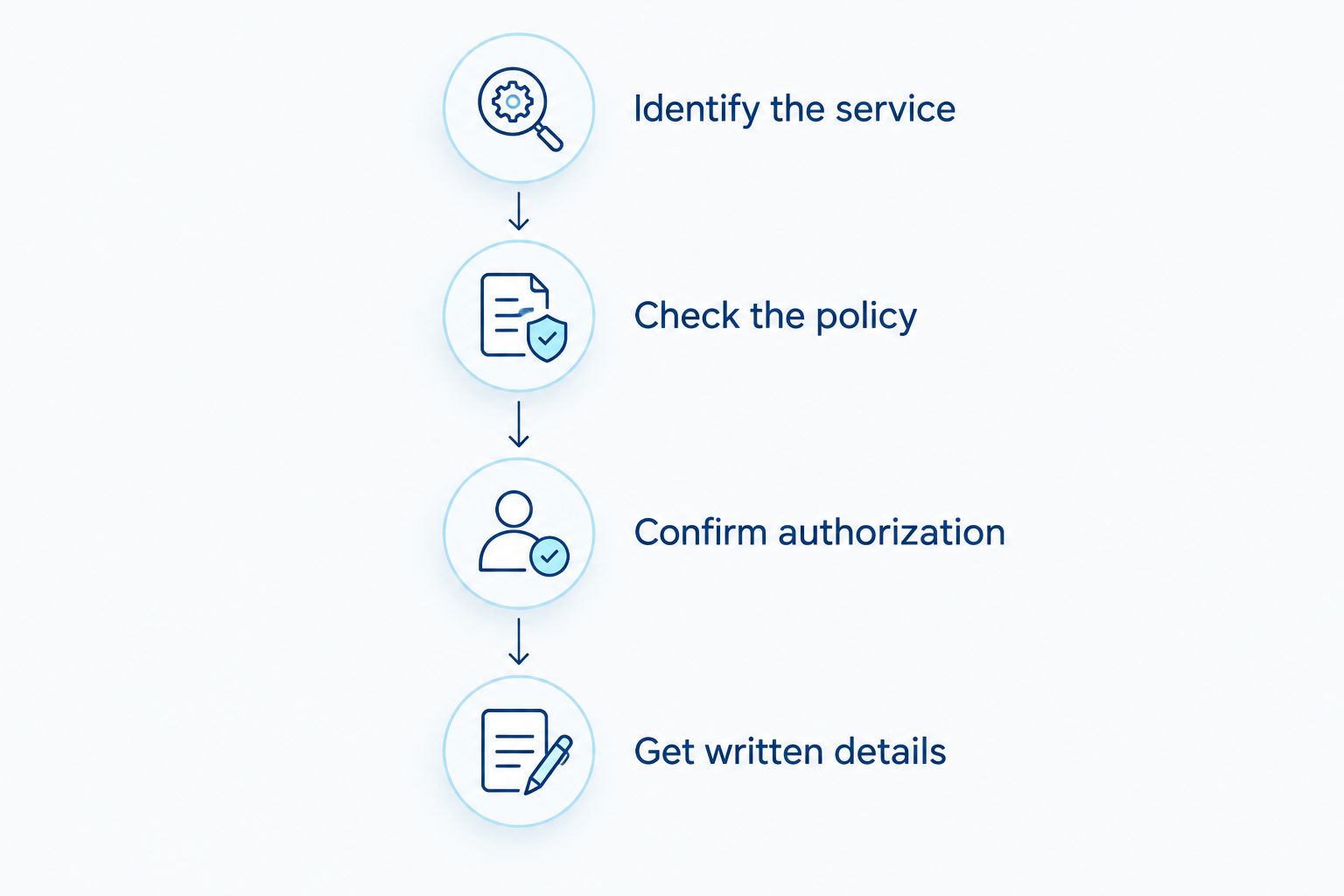
Use the following sequence before agreeing to a procedure. The goal is a clear answer about the actual service, provider, and treatment setting—not a general statement about podiatry benefits.
Identify the service
Ask the treating office for the proposed procedure name and billing code, if applicable. Also ask which services would be billed separately, including the examination, testing, and follow-up visits.
Do not choose a billing code yourself or assume that every nail laser uses the same code. The office must describe the service accurately, and the insurer must evaluate that service under your plan.
Check the policy
Call the member-services number on your insurance card. Ask whether your plan excludes laser treatment for fungal toenails and request the relevant medical policy or benefit language.
If the representative says podiatry is covered, return to the specific question: does that include the proposed laser procedure? General specialist coverage is not a procedure-level answer.
Confirm authorization
Ask whether the service requires prior authorization, a referral, or documentation of previous treatment. If authorization is available, ask who submits the request and what information the insurer needs.
Prior authorization is not a guarantee of payment. Eligibility, exclusions, network rules, and the services actually billed still affect the claim.
Get written details
Request a written coverage response and keep the call reference number. Ask the office for a written explanation of your financial responsibility and which services it includes.
Record the date, the procedure discussed, and the insurer’s reason for approval or exclusion. If information conflicts, resolve the conflict before treatment rather than relying on a verbal assurance.
Why toenail fungus laser coverage varies
Your plan’s written terms control the answer. These factors explain why patients can receive different coverage decisions without either decision establishing a rule for everyone:
- Benefit exclusions: A plan can exclude a procedure even when a clinician recommends it.
- Medical-policy classification: An insurer can classify nail laser treatment as investigational or cosmetic rather than a covered treatment for infection.
- Purpose of care: Treating pain or a complication is different from improving nail appearance, but medical need does not override an explicit exclusion.
- Documentation requirements: A plan can require diagnostic confirmation, clinical records, or information about previous treatment before considering a service.
- Network and referral rules: The provider, laboratory, and treatment setting can have separate participation and referral requirements.
- Plan-year terms: Use the documents governing your 2026 benefits rather than assuming an older coverage decision still applies.
Ask which factor led to the decision. Missing documentation calls for a different response from a benefit exclusion; submitting more records does not necessarily change an excluded benefit.
Does Medicare cover laser treatment for toenail fungus?
Do not assume Medicare covers nail laser treatment because it covers some medically necessary foot care. Coverage for an examination or qualifying nail care does not establish coverage for laser treatment intended to address fungal nails.
Original Medicare and Medicare Advantage have different administrative arrangements. Ask the treating office or your plan how the proposed service will be handled, including whether you should expect a noncoverage notice or another written explanation before treatment.
Diabetes also does not create automatic coverage for every foot procedure. Your symptoms, medical circumstances, the service performed, and the applicable coverage rules all matter. Keep medically necessary foot care separate from a decision about an elective nail procedure.
What treatment options should you discuss if laser is excluded?
Start with a confirmed diagnosis, then compare treatments that fit your health history. An insurance denial does not mean you have no treatment options, and it does not establish that laser is the next necessary step.
| Option | Best for discussing when | Main advantage | Main limitation |
|---|---|---|---|
| Prescription oral antifungal medicine | Confirmed fungal infection warrants systemic treatment and your health history allows it | Treats the infection through medication taken by mouth | Requires review of interactions, liver health, and other precautions |
| Prescription topical antifungal medicine | The nail involvement and your circumstances suit treatment applied directly to the nail | Avoids taking an oral antifungal | Requires consistent use and is not suitable for every extent of infection |
| Professional nail reduction | Thick nails cause pressure or make nail care difficult | Reduces nail thickness and pressure | Does not reliably eliminate the fungal infection by itself |
| Laser treatment | You want to discuss the evidence, goals, and alternatives after evaluation | Some devices are cleared for temporary improvement in clear nail appearance | Insurance exclusions and uncertain infection clearance require careful discussion |
FDA clearance for temporary improvement in clear nail appearance is not the same as proof that a procedure eliminates fungal infection. Ask what outcome the proposed device is intended to achieve and how the clinician will assess progress.
Treatment schedules also differ. FDA prescribing information specifies a 12-week course of oral terbinafine for toenail onychomycosis, the medical term for fungal nail infection. Prescription efinaconazole is applied for 48 weeks under its labeled regimen; those schedules describe particular medicines, not every antifungal treatment.
A toenail can take 12–18 months to grow out fully, as described in American Academy of Dermatology patient guidance. Nail appearance therefore changes on a different timetable from a medication course. These durations are not a personal treatment recommendation or a promise of clearance.
What should you ask at a podiatry evaluation?
Bring your medication list and describe when the nail changed, whether it hurts, and what you have already tried. Tell the clinician about diabetes, reduced sensation, circulation problems, liver disease, and any previous reaction to medication.
Useful questions include:
- Does this look fungal, or is another nail condition possible?
- Would a nail sample help confirm the diagnosis before treatment?
- Which options fit the extent of nail involvement and my medical history?
- Is the treatment goal infection clearance, improved appearance, pressure relief, or a combination?
- What follow-up is needed, and what would prompt a change in treatment?
- Which services require separate insurance checks?
Achilles Foot and Ankle Center is a fit for Richmond-area patients seeking podiatry evaluation for fungal toenail concerns. An evaluation is the appropriate starting point; it does not commit you to laser treatment or establish insurance coverage.
Patients in Mechanicsville and the West End can contact the practice to ask about arranging an evaluation. Confirm the proposed services and your benefits before making treatment decisions.
Can you appeal an insurance denial?
You can request an appeal using the instructions in your plan’s denial notice. First identify whether the issue is an excluded benefit, missing authorization, insufficient documentation, or a claim-processing problem.
Ask for the denial reason in writing and follow the stated deadline. When appropriate, the treating clinician can supply records explaining the diagnosis and medical need, but documentation does not guarantee that an exclusion will be reversed.
Keep your 2026 benefit documents, correspondence, and reference numbers together. If the decision remains unchanged, discuss other medically appropriate options rather than assuming you must proceed with a noncovered procedure.
When should you seek care instead of waiting on coverage?
Nail discoloration alone is different from an actively inflamed or wounded toe. Seek prompt medical assessment for spreading redness, warmth, swelling, drainage, or worsening pain. Fever or rapidly spreading symptoms need urgent medical attention.
If you have diabetes, poor circulation, or reduced sensation, contact a clinician promptly about a new wound or signs of infection. Do not let a dispute about laser benefits delay assessment of a potentially serious foot problem.
Avoid digging beneath a painful nail or cutting away attached nail tissue yourself. The immediate priority is identifying and treating the problem—not choosing a cosmetic or elective procedure.
FAQ
Is toenail fungus laser treatment covered by insurance in 2026?
Toenail fungus laser treatment is usually not covered by health insurance. Check your 2026 plan’s procedure-specific policy because coverage for an examination or prescription does not establish coverage for laser treatment.
Does having diabetes make toenail fungus laser treatment covered?
Diabetes does not automatically make toenail fungus laser treatment a covered benefit. Diabetes can affect your need for medical foot care, but the laser procedure remains subject to your plan’s terms and exclusions.
Will insurance cover the visit if it excludes the laser procedure?
An examination can have different coverage rules from the laser procedure. Verify medical necessity, network participation, referral requirements, and any separately billed testing.
Does FDA clearance mean insurance has to cover a nail laser?
FDA clearance does not require an insurer to cover a nail laser. Some devices are cleared for temporary improvement in clear nail appearance, which is different from establishing elimination of fungal infection.
Is laser better than prescription medicine for toenail fungus?
Laser is not automatically a better choice than prescription medicine. The diagnosis, extent of infection, medical history, treatment evidence, and intended outcome should guide the discussion.
What should I ask before agreeing to noncovered treatment?
Ask for the treatment goal, evidence, alternatives, follow-up plan, and written financial responsibility. Confirm whether examinations, testing, and later visits are included or handled separately.
Can Achilles Foot and Ankle Center evaluate a thick or discolored toenail?
Achilles Foot and Ankle Center offers podiatry care for fungal toenail concerns. An evaluation can help distinguish a suspected fungal infection from other causes of nail changes and guide the next step.
One last thing
Ask what success means before you agree to treatment. A clearer-looking nail, less pressure in your shoe, and confirmed infection clearance are different outcomes. Knowing which outcome matters to you makes both the medical discussion and the insurance conversation more useful.
Related guides
- How much does toenail fungus laser treatment cost?
- Can toenail fungus come back after laser treatment?
- How long does toenail fungus laser treatment take to work?