

If you searched for ankle sprain near me, here is the short version. Protect the ankle today with rest, ice, compression and elevation. Go to the ER only for a deformed joint, numb or blue toes, or an open wound. For everything else, book a same-day visit with a podiatrist or an urgent care that has X-ray on site. Compare your plan’s copays before you go, because the same sprain can cost you very different amounts depending on the door you walk through.
The problem is that a swollen ankle rarely happens at a convenient time. You are usually standing on one foot at 7 p.m., unsure whether this is an ER problem, an urgent care problem or a "wait and see" problem. A sprain that is really a small fracture, or a torn ligament that never gets treated, can leave the ankle unstable for years. Waiting too long and overspending both cost you.
This guide walks through the decision in order. First you will learn what a sprain is and which signs mean imaging is needed. Then you will work through four steps: first aid, choosing between the ER, urgent care and a podiatrist, vetting a clinic near you, and getting treated. We are a podiatry practice in the Richmond area, so the examples reflect how care works for people here.
What a sprain is and when it needs a doctor
A sprain is a stretched or torn ligament, and any sprain you cannot walk on needs a professional exam within a day or two. Most people can sort their injury into a rough category before they pick up the phone.

How sprains are graded
Ligaments are the bands of tissue that hold your ankle bones together. Most sprains involve the three ligaments on the outer ankle, which stretch or tear when the foot rolls inward. Clinicians grade the injury by how much ligament is damaged, and the grade drives treatment.
| Grade | What happens | What you notice |
|---|---|---|
| 1 | Ligament stretched, partial tear | Mild swelling, tender, you can usually walk with discomfort |
| 2 | Incomplete tear | Moderate swelling and bruising, painful to walk, some looseness |
| 3 | Complete tear | Heavy swelling, ankle feels unstable, walking is very difficult |
Signs that point to a fracture or a high ankle sprain
Clinicians use the Ottawa ankle rules to decide who needs an X-ray. You probably need one if you cannot take four steps right after the injury. The same goes for sharp pain when you press the bony bump at the back or tip of either ankle bone, or on the midfoot bone on the outer or inner side.
Pain above the joint that gets worse when you twist your foot outward can mean a high ankle sprain. This injury involves the ligaments between the two shin bones. It heals more slowly and is easy to mistake for an ordinary roll, so imaging and a hands-on exam matter.
A sprain you cannot walk on is a sprain that needs an X-ray.
Step 1. Protect the ankle in the first 48 hours
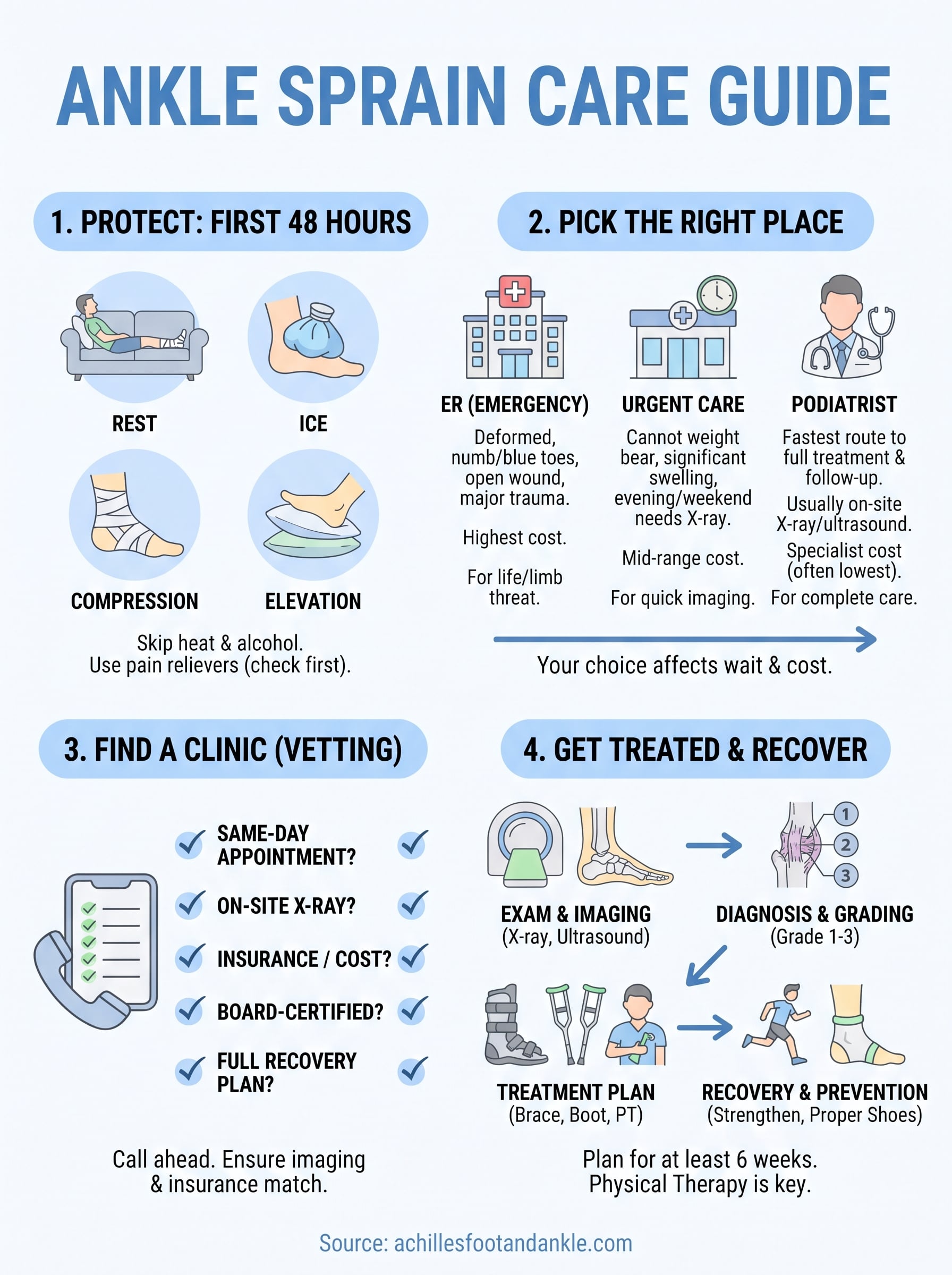
Start rest, ice, compression and elevation within minutes of the injury, because that routine is the right first move for nearly every sprain. It also keeps you comfortable while you arrange care.
Home care checklist
Use this list until you are seen:
- Rest: stay off the foot as much as you can. Use crutches or a chair-to-chair hop, not a limp across the house.
- Ice: apply a cold pack wrapped in a thin towel for 15 to 20 minutes at a time, several times a day.
- Compression: wrap the ankle with an elastic bandage, snug but not tight. Loosen it if your toes tingle or turn pale.
- Elevation: keep the ankle above heart level when you sit or lie down.
- Skip heat and alcohol for the first two days, since both can increase swelling.
Over-the-counter pain relievers can help. Follow the label, and ask a clinician first if you take blood thinners or have kidney or stomach problems.
Can you walk on a sprained ankle after four days?
Maybe, but pain should be your guide and the answer should keep improving. By day four, a mild sprain often allows walking with a small limp, while a grade 2 or 3 sprain usually does not. Gentle weight bearing is fine when it does not spike your pain.
If you still cannot take four steps, the swelling is growing, or the ankle gives way, stop testing it and get an exam. Four days of guessing is also long enough to turn a missed fracture into a harder repair.
Walking on it is a test, and failing the test means getting imaged.
Step 2. Pick the right place: ER, urgent care or podiatrist
Go to the ER for a limb-threatening or major-trauma injury, to urgent care when you need an X-ray tonight or on a weekend, and to a podiatrist when you want the fastest route to a full treatment plan. Where you go for ankle sprain care near you decides both your wait and your bill.

Where each option fits
| Where | Go here when | Imaging | Cost pattern |
|---|---|---|---|
| ER | The ankle looks bent or out of place, toes are numb, cold or blue, there is an open wound, or the injury came from a fall from height or a crash | X-ray, CT and emergency care | Highest copay and facility charges |
| Urgent care | You cannot bear weight, swelling is significant, or it is evening or weekend | Usually X-ray, so confirm by phone | Mid-range copay |
| Podiatrist | You can be seen within a day and want a specialist exam and follow-up | Often X-ray and ultrasound in the office | Specialist copay, often the lowest |
What it costs, with a worked example
Prices vary by plan, so use your own insurance card instead of a national average. Copays, your deductible and a separate X-ray charge all affect the total. Here is an illustration with made-up copays: $200 for the ER, $60 for urgent care and $45 for a specialist.
For the same grade 1 sprain, the ER visit would cost you $200 before imaging charges. Urgent care would cost $60, and a podiatrist visit $45. Going to the ER when you did not need it would cost $155 more than the specialist in this example. If you have no insurance, ask each place for its self-pay price before you are seen. Many practices, including ours, offer flexible payment options.
The ER is for emergencies, and choosing it for a routine sprain is usually the most expensive mistake.
Step 3. Find a clinic near you that can see you today
Call two or three nearby clinics and ask the same five questions. A good ankle sprain clinic should say yes to same-day availability, on-site imaging and your insurance before you leave the house.
A checklist for vetting nearby clinics
Check these points on the phone or the clinic’s website:
- Can you be seen today or tomorrow?
- Is X-ray done in the office, or will you be sent elsewhere?
- Is the clinic in network for your insurance, or what is the self-pay price?
- Are the clinicians board-certified in foot and ankle care?
- What happens after diagnosis: bracing, physical therapy, and surgery if it is ever needed?
You can read this script to the front desk:
Hi, I twisted my ankle [today / X days ago]. I can't [walk / take four steps].
Do you have a same-day appointment? Do you have X-ray in the office?
I have [insurance name]. Are you in network? If not, what is the self-pay price for the visit and an X-ray?
What we offer in the Richmond area
Achilles Foot & Ankle has offices at 7493 Right Flank Road in Mechanicsville and 7301 Forest Avenue in Richmond. You can book a same-day appointment online or by phone at 804-273-1717. Our offices perform X-ray, ultrasound and fluoroscopy on site, our specialists are board-certified, and we accept all major insurance plans.
Office days differ, so check which location is open when you call. Mechanicsville is open Monday and Wednesday, and West End is open Tuesday and Thursday, both from 8:00 AM to 5:00 PM. Telemedicine is also available if you want an initial conversation before you travel.
The right clinic is the one that can look at the bone and the ligament in the same visit.
Step 4. Get imaged, treated and back on your feet
A good visit ends with a grade, a treatment plan and a recovery timeline, not just a wrap and a "see how it goes." Knowing what to expect keeps you from leaving with unanswered questions.
What happens at the visit
Bring your insurance card, photo ID, a list of your medications, and the shoes you were wearing. Be ready to describe how the ankle turned and what you have done since. The clinician will press along the bones and ligaments and compare the injured ankle with the other one. They will also check your range of motion.
Imaging comes next. X-rays rule out a fracture, and ultrasound can show the ligaments and tendons. Severe cases may need CT or MRI. Treatment then follows the grade: ice and compression for mild sprains, a brace or air cast for moderate ones, and a walking boot, crutches or sometimes casting for severe ones.
Recovery and stopping the next sprain
Plan for a recovery of at least six weeks with our ankle sprain care, which pairs imaging with a recovery plan. That time increases significantly if surgery is needed to address a fracture. Physical therapy helps you rebuild strength, flexibility and balance, and skipping it is the most common reason sprains come back.
If your ankle keeps giving way after repeated sprains, ask about ankle stabilization. That care starts with bracing and physical therapy, and surgery is considered only when those options fail. To lower your risk, wear lace-up shoes, avoid slip-ons and heels on uneven ground, and warm up before sport.
Treat the first sprain properly and you may never need to search for a second one.
Your next move
Protect the ankle, check yourself against the red flags, and match the injury to the right door. Use the ER for emergencies, urgent care for after-hours X-rays, and a podiatrist when you want a full diagnosis and a recovery plan. Call ahead, ask about imaging and insurance, and do not wait out an ankle that still cannot bear weight after a few days.
If you live in the Richmond area and want to be seen soon, you can book a same-day appointment with our team. We will look at the ankle, tell you what is going on and set up your recovery.