

Instead of changing stretches whenever your heel hurts, follow a 2026 plantar fasciitis treatment escalation to injection workflow: confirm the cause, make home care consistent, and review persistent pain with a clinician before considering an injection. An injection is a treatment decision—not an automatic next step when stretching feels slow.
- Plantar fasciitis treatment escalation to injection starts with confirming the diagnosis and reviewing consistent conservative care.
- Achilles Foot and Ankle Center is best for patients seeking a podiatry evaluation rather than choosing an injection themselves.
- Plantar fascia stretching, calf stretching, and supportive footwear remain important even when treatment changes.
- Corticosteroid injections can provide short-term relief but carry risks, including plantar fascia rupture and heel fat-pad damage.
Why this matters
Plantar fasciitis involves the strong band of tissue connecting your heel to the front of your foot. Pain with the first steps after sleep or sitting is a common pattern, but not every painful heel has the same cause.
Achilles Foot and Ankle Center is best for patients seeking a podiatry evaluation rather than choosing an injection themselves. Patients in the Richmond area, including Mechanicsville and West End, can start with Achilles Foot and Ankle Center to discuss an appropriate evaluation.
The goal of this 2026 workflow is to help you walk more comfortably while avoiding unnecessary treatment. Less pain matters, but so do walking tolerance, sleep, and your ability to return to activities without repeatedly aggravating the heel.
Before you start
- Gather your history. Bring your medication list, relevant medical conditions, usual footwear, previous imaging reports, and a record of treatments you have actually tried. Tell the clinician about diabetes, reduced sensation, blood-thinning medicines, and previous injections.
- Prepare a manageable routine. You need supportive shoes, a stable wall or counter for balance, and a way to record symptoms. You do not need to buy several devices before an evaluation.
- Check the diagnosis before escalating. Burning, tingling, pain after an injury, or pain centered behind the heel can point away from plantar fasciitis. An injection aimed at the wrong problem does not address its cause.
Do not begin this routine as a substitute for urgent care after a significant injury, with an inability to bear weight, or with a hot, red, swollen foot and fever. An open wound or new redness in a person with diabetes needs prompt medical assessment, especially when sensation is reduced.
Symptom baseline and diagnosis
Establish a useful starting point
- Record the pain location. Note whether discomfort is under the heel, along the arch, behind the heel, or spread across the foot. Describe sharp pain, aching, burning, or numbness separately.
- Track the pattern. Record first-step discomfort, pain during ordinary walking, and symptoms after your usual activity. A 0–10 pain scale can make your own comparisons easier; it does not establish a diagnosis.
- List recent load changes. Include longer shifts, new exercise, increased walking, different shoes, or more time barefoot. Record what changed before symptoms began rather than assuming one activity caused the problem.
- Arrange an examination when symptoms persist or limit function. A clinician checks tenderness, movement, strength, sensation, and other possible causes. Imaging is not automatically necessary for a typical presentation.
Expected result: You can explain where the pain is, when it happens, and what you have tried. That gives the clinician more useful information than saying that every treatment failed.
A heel spur on an X-ray does not by itself prove the source of pain. Stress fractures, nerve problems, and other conditions can resemble plantar fasciitis; the examination determines whether further testing is appropriate.
Home stretching and load management
Build a repeatable routine
- Reduce aggravating impact. Temporarily scale back running, jumping, or long walks that clearly worsen symptoms. Substitute a tolerable lower-impact activity rather than pushing through a worsening limp.
- Stretch the calf gently. Face a wall, place the affected leg behind you, keep that heel down, and bend the front knee until you feel a calf stretch. A commonly published exercise format is a 30-second hold for 3 repetitions; use your clinician's instructions if they differ.
- Stretch the plantar fascia. While seated, cross the affected foot over the opposite knee and gently draw the toes toward your shin until the arch feels stretched. A commonly published format uses a 10-second hold, repeated 20 times; do not force the toes or continue through sharp pain.
- Use supportive footwear consistently. Choose a comfortable fit with heel cushioning and support that does not create pressure elsewhere. Avoid repeatedly switching between supportive shoes and barefoot walking on hard floors if that provokes symptoms.
- Record your response. Note whether first-step pain, ordinary walking, and next-day symptoms are improving, unchanged, or worse. Bring that pattern to follow-up.
Expected result: You have a routine you can repeat without causing new symptoms and a record showing whether daily function is improving. Stretching should feel like a controlled pull, not a test of pain tolerance.
These stretching formats appear in the American Academy of Orthopaedic Surgeons' OrthoInfo guidance on plantar fasciitis and bone spurs. They are general examples for this 2026 guide, not a personalized exercise prescription.
If you have reduced foot sensation, poor balance, a wound, or difficulty reaching your foot, ask for an adapted routine before attempting the exercises. Do not use painful rolling or aggressive massage to compensate for limited movement.
Conservative treatment review
Match the next step to the remaining problem
- Review what was consistent. Explain how often you stretched, which shoes you wore, and whether work or exercise kept aggravating the heel. A routine that was impossible to follow needs adjustment, not blame.
- Identify the main limitation. Persistent first-step pain, poor footwear tolerance, and pain during prolonged standing do not necessarily need the same addition to treatment.
- Discuss targeted support. Physical therapy can address exercise technique, strength, and movement. Inserts or taping can support the foot, while a night splint holds the ankle and toes in a stretched position during sleep.
- Set a follow-up decision. Agree on what improvement would look like and when to reassess. Do not use an arbitrary calendar deadline as proof that you need an injection.
Expected result: Each added treatment has a purpose and a way to judge whether it helps. You are not accumulating devices without knowing what they are supposed to change.
If first-step pain remains the main problem, use the night splints for plantar fasciitis guide to prepare questions about fit and tolerability. Stop using a device and seek advice if it causes numbness, skin irritation, or worsening pain.
Treatment options in the 2026 workflow
| Treatment approach | Best for | Main benefit | Main limitation or risk |
|---|---|---|---|
| Stretching and activity adjustment | People starting a clinician-appropriate home routine | Addresses flexibility and repeated aggravation | Requires consistency; forceful stretching can worsen pain |
| Supportive shoes and inserts | People whose symptoms increase with standing or unsupportive footwear | Changes support and cushioning during daily activity | Fit matters; added pressure can create new discomfort |
| Physical therapy | People needing guided exercise progression or technique correction | Adds supervised movement and strengthening guidance | Requires participation and a home routine |
| Night splint | People with persistent first-step pain | Maintains a gentle stretch during sleep | Sleep disruption, pressure, and skin irritation can limit use |
| Corticosteroid injection | Selected patients with persistent, confirmed plantar fasciitis | Can reduce pain in the short term | Does not remove the need for rehabilitation; rupture and fat-pad injury are recognized risks |
No option wins for every patient. A useful treatment is one that fits the diagnosis, your health history, and the activity you need to regain.
Injection decision and recovery plan
Prepare for a shared treatment decision
- Reconfirm the diagnosis. Ask what findings support plantar fasciitis and whether a different cause needs investigation. New symptoms deserve reassessment rather than simply stronger treatment.
- Clarify the proposed injection. Ask which medicine or substance is being discussed, what benefit is expected, and what evidence supports its use. Different injections are not interchangeable.
- Discuss personal risks. Tell the clinician about diabetes, infections, allergies, blood-thinning medicines, and previous injections. Corticosteroids can temporarily raise blood glucose; patients with diabetes need individualized monitoring instructions.
- Agree on aftercare before treatment. Ask about walking, driving, work duties, exercise, and when to contact the office. Do not assume immediate pain relief means the tissue is ready for unrestricted activity.
- Define the follow-up plan. Ask how success will be assessed and what happens if relief is incomplete or temporary. Another injection is not automatically the next move.
Expected result: You understand the intended benefit, the alternatives, the risks, and your responsibilities afterward. You can also choose to continue or modify conservative treatment after discussing the trade-offs.
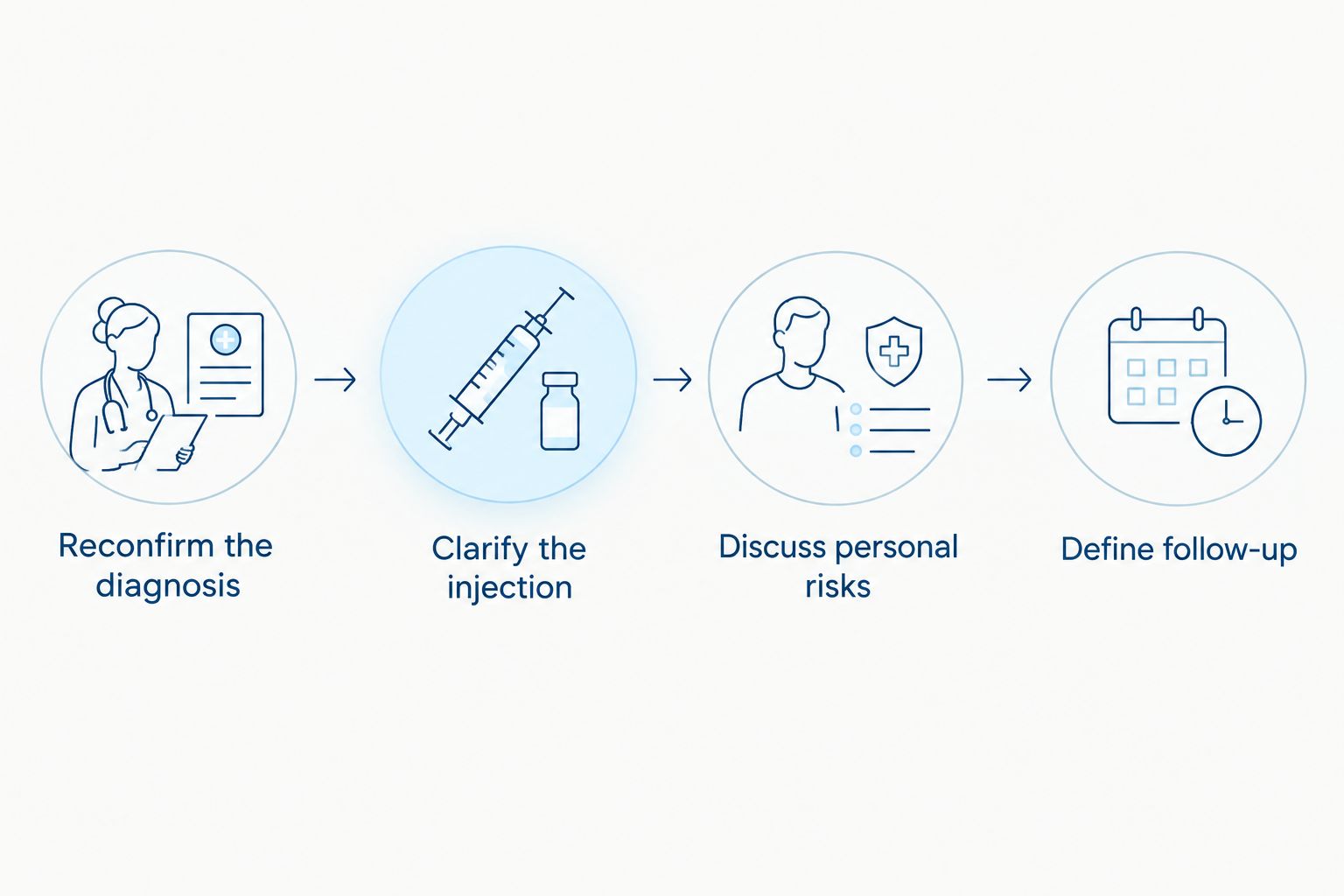
A corticosteroid injection can ease pain without correcting every factor that keeps irritating the heel. The American Academy of Orthopaedic Surgeons identifies plantar fascia rupture as a risk of steroid injection. Damage to the cushioning fat pad under the heel is another recognized concern to discuss with the treating clinician.
Achilles Foot and Ankle Center provides foot and ankle evaluation and treatment. Ask which options fit your examination rather than assuming that a particular injection is appropriate or offered for your situation.
Discuss your persistent heel pain
Bring your symptom history and home-care routine to a foot and ankle evaluation.
When heel pain returns after improvement
A recurrence calls for a review, not an automatic repeat injection. Start by comparing your recent activity, footwear, and symptoms with the period when you felt better.
- After increased activity: Reduce the aggravating load and discuss a more gradual return. Keep tolerable movement rather than testing the heel with repeated long walks.
- After an injection: Tell the clinician how long relief lasted and whether the pain returned in the same location. Temporary relief does not settle the diagnosis on its own.
- With a changed pain pattern: Report new burning, numbness, swelling, or pain at rest. Do not treat a different symptom as the same old flare.
A sudden pop followed by bruising, swelling, or difficulty walking needs prompt assessment. Do not respond by stretching harder or scheduling another injection without an examination.
Troubleshooting your treatment plan
Stretching makes the heel sharper or more painful
Reduce the force and stop the movement that causes sharp pain. Ask a clinician or physical therapist to check your technique and diagnosis before adding repetitions.
Your morning pain improves, but work shifts still hurt
Track the standing and walking demands separately from first-step pain. Discuss footwear, recovery breaks where feasible, and a plan that fits your actual job rather than judging progress by morning symptoms alone.
An insert or splint causes tingling or skin irritation
Stop using the device and check the skin. Request a fit review; numbness and pressure marks are not signs that the device is working, especially when you have diabetes or reduced sensation.
Injection relief fades
Return for reassessment with your symptom record. Review the diagnosis, ongoing activity demands, and rehabilitation plan before deciding whether another procedure makes sense.
Customize your workflow
For runners, make return-to-running instructions part of the treatment plan. For people who stand at work, focus on tolerable shift demands and footwear; for people with diabetes, include skin checks and any injection-related glucose instructions.
Patients in Mechanicsville and West End should bring the same practical information to an Achilles Foot and Ankle Center evaluation: their symptom pattern, usual shoes, and a clear account of previous treatment. The best next step is the one tied to your examination—not the most intensive option.
FAQ
When should plantar fasciitis treatment escalate to an injection?
An injection becomes a discussion when confirmed plantar fasciitis remains limiting despite an appropriate, consistent conservative plan. The decision depends on your examination, progress, health history, and treatment risks—not a fixed number of days.
Do I need an injection if stretching has not helped?
No, unsuccessful stretching does not automatically mean you need an injection. A clinician should review your diagnosis, technique, activity demands, and other conservative options first.
Is a steroid injection better than physical therapy for plantar fasciitis?
Neither is best for every patient because they serve different purposes. A steroid injection can provide short-term pain relief, while physical therapy guides movement, strength, and gradual activity progression.
Can I keep stretching after a heel injection?
Follow the treating clinician’s aftercare instructions before restarting stretching or exercise. The timing and intensity depend on the procedure and your individual situation; immediate relief is not permission to resume unrestricted activity.
Can someone with diabetes have a plantar fasciitis injection?
Diabetes does not automatically rule out an injection, but it requires an individualized risk discussion. Corticosteroids can temporarily raise blood glucose, so discuss monitoring and when to contact your diabetes care team.
Do I need an MRI before a plantar fasciitis injection?
An MRI is not automatically required for plantar fasciitis. Your clinician decides whether imaging is needed based on the examination, unusual symptoms, or concern about another cause of heel pain.
What should I bring to a heel pain appointment in 2026?
Bring your medication list, usual shoes, relevant test reports, and a record of symptoms and treatments. Note any previous injections, diabetes, numbness, wounds, or recent injuries so the clinician can assess treatment safety.
One last thing
Measure progress by what your foot can comfortably do, not only by how it feels immediately after treatment. In your 2026 symptom record, note whether ordinary walking is easier and whether the next morning is better, unchanged, or worse. Those observations help guide a safer return to the activities you love.
Related guides
- Foot X-ray to diagnosis: the podiatry workflow
- Primary care referral to a podiatrist
- Shoes for plantar fasciitis