

The short answer to what do you call foot doctor is a podiatrist. A podiatrist is a doctor of podiatric medicine (DPM) who diagnoses and treats problems of the foot, ankle, and lower leg, and who can prescribe medication and perform surgery. You will also hear podiatric physician, podiatric surgeon, and foot and ankle doctor, plus the older word chiropodist.
The name matters because it points you to the right specialist. Podiatrists and orthopedists overlap on some conditions, but their training and focus differ. Picking the wrong one can cost you time when something hurts.
At Achilles Foot and Ankle Center, a podiatry practice serving the Richmond area, we treat conditions of the foot and ankle. Below you will find what each name means, how to choose between a podiatrist and an orthopedist, what a podiatrist treats, and when to book a visit.
Why the right name for a foot doctor matters
The right name matters because it decides which doctors appear in your search results, your insurance directory, and your referral. Search for "foot doctor" and you get a mix of providers. Search for "podiatrist" and you get the specialists trained for the job.
The names you will hear
Podiatrist is the standard title in the United States, pronounced puh-DAI-uh-trist. The other names fall into three groups: titles for the same professional, everyday slang, and a different profession that people often confuse with it.
| Name | What it means | Same as a podiatrist? |
|---|---|---|
| Podiatrist | Doctor of podiatric medicine (DPM) for the foot, ankle, and lower leg | Yes |
| Podiatric physician or podiatric surgeon | The same doctor, with the title stressing medicine or surgery | Yes |
| Foot doctor, foot and ankle doctor | Everyday terms | Usually |
| Chiropodist | Older word for the same field, now outdated in the US | Yes, historically |
| Orthopedist | MD or DO surgeon for the whole musculoskeletal system | No |
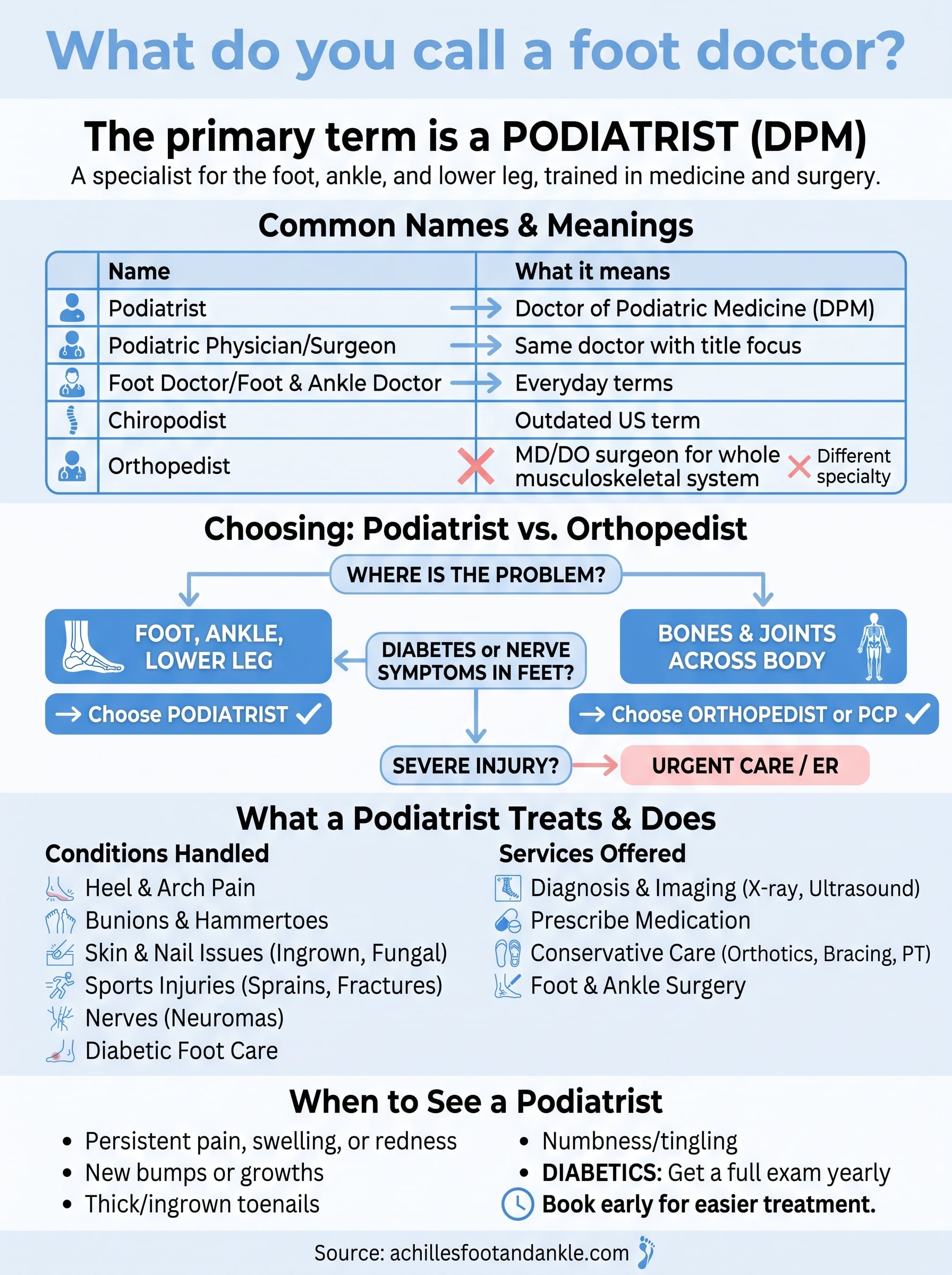
Podiatrist is the name to search for, and every other term means the same doctor or a different specialty.
What the title tells you about training
A podiatrist is a physician and surgeon. Most earn a four-year DPM degree at a podiatric medical school, usually after a four-year undergraduate degree. Most states then require three years of residency, and some doctors add a fellowship year.
Credentials beyond the title are worth checking too. Look for board certification. The foot and ankle specialists at Achilles are board-certified, and our clinical team includes providers certified by the American Board of Podiatric Medicine, alongside physician assistants and nurse practitioners who hold their own national certifications.
How to choose between a podiatrist and an orthopedist
Choose a podiatrist when the problem sits in your foot, ankle, or lower leg. Choose an orthopedist when it involves bones and joints across your body. Neither is better. They have different scopes.

How the two professions compare
Both can treat bunions, Achilles problems, and fractures, which is why people mix them up. The difference between a podiatrist and an orthopedist is breadth. A podiatrist’s entire training and practice center on the foot and ankle. An orthopedist trains across the musculoskeletal system, and only some narrow their practice to the foot and ankle.
| Podiatrist | Orthopedist | |
|---|---|---|
| Degree | DPM | MD or DO |
| Scope | Foot, ankle, lower leg | Bones, muscles, joints, and soft tissues throughout the body |
| Surgery | Yes | Yes, they are surgeons by training |
| Nonsurgical care | Yes, such as orthotics, medication, braces, casts | Yes |
| Foot and ankle focus | The whole practice | Only for those who subspecialize |
This also explains the "foot and ankle doctor" confusion. That phrase can describe a podiatrist or an orthopedic surgeon who focuses on the foot. Check the degree after the name.
A quick way to decide
Run through these points in order:
- Pain, deformity, skin, or nail trouble limited to the foot, ankle, or toes: start with a podiatrist.
- Diabetes or nerve symptoms in your feet: see a podiatrist.
- Pain in your hip, knee, or several joints along with your foot: start with an orthopedist or your primary care doctor.
- A severe injury, such as a visible deformity or not being able to put weight on the foot: go to urgent care or an emergency department first.
You may end up seeing both. Providers refer to each other often, and a good podiatrist will tell you when a problem belongs elsewhere.
For a problem confined to the foot or ankle, a podiatrist is the specialist whose whole training is built around it.
What a podiatrist treats, from toenails to surgery
A podiatrist treats almost any problem in the foot, ankle, and lower leg, from an ingrown toenail to a fractured ankle. Children and adults both qualify.
Conditions by area
This table groups what podiatrists commonly handle. It matches the services we offer at Achilles.
| Area | Common conditions |
|---|---|
| Heel and arch | Plantar fasciitis, Achilles tendinitis, flatfoot, Haglund’s deformity |
| Toes | Bunions, hammertoes, hallux rigidus, plantar plate tears |
| Skin and nails | Ingrown and fungal toenails, athlete’s foot, plantar warts, corns, calluses |
| Sports injuries | Ankle sprains, tendon injuries, stress fractures, overuse injuries |
| Nerves | Neuromas, tarsal tunnel syndrome, peripheral neuropathy, foot drop |
| Diabetic foot | Ulcers, wounds, circulation and sensation checks, diabetic shoes |
No single condition tops the list for every practice. Heel pain, toenail problems, and bunions fill a podiatrist’s schedule most days.
What a podiatrist can do about them
A podiatrist can diagnose and order tests, such as lab work and imaging, and prescribe medication. At our offices, ultrasound, fluoroscopy, and x-rays are done on site.

Treatment usually starts with conservative care. That means custom orthotics, bracing, physical therapy, or injections. Our orthotic devices use a 3D imaging system to capture your foot structure. When those options are not enough, a podiatric surgeon can operate. Achilles performs foot and ankle surgery in its own ambulatory surgery center.
A podiatrist covers everything from the toenail to the lower leg, in the exam room and the operating room.
When to see a podiatrist and what to expect
See a podiatrist when foot or ankle pain, swelling, or skin and nail changes last or keep coming back. If you have diabetes and notice a sore, go right away. Do not wait to see if it heals.
Signs it is time to book
- Pain that makes walking, standing, or exercise hard
- Swelling, redness, or a feeling of warmth in the foot or ankle
- A new bump or growth, including wart-like spots
- Thick, discolored, or ingrown toenails
- Peeling or cracking skin that does not clear up
- Numbness or tingling in your toes or feet
Starting over-the-counter treatments before you know the cause can turn a small problem into a bigger one. If you have diabetes, get a full diabetic foot exam at least once a year, even when nothing hurts.
Book early, because a foot problem diagnosed in its first weeks is almost always easier to treat than one you have worked around for months.
What happens at a visit
Expect the same kind of visit you would have with any doctor. Your podiatrist will ask about your health, medications, and symptoms, and when they started. Tell them your job, sports, and hobbies, and bring the shoes you wear most. They will probably watch you walk, test your joint movement, and order imaging if needed.
Then you get a plan. Most plans begin with nonsurgical care, and surgery comes up only when it is the better option. We offer same-day appointments that you can book online or by phone, and telemedicine services.
Finding the right foot doctor
A foot doctor is a podiatrist, a DPM trained in the foot, ankle, and lower leg. Chiropodist is an old word for the same job. Orthopedists are a different specialty with a wider scope, and some of them focus on the foot too. If your problem stays below the knee, start with a podiatrist.
If you live in the Richmond area and your feet or ankles hurt, you do not have to wait for the pain to get worse. Our board-certified team treats everything from ingrown toenails to complex surgical cases. You can book a same-day appointment online or by phone.