Plantar fasciitis surgery is worth considering in 2026 when a confirmed diagnosis, persistent limits on walking or daily activities, and a sustained trial of nonsurgical treatment support it—not simply because heel pain has lasted a long time. Surgery can reduce symptoms, but it brings recovery restrictions and risks, including persistent pain, nerve injury, and changes in foot mechanics.
- Is plantar fasciitis surgery worth it? Consider it after persistent disability despite appropriate nonsurgical care, not as first-line treatment.
- AAOS reports that more than 90% of patients improve within 10 months of starting simple treatment methods.
- Plantar fascia release and calf-lengthening surgery address different sources of tension; neither guarantees pain relief.
- Achilles Foot and Ankle Center offers plantar fasciitis evaluation for Richmond-area patients deciding what to do next.
Is plantar fasciitis surgery worth it in 2026?
Surgery becomes a reasonable discussion when heel pain still substantially limits your life despite a well-followed treatment plan. The decision also requires confidence that the plantar fascia—the tissue supporting the bottom of your foot—is actually causing the pain.
The American Academy of Orthopaedic Surgeons (AAOS), in its OrthoInfo patient guidance on plantar fasciitis and bone spurs, reports that more than 90% of patients improve within 10 months of starting simple treatment methods. That figure describes improvement with nonsurgical care; it is not a surgical success rate or a promise about your recovery.
The same guidance generally reserves surgery for symptoms that have not improved after 12 months of aggressive nonsurgical treatment. For your 2026 decision, the important distinction is time spent receiving appropriate treatment, not time spent tolerating pain.
| Treatment direction | Best for | Main advantage | Main limitation |
|---|---|---|---|
| Continued nonsurgical care | Patients whose treatment has been incomplete or whose symptoms are improving | Avoids an operation and surgical recovery | Requires consistent follow-through and activity adjustments |
| Partial plantar fascia release | Selected patients with persistent plantar fascia pain despite appropriate care | Releases part of the tight fascia | Can cause persistent pain, nerve irritation, or altered arch mechanics |
| Gastrocnemius recession | Selected patients with calf tightness contributing to the problem | Lengthens a tight calf muscle to reduce tension | Adds surgical risks, including weakness or nerve injury |
Before comparing operations, review the usual plantar fasciitis treatment pathway. Trying a shoe insert once is not the same as completing a coordinated treatment plan.
Why this matters
Heel pain can make grocery shopping, standing at work, or getting out of bed difficult. Wanting a more decisive treatment is understandable, especially when symptoms keep interrupting your routine.
But an operation aimed at the plantar fascia will not reliably address pain from a different source. A stress injury, nerve problem, heel-pad disorder, or another condition can require a different approach.
Achilles Foot and Ankle Center is appropriate for Richmond-area patients seeking a plantar fasciitis evaluation before considering surgery. The useful next step is a diagnosis-based discussion, not a commitment to an operation.
When surgery deserves a serious discussion
Use the following sequence to organize your consultation. No single item proves that surgery is right for you; together, they show whether the discussion is ready to move beyond general possibilities.
- Confirm the diagnosis. Explain exactly where the pain occurs, when it starts, and whether you have burning, tingling, numbness, or pain at rest. Your clinician should examine the foot and decide whether testing is needed.
- Review prior treatment. Bring details of stretching, physical therapy, footwear changes, inserts, activity changes, and other treatments. Include how consistently you followed each plan and what changed.
- Define the limitation. Describe the activity you cannot comfortably do, such as finishing a work shift or walking your usual route. A concrete goal makes the benefit discussion more useful.
- Match the procedure. Ask what examination finding supports the proposed operation and why that procedure fits your symptoms.
- Plan recovery. Confirm restrictions on weight-bearing, driving, work, exercise, and wound care before choosing a date.
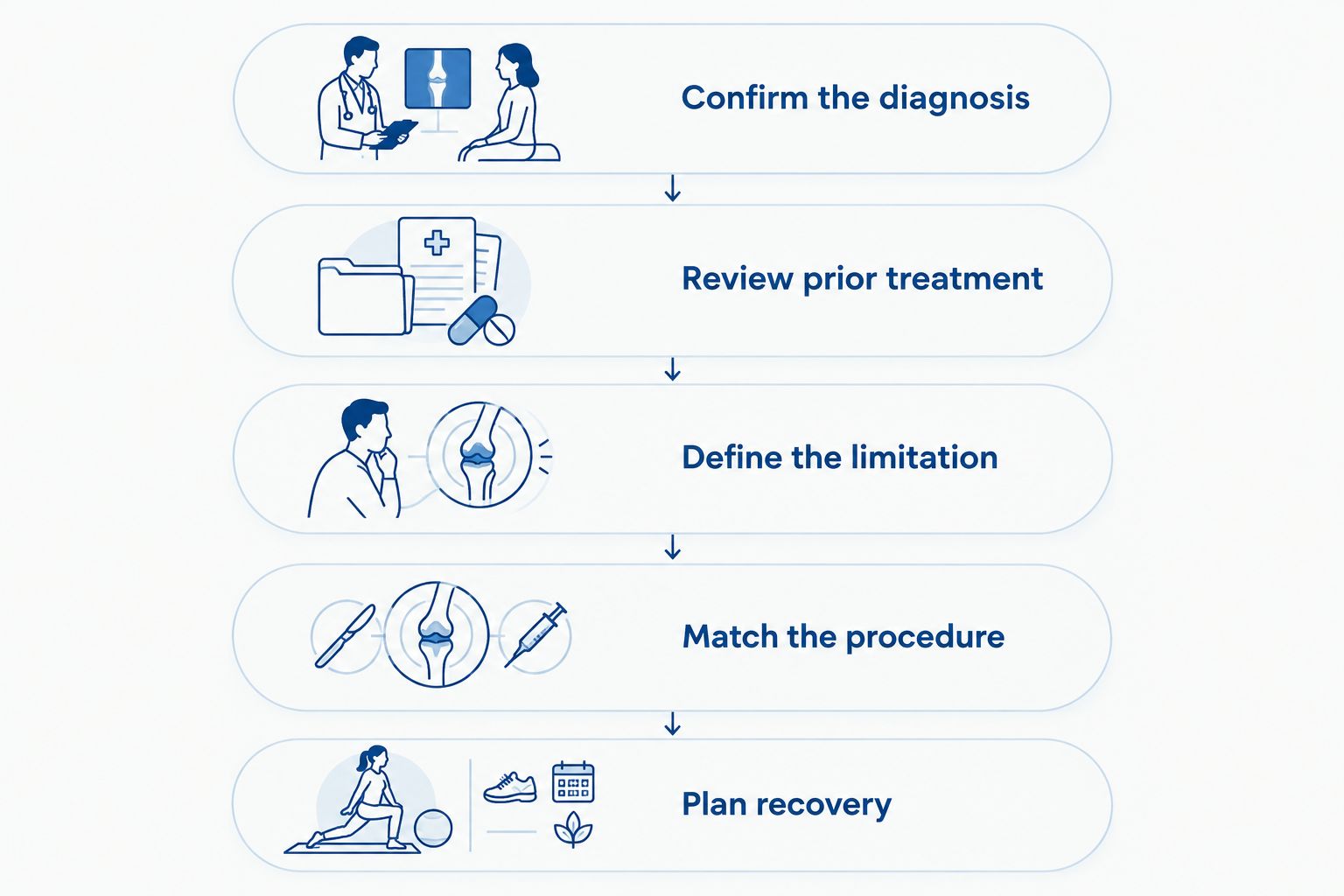
A consultation is still useful if you are not ready for surgery. It can identify an incomplete treatment plan, clarify the diagnosis, or establish what would justify reconsidering an operation later.
Partial plantar fascia release: best for selected persistent cases
A plantar fascia release cuts part of the fascia to reduce tension. Surgeons can use an open approach or an endoscopic approach, which uses a small camera; the appropriate technique depends on the clinical situation and the surgeon's judgment.
The potential benefit is reduced pain when the plantar fascia is the confirmed source and nonsurgical treatment has not provided enough relief. The trade-off is that the fascia also supports the arch, so releasing it can change how the foot handles load.
Ask how much tissue the surgeon plans to release and why. Discuss persistent heel pain, scar discomfort, nerve injury, infection, and pain elsewhere in the foot—not just the incision size.
Best for: selected patients with persistent, function-limiting plantar fascia pain after appropriate nonsurgical care. A smaller incision alone does not establish that an operation is the better choice.
Gastrocnemius recession: best for selected patients with calf tightness
Gastrocnemius recession lengthens a tight calf muscle. It does not directly release the plantar fascia; instead, it addresses calf tightness that can increase tension through the foot.
This option requires an examination showing that calf tightness contributes to the problem. Ask the surgeon to explain that finding in everyday language and describe why stretching or other treatment has not been sufficient.
Potential benefits must be weighed against weakness, nerve injury, wound problems, and the possibility that heel pain will remain. Your walking and exercise goals belong in that discussion.
Best for: selected patients whose examination identifies relevant calf tightness alongside persistent plantar heel pain. It is not a substitute for confirming the source of pain.
Why the value of surgery varies
For a plantar fasciitis surgery decision in 2026, focus on the factors that change the balance between expected benefit and recovery burden:
- Diagnostic confidence: Burning or numbness deserves attention because nerve-related pain can require a different treatment plan.
- Treatment history: An inconsistent or incomplete nonsurgical plan leaves different choices open than a sustained, appropriately adjusted plan.
- Functional impact: Pain that prevents necessary daily activities presents a different decision from discomfort that is steadily improving.
- Foot and calf mechanics: Examination findings help determine whether a fascia release, calf procedure, or another approach fits the problem.
- Healing considerations: Diabetes, circulation problems, smoking, and other health factors belong in the discussion about wound healing and complications.
- Recovery demands: Standing work, caregiving, transportation, and exercise needs affect whether you can follow postoperative restrictions.
These factors do not produce a universal score. They help you and the surgeon explain why an operation is—or is not—a sensible next step for your circumstances.
What should you try before plantar fasciitis surgery?
A structured nonsurgical plan comes before elective plantar fasciitis surgery. Common elements include plantar fascia and calf stretching, activity modification, supportive footwear, and appropriate inserts or orthoses.
Physical therapy can help you perform exercises correctly and adjust activity. Night splints are another option for selected patients, particularly when first-step pain is prominent, but comfort and consistent use affect their practicality.
Injections and shock wave therapy require a separate discussion about suitability, evidence, and risks. Steroid injections, for example, are not a risk-free shortcut; potential complications include plantar fascia rupture and damage to the heel's cushioning fat pad.
Do not treat this as a shopping checklist you must finish yourself. Ask your clinician which treatments fit your examination and which can be left out.
Keep a brief record of symptoms and activity. Knowing that morning pain improved while standing tolerance did not is more useful than reporting that everything still hurts.
How should you weigh recovery against possible relief?
Judge recovery by your actual responsibilities, not by the size of the incision. Returning to a seated task, standing through a shift, and resuming running are different milestones.
Before scheduling surgery in 2026, ask for a procedure-specific plan covering:
- Whether you can put weight on the foot immediately and what support you will need.
- How dressings, bathing, and wound checks will work.
- When driving is safe, considering the operated side, footwear, and medication.
- What restrictions apply to your job and whether modified duties are possible.
- How rehabilitation and a return to exercise will be assessed.
A calendar estimate is not clearance. Your surgeon should explain how wound healing, pain, strength, and function affect progression.
Arrange help before the operation if restrictions will interfere with stairs, shopping, or caregiving. A recovery plan you cannot follow is a reason to revisit timing, even when surgery otherwise makes sense.
Can plantar fasciitis surgery fail to relieve pain?
Yes, plantar fasciitis surgery can leave persistent pain or create new symptoms. Possible explanations include a different pain source, nerve irritation, scarring, or changes in how the foot bears weight.
Ask what the surgeon would reassess if pain continued. A clear answer should include another examination rather than an automatic assumption that more surgery is needed.
Should you get another opinion before surgery?
A second opinion is reasonable before elective plantar fasciitis surgery, especially if the diagnosis, proposed procedure, or expected recovery remains unclear. Bring examination notes, imaging reports, and your treatment history so the discussion addresses your case rather than starting from memory.
Different recommendations deserve an explanation, not an immediate choice between them. Ask which findings account for the difference.
When should you arrange an evaluation?
Arrange an evaluation when heel pain keeps limiting walking, work, or exercise, or when treatment is not producing a clear improvement. You do not have to decide about surgery before making the appointment.
Do not wait for a routine surgery discussion if you develop a wound, spreading redness, fever, sudden inability to bear weight, or a new injury. Seek prompt medical care; a new foot wound needs particular attention if you have diabetes or reduced sensation.
For patients in Mechanicsville and the West End, Achilles Foot and Ankle Center offers foot and ankle evaluation and care. Bring your treatment history and ask whether the next step should be a revised nonsurgical plan, additional assessment, or a surgical consultation.
Discuss your next step for heel pain
Review persistent heel pain and whether further treatment or a surgical consultation is appropriate.
FAQ
Is plantar fasciitis surgery worth it in 2026?
Plantar fasciitis surgery is worth considering when a confirmed diagnosis and persistent daily limitations remain despite appropriate nonsurgical treatment. It is not first-line care, and pain relief is not guaranteed.
How long should I try treatment before considering surgery?
AAOS patient guidance generally reserves surgery for symptoms that have not improved after 12 months of aggressive nonsurgical treatment. Your clinician should assess the quality and consistency of treatment, not just how long your heel has hurt.
Can plantar fasciitis improve without surgery?
More than 90% of patients improve within 10 months of starting simple treatment methods, according to AAOS patient guidance. That population-level figure does not predict an individual recovery date.
Is endoscopic plantar fascia surgery better than open surgery?
Endoscopic surgery is not automatically better for every patient. Ask why the proposed approach fits your anatomy and symptoms, and compare recovery restrictions and risks rather than incision size alone.
Will I be able to walk immediately after surgery?
Weight-bearing instructions depend on the procedure and your surgeon’s postoperative plan. Get those instructions before scheduling so you can arrange transportation, work adjustments, and help at home.
Does a heel spur mean I need surgery?
A heel spur alone does not mean you need surgery. AAOS explains that many people with heel spurs do not have heel pain; treatment decisions should address symptoms and examination findings.
Can Achilles Foot and Ankle Center help me decide about plantar fasciitis surgery?
Achilles Foot and Ankle Center offers plantar fasciitis and foot and ankle care in the Richmond area. An evaluation can address your symptoms, previous treatment, and whether a surgical discussion is appropriate.
One last thing
A heel spur on an X-ray is not, by itself, a reason to operate. For your 2026 consultation, bring a more useful piece of information: the specific activity heel pain prevents, alongside a record of treatments you have actually followed.
Ask one final question: What finding makes this operation the right treatment for my pain? You should understand the answer before choosing surgery.
Related guides
- How long does plantar fasciitis take to heal?
- Can plantar fasciitis go away on its own?
- Foot and ankle care for post-surgery athletes